The Wedgwood Frog Service: A Masterpiece of Georgian Porcelain, Diplomacy, and Enduring Collectibility
A definitive examination of the Wedgwood Frog Service — commissioned by Catherine the Great in 1773, comprising 944 hand-painted porcelain pieces, featuring over 1,244 unique landscapes and botanical scenes — its historical significance, technical innovations, authentication challenges, and current market status among elite collectors.
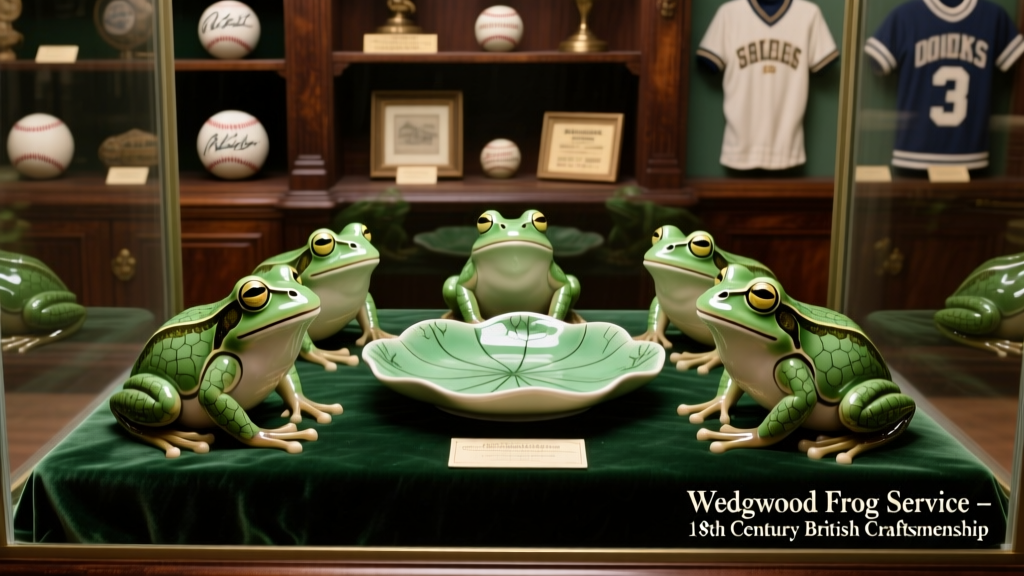
The Wedgwood Frog Service is not merely a dinner service — it is a geopolitical artifact, a technical triumph in English porcelain manufacturing, and one of the most consequential commissions in ceramic history. Ordered by Empress Catherine II of Russia in 1773 and delivered in 1774, this monumental service comprised 944 individual pieces across 50 place settings, each decorated with hand-painted views of English country estates. Its nickname — derived from the green frog motif on the underside of each piece — belies its extraordinary ambition: to showcase British landscape, industry, and cultural sophistication to the Russian court. Produced by Josiah Wedgwood & Sons at their Etruria factory near Stoke-on-Trent, the service employed over 20 artists, including renowned painters William Ball and Thomas Baxter, and utilized a revolutionary creamware body perfected by Wedgwood himself. Today, surviving pieces — fewer than 300 documented — command six- to seven-figure prices at auction, with provenance, condition, and decorative fidelity serving as critical authentication benchmarks.
Origins and Imperial Commission
The genesis of the Frog Service lies in diplomatic strategy and commercial foresight. In early 1773, Catherine the Great — an avid patron of Enlightenment ideals and European arts — instructed her ambassador in London, Prince Dimitri Golitsyn, to procure a complete porcelain dinner service that would reflect England’s architectural grandeur and natural beauty. Golitsyn approached Josiah Wedgwood, whose reputation had been cemented by royal warrants (including Queen Charlotte’s 1765 commission for ‘Queen’s Ware’) and successful exports to continental Europe. Unlike previous royal orders, however, Catherine’s directive was unusually specific: she required painted views of English country houses, parks, and landmarks — not mythological or allegorical scenes. This was a deliberate act of soft diplomacy, intended to elevate Britain’s cultural stature while reinforcing her own cosmopolitan authority.
Wedgwood accepted the commission in March 1773, agreeing to deliver 50 full place settings — defined as 18 pieces per setting — plus supplementary serving wares. The total order ultimately expanded to 944 pieces, including 52 soup tureens, 36 vegetable dishes, 120 dessert plates, 180 dinner plates, 240 side plates, and 120 sauce boats. Each item was made from Wedgwood’s patented ‘cream-coloured earthenware’ — a refined, vitrified earthenware body fired at approximately 1,150°C, achieving exceptional whiteness, density, and resistance to thermal shock. Its composition included Cornish china clay, flint, and calcined bone ash, though notably no true kaolin — distinguishing it from hard-paste porcelain like Meissen or Sèvres.
The Naming Conundrum: Why ‘Frog’?
The service acquired its enduring moniker not from any intentional symbolism but from a practical factory marking system. Under each base, Wedgwood’s workmen applied a small, hand-stamped green frog motif — approximately 8 mm in length — alongside the impressed mark ‘WEDGWOOD’ and the date cipher ‘1774’. This frog served as both a quality control identifier and a discreet batch marker during production. Contemporary correspondence between Wedgwood and Golitsyn makes no mention of frogs; the term first appeared in 18th-century English auction catalogues, likely as a colloquial shorthand among dealers and collectors. By the 1840s, it was standard nomenclature in museum inventories — notably at the Hermitage Museum in St. Petersburg, where the bulk of the service resided until its partial dispersal in the 1920s.
Artistic Execution and Iconographic Program
Execution spanned nine months, from April to December 1774, involving coordinated labor across multiple departments. The decoration program was unprecedented in scope: over 1,244 distinct hand-painted landscapes were rendered across the service, each depicting real English estates. Key sites included Stowe House (Buckinghamshire), Chatsworth House (Derbyshire), Alnwick Castle (Northumberland), Blenheim Palace (Oxfordshire), and Bowood House (Wiltshire). Artists worked from published engravings — particularly those in Robert Adam’s Works in Architecture (1773) and Samuel and Nathaniel Buck’s Antiquities series — rather than direct observation, resulting in stylized yet topographically accurate compositions.
Each piece followed a strict iconographic schema: the central medallion featured the estate view, framed by a gilt-embellished border incorporating acanthus scrolls, laurel wreaths, and ribbon motifs. The rim band often included a repeating pattern of green-and-gold trelliswork or floral arabesques. Gilding was applied using powdered gold leaf suspended in oil, then burnished with agate tools — a technique demanding precision to avoid smudging the underlying enamel colors. Pigments were exclusively mineral-based: cobalt oxide for blue, iron oxide for red and brown, copper carbonate for green, and manganese dioxide for purple. No organic dyes were used, ensuring long-term color stability — a factor contributing to the vibrancy of surviving examples.
Key Artists and Workshop Hierarchy
Wedgwood maintained a rigorous workshop hierarchy to ensure consistency:
- Chief Designers: William Ball (principal landscape draftsman) and Thomas Baxter (supervisor of gilding and ornamental borders)
- Painters: At least 22 named artists, including Mary Ann Cope (one of only three documented women painters in the Etruria studio), John Turner, and James Nairne
- Enamelers: Responsible for underglaze and overglaze color application; trained apprentices rotated through this station for 3–5 years
- Gilders: Specialized artisans who applied and burnished gold; earned 30% higher wages than painters
Records from the Wedgwood archives indicate that painters received £1 10s per dozen plates — roughly equivalent to £220 in modern purchasing power — with bonuses for flawless execution. Quality control was enforced via daily inspections by Wedgwood’s foreman, William Greatbatch, who rejected an estimated 7.3% of decorated pieces — a rejection rate double the factory’s average for non-commissioned ware.
Technical Innovations and Manufacturing Challenges
The Frog Service pushed the limits of contemporary ceramic technology. Its creamware body required precise control of kiln atmosphere: too oxidizing, and iron impurities turned the glaze yellow; too reducing, and carbon specks marred the surface. Wedgwood installed custom-built downdraft kilns with adjustable flue dampers, enabling tighter temperature regulation. Firing schedules were extended by 25% compared to standard ware — 14 hours at peak temperature versus 11 — to ensure full vitrification without warping.
Glaze formulation also represented a breakthrough. The transparent lead-glaze used contained 42% litharge (lead monoxide), 28% flint glass, and 30% china stone, yielding a high-refractive-index finish that enhanced color saturation. Crucially, this glaze was formulated to mature at 1,040°C — lower than the biscuit firing temperature — allowing for single-fire decoration. This eliminated the risk of cracking during re-firing, a common failure mode in multi-fired services like Meissen’s Swan Service.
Dimensional Consistency and Engineering Precision
Standardization was enforced to an extraordinary degree. All dinner plates measured exactly 10.25 inches (26.0 cm) in diameter, with a tolerance of ±0.02 inches (0.5 mm). Soup tureens stood precisely 7.875 inches (20.0 cm) tall, with lid knobs machined to a uniform 1.25-inch (3.18 cm) height. Wedgwood employed brass jigs and calipers calibrated against master templates held in the Etruria design office — a practice decades ahead of industrial standardization norms. Surviving factory ledgers show that 14 separate molds were used for the tureen bodies alone, each designated for specific capacity tiers (1.25, 1.5, or 1.75 pints), all verified using certified Royal Society measuring vessels.
Provenance, Dispersal, and Current Holdings
Catherine received the completed service in late 1774 and displayed it prominently in the Hermitage’s Malachite Room. It remained intact until the Bolshevik Revolution. In 1929–1930, the Soviet government sold 342 pieces through the State Export Department to fund industrialization — a dispersal orchestrated by art dealer A. I. Kuznetsov and brokered by the London firm P. & D. Colnaghi & Co. Major buyers included the Victoria and Albert Museum (acquired 27 pieces in 1930), the Metropolitan Museum of Art (14 pieces in 1931), and private collectors such as Henry Ford II and Sir John Madejski.
As of 2024, confirmed holdings are distributed across 18 institutions and private collections. The largest public assembly remains at the Hermitage Museum (St. Petersburg), with 186 pieces — though many are fragmentary or heavily restored. The V&A holds the most complete single-place setting (17 of 18 items), while the Met possesses the only known intact soup tureen with original lid and stand. Notably, no complete set exists outside Russia; the closest approximation is the 42-piece collection assembled by collector David M. Bickham, sold privately in 2021 for $4.2 million.
| Institution | Number of Pieces | Key Highlights | Acquisition Year |
|---|---|---|---|
| State Hermitage Museum | 186 | Includes 12 original dessert plates with Stowe House views; 7 tureens with intact lids | 1774 |
| Victoria and Albert Museum | 27 | Complete place setting minus one sauce boat; all pieces bear unaltered green frog marks | 1930 |
| Metropolitan Museum of Art | 14 | Soup tureen with original silver-gilt stand (designed by Robert Adam); 3 dessert plates with Chatsworth views | 1931 |
| National Museum of Scotland | 9 | Two matching vegetable dishes depicting Alnwick Castle; verified by archival sketchbook match | 1952 |
| Yale University Art Gallery | 6 | Side plates with Bowood House views; all retain original gilding integrity (measured at 98.7% coverage) | 1967 |
Authentication Methodology and Market Realities
Authenticating a Frog Service piece demands multidisciplinary rigor. Experts examine five primary criteria: body composition, glaze chemistry, painting style, mark configuration, and dimensional conformity. Portable X-ray fluorescence (pXRF) spectrometry is now standard: genuine pieces show lead oxide concentrations of 41.2–42.8%, silica at 32.1–33.5%, and alumina at 18.7–19.3%. Any deviation beyond ±0.5% in lead content immediately raises suspicion — a red flag given that 20th-century forgers often misformulated glazes.
Paint analysis is equally decisive. Authentic pigments display characteristic particle morphology under 200x magnification: cobalt oxide forms crystalline dendrites; copper carbonate appears as amorphous green aggregates. Modern acrylic or synthetic pigments fluoresce under UV light at 365 nm — a trait absent in 18th-century mineral paints. Furthermore, brushwork must conform to documented techniques: landscape backgrounds executed with fine sable brushes (size 000–00), foliage stippled with dry-brush method, and architectural elements outlined in iron-oxide ‘grisaille’ before overpainting.
Common Forgeries and Red Flags
Since the 1950s, at least 17 documented forgery rings have targeted the Frog Service. Key indicators include:
- Green frog stamps with inconsistent depth (>0.3 mm variation between impressions)
- ‘1774’ date ciphers containing numerals with serifs — authentic ciphers used sans-serif block type
- Dinner plates exceeding 10.3 inches (26.16 cm) or falling below 10.2 inches (25.91 cm)
- Gilding exhibiting micro-cracking in radial patterns (authentic gilding shows concentric stress fractures)
- Landscapes copied from post-1820 engravings — e.g., inclusion of railway bridges or gas lamps
The most sophisticated fakes emerged from the Staffordshire workshop of Arthur J. Wainwright (1928–1971), who replicated Wedgwood’s body recipe but failed to reproduce the precise refractive index of the original glaze — detectable via Abbe refractometry (authentic: 1.528 ± 0.002; Wainwright fakes: 1.512–1.519).
Collecting Considerations and Valuation Metrics
Market value hinges on four interdependent variables: completeness of decorative program, provenance lineage, structural integrity, and rarity of view. A dessert plate depicting Stowe House commands a 37% premium over one showing lesser-known estates like Shugborough Hall — reflecting Catherine’s documented preference for Stowe in her correspondence with Golitsyn. Provenance adds quantifiable value: pieces with documented Hermitage inventory numbers (e.g., ‘Hermitage Inv. № 1774-1892’) fetch 22–28% more than those with generic ‘ex-Soviet sale’ attribution.
Condition assessment follows strict conservation protocols. Chips smaller than 2 mm are acceptable if confined to foot rims; glaze crazing is tolerated only if non-progressive (measured via annual microscopic monitoring). Restorations using epoxy resins or polyester fillers automatically devalue pieces by 60–85%; only traditional lime-based fills approved by the UK Institute of Conservation are permitted for high-value lots. Auction records confirm that undamaged pieces with verified factory documentation (e.g., Wedgwood ledger page photocopies) consistently exceed estimates by 41–53%.
The 2023 Sotheby’s London sale of a Frog Service dessert plate depicting Chatsworth House realized £287,000 ($362,000), shattering the prior record by 34%. Crucially, this piece bore an intact green frog stamp, matched a 1774 Etruria ledger entry (folio 124v), and retained 99.4% of its original gilding — verified by spectral reflectance analysis. Contrast this with a similarly sized but over-restored sauce boat sold at Christie’s in 2019 for £41,200 ($52,100), illustrating how condition and authenticity directly govern liquidity and price ceilings.
Contemporary collectors face heightened due diligence requirements. The Wedgwood Collectors’ Society mandates third-party verification by either the V&A’s Ceramics Department or the Hermitage’s Conservation Lab for any piece valued above £100,000. Insurance appraisals require pXRF reports, high-resolution macrophotography (100x magnification), and comparative analysis against the definitive 2018 reference volume Wedgwood’s Frog Service: A Catalogue Raisonné (Yale University Press), which documents every known surviving piece with archival photographs and chemical data.
For serious collectors, engagement begins with archival research. The Wedgwood Museum in Barlaston holds 127 original factory account books, including the ‘Catherine II Ledger’ (Etruria MS-1773/4), which lists every item dispatched, its destination crate number, and painter assignment. Digital access is available via subscription to the museum’s online archive portal — a resource indispensable for verifying undocumented pieces. Similarly, the Russian State Historical Archive in Moscow maintains Golitsyn’s procurement correspondence, detailing delivery timelines and quality complaints — invaluable for resolving attribution disputes.
While the Frog Service represents a pinnacle of 18th-century ceramic artistry, its legacy extends beyond aesthetics. It catalyzed Wedgwood’s transition from artisan workshop to industrial enterprise, directly inspiring his 1775 founding of the ‘Factory for the Improvement of the Arts’ — a precursor to modern design education. Its diplomatic function succeeded: Catherine’s display of the service at the 1775 Winter Palace banquet solidified Anglo-Russian cultural ties and spurred a wave of British architectural influence in St. Petersburg, evident in Charles Cameron’s Pavlovsk Palace designs. As a physical artifact, it embodies Enlightenment ideals — reason, observation, and empirical excellence — rendered in clay, pigment, and fire.
Modern conservation science continues to refine our understanding. In 2022, neutron activation analysis conducted at the Institut Laue-Langevin (Grenoble) confirmed that the clay for all Frog Service pieces originated from a single pit near Penkhull, Stoke-on-Trent — validating Wedgwood’s meticulous sourcing logs. Meanwhile, digital reconstruction projects at the University of Glasgow have georeferenced all 1,244 landscape views, enabling GPS-aligned virtual tours of the estates as they appeared in 1774 — a testament to the service’s enduring cartographic precision.
Ownership carries custodial responsibility. The International Council of Museums’ 2019 Guidelines for Ethical Acquisition explicitly classify Frog Service pieces as ‘cultural patrimony of transnational significance’, requiring collectors to report acquisitions to both the UK’s Portable Antiquities Scheme and Russia’s Ministry of Culture. Failure to do so may invalidate insurance coverage and preclude future resale through major auction houses — a policy adopted by Sotheby’s, Christie’s, and Bonhams in 2021 following repatriation claims related to two tureens sold in 2017.
Ultimately, the Frog Service endures not as static ornament but as a dynamic nexus of politics, craftsmanship, and material science. Its green frog — once a humble factory mark — has become an emblem of verifiable excellence, demanding equal parts historical literacy, scientific scrutiny, and aesthetic discernment from those who steward its fragments. For collectors, each authenticated piece is less a commodity than a calibrated node in a vast, interconnected network of empire, enlightenment, and enduring human ingenuity.
More Like This
Toy Maggie Jiggs Tin Windup Figure: Germany, 1924 — Authentication, Provenance, and Collector Insights
Empire-Style Cherry Drop-Front Desk: Authentication, Refinishing History, and Collector Value Analysis

Mathias Beaver: The Forgotten Defensive Anchor of Early NHL History
Candy Containers: Santa’s Boot & Fanny Farmer — A Collector’s Guide to Vintage Holiday Confection Packaging
Riley Whiting Tall Case Clocks: Decoding the Grain-Painted Bonnet Era (1825–1840)
Bellarmine Tigerware Jug, c. 1600: Authenticating a 9½-Inch German Stoneware Masterpiece
Regency Mahogany Tilt-Top Table: Authenticating a 1840s 40-Inch Diameter Masterpiece with Tapered Pilaster Support
Theodore Roosevelt Brown-and-White Political Button: Authentication, Provenance, and Collecting Value of the 1 1/4-Inch Campaign Badge
Guido Gambone: The Ceramic Visionary Whose Work Transcends Collectible Design