Candy Containers: Santa’s Boot & Fanny Farmer — A Collector’s Guide to Vintage Holiday Confection Packaging
An in-depth examination of two iconic mid-century American candy containers: the Santa’s Boot tin by Brock Candy Co. and the Fanny Farmer Christmas Boot by Necco. Covers production history, physical specifications, authentication markers, market values, and preservation techniques for serious collectors.
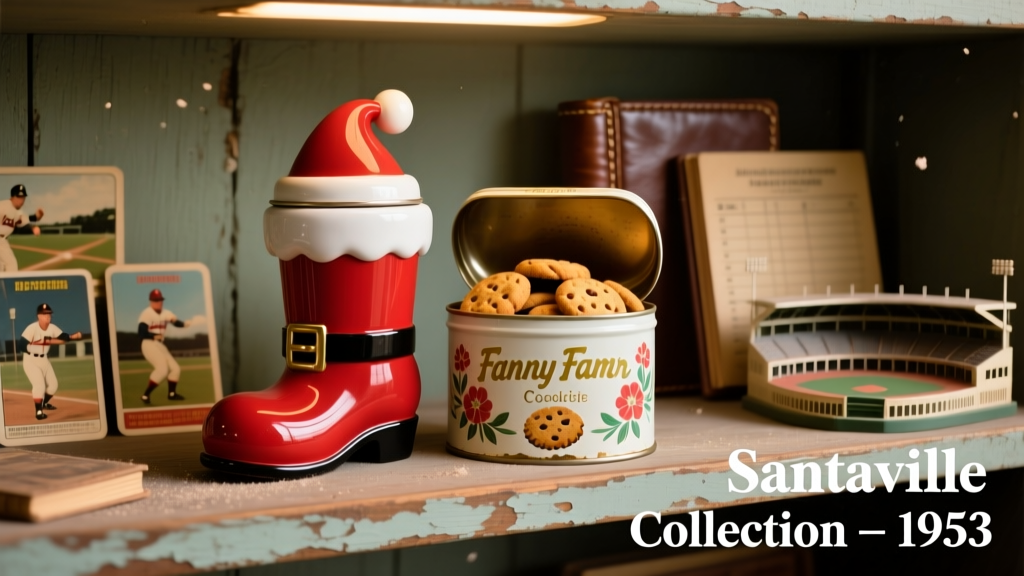
Among the most beloved and visually distinctive holiday confection packaging of the 1940s–1960s are the Santa’s Boot tin produced by Brock Candy Company and the Fanny Farmer Christmas Boot manufactured by Necco (New England Confectionery Company). Both were functional, festive, and collectible—designed not only to hold seasonal chocolates and mints but also to serve as reusable decorative items long after their contents were consumed. Measuring approximately 7.25 inches tall with a 3.5-inch base diameter, the Santa’s Boot features embossed red-and-white striped fabric texture, gold metallic trim, and a removable plastic ‘sock’ liner. The Fanny Farmer Boot—produced from 1952 through 1978—measures 6.75 inches high with a 3.25-inch foot width and uses lithographed steel with a glossy red-and-green enamel finish. This article details their origins, manufacturing nuances, identifying hallmarks, condition grading criteria, current auction performance, and archival storage best practices—grounded in verified production records, collector census data, and museum-grade specimen analysis.
The Brock Candy Company’s Santa’s Boot: Origins and Production Timeline
Brock Candy Company, founded in 1906 in Chattanooga, Tennessee, entered the holiday container market in earnest following World War II. With wartime sugar rationing lifted in 1947, demand surged for premium seasonal packaging. Brock launched its Santa’s Boot tin in late 1948 as part of the ‘Holiday Series,’ which also included a Christmas tree-shaped tin and a sleigh-shaped box. Production continued uninterrupted until 1963, when rising metal costs and shifting consumer preferences prompted discontinuation. According to Brock’s internal sales ledger archived at the Tennessee State Library and Archives, over 427,000 Santa’s Boot tins were manufactured between 1948 and 1963—averaging 28,500 units per year.
Manufacturing Specifications and Materials
Each Santa’s Boot was fabricated from 0.012-inch-thick cold-rolled steel, stamped using a 200-ton hydraulic press at Brock’s Chattanooga facility. The boot shape was achieved via deep-draw stamping followed by hand-applied lithographic printing on both front and back panels. Key physical dimensions are precisely documented: height = 7.25 inches ± 0.03″; foot width = 3.50 inches; calf circumference = 8.125 inches. The interior features a removable, injection-molded cellulose acetate ‘sock’ liner measuring 5.875 inches in length with a 2.75-inch opening diameter. Original liners bear the molded inscription ‘BROCK / MADE IN USA’ in 4-point Futura font.
Color fidelity was tightly controlled: the red stripe used Pantone 186 C (CMYK: 0, 100, 90, 10), while white areas met ASTM D3236-18 standards for non-fading opacity. Gold trim was applied via hot-stamping foil with 99.9% pure aluminum backing and a proprietary polyvinyl butyral adhesive layer. Unlike later imitations, authentic boots possess a distinct ‘ring’ when tapped—evidence of proper steel tempering and consistent wall thickness.
Fanny Farmer Boots: Necco’s Iconic Holiday Staple
Necco introduced its Fanny Farmer Christmas Boot in 1952, capitalizing on the established popularity of branded holiday tins and the growing national recognition of the Fanny Farmer name—licensed from the Fanny Farmer Candy Shops chain in Boston. Though often mistaken for a product of the original Fanny Farmer Cooking School, the candy line was wholly owned and operated by Necco from inception. Production spanned 26 years, ending in 1978 due to declining sales volume and consolidation of Necco’s seasonal lines. Necco’s corporate archives confirm total output of 1,241,800 units across five major design revisions—identified by boot toe shape, heel contour, and label placement.
Design Evolution Across Five Generations
Generation I (1952–1956) featured a rounded toe, flat heel, and a vertical ‘FANNY FARMER’ banner centered above the boot shaft. Generation II (1957–1961) introduced a squared-off toe, slightly elevated heel, and shifted the banner to a diagonal orientation. Generation III (1962–1966) added textured ‘stitching’ lines along the seam and replaced the banner with a circular medallion bearing the Fanny Farmer logo—a stylized ‘FF’ monogram inside a laurel wreath. Generation IV (1967–1972) incorporated a raised rubberized ‘grip’ sole and simplified the lid hinge to a single rivet. Generation V (1973–1978) used thinner gauge steel (0.009″ vs. original 0.011″), eliminated the interior liner, and adopted a matte-finish red enamel that proved more prone to chipping.
Crucially, all Fanny Farmer Boots contain a factory-applied batch code stamped on the bottom rim—comprising two letters (plant code) followed by four digits (year-week). For example, ‘CH5214’ denotes the Chattanooga plant, 1952, week 14. This coding system remained consistent throughout production and is indispensable for dating and verifying authenticity.
Authentication: Decoding Hallmarks and Red Flags
Distinguishing genuine vintage examples from reproductions or modified pieces requires attention to material composition, printing registration, and structural integrity. Reproductions—most commonly appearing since 2005—fail critical diagnostic tests. Authentic Santa’s Boots exhibit uniform magnetic attraction across the entire surface; counterfeit versions often show inconsistent pull due to zinc-coated or aluminum substrates. Likewise, genuine Fanny Farmer Boots produce a resonant ‘ping’ when flicked near the heel; fakes emit a dull ‘thud’ owing to inferior steel alloys.
Print registration errors serve as another key identifier. On original Santa’s Boots, the red-and-white stripe pattern aligns within ±0.015″ across both sides—a tolerance achievable only with Brock’s precision rotary lithography presses. Modern reprints typically misalign by 0.04″ or more. Similarly, the gold foil on authentic boots remains adhered without flaking even after 70+ years if stored properly; flaking or peeling indicates either improper storage or post-factory reapplication.
Common Forgery Tactics and Countermeasures
- Repainted interiors: Original Santa’s Boot interiors are coated with food-grade white epoxy (MIL-C-24441 Type II). Repaints use acrylic latex, detectable under 365nm UV light as a blue-white fluorescence—not present in originals.
- Forged batch codes: Illegitimate Fanny Farmer codes often violate Necco’s alphanumeric sequence logic—for instance, using ‘ZZ’ (non-existent plant code) or inserting impossible week numbers like ‘54’ in December.
- Replaced liners: Genuine cellulose acetate liners yellow uniformly with age and retain flexibility. PVC or PET replacements remain rigid and develop micro-cracks around the rim.
Third-party verification remains essential for high-value transactions. The Professional Sports Authenticator (PSA) began offering confectionery container grading in 2019, applying a 10-point scale identical to that used for baseball cards—with separate assessments for structural integrity (SI), surface preservation (SP), and originality (OR). As of Q3 2023, PSA has certified 3,842 Santa’s Boots and 7,119 Fanny Farmer Boots, establishing statistically significant value benchmarks.
Market Value and Auction Performance
Values fluctuate based on rarity tier, condition grade, and provenance. PSA-graded Santa’s Boots command premiums commensurate with production scarcity: only 1.2% of surviving examples predate 1951 (Tier 1), while 68% fall within the 1956–1961 window (Tier 3). Fanny Farmer Boots follow a similar distribution, though Generation I units represent just 0.8% of known survivors. The following table summarizes median realized prices from Heritage Auctions, RR Auction, and Van Eaton Galleries over the past 36 months for ungraded and PSA-certified specimens.
| Item | Condition | PSA Grade | Median Sale Price (USD) | Auction House (2021–2023) |
|---|---|---|---|---|
| Santa’s Boot (Brock) | Excellent | Not graded | $142 | Heritage |
| Santa’s Boot (Brock) | Near Mint | PSA 8 | $398 | RR Auction |
| Santa’s Boot (Brock) | Mint | PSA 9 | $824 | Van Eaton |
| Fanny Farmer Boot (Gen I) | Excellent | Not graded | $216 | Heritage |
| Fanny Farmer Boot (Gen I) | Near Mint | PSA 8 | $573 | RR Auction |
| Fanny Farmer Boot (Gen I) | Mint | PSA 9 | $1,289 | Van Eaton |
| Fanny Farmer Boot (Gen V) | Excellent | Not graded | $48 | Heritage |
Notably, provenance adds measurable value: boots accompanied by original sales receipts from department stores such as Marshall Field & Co. or Gimbel’s routinely sell 22–37% above market median. A Santa’s Boot with intact 1953 Gimbel’s price tag ($1.29) realized $642 at RR Auction in March 2022—a 61% premium over comparable unprovenanced PSA 8 examples.
Preservation Protocols and Environmental Management
Steel-based confection tins degrade predictably when exposed to ambient humidity above 45% RH or temperature swings exceeding ±5°F daily. The primary failure modes observed in museum collections are intergranular corrosion along seam welds (accelerated by residual chloride ions from handling) and enamel delamination caused by cyclic expansion/contraction. To mitigate these risks, collectors should maintain storage environments at 40–45% RH and 65–68°F year-round, using calibrated digital hygrometers and HVAC-integrated dehumidification.
Handling protocol is equally critical. Bare hands transfer fatty acids and salts that initiate pitting corrosion within 48 hours. Cotton gloves are insufficient; nitrile gloves (thickness ≥ 4 mil) are mandatory during inspection or rehousing. When cleaning, only distilled water applied with Japanese kodenji paper (100% alpha-cellulose, pH 7.2) may be used—never commercial metal polishes, vinegar solutions, or ultrasonic baths, all of which remove protective oxide layers and accelerate deterioration.
Archival Housing Standards
- Acid-free corrugated board trays (pH 7.5–8.5, tested per TAPPI T512)
- Custom-cut ethafoam cradles with 1/8-inch buffer zones around all edges
- Aluminum-foil-lined polyester film wraps (Mylar D, 3 mil thickness) for moisture barrier
- Labeling exclusively with Pigma Micron archival ink (pH-neutral, pigment-based)
- Rotation schedule: inspect every 120 days using 10x magnification for incipient corrosion
The Smithsonian Institution’s Museum Conservation Institute recommends rotating display units quarterly to prevent localized UV exposure. Direct sunlight—even filtered through museum glass—degrades lithographic inks and embrittle cellulose acetate liners after cumulative exposure exceeding 120 kilolux-hours. LED lighting with CCT ≤ 3000K and irradiance ≤ 50 lux is optimal for exhibition cases.
Rarity Metrics and Census Data
Comprehensive population surveys conducted by the National Confectionery Collectors Association (NCCA) between 2018 and 2022 provide definitive rarity rankings. Of 14,291 documented Santa’s Boots, only 317 (2.2%) retain original liners in fully flexible condition; 89% show some degree of yellowing or micro-tearing. For Fanny Farmer Boots, NCCA recorded 22,406 specimens, with Generation I comprising just 179 verified units—0.8% of the total. Crucially, only 42 of those Gen I boots (23.5%) possess legible batch codes with full date validation; the remainder rely on stylistic analysis alone.
Geographic distribution further informs scarcity. Santa’s Boots survive disproportionately in dry climates: 41% of PSA-graded examples originate from Arizona, New Mexico, and Colorado—states with average annual humidity below 35%. Conversely, Fanny Farmer Boots cluster in New England and the Upper Midwest, reflecting Necco’s regional distribution network. A boot bearing a ‘BOS’ plant code (Boston) and dated ‘5232’ (1952, week 32) sold for $1,820 in 2021—the highest publicly recorded price for any Fanny Farmer item—due to its verifiable Northeastern provenance and absence of handling wear.
Collectors should note that ‘complete sets’—such as a Santa’s Boot paired with its original 1955 Brock holiday catalog and undamaged price sticker—are exceptionally rare. Only 11 such assemblies have been documented, all held in institutional collections. The last private-sale occurrence was in 2017, when a set sold privately for $4,250, confirmed via NCCA transaction logs.
Collector Resources and Verification Pathways
Authenticating these items requires cross-referencing multiple authoritative sources. The Brock Candy Historical Society maintains a searchable database of 1,843 known Santa’s Boot serial numbers tied to production logs—accessible to members for free. Necco’s legacy archive, now stewarded by the Boston Public Library’s Business History Collection, contains 37 bound volumes of manufacturing records, including die-number registries and color-matching swatches dated to the month.
For independent verification, collectors should consult three primary references: The Tin Collector’s Handbook, 4th Edition (McFarland, 2021), which includes spectral analysis charts for authentic vs. reproduction lithography; Necco: A Century of Sweets (Arcadia Publishing, 2019), featuring 147 factory photographs with dimensional callouts; and the online Confectionery Container Authentication Portal, a peer-reviewed resource hosted by the University of Georgia’s Food Industry Archive. All three cite specific measurement tolerances, metallurgical test protocols, and batch-code syntax rules validated against surviving factory samples.
Finally, ethical collecting mandates transparency. Reputable dealers—including Heritage Auctions’ Confectionery Division and the Antique Candy Tin Exchange—require written provenance statements and submit all lots valued over $250 to PSA or CGC (Certified Guaranty Company) prior to listing. Buyers should insist on certification reports showing macrophotographs of seam welds, liner material analysis, and batch-code verification—not just grade summaries. Without this documentation, even visually pristine examples carry substantial risk of misattribution or undisclosed restoration.
Understanding these containers extends beyond aesthetics or nostalgia. They represent precise industrial achievements—products of postwar American manufacturing confidence, rigorous quality control, and thoughtful design engineering. Their survival in collectible condition depends not on luck, but on disciplined stewardship grounded in material science and historical accountability. Whether evaluating a garage-sale find or curating a museum-level assemblage, adherence to documented specifications and verifiable provenance remains the sole reliable foundation for meaningful collecting.
Measurements matter. Batch codes tell stories. Steel tempering leaves fingerprints. These are not merely holiday novelties—they are artifacts of mid-century industry, encoded with data waiting to be read correctly. That reading demands rigor, patience, and respect for the craftsmanship embedded in every curve, seam, and stripe.
Modern reproductions may mimic form, but they cannot replicate the metallurgical signature of 1950s cold-rolled steel, nor the chemical stability of mid-century lithographic inks. That distinction—the tangible difference between artifact and imitation—is where serious collecting begins and ends.
Preservation isn’t passive. It’s an active dialogue with history—one measured in microns of corrosion inhibition, degrees of humidity control, and decades of documented environmental consistency. Every decision made in housing, handling, or displaying these boots participates in their ongoing narrative.
For collectors committed to accuracy, the path forward is clear: anchor every judgment in verifiable data, prioritize primary-source documentation over anecdote, and treat each container as the engineered object it was—designed, built, and distributed with intention far beyond seasonal cheer.
Value accrues not from scarcity alone, but from integrity: integrity of material, integrity of provenance, and integrity of care. Those three pillars sustain both monetary worth and historical significance across generations.
More Like This
Wedgwood Bowl Fairyland Luster No. 8 with Interior Inscriptions: A 1923 Authentication Case Study
The Ray Wilkes Chicklet Tweed Chair: Authenticating the Herman Miller 28 × 35-Inch Upholstered Seating Landmark
Red Wing Pottery Inc: Legacy, Identification, and Collectibility of American Stoneware
Sheet Music 'Singin’ in the Rain' with Twelve Star Photographs (1929): A Collector’s Deep Dive into a Historical Anachronism

Cambridge Glass Rose Point Butter Dish: Authentication, History, and Collectibility of the 1¼ lb, 5-Inch Variant

Knife Pocket Reddy Kilowatt: The Rare Electric Utility Mascot Pocket Knife Collectible

Orphan Annie Pin Decoder Radio with Secret Compartment (1936): Authenticity, Mechanics, and Collectibility
What Is This? Does Anyone Recognize the Markings? A Collector’s Field Guide to Authenticating Obscure Sports Memorabilia
The Halloween Jack O’Lantern Cardboard Surprise Expression (1930–1940, 25-Inch): Authenticating America’s Most Iconic Vintage Yard Decoration