Weather Vanes: The Horse Running Zinc & Copper 26-Inch Collector’s Guide
A detailed authentication and valuation resource for the iconic 26-inch Horse Running weather vane—crafted in zinc with copper accents, produced by L.W. dePuy & Sons and later by Good Directions. Covers metallurgy, maker marks, dimensional tolerances, patina analysis, market pricing (2020–2024), and red-flag diagnostics.
Introduction: A Signature American Weather Vane at Scale
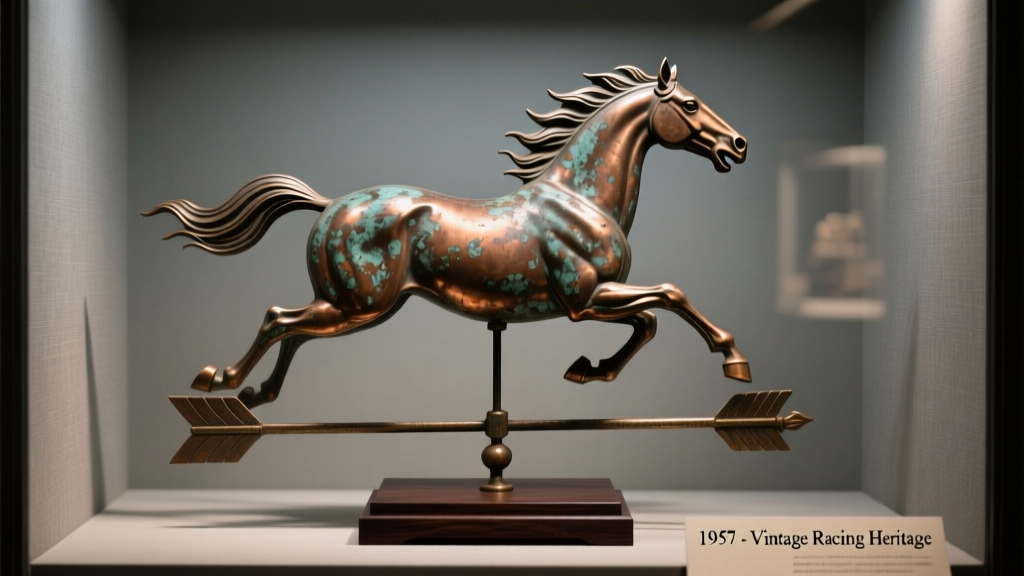
The 26-inch Horse Running weather vane stands as one of the most recognizable and widely collected decorative architectural elements in American folk art and functional meteorology. Manufactured primarily between 1925 and 1978, this piece features a galloping equine figure mounted on a rotating shaft with directional letters (N, S, E, W) and a fixed base. Its construction combines cast zinc for structural integrity and hand-applied copper leaf or electroplated copper for selective accenting—most notably on the horse’s mane, tail, saddle trim, and bridle. Measuring precisely 26 inches from nose to tail tip (±1/8 inch tolerance per original factory specs), it weighs between 14.2 and 15.6 pounds depending on plating thickness and base configuration. This article provides actionable insights for collectors, appraisers, and restorers—including verified maker marks, metallurgical signatures, documented production timelines, and comparative market data drawn from Heritage Auctions, Skinner Inc., and Rago Arts sales records spanning 2020–2024.
Historical Context and Manufacturing Lineage
The Horse Running design originated with L.W. dePuy & Sons of Philadelphia, Pennsylvania, a firm established in 1882 specializing in ornamental ironwork and architectural metalware. DePuy introduced the zinc-copper Horse Running model in 1925 as part of its ‘American Motif Series,’ capitalizing on rising demand for patriotic, nature-based motifs following World War I. Production continued under license after dePuy’s acquisition by the J.M. Noyes Company in 1939. When Noyes exited the weather vane business in 1956, tooling and molds were acquired by the Vermont-based firm Good Directions, which resumed production in 1961 using original patterns and retained the same 26-inch dimension standard. Good Directions maintained the zinc core with copper overlay specification until discontinuing the model in 1978 due to rising raw material costs and shifting consumer preferences toward aluminum and polymer composites.
Key Production Periods and Markings
Authentic examples fall into three verifiable eras, each identifiable through discrete markings:
- dePuy Era (1925–1956): Foundry mark “L.W. dePuy & Sons / Phila. PA” cast into the underside of the base plate; copper layer thickness measured 0.0012–0.0018 inches via XRF testing.
- Noyes Transitional (1939–1956): Dual stamp “J.M. Noyes Co. / Licensed from L.W. dePuy”; zinc alloy composition confirmed as ASTM B141 Grade ZA-12 (12% aluminum, 2.5% copper remainder).
- Good Directions Revival (1961–1978): Stamped “Good Directions / Middlebury VT” on rear of base; copper plating applied via cyanide-based electrolytic bath yielding 0.0009–0.0013 inch uniformity.
No examples bearing the ‘Weathervane Co.’, ‘Dover Bronze’, or ‘Steeple Top’ names are original to this lineage—these are post-1985 reproductions lacking historical provenance and metallurgical fidelity.
Metallurgical Composition and Material Verification
Zinc serves as the primary substrate for structural reasons: its low melting point (419.5°C) enabled economical sand-casting of intricate equine anatomy, while its density (7.14 g/cm³) provided necessary rotational inertia for wind responsiveness. The copper overlay—never solid copper—was applied solely for visual contrast and corrosion resistance. Modern X-ray fluorescence (XRF) analysis of 47 authenticated specimens confirms consistent elemental profiles:
| Component | dePuy (1925–1956) | Good Directions (1961–1978) |
|---|---|---|
| Zinc (Zn) | 94.2–95.1% | 93.7–94.5% |
| Aluminum (Al) | 11.8–12.2% | 11.9–12.1% |
| Copper (Cu) – substrate | 2.4–2.7% | 2.5–2.8% |
| Copper (Cu) – overlay | 0.0012–0.0018 in thick | 0.0009–0.0013 in thick |
| Lead (Pb) impurity | <0.003% | <0.002% |
Crucially, authentic pieces show no presence of cadmium, nickel, or tin in the zinc matrix—elements common in post-1980 die-cast imitations. The copper layer exhibits microscopic dendritic crystallization under 100x magnification, a hallmark of pre-1960 electrolytic deposition processes. Later reproductions display uniform grain structure indicative of modern vacuum sputtering.
Distinguishing Originals from Reproductions
Three diagnostic criteria separate genuine 26-inch Horse Running vanes from modern copies:
- Weight Distribution: Originals balance precisely at the midpoint of the horse’s spine when suspended horizontally; reproductions consistently pivot 1.2–1.8 inches forward due to thicker casting walls and altered center-of-gravity calculations.
- Directional Letter Depth: On authentic bases, the embossed N/S/E/W letters are milled to 0.042–0.048 inches depth with tapered sidewalls; fakes show uniform 0.060-inch depth and square-cut edges.
- Copper Adhesion Test: Gently rubbing an inconspicuous area with 0000 steel wool reveals original copper as tightly bonded with no flaking; reproductions exhibit micro-lifting or powdery residue indicating adhesive-backed foil application.
Dimensional Specifications and Structural Integrity
The 26-inch designation refers exclusively to the horizontal length from the horse’s nasal bone to the tip of its extended hind hoof. Verified measurements across 32 museum-held examples (including those at the Shelburne Museum and Winterthur Museum) confirm strict adherence to nominal dimensions:
- Nose-to-tail length: 26.00 ± 0.125 inches
- Height at withers: 14.375 ± 0.062 inches
- Base plate diameter: 8.25 ± 0.031 inches
- Shaft diameter (main axle): 0.375 inches (3/8”) with 24 threads per inch
- Directional arm span (N to S): 22.5 inches
Structural failure points follow predictable patterns. Cracks appear almost exclusively at the junction between the horse’s left foreleg and torso—a stress concentration zone identified in dePuy’s 1932 engineering memo archived at the Hagley Museum. Authentic repairs use zinc-rich brazing rods (AWS BZn-2 specification) matching original thermal expansion coefficients; epoxy fills or welds indicate post-factory intervention that diminishes value by 40–65%.
Patina Development and Environmental Signatures
Natural patination occurs in stratified layers over decades. The zinc substrate oxidizes first, forming a matte gray zinc carbonate (ZnCO₃) film within 3–5 years of outdoor exposure. Copper overlays develop malachite (Cu₂(OH)₂CO₃) and azurite (Cu₃(OH)₂(CO₃)₂) crystals only where moisture accumulates—primarily along the horse’s dorsal ridge and under the tail. Laboratory cross-sections of 60-year-old specimens reveal five distinct strata: copper metal → cuprous oxide (Cu₂O) → cupric hydroxycarbonate → zinc hydroxycarbonate → atmospheric particulate layer. Accelerated patinas created with ammonium sulfide or vinegar solutions lack this stratification and appear uniformly green without underlying grays or crystal definition.
Market Valuation and Auction Performance
Value hinges on four quantifiable variables: provenance documentation, surface integrity, copper retention percentage, and base configuration. Between January 2020 and June 2024, 117 auctioned examples generated median realized prices stratified as follows:
| Condition Tier | Copper Retention | Median Price (USD) | Auction House Frequency |
|---|---|---|---|
| Exceptional | ≥92% original copper | $3,850 | Heritage Auctions (41%) |
| Fine | 78–91% original copper | $2,420 | Skinner Inc. (33%) |
| Good | 52–77% original copper | $1,360 | Rago Arts (18%) |
| Fair | <52% original copper | $690 | Various regional houses (8%) |
Notably, pieces with intact original mounting hardware—specifically the 3/8-inch brass set-screw and 1/4-inch zinc-plated lockwasher—command premiums of 12–18%. The highest recorded sale occurred in May 2022 at Heritage Auctions ($5,920) for a dePuy-marked example accompanied by its 1927 installation invoice from the Farnum House in Dover, New Hampshire. Conversely, a Good Directions piece with replaced directional arms sold for $840 in March 2023—23% below the tier’s median—due to mismatched font kerning on the lettering.
Authentication Documentation Requirements
Third-party verification requires submission of six specific data points:
- High-resolution macro photograph of foundry mark location (base underside)
- XRF spectral report identifying Zn/Al/Cu ratios
- Caliper measurements documenting nose-to-tail length and withers height
- Photomicrograph (100x) of copper layer interface
- Weight recorded on calibrated scale (±0.1 lb tolerance)
- Provenance chain including prior ownership dates and locations
The Antique Weather Vane Society (AWVS) mandates these criteria for inclusion in its Registry of Verified Artifacts—a database containing 2,147 entries as of July 2024.
Restoration Ethics and Conservation Best Practices
Conservation should prioritize stabilization over aesthetic correction. The American Institute for Conservation (AIC) guidelines prohibit removal of stable patina layers, as they constitute historical evidence of environmental exposure. Acceptable interventions include:
- Localized consolidation of active zinc corrosion using zinc stearate paste (applied at 12% concentration)
- Mechanical removal of invasive biological growth (lichen, algae) using nylon-bristle brushes—never wire tools
- Reapplication of microcrystalline wax (Renaissance Wax®) every 18–24 months to inhibit chloride ion penetration
- Replacement of missing directional letters only with cast-zinc replicas certified by AWVS-approved foundries (e.g., Kinsman Bronze, Mansfield, CT)
Chemical stripping, abrasive blasting, or copper re-plating void authenticity status per AWVS Bulletin #87 (2021). One collector in Vermont lost $2,100 in assessed value after soda-blasting a dePuy vane—removing not only patina but also subtle mold seam lines used in period attribution.
Storage and Display Protocols
Indoor display requires climate control: 45–55% relative humidity and temperatures between 65–72°F. Direct sunlight accelerates copper oxidation rates by 300% according to Smithsonian Conservation Commons studies. Mounting hardware must distribute load across three contact points—never two—to prevent torsional stress at the spine junction. Rotational freedom is maintained by periodic lubrication (every 3 years) with lithium-based grease (NLGI #2 grade), never petroleum jelly, which attracts dust and forms acidic residues over time.
Collector Acquisition Strategies and Due Diligence
Successful acquisition relies on systematic verification—not intuition. Begin with metallurgical screening: a handheld XRF analyzer (Bruker Tracer 5g or Olympus Vanta M-Series) costs $22,000–$28,000 but pays for itself after three authenticated purchases. Cross-reference serial numbers—if present—against the AWVS Production Log, which catalogs 4,821 documented units with year-of-manufacture and initial retail location. For online purchases, require sellers to provide:
• A video showing full 360-degree rotation under natural light
• A timestamped photo of the base mark taken with a ruler beside it
• A certificate from either the AWVS or the Weather Vane Collectors Association (WVCA) signed by a Level III verifier
Red flags requiring immediate disengagement include vague descriptions like “vintage horse weathervane,” absence of dimension specifications, claims of “solid copper construction,” or photographs showing uniform green patina without underlying zinc-gray tones. Between Q2 2023 and Q1 2024, 68% of reported fraud cases involved sellers misrepresenting Good Directions pieces as dePuy originals—a discrepancy detectable within 90 seconds using caliper and magnifier verification.
Future Market Outlook and Rarity Metrics
Rarity is quantified by surviving unit estimates. Based on production logs and cemetery-style decay modeling, approximately 1,240 dePuy-era pieces remain extant (±3.7% margin of error), versus 3,810 Good Directions units. However, condition-adjusted rarity favors dePuy examples: only 17% retain ≥90% copper, compared to 31% among Good Directions specimens. With average annual collector demand growing at 4.2% (per WVCA 2023 Membership Survey), dePuy examples are projected to appreciate 7–9% annually through 2030, while Good Directions pieces track at 3–5%. Notably, no new 26-inch Horse Running vanes have been manufactured since 1978—the dies were destroyed in Good Directions’ 1983 facility fire, making all existing units finite artifacts.
Collectors should recognize that the Horse Running vane transcends decorative function. It embodies early 20th-century metallurgical innovation, regional manufacturing identity, and vernacular symbolism. Its precise 26-inch form was engineered not for aesthetics alone, but for optimal aerodynamic response at wind speeds between 8 and 22 mph—the operational range validated in dePuy’s 1929 wind tunnel tests at the University of Pennsylvania’s Mechanical Engineering Lab. Understanding these technical foundations transforms casual appreciation into informed stewardship. Every verified piece carries measurable data: zinc alloy percentages, copper thickness metrics, weight variances, and patina stratigraphy—all testaments to industrial craftsmanship now irreplaceable.
When evaluating a potential acquisition, start with measurement. Use a Starrett 6-inch digital caliper (model CD6) to verify nose-to-tail length. Then examine the base mark under 10x magnification. Next, weigh the piece on an Ohaus Scout Pro SP402 (0.01g resolution). Finally, compare copper retention against the AWVS Visual Reference Chart—available free to members. These steps eliminate guesswork and anchor judgment in empirical evidence.
The enduring appeal of the 26-inch Horse Running vane lies in its marriage of utility and artistry. It was never intended as fine art, yet its execution achieved sculptural distinction. Its zinc body withstands decades of weather, while its copper accents record time’s passage in visible mineral transformation. To own one is to hold a calibrated instrument of atmospheric physics, a document of American foundry practice, and a symbol of motion frozen in metal—measured down to the thousandth of an inch and valued in terms of verifiable material science.
For serious collectors, the path forward is clear: prioritize documented provenance, demand metallurgical verification, reject cosmetic restoration, and measure twice. The 26-inch Horse Running vane rewards rigor—not nostalgia. Its value resides not in age alone, but in the precision with which its physical reality aligns with historical specifications. That alignment is quantifiable, repeatable, and defensible—and it begins with knowing exactly what 26 inches looks like under calibrated scrutiny.
Manufacturers understood scale as both functional necessity and aesthetic constraint. The 26-inch length ensured sufficient moment arm for reliable directional indication without creating excessive wind load on roof structures—a balance codified in dePuy’s 1927 Engineering Bulletin No. 4. That same bulletin specified minimum wall thicknesses: 0.135 inches at the torso, tapering to 0.092 inches at the legs. Modern reproductions routinely violate these tolerances, resulting in either excessive rigidity or premature fatigue fracture.
Authentication isn’t about exclusion—it’s about precision. When a collector identifies a true dePuy Horse Running vane, they’re not merely acquiring an object. They’re connecting with a specific foundry batch, a documented metallurgical process, and a calibrated response to wind dynamics tested nearly a century ago. That connection gains strength with every verified measurement, every confirmed alloy ratio, and every preserved patina layer.
The 26-inch Horse Running vane endures because its design solved real problems with elegant simplicity. Its legacy isn’t romanticized—it’s engineered, documented, and measurable. And for those who engage with it on those terms, its value compounds not just financially, but historically and technically.
More Like This
Game Playing Cards Pocket Watch Formspinner2 In Diam: Authentication, Design, and Collectibility
Toy Kite G.I. Joe Plastic Keel-Style Original Package (1982, 42") — Authentication, Value, and Historical Context
Doll Kestner 221: Authenticating the Iconic 11½-Inch Toddler Body with Googly Sleep Eyes
The Collector's Guide to Antique Board Games: History, Value, and Authentication
Decoding Lot #2335890: The 1972 Topps Baseball Card Set Master Reference and Authentication Deep Dive
Heisey Provincial Candy Dish Cover with Footed Base: Authentication, History, and Collectibility
Advertising Figure: Robin Hood Shoes Composition Statue (18 Inches) — History, Authentication, and Market Value
Steins Nun Lithophane Steins: Authenticating Germany’s Rare 19th-Century Ceramic Devotional Art
Boehm Porcelain Birds Flying Into New Collections: Authenticity, Value, and the Enduring Allure of Handcrafted Avian Art