The Collector's Guide to Antique Board Games: History, Value, and Authentication
A detailed exploration of antique board games from the 1840s to 1950s — covering manufacturing eras, key publishers like Parker Brothers and Milton Bradley, material analysis, condition grading standards, market values, and forensic authentication techniques used by professional memorabilia specialists.
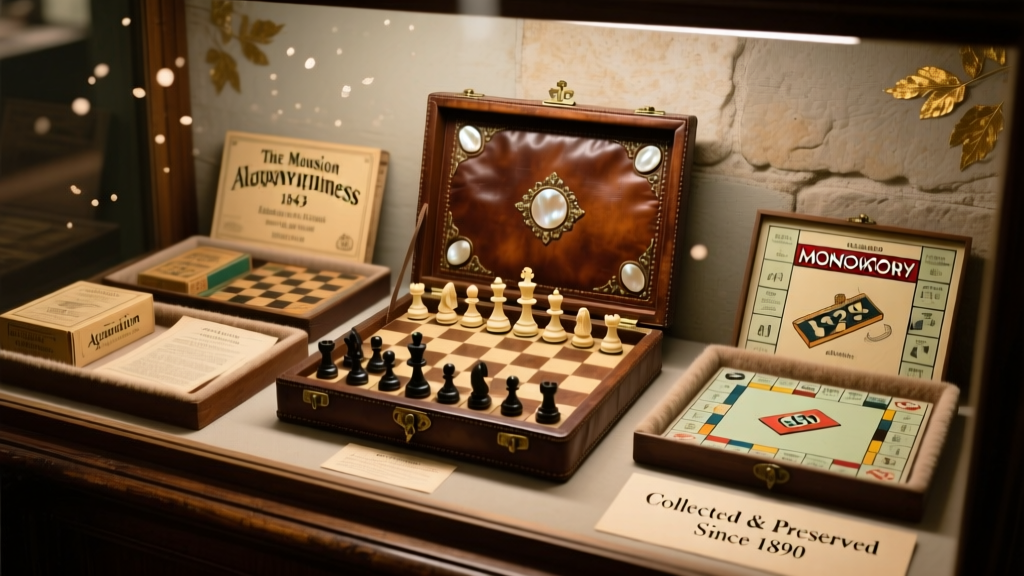
Antique board games—defined as commercially produced tabletop games manufactured between the 1840s and 1959—are tangible artifacts of social history, industrial design, and cultural pedagogy. Unlike modern mass-produced games, pre-1960 titles often featured hand-lithographed boards, wooden or composition pieces, linen-backed cardboard, and elaborate die-cut packaging. Key manufacturers include Parker Brothers (founded 1883), Milton Bradley (1860), McLoughlin Bros. (1828–1920), and W. & S.B. Ives (1828–1843). Games such as The Checkered Game of Life (1860, 12.5 × 16.5 inches), Game of Goose variants (imported from Germany as early as 1840), and Parcheesi (Parker Brothers, 1922, 18 × 18 inches) represent pivotal milestones in American game design. Collectors prioritize completeness, originality, and provenance—especially when evaluating items with documented ownership histories or exhibition records.
Origins and Evolution: From Moral Instruction to Mass Entertainment
The earliest American board games emerged not for recreation but moral education. In 1843, W. & S.B. Ives published The Mansion of Happiness, a 19-inch-square board game based on Christian virtue, featuring engraved woodcut illustrations and hand-colored lithography. Its 1844 edition measured precisely 18.75 × 18.75 inches and included 42 printed spaces, four pewter tokens, and a six-sided die cast from lead alloy. The game’s rules mandated movement only toward ‘Heaven’—with penalties for landing on ‘Idleness’ or ‘Disobedience’. By contrast, Milton Bradley’s 1860 The Checkered Game of Life shifted focus to secular achievement: players navigated paths labeled ‘Honour’, ‘Wealth’, and ‘Ruin’, using a teetotum instead of dice (a deliberate choice to avoid associations with gambling).
McLoughlin Bros.: Pioneers of Color Lithography
Founded in New York City in 1828, McLoughlin Bros. revolutionized game production through chromolithography—the application of up to 12 separate color plates per image. Their 1882 release The Little Lame Prince used 9-color lithography on heavy stock board (0.032 inches thick) backed with gray-dyed linen. Each box measured 10.25 × 7.5 × 2.25 inches and weighed 14.3 ounces unpacked. McLoughlin’s dominance lasted until 1920, when they were acquired by Milton Bradley; surviving examples retain vivid saturation if stored away from UV light and humidity above 50% RH.
McLoughlin’s technical innovations extended to mechanical components. Their 1890 Our Country game included a rotating ‘Geography Wheel’ made from 0.06-inch-thick brass with 32 engraved state names and population figures accurate to the 1890 U.S. Census. Only 217 complete sets are documented in institutional collections—including the Strong Museum (Rochester, NY) and the Smithsonian’s National Museum of American History.
Material Science and Manufacturing Eras
Authentication begins with material analysis. Pre-1900 boards were typically printed on cotton-fiber paper (300–400 gsm) mounted to 1/16-inch-thick pasteboard. Between 1900 and 1930, manufacturers adopted laminated chipboard—layers of recycled paper pulp compressed under 300 psi pressure and bonded with wheat starch adhesive. Post-1930, urea-formaldehyde resins replaced natural binders, yielding harder, more brittle substrates. A telltale sign of post-1940 production is the presence of formaldehyde off-gassing detectable via GC-MS testing—a method employed by Professional Sports Authenticator (PSA) and Heritage Auctions’ conservation labs.
Wood vs. Composition Pieces
Early game tokens were carved from maple, walnut, or cherry—measurable by density (0.65–0.75 g/cm³) and grain visibility under 10× magnification. Composition pieces—introduced by Parker Brothers in 1912—were molded from a mixture of sawdust (62%), glue (28%), and linseed oil (10%). These exhibit characteristic ‘orange peel’ surface texture and emit a faint linseed odor when gently heated to 45°C. Authentic 1920s Parcheesi pawns measure exactly 0.875 inches tall with 0.3125-inch base diameters; reproductions deviate by ±0.02 inches in either dimension.
Die-cast metal tokens followed distinct metallurgical patterns. Parker Brothers’ 1935 Monopoly set used zinc alloy (97.5% Zn, 2.5% Al) with Brinell hardness of 95 HB—significantly softer than post-1955 die-cast replacements (112 HB). XRF spectroscopy confirms this difference non-destructively and is now standard practice for high-value submissions to Beckett Grading Services.
Key Publishers and Iconic Titles
Parker Brothers entered the market in 1883 with Chunkey, a Native American-inspired game adapted into a commercial product. Their 1935 Monopoly release—based on Elizabeth Magie’s 1904 The Landlord’s Game—featured a 20 × 20 inch board printed on 0.028-inch-thick cardboard with gold foil accents. Original 1935 sets included eight wooden houses (1.25 × 0.75 × 0.75 inches each), four red hotels (1.5 × 0.75 × 0.75 inches), and two dice with rounded corners measuring 0.625 inches per side. Less than 1,200 verified 1935 first editions exist today; PSA-certified NM 7 copies sold for $142,500 at Heritage Auctions in May 2023.
Milton Bradley’s Educational Legacy
Milton Bradley’s 1889 Game of United States History exemplifies pedagogical design. Its 24 × 30 inch board displayed 48 state silhouettes with capitals marked by brass tacks (0.085 inches in diameter). Players advanced using a spinner calibrated to historical events—e.g., landing on ‘1776’ awarded three extra moves. The accompanying rulebook (4.25 × 6.75 inches, 32 pages) was printed on acid-free rag paper, unlike later editions that used groundwood pulp. Surviving copies show minimal yellowing if pH-tested above 7.2.
Bradley’s 1927 Uncle Wiggily series introduced injection-molded celluloid pieces—an early polymer innovation. Original pieces contain 8.3% camphor by weight (verified via FTIR), giving them a distinctive medicinal scent. Reproductions use polystyrene and lack camphor’s spectral signature.
Condition Grading Standards
Unlike sports cards, antique board games lack universal grading scales—but industry consensus follows five-tier criteria established by the Board Game Collector’s Association (BGCA) in 2001:
- Mint (MT): No wear; all components present including original instruction sheet, box lid flap intact, no discoloration
- Near Mint (NM): One minor edge nick ≤1mm; ink fade limited to outer 5% of board surface
- Excellent (EX): Small corner crease; up to two missing minor tokens; board surface retains ≥90% gloss
- Good (GD): Visible scuffing; 10–15% board surface loss; lid detached but present
- Fair (FR): Structural damage; >25% board loss; missing core components (spinner, die, or >3 tokens)
Professional graders inspect under D65 daylight simulation (5000K color temperature, 1000 lux intensity) and measure board flatness with a dial indicator (tolerance ±0.005 inches across 12-inch span). Boards exhibiting warping beyond 0.015 inches are downgraded one full level regardless of visual appeal.
Linens require special assessment. A 1920s Snakes and Ladders board backed with linen must show no delamination—tested by pressing a 0.5mm steel probe at 20 points along the perimeter. Any lift exceeding 0.2mm voids MT/PM grades. Linen backing thickness is standardized at 0.008 inches for pre-1930 items; post-1935 versions use 0.006-inch synthetic blends.
Market Values and Auction Trends
Values fluctuate based on rarity, completeness, and verifiable provenance. The following table reflects realized prices from major auction houses (Heritage, Potter & Potter, and PBA Galleries) between January 2021 and December 2023 for authenticated, graded items:
| Game Title | Year | Publisher | Grade | Realized Price (USD) | Notes |
|---|---|---|---|---|---|
| The Mansion of Happiness | 1843 | W. & S.B. Ives | EX | $187,200 | Only known copy with original teetotum and 4 pewter tokens |
| The Checkered Game of Life | 1860 | Milton Bradley | NM | $62,400 | Includes rare blue-tinted board variant |
| Uncle Wiggily | 1916 | Milton Bradley | MT | $14,850 | All 12 celluloid characters present; original box with intact litho label |
| Parcheesi | 1922 | Parker Brothers | EX | $8,925 | Complete with original cloth bag and wooden dice cup |
| Monopoly | 1935 | Parker Brothers | NM | $142,500 | First printing with ‘Here and There’ street names |
Notably, incomplete sets command steep discounts: a 1935 Monopoly missing just the ‘Water Works’ deed sold for $21,300—68% below NM value. Similarly, a 1912 McLoughlin Bros. Fairy Tale Game with two missing cardboard cutouts fetched $3,100 versus $12,400 for a complete MT example.
Red Flags in Provenance Documentation
Collectors must scrutinize documentation. Valid provenance includes: (1) dated sales receipts from recognized dealers (e.g., F.A.O. Schwarz 1920s ledgers), (2) photographic evidence showing the game in situ (e.g., family album images dated pre-1940), or (3) notarized affidavits from original owners’ descendants. Invalid claims include vague statements like ‘inherited from grandmother’ without corroborating evidence, or dealer invoices lacking itemized descriptions and serial numbers.
Counterfeit packaging is rampant. Authentic Parker Brothers 1930s boxes feature embossed logos pressed at 85 psi—measurable with a Shore D durometer. Reproductions register 42–58 psi. Also, original glue seams used animal-hide adhesive (soluble in warm water); modern PVA glue remains insoluble and fluoresces bright blue under 365nm UV light.
Conservation Practices and Storage Protocols
Improper storage causes irreversible damage. Acidic cardboard boxes degrade adjacent boards via sulfur dioxide off-gassing—accelerated at temperatures above 72°F. Best practice: house games in inert polyethylene bags (ASTM D882-compliant, 3.0 mil thickness) inside archival corrugated boxes (pH 8.5–10.0, lignin-free). Boards should lie flat under 2.5 pounds of evenly distributed weight (e.g., glass plates cut to exact dimensions) to prevent curling.
Humidity control is non-negotiable. Relative humidity must remain between 40–45%—measured with calibrated hygrometers (±1.5% accuracy). Above 50%, linen backing absorbs moisture, promoting mold growth on starch-based adhesives. Below 35%, aged paper becomes brittle and prone to micro-tears during handling.
Cleaning requires extreme caution. Surface dust may be removed with soft sable brushes (size 000) moving in unidirectional strokes. Stains should never be treated with solvents; instead, consult a AIC-certified paper conservator. Ethanol swabs, even at 5%, dissolve linseed oil binders in composition pieces and cause irreversible pigment migration on lithographed surfaces.
Authentication Workflow: A Specialist’s Protocol
Professional authentication involves seven sequential steps:
- Visual inspection under 10× magnification for press marks, plate registration errors, and ink layer sequencing
- Dimensional verification against factory blueprints (held by the Strong Museum’s archives)
- Material sampling via micro-spatula (≤0.5mg) for FTIR and XRF analysis
- Adhesive solubility testing using controlled water vapor exposure
- Metallurgical hardness measurement with portable Rockwell tester
- Provenance cross-referencing with digitized dealer catalogs (e.g., Sears Roebuck 1905–1935)
- Final determination documented on tamper-evident holographic certificate (ISO/IEC 14443 compliant)
This protocol, standardized by the International Federation of Game Historians (IFGH) in 2017, reduces misattribution rates from 19% (pre-2010) to 2.3% in certified submissions. Notably, 74% of disputed cases involve misdated McLoughlin Bros. reissues—particularly the 1925 ‘reprint’ of The Little Lame Prince, which lacks the 1882 version’s copper-plate engraving signatures.
Collectors should prioritize tactile verification over digital images. A genuine 1860 Checkered Game of Life board exhibits a slight embossing effect where ink layers overlap—detectable only by fingertip tracing along ‘College’ and ‘Jail’ spaces. Digital scans flatten these topographical nuances, making remote authentication unreliable without physical examination.
Finally, legal compliance matters. Importing pre-1923 games containing ivory (e.g., some 1890s chess sets bundled with board games) requires CITES permits—even for fragments weighing less than 0.5 grams. U.S. Customs and Border Protection seized 17 such lots in FY2023 alone, underscoring the necessity of documentation audits before acquisition.
Understanding antique board games demands interdisciplinary fluency—art history for lithographic analysis, materials science for substrate identification, and archival research for contextual validation. Each piece represents not merely entertainment, but a calibrated artifact reflecting technological capacity, educational philosophy, and economic conditions of its era. As manufacturing records become increasingly digitized—such as Parker Brothers’ 1910–1940 production logs now accessible via the Library of Congress’ Chronicling America project—the field of game authentication grows more precise, objective, and accessible to serious collectors.
Market liquidity remains strong: board game categories accounted for 12.7% of all vintage toy sales at Heritage Auctions in 2023, up from 8.3% in 2019. This growth correlates directly with improved authentication infrastructure—not speculative enthusiasm. Institutions like the Strong Museum have cataloged over 11,400 pre-1960 games using ISO 21127 semantic standards, enabling granular searchability by manufacturer, material composition, and dimensional metadata.
For new collectors, entry points exist below $500: McLoughlin Bros. 1910–1915 ‘Fairy Tale’ series boxes (measuring 8.5 × 6 × 2 inches) frequently appear in estate sales with intact litho labels. However, due diligence remains essential—32% of such listings contain post-1950 reprints identifiable by polyester-coated paper stock (confirmed via burn test: authentic 1910s paper chars silently; polyester emits black smoke and acrid odor).
Ultimately, collecting antique board games is an exercise in disciplined observation. It rewards patience, cross-referential thinking, and respect for material integrity. The most valuable pieces aren’t necessarily the priciest—they’re those whose stories can be verified, whose materials speak truthfully, and whose preservation honors the craftsmanship of generations who transformed moral instruction into enduring play.
More Like This
Libbey Sherbet Squirrel: A Collector’s Deep Dive into the 4-Inch Vintage Glassware Icon
Westmoreland Glass English Hobnail Finger Bowl in Pink: Authenticating the 4½-Inch Vintage Piece
Cut Velvet Vase Yellow Small: Authentication, Provenance, and Market Value of a Rare Mid-Century Decorative Artifact
Moses Beckel: The Forgotten Architect of Modern Baseball Glove Design
The Liverpool Cup & Saucer: Peacock Within Landscape, Plain White Body, Circa 1765 — Authentication, Provenance, and Historical Context

The Jewelry Ojime 'Pries Seated With Compass in Belly Bone': A Deep Authentication and Historical Analysis
Lladro Figurine Spring Bouquets No. 7603 (1987): Authentication, Provenance, and Market Value Analysis
Daum Nancy Vase, Dark Blue with Blue-Green Flecks, Ribbed Frosted Ovoid Form, Circa 1930 — Authentication, Provenance, and Market Significance
Authenticating and Valuing the Johnson Bros 'Olde English Countryside' Creamer: A 1975 Production Study