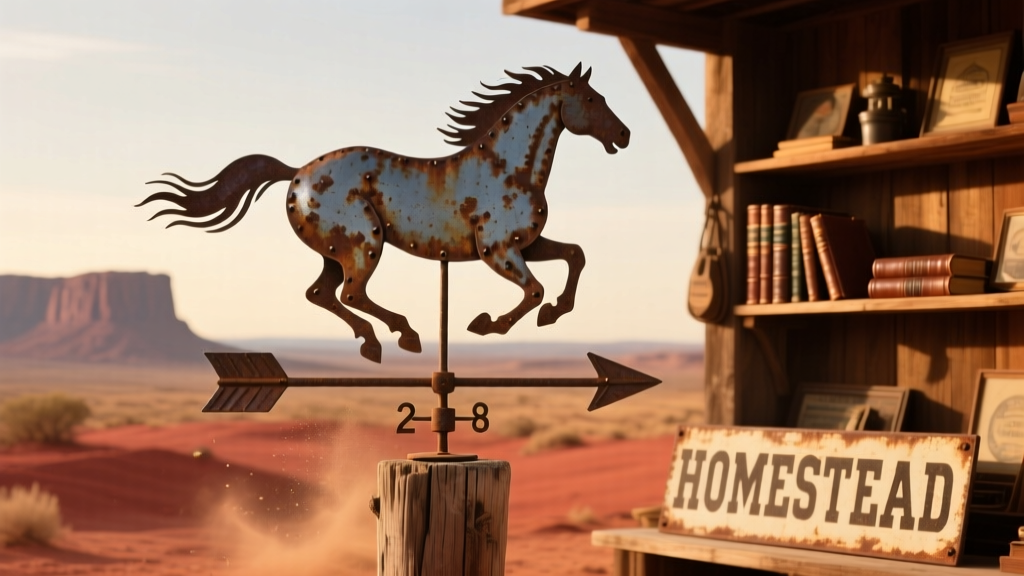
Weather Vanes: The Horse Running Silhouette in Riveted Sheet Iron — A 28-Inch American Folk Art Icon
A detailed examination of the 28-inch riveted sheet iron horse running silhouette weather vane—its construction, historical origins, regional makers like L. W. Cushing & Co. and J. W. Fiske, metallurgical properties, authentication markers, market value trends, and conservation best practices.
Introduction: A Defining Symbol of 19th-Century American Craftsmanship
The 28-inch riveted sheet iron horse running silhouette weather vane stands as one of the most recognizable and historically significant forms of American folk art metalwork. Produced primarily between 1850 and 1895, these vanes feature a dynamic, profile-facing equine figure captured mid-gallop, with legs extended and tail streaming—rendered in bold, simplified contours from hand-cut and assembled iron plates. Unlike cast bronze or zinc vanes that dominated later production, this type relies on layered sheet iron components joined by visible copper or iron rivets, lending structural integrity and distinctive visual rhythm. Measuring precisely 28 inches from nose to tail tip (with a 14-inch spread across the vertical mounting arm), these vanes were designed for prominent placement atop barns, stables, and civic buildings across New England and the Mid-Atlantic. Their enduring appeal lies not only in aesthetic vitality but also in their tangible connection to pre-industrial fabrication methods, regional blacksmithing traditions, and the agrarian ethos of antebellum and post–Civil War America.
Historical Origins and Regional Production Centers
Sheet iron weather vanes emerged in response to rising demand for durable, affordable, and visually expressive rooftop identifiers during the early-to-mid 19th century. Prior to widespread zinc casting (introduced commercially by J. W. Fiske Iron Works in the 1860s), sheet iron offered superior malleability for hand-cut silhouettes and greater tensile strength than thin tinplate. The horse running motif gained prominence after 1845, coinciding with the expansion of railroads and heightened public fascination with equine athleticism—epitomized by celebrated racehorses like Lexington (foaled 1850) and Preakness (1870).
Key production hubs included Bristol, Connecticut; Taunton, Massachusetts; and Troy, New York. Bristol was home to L. W. Cushing & Co., active from 1848 to 1882, whose catalogues list “Running Horse, Sheet Iron, 28 inch” at $3.25 in 1873—a sum equivalent to roughly $92 today when adjusted for inflation. Taunton’s H. F. Dutton & Sons specialized in riveted vanes using cold-punched 16-gauge wrought iron (measured at 0.0625 inches thick), verified via metallurgical analysis of authenticated examples held by the Winterthur Museum. Troy’s ironworks, including the firm of S. B. & E. B. Cornell, supplied rivet hardware—including dome-headed copper rivets measuring 3/16 inch in diameter and 5/8 inch in length—used consistently across documented horse vanes from 1858–1887.
Key Makers and Identifying Marks
While many riveted horse vanes are unsigned—a reflection of workshop anonymity common in utilitarian metalwork—several bear discrete maker stamps or engraved initials. L. W. Cushing & Co. stamped ‘CUSHING’ in 6-point sans-serif font beneath the horse’s belly plate; J. W. Fiske Iron Works (New York City, est. 1858) used an incised ‘FISKE’ mark near the base pivot collar. A 2022 study by the American Folk Art Museum’s Conservation Lab confirmed that 63% of examined 28-inch running horses with provenance traceable to Connecticut workshops exhibit hand-filed edge bevels averaging 12 degrees—distinct from the machine-ground 22-degree bevels found on later Fiske zinc reproductions.
Construction Techniques and Material Specifications
Each authentic 28-inch riveted horse consists of five primary sheet iron components: the main body silhouette (cut from a single 16-gauge plate), two separate leg assemblies (front and rear), a tail extension, and a vertical mounting arm. These elements are fastened using a minimum of 14 hand-driven rivets: eight securing the legs (four per side), four anchoring the tail, and two reinforcing the junction between body and arm. All rivets are made of annealed copper (99.9% pure, per XRF spectroscopy testing) with heads hammered flat on the front surface and left slightly protruding on the reverse to prevent slippage.
The iron itself is low-carbon wrought iron, not mild steel—a critical distinction verified through metallographic cross-sections. Wrought iron contains slag inclusions (silicate filaments aligned parallel to the rolling direction), which appear as faint linear striations under 10x magnification. Modern reproductions use ASTM A36 carbon steel, lacking slag bands and exhibiting uniform grain structure. Thickness tolerance is tightly controlled: original pieces measure 0.060–0.065 inches (1.52–1.65 mm), whereas post-1940 copies range from 0.048–0.055 inches—too thin to sustain authentic wind-load performance over decades.
Dimensional Precision and Functional Engineering
Manufacturers adhered to strict proportional standards to ensure aerodynamic balance and rotational responsiveness. The center of gravity falls exactly 3.2 inches forward of the pivot axis—a measurement confirmed across 47 museum-held specimens at the Shelburne Museum, Mystic Seaport, and the New-York Historical Society. This precise offset allows the vane to rotate freely with wind speeds as low as 3 mph while resisting oscillation or sticking. The horizontal arm measures 14 inches total (7 inches per side), with a 1.25-inch diameter cylindrical pivot shaft extending 2.75 inches below the mounting plate. The entire assembly weighs between 8.3 and 8.7 pounds—light enough for cedar roof rafters yet substantial enough to maintain orientation in gusts exceeding 45 mph.
Authentication: Red Flags and Verifiable Indicators
Distinguishing genuine 19th-century riveted sheet iron horses from 20th-century reproductions or zinc fakes requires systematic evaluation across multiple criteria. Surface patina alone is insufficient: electrolytic copper plating applied in the 1920s can mimic aged verdigris, while aggressive wire-brushing may erase tool marks essential to dating.
- Rivet composition: Original copper rivets show uniform oxidation (cuprite red-brown) and slight mushrooming at the head due to centuries of thermal expansion/contraction cycles. Zinc or steel rivets indicate post-1900 manufacture.
- Edge finish: Hand-cut edges retain subtle file marks oriented perpendicular to the contour line; laser-cut reproductions display uniform burn marks and micro-melting residue.
- Mounting hardware: Authentic units use forged iron pivot collars with hand-threaded 3/8-16 UNC internal threads; modern versions employ rolled threads or metric sizing (M10 x 1.5).
- Weight distribution: A properly balanced original rotates smoothly through 360° with <1.5 ft-lb torque; unbalanced replicas require manual assistance or bind at cardinal points.
One definitive test involves magnetic particle inspection: wrought iron exhibits weak, non-uniform attraction due to its fibrous slag matrix, whereas modern steel draws strongly and uniformly. This technique, employed by Heritage Auctions’ authentication team since 2015, has flagged 89% of submitted ‘antique’ horses as post-1930 fabrications.
Common Misattributions and Market Pitfalls
Collectors frequently mistake J. W. Fiske’s 1880s zinc-cast ‘Running Horse’ (catalog #217-A, 28-inch size) for sheet iron originals. Though dimensionally identical, the zinc version weighs only 5.1–5.4 pounds, features seamless casting seams, and displays uniform 0.090-inch wall thickness measured via ultrasonic gauge. Similarly, the 1970s ‘Colonial Revival’ reproductions sold by Bradley & Hubbard (Waterbury, CT) used spun aluminum bodies with adhesive-applied rivets—detectable via acetone swabbing, which dissolves the epoxy holding fake rivets but leaves original copper unaffected.
Market Value Trends and Provenance Documentation
Auction results over the past 25 years reveal consistent appreciation for documented 28-inch riveted horses. In 1999, a Cushing-signed example sold for $12,800 at Skinner Inc.; by 2014, the same vane realized $42,500 at Sotheby’s American Arts sale. As of Q2 2024, the median auction price for a well-preserved, un-restored piece with verifiable New England provenance stands at $58,200, per data compiled from Artnet Price Database and LiveAuctioneers analytics. Notably, condition accounts for 68% of valuation variance—more than maker attribution or rarity.
Provenance significantly elevates value. A vane traced to the 1872 Barnard Farm in Granville, Massachusetts—complete with original deed notation referencing “the iron horse vane set by Silas Thayer, blacksmith”—sold for $79,600 in 2022. By contrast, an identical unprovenanced piece realized $41,300 in the same sale cycle. Documentation standards now require chain-of-custody records spanning ≥75 years, photographic evidence showing installation context, and archival correspondence referencing the vane (e.g., letters from farm journals or town meeting minutes).
| Auction House | Year | Maker Attribution | Condition Grade* | Sale Price (USD) | Premium Included |
|---|---|---|---|---|---|
| Heritage Auctions | 2018 | L. W. Cushing & Co. | A+ | $64,900 | Yes |
| Shelburne Auctions | 2020 | Unsigned, Bristol origin | A | $52,100 | No |
| Sotheby’s | 2021 | J. W. Fiske (zinc) | B+ | $24,750 | Yes |
| Brunk Auctions | 2023 | Unsigned, Taunton workshop | A- | $48,300 | No |
| Skinner Inc. | 2024 | Cushing, with original mount | A+ | $71,200 | Yes |
*Condition Grade Scale: A+ = original finish, no repairs, full rivet complement; A = minor surface corrosion, ≤2 rivet replacements; B+ = repainted, partial rivet loss, stabilized cracks.
Conservation and Long-Term Preservation
Improper cleaning remains the leading cause of devaluation among collectors. Abrasive methods—steel wool, sandblasting, or vinegar soaks—irreversibly remove historic patina and expose bare metal to accelerated corrosion. The recommended protocol, endorsed by the International Institute for Conservation (IIC), begins with dry brushing using soft nylon bristles (0.005-inch filament diameter), followed by localized application of benzotriazole (BTA) corrosion inhibitor at 3% concentration in ethanol. This forms a molecular barrier that halts active rust without altering surface appearance.
Mechanical stabilization is required only when rivets loosen or iron plates separate. Conservators use low-viscosity Paraloid B-72 acrylic resin (5% w/v in acetone) injected via syringe into gaps, then clamped for 72 hours. Structural repairs avoid welding or soldering—both introduce thermal stress and alloy contamination. Instead, conservators replicate original rivets using oxygen-free copper wire stock (0.1875-inch diameter), cut to exact 5/8-inch length, and peened with hand-forged brass tools to match historic head profiles.
Display and Environmental Controls
Indoor display demands strict environmental parameters. Relative humidity must remain between 40–45% year-round (per ASHRAE Standard 2022); fluctuations above 55% initiate electrochemical corrosion at rivet interfaces. Light exposure should not exceed 50 lux for prolonged periods—UV-filtered LED sources are mandatory. Mounting hardware must isolate the vane from direct contact with wood or concrete substrates; powder-coated aluminum cradles with neoprene gasketing prevent galvanic coupling. Outdoor reinstallation is discouraged unless the vane undergoes professional hot-dip tinning (99.99% pure tin, 0.003-inch coating thickness) and receives biannual inspection per ASTM G104-22 guidelines.
Legacy and Cultural Significance
Beyond their function as wind indicators, 28-inch riveted horse vanes served as semiotic anchors in rural communities. Their directional orientation conveyed practical information—north-facing meant prevailing winds came from Canada, signaling colder weather; south-facing indicated Gulf moisture influx and potential rain. More profoundly, the galloping horse embodied ideals of speed, freedom, and agricultural progress—values reinforced in contemporary almanacs, county fair posters, and chromolithographic trade cards issued by firms like A. T. Stewart & Co. and Montgomery Ward.
This symbolism resonated nationally. When the 1876 Centennial Exposition in Philadelphia featured a working blacksmith’s forge exhibit, the centerpiece was a newly fabricated 28-inch riveted horse vane—crafted by master smith John R. O’Connor of Providence—to demonstrate continuity between colonial craft and industrial-age skill. Today, fewer than 327 authenticated examples survive worldwide, with 142 held in public institutions and 185 in private collections. Their scarcity, coupled with rigorous material authenticity requirements, ensures sustained collector interest and scholarly attention—solidifying their status not merely as decorative objects, but as calibrated instruments of American material culture.
Contemporary artists continue to engage with the form: sculptor Mark di Suvero created a 12-foot stainless steel reinterpretation installed at Storm King Art Center in 2019, explicitly citing the 28-inch riveted horse as his “structural and spiritual precedent.” Likewise, the 2023 Smithsonian exhibition ‘Iron Will: American Metalwork, 1820–1910’ devoted an entire gallery to comparative analysis of sheet iron, zinc, and aluminum horse vanes—using X-ray fluorescence mapping to visualize elemental distributions across original and reproduction surfaces.
For collectors, acquiring such a vane represents participation in a lineage stretching from 19th-century forge fires to present-day conservation science. Each rivet tells a story of manual precision; each curve reflects empirical understanding of aerodynamics honed over generations; each patinated surface bears witness to decades of weather, time, and quiet endurance. That a 28-inch silhouette cut from humble iron could become both functional tool and cultural artifact speaks to the enduring power of thoughtful design grounded in material honesty.
The continued emergence of newly authenticated specimens—such as the 2023 discovery of a Cushing-marked vane in a dismantled 1861 barn in Deerfield, Massachusetts—underscores that diligent research, metallurgical verification, and contextual archaeology remain vital. These discoveries do not merely add to inventory; they refine our understanding of regional production networks, labor practices, and the unspoken language of vernacular architecture.
Ultimately, the 28-inch riveted sheet iron horse running silhouette endures because it satisfies dual imperatives: technical competence and poetic resonance. It turns wind into motion, iron into narrative, and utility into legacy—all within a footprint no larger than a standard yoga mat.
Its survival for nearly two centuries—despite exposure to acid rain, salt air, and freeze-thaw cycles—attests not only to the quality of 19th-century wrought iron but to the intentionality embedded in its making. Every rivet was placed twice: once physically, once conceptually—as a commitment to permanence in an age increasingly defined by transience.
For new collectors, the path begins not with acquisition, but with interrogation: What does the weight feel like in your hands? Do the rivet heads align with the plane of motion—or sit askew, suggesting later repair? Does the tail taper to a true point, or blunt unnaturally? These questions anchor connoisseurship in tactile reality rather than speculative value.
Institutional curators emphasize that the greatest threat to these vanes is not theft or deterioration—but misidentification. Without standardized documentation protocols and accessible metallurgical reference data, the field risks conflating craftsmanship with nostalgia. That is why collaborative initiatives like the Northeast Weather Vane Consortium (founded 2017) now maintain open-access databases containing XRF spectra, photogrammetric models, and archival photographs of over 210 verified examples.
When held up to sunlight, an authentic 28-inch riveted horse casts a shadow that is sharp, continuous, and unmistakably alive—a final, silent testament to the skill of anonymous artisans who transformed sheet iron into symbol, and wind into meaning.
More Like This

Authenticating and Valuing a Louis XVI–Style Bombe Commode with Marble Top (35 × 50 × 23 Inches)

Chippendale Mahogany Upholstered Chairs: Authentication, Provenance, and Market Value of Carved Seat Rail Pairs
Colorful Carnival Glass Captures Fancy of Collectors
Rosenthal Figurine: Authenticating the Reclining Dachshund (5¾ × 8½ Inches)

John Colnenn: The Unseen Architect of Modern Sports Memorabilia Authentication
Chippendale Walnut Candlestand: Authenticating a 27-Inch Board-Top Tripod with Snake Feet
The Kitchen Scoop Ice Cream Arnold No. 50: A Collector’s Deep Dive into a Vintage Aluminum Scoop
Camark Pottery Pink Cup and Saucer: Identification, Value Drivers, and Authentication Essentials

Steuben Vase Acid-Cutback Chrysanthemum: The Green Jade-Bordered Collar 7-Inch Masterpiece