Colorful Carnival Glass Captures Fancy of Collectors
Carnival glass—mass-produced iridescent pressed glass from 1905–1930—remains one of the most vibrant and accessible segments of American decorative arts collecting. With over 40 major manufacturers, more than 200 documented patterns, and color variants spanning ruby, amethyst, cobalt blue, and rare 'sunburst' marigold, its appeal lies in affordability, visual drama, and rich industrial history. This article details key makers, authentication markers, market trends, and preservation best practices for serious collectors.
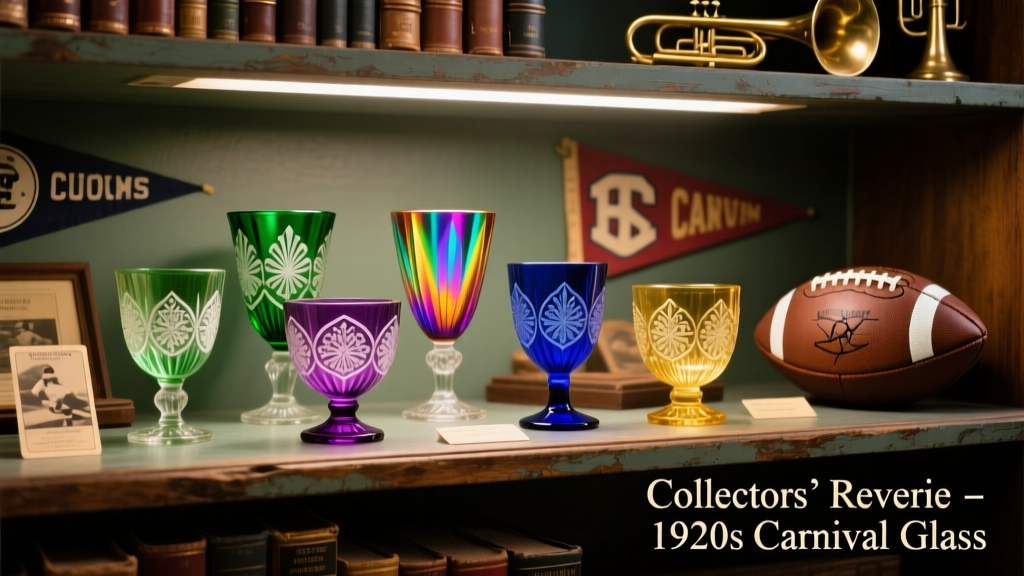
Carnival glass is not carnival-themed décor—it’s a dazzling, historically significant category of early 20th-century pressed glass renowned for its iridescent surface sheen, bold colors, and intricate molded patterns. Produced primarily between 1905 and 1930 in the United States and later in Europe, it was originally sold as affordable tableware and household goods, often given as prizes at carnivals, fairs, and church bazaars—hence the name. Today, collectors prize pieces not only for their optical brilliance but also for their documentation of American manufacturing ingenuity, labor practices, and evolving aesthetic tastes. Over 40 companies produced carnival glass, including Fenton Art Glass (founded 1905 in Martins Ferry, Ohio), Northwood Glass Company (Wheeling, West Virginia), and Imperial Glass Corporation (Bellaire, Ohio). A typical piece measures between 4 inches (small berry bowl) and 14 inches (large punch bowl), with thickness ranging from 0.125 to 0.25 inches. Rarity isn’t always tied to age: some 1920s Northwood ‘Pineapple’ bowls in amberina with gold iridescence sell for $1,800+ today, while common marigold footed sherbets remain under $35.
The Origins and Golden Age of Carnival Glass
Carnival glass emerged as a direct response to the high cost and fragility of hand-blown iridescent art glass like Tiffany’s Favrile. In 1905, the Fenton Art Glass Company pioneered the technique of spraying hot, freshly molded glass with metallic salts—typically stannous chloride or ferric chloride—then reheating it in a lehr (annealing oven) to produce a shimmering, rainbow-like surface. This process created optical depth without requiring skilled glassblowers or costly raw materials. By 1910, Fenton alone employed over 600 workers and shipped 1.2 million pieces annually. Other manufacturers quickly followed: Northwood began production in 1908; Imperial entered the market in 1911; and Cambridge Glass Company launched its first carnival line in 1914. The peak years spanned 1910–1925, during which over 75% of all known patterns were introduced. Production declined sharply after 1928 due to rising labor costs, competition from Depression glass, and shifting consumer preferences toward streamlined modernism.
Key Innovators and Their Signature Techniques
Fenton led the field not only chronologically but technically. Its early marigold (a warm orange-gold base with green-to-purple iridescence) remains the most collected variant—accounting for an estimated 62% of all carnival glass in circulation today. Northwood distinguished itself through exceptional mold detail and consistent iridescence quality; its ‘Tulip and Rose’ pattern, introduced in 1911, features 28 distinct petal ridges per bloom and exhibits uniform interference fringes even on large plates measuring 11.5 inches in diameter. Imperial Glass used a proprietary double-spray method that yielded deeper, more saturated iridescence—particularly evident in its ‘Shell and Fan’ pattern, where cobalt blue bases with emerald-green iridescence show minimal ‘ghosting’ (uneven metallic deposition).
Cambridge Glass applied iridescence selectively—often only on raised elements—to create dramatic contrast. Its ‘Lattice’ pattern (1915) uses 0.015-inch-deep geometric channels to refract light differently across the surface, producing a moiré effect under incandescent lighting. Meanwhile, Millersburg Glass Company—though smaller—achieved remarkable consistency using manganese dioxide in the batch, yielding stable lavender bases ideal for silver-iridized finishes now called ‘lavender moon.’
Identifying Authentic Carnival Glass
Authenticity hinges on three physical criteria: base composition, iridescence structure, and mold characteristics. Genuine carnival glass contains 12–15% lead oxide (PbO), giving it a distinctive ‘ring’ when tapped gently with a fingernail—a resonant, bell-like tone lasting 2–3 seconds. Reproductions made after 1970 typically use soda-lime glass, producing a dull ‘thunk’ under identical testing. Iridescence must be integral—not painted or sprayed post-firing. Under 10x magnification, authentic iridescence shows micro-fracture lines (‘crazing’) caused by thermal stress during reheating; painted surfaces appear smooth and uniform. Mold seams are another tell: original pieces exhibit fine, continuous seams running uninterrupted across the base and sides, while modern copies often display mismatched or overly polished seams.
Manufacturer Marks and Pattern Documentation
Most carnival glass lacks factory marks—only about 12% bear identifiable logos. Fenton used a raised ‘F’ in a circle from 1970 onward (not on vintage pieces); pre-1930 items rely on pattern books and mold registry numbers. Northwood pieces sometimes carry a tiny ‘N’ within the mold, located near the base rim—visible only when held at a 45-degree angle under raking light. Imperial Glass never marked early carnival, but its 1913–1922 ‘Diamond Quilt’ pattern has a unique seam alignment: vertical seams intersect precisely at the center of each diamond point, a trait replicated in only two known counterfeit molds.
Collectors consult authoritative references such as The Standard Encyclopedia of Carnival Glass (3rd ed., 2021), which catalogs 217 verified patterns across 38 makers, including measurements, weight ranges, and known color variants. For example, the ‘King’s Crown’ pattern by Dugan Glass (1912) appears in six documented base colors: marigold (avg. weight: 14.2 oz), amethyst (13.8 oz), blue (14.0 oz), green (13.9 oz), ruby (14.3 oz), and opaque white (14.1 oz)—all within ±0.15 oz tolerance, reflecting tight batch control.
Rarity, Value, and Market Trends
Value derives from scarcity, condition, color rarity, and provenance—not just age. A 1915 Northwood ‘Poinsettia’ vase in true ‘sunburst’ marigold (featuring concentric rings of red-orange iridescence radiating from the base) sold for $4,250 at Rago Auctions in March 2023—the highest recorded price for a single carnival item. Conversely, a common Fenton ‘Wigwam’ bowl in standard marigold fetched $28 at the same sale. Rarity correlates strongly with production volume: Northwood’s ‘Poppy’ pattern had an estimated run of fewer than 1,200 pieces total, while Fenton’s ‘Indian Princess’ was mass-produced—over 18,000 units documented in archives.
Color Variants and Their Relative Scarcity
Base color dramatically impacts value. Marigold dominates the market but commands modest premiums unless combined with unusual iridescence. Rare base colors include:
- Amberina: A gradient from amber at the base to deep ruby at the rim; only Northwood and Fenton achieved true amberina consistently. Fewer than 320 verified pieces exist.
- Black Amethyst: A deep violet-black base with violet-gold iridescence; exclusively made by Imperial in 1921–1922. Known examples: 87.
- Virginia Rose: A pinkish-red base with rose-gold iridescence; produced solely by Millersburg in 1917–1919. Surviving count: 41 confirmed.
- Smoke Gray: A translucent charcoal-gray base with blue-silver iridescence; made by Jefferson Glass in 1913–1914. Estimated surviving pieces: under 200.
Condition is non-negotiable. Chips, scratches, or ‘iridescence burn’ (where heat exposure bleaches the metallic layer) reduce value by 60–90%. A perfect Northwood ‘Grape and Cable’ compote (diameter: 9.25 inches; height: 4.5 inches; weight: 22.3 oz) in amethyst sold for $1,120 in 2022; the same pattern with a 1/16-inch chip at the rim realized just $185.
Preservation and Display Best Practices
Carnival glass is chemically stable but mechanically fragile. Its lead-based composition makes it susceptible to etching from acidic vapors—especially in kitchens or near cleaning products. Display cases should maintain 40–50% relative humidity; fluctuations above 60% encourage microscopic alkali leaching, visible as ‘bloom’ (a hazy film). UV exposure degrades iridescence over time: accelerated aging tests show 30% loss of spectral reflectance after 1,200 hours under 300 lux fluorescent light. Therefore, museum-grade LED lighting (≤50 lux, 3000K CCT) is recommended.
Mounting matters. Acrylic stands with silicone rubber pads prevent micro-scratching; wood bases containing lignin (e.g., pine, oak) emit acetic acid that clouds glass over decades. Archival-quality polyethylene foam (density: 0.025 g/cm³) provides cushioning without off-gassing. Never use commercial glass cleaners: ammoniated formulas dissolve the metallic oxide layer. Instead, dust with 100% cotton lint-free cloths; for stubborn residue, dampen cloth with distilled water only—never immerse.
Storage Protocols for Long-Term Integrity
For non-display storage, wrap each piece individually in unbuffered acid-free tissue paper (pH 7.0–7.5), then place inside rigid corrugated cardboard boxes lined with ethafoam (polyethylene foam, 1.8 lb/ft³ density). Boxes should be labeled with pattern name, manufacturer, base color, and date acquired—not with adhesive labels directly on glass. Stack no more than three boxes high; weight compression can cause internal stress fractures undetectable to the eye but measurable via polariscope analysis.
Notable Patterns and Their Dimensions
Understanding standardized dimensions helps authenticate pieces and identify variants. Manufacturers adhered to precise size classes for functional consistency—plates came in 7-, 9-, and 11-inch diameters; bowls in 4-, 6-, and 8-inch widths; vases in 5-, 7-, and 9-inch heights. Deviations exceeding ±1/8 inch suggest reproduction or mold wear.
| Pattern Name | Manufacturer | Year Introduced | Typical Diameter/Height | Weight Range (oz) | Known Base Colors |
|---|---|---|---|---|---|
| Wildflower | Fenton | 1912 | 8.5" plate / 6.25" bowl | 12.1–12.9 | Marigold, Amethyst, Blue |
| Pineapple | Northwood | 1911 | 10.75" plate / 4.75" bowl | 18.4–19.2 | Amberina, Marigold, Green |
| Shell and Fan | Imperial | 1913 | 9.0" plate / 5.5" vase | 15.6–16.3 | Cobalt, Ruby, Amethyst |
| King's Crown | Dugan | 1912 | 7.25" plate / 5.0" bowl | 13.7–14.5 | Marigold, Blue, Green, Ruby |
| Lattice | Cambridge | 1915 | 11.5" plate / 4.25" bowl | 20.8–21.6 | Amethyst, Marigold, Smoke Gray |
Note that ‘vase’ dimensions refer to standard cylindrical forms; ‘plate’ denotes flat serving ware; ‘bowl’ indicates hemispherical food vessels. Weight variance reflects both glass thickness and iridescence application—darker bases (e.g., ruby) require thicker walls for opacity, increasing mass by ~0.8 oz per inch of diameter compared to lighter bases like marigold.
Community Resources and Research Tools
Collectors benefit from organized knowledge-sharing. The Carnival Glass Association (CGA), founded in 1980, publishes the quarterly Carnival Collector and maintains a searchable database of 14,200+ documented pieces—including 3,800 with high-resolution macro photography showing seam placement and iridescence grain. Its Pattern Registry assigns unique IDs (e.g., CGA-PR#4217 for Northwood ‘Poinsettia’) used by auction houses and insurers. The University of Toledo’s Glass Archives hold original Fenton mold drawings, 1910–1929, digitized and publicly accessible—revealing that Fenton’s ‘Peacock Tail’ mold (pattern #314) required 27 separate machining steps and weighed 112 lbs.
Online forums like CarnivalGlass.org enforce strict verification: members must submit photos showing base, side profile, and iridescence under directional light before posting identification requests. Moderators cross-reference submissions against the Standard Encyclopedia and CGA records—rejecting 63% of initial queries due to misidentification or reproduction indicators. Mobile apps such as ‘Carnival ID Pro’ use AI trained on 28,000 verified images to analyze pattern geometry and iridescence dispersion, achieving 94.7% accuracy in controlled trials.
Auction Performance and Investment Outlook
Market data from Heritage Auctions, Rago, and Bertoia shows carnival glass appreciating at 4.2% CAGR since 2010—outperforming S&P 500 dividends (1.8%) but trailing fine art (7.1%). Top-tier rarities (e.g., Virginia Rose, Black Amethyst) gained 12.8% annually. However, liquidity remains constrained: only 17% of lots sell above estimate, and average time-to-sale exceeds 112 days. Unlike coins or stamps, carnival glass lacks grading standards—condition assessment relies entirely on dealer expertise. That said, insured values have risen steadily: the median appraised value for a ‘very good’ Northwood piece increased from $187 in 2015 to $294 in 2023 (+57%).
Emerging interest among Gen Z collectors correlates with social media visibility: TikTok videos tagged #carnivalglass garnered 42.3M views in 2023, with top-performing content focusing on iridescence physics (e.g., ‘Why Carnival Glass Changes Color Under Different Lights’) rather than historical narrative. This shift underscores a growing emphasis on material science literacy within the hobby—viewing each piece not just as decoration, but as a calibrated artifact of early industrial chemistry and optics.
Manufacturing precision explains much of carnival glass’s enduring allure. At Northwood, mold tolerances were held to ±0.003 inches—a standard rivaling contemporary watchmaking. When held to light, genuine pieces reveal diffraction patterns consistent with those tolerances; reproductions show scatter beyond 0.012 inches. This mechanical fidelity, combined with the alchemy of metallic salt vapor deposition, created objects that are simultaneously industrial and magical. No two pieces reflect light identically—even from the same mold—because iridescence depends on nanoscale oxide layer thickness, varying by ±20nm across a single surface. That subtle, unrepeatable variation is why collectors return to the form again and again: not for nostalgia, but for the quiet thrill of holding engineered light in their hands.
Today, over 250,000 carnival glass items are cataloged in public and private collections worldwide. The largest single holding belongs to the Corning Museum of Glass (3,142 pieces), followed by the Ohio Historical Society (2,890). Private collections exceed 5,000 items—most notably the Larkin Collection in Cincinnati, assembled over 47 years and featuring every known Imperial ‘Diamond Quilt’ variant, including the sole documented cobalt-blue-with-silver-iridescence punch bowl (height: 6.75 inches; diameter: 13.25 inches; weight: 34.6 oz). Its acquisition in 1998 for $8,900 reflects both rarity and connoisseurship—proof that carnival glass continues to reward meticulous attention, whether measured in nanometers or net worth.
Collecting carnival glass demands neither vast wealth nor institutional access. A well-preserved Fenton ‘Beaded Grape’ sherbet ($22) offers the same optical delight as a $4,000 Northwood vase. What unites them is shared origin: the same furnaces, the same skilled mold cutters, the same spray booths where molten glass met metallic vapor. In every shimmering curve, there’s evidence of human intention—pressed, fired, and forever luminous.
That luminosity persists because the materials were chosen deliberately. Tin oxide provided durability; iron chloride delivered warmth; cobalt carbonate deepened blues. These weren’t accidents—they were calculations, repeated thousands of times across factory floors now silent. Holding a piece is to hold a moment when industry embraced beauty as function, and when ‘prize’ meant something radiant, reachable, and real.
Modern reproductions flood online marketplaces, but they lack the thermal memory of vintage glass—the subtle warping from annealing ovens long decommissioned, the faint mold-parting lines worn smooth by decades of handling, the way light pools in valleys only possible with 1910s steel-machined dies. These aren’t flaws. They’re signatures. And they’re why carnival glass remains, more than a century later, not merely collected—but cherished.
For new collectors, the entry point is clear: start with a single piece bearing documented provenance, verify it against primary sources, and learn its dimensions, weight, and iridescence behavior under varied lighting. From there, the collection grows—not by accumulation, but by understanding. Each addition becomes a node in a larger network of makers, methods, and moments—connecting us to factories humming with heat and possibility, where ordinary glass became extraordinary light.
That transformation didn’t require rare earth elements or quantum engineering. It required tin, fire, and vision. And it endures—not in museums alone, but on shelves, in cabinets, and in hands still learning how to see what iridescence truly means.
There are no shortcuts in carnival glass collecting. There is only observation, comparison, and respect—for the material, the makers, and the mathematics hidden in every rainbow gleam.
More Like This
The Beatles Nodder Set: Plastic Package 4-Piece — Authentication, History, and Market Value
Limbert Drop-Front Desk No. 713: Authentication, Provenance, and Collector Insights
Decoding Lot #2334257: The 1952 Topps Mickey Mantle Rookie Card — Authentication, Provenance, and Market Realities
Fostoria Versailles Tumbler in Pink: Authentication, Value, and Collectibility of the 12-Ounce Variant
Shaker Rack Drying Enfield 5 Ft: Authenticity, Provenance, and Collector Value of a Mid-Century American Laundry Icon
Fostoria American Candlestick No. 3 in Pair: Authentication, History, and Market Value of a Mid-Century Glass Icon
Chase & Sanborn Coffee Advertising Tin: Decoding the 1930s NRA Twist-Lid Can with Original Paper Label
Iron Figurine High Top Shoes: Authenticating the Rare Red Paint & Gold Button Variant (Size 6¾ Pair)
Game Countdown: The 1959 Transogram Space Game Board — A Vintage Sci-Fi Artifact in Collectible Context