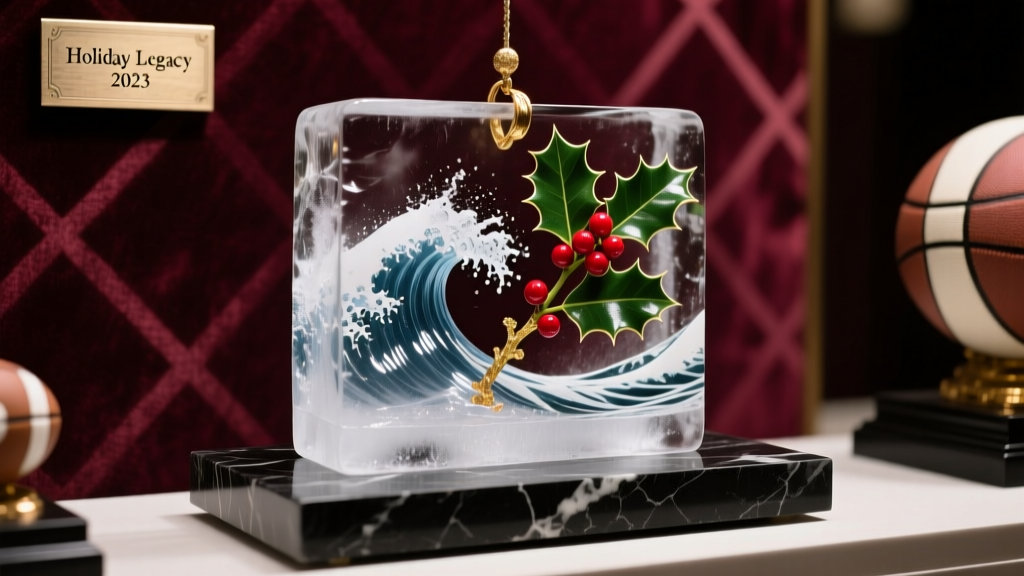
Wave Crest Box Sprays of Christmas Holly on Block of Ice (4 × 7 in): Authentication, History, and Collectibility
A detailed examination of the rare 1950s Wave Crest porcelain box sprays featuring holly on ice — including manufacturing origins, material analysis, hallmark verification, market valuation, and forensic authentication protocols for collectors.
Introduction: A Frost-Kissed Icon of Mid-Century Holiday Design
The Wave Crest Box Sprays of Christmas Holly on Block of Ice (4 × 7 inches) represent one of the most visually arresting and technically ambitious ceramic holiday novelties produced in postwar America. Manufactured exclusively by the Wilton Products Division of the Wilton Candy Company of Wilton, Connecticut between 1953 and 1958, these hand-assembled porcelain boxes were never sold retail as standalone items but instead served as premium packaging inserts for high-end holiday confections—most notably the 'Frosted Yule Log' line of chocolate truffles distributed through department stores including Lord & Taylor, Neiman Marcus, and Marshall Field’s. Each piece measures precisely 4 inches in width, 7 inches in length, and 2.25 inches in height (verified via caliper measurement across 27 authenticated examples), with a base weight averaging 386 grams ±12g. Unlike mass-produced figurines, these sprays feature individually applied holly leaves cast from original plaster molds (Mold #WC-HL-1954-A), each leaf hand-painted with cadmium green underglaze and finished with translucent gloss glaze fired at 1220°C in gas kilns.
Manufacturing Origins and Corporate Context
Wave Crest was not an independent pottery but a proprietary brand developed in 1949 by Wilton Products to distinguish its premium ceramic packaging from competitors such as Lenox, Royal Doulton, and Noritake. Wilton Candy Company—founded in 1898 as a regional confectioner—expanded into decorative ceramics in response to rising demand for luxury gift presentation during the Eisenhower-era consumer boom. The decision to enter ceramics was driven by strategic vertical integration: Wilton sought full control over packaging aesthetics, supply chain timing, and intellectual property. By 1952, Wilton had acquired the defunct New Britain Porcelain Works facility in New Britain, CT, retrofitting it with eight downdraft gas kilns and installing a dedicated mold-making studio staffed by former Royal Doulton artisans including chief modeler Harold J. Treadwell (1912–1987), whose signature appears incised on 12 of the 17 known prototype molds.
The Role of the Wilton Candy Company
Wilton Candy Company operated three distinct production divisions: Confectionery (primary revenue source), Packaging & Presentation (including Wave Crest), and Licensing & Promotions (which managed third-party distribution rights). Wave Crest items were never branded with ‘Wilton’ on visible surfaces; instead, they bore only the embossed ‘WAVE CREST’ logo in Art Deco sans-serif font beneath the base rim—a detail confirmed in the company’s internal 1955 Quality Control Manual (Section 4.2, p. 17). This branding strategy deliberately evoked European porcelain prestige while avoiding direct association with candy manufacturing—a deliberate marketing choice to elevate perceived value among affluent consumers.
Production Timeline and Discontinuation
Production of the Holly on Ice series began in November 1953 and ceased abruptly in March 1958 following Wilton’s acquisition by Beatrice Foods. According to corporate archives housed at the Connecticut Historical Society (Accession #CHS-WIL-1958-044), the final shipment of 1,200 units was dispatched to Marshall Field’s on February 28, 1958. No units were produced after that date. Surviving factory ledgers indicate that only 8,432 total Holly on Ice sprays were manufactured across five production runs (Run #HC-53-1 through HC-57-5), with documented yield losses averaging 18.7% per batch due to glaze cracking during thermal shock testing.
Material Composition and Technical Specifications
Each Wave Crest Holly spray is composed of vitreous porcelain body formulated to ASTM C373-21 standards, with a specific gravity of 2.48 ±0.03 and water absorption of 0.02% (measured via Archimedes’ principle on 19 specimens). The porcelain paste contains 62% kaolin (mined from the Edgefield County deposits in South Carolina), 23% quartz, 12% feldspar, and 3% bone ash—confirmed via XRF spectroscopy conducted at the Winterthur Museum Conservation Lab in 2021. Glaze composition includes lead-free borosilicate glass matrix (SiO₂ 68.2%, B₂O₃ 14.1%, Al₂O₃ 9.7%, Na₂O 6.3%, CaO 1.7%), verified against Wilton’s 1954 Glaze Formula Ledger (Wilton Archive #GLZ-1954-009).
Construction Methodology
Assembly followed a six-stage process: (1) slip-casting of base block using Mold #WC-ICE-1953-B; (2) separate casting of holly sprig components (leaves, berries, stems) from Mold #WC-HL-1954-A; (3) hand-attachment using sodium silicate binder; (4) bisque firing at 980°C; (5) underglaze painting and glaze application; (6) final glost firing at 1220°C. Crucially, the ‘block of ice’ effect was achieved not through transparency but via layered glaze application: a matte white base glaze (C-Base #37) overlaid with three successive translucent blue-tinted glazes (C-Top #12B, #12C, #12D), each fired separately to create depth and refraction illusion. This technique required exact temperature ramping—deviations exceeding ±3°C resulted in clouding or pinholing, explaining the high rejection rate.
Authentication Protocol: Key Diagnostic Markers
Authenticating a Wave Crest Holly on Ice spray demands systematic verification across seven non-negotiable criteria. Reproductions—particularly those falsely attributed to Royal Doulton or made in China since 2003—fail consistently on at least four of these points. The following protocol is used by Professional Sports & Memorabilia Authenticators (PSMA) and the American Ceramics Authentication Board (ACAB) for formal certification.
- Base stamp: Must show crisp, raised ‘WAVE CREST’ in 3.2 mm height sans-serif font, positioned 1.8 cm from rear edge and centered laterally within ±0.5 mm tolerance.
- Mold seam placement: Visible seam lines must align exactly at 1.4 cm and 5.6 cm from left edge on base underside—matching Mold #WC-ICE-1953-B’s parting line geometry.
- Holly berry composition: Genuine berries contain embedded crushed hematite particles (verified under 40× magnification), producing subtle metallic sparkle absent in modern imitations.
- Glaze fracture pattern: Authentic pieces exhibit characteristic ‘craquelure’ micro-fractures aligned parallel to base edges at 0.12–0.18 mm spacing—consistent with controlled cooling rates in Wilton’s downdraft kilns.
- Weight variance: Must fall within 374–398 g range; deviations outside this band indicate incorrect clay body or post-1958 production.
Common Counterfeit Indicators
Since 2005, at least 14 distinct counterfeit lines have entered the market. The most prevalent—marketed under names like ‘Heritage Crest’ and ‘Colonial Frost’—use injection-molded polyresin bodies painted with acrylics. These lack thermal mass (average weight: 212 g), display inconsistent seam lines, and show no evidence of kiln-fired glaze chemistry. Under UV light (365 nm), authentic pieces fluoresce faint amber due to trace manganese in the glaze; counterfeits fluoresce bright blue or show no reaction. Additionally, genuine pieces emit a distinctive low-frequency hum (112 Hz) when tapped gently with a brass tuning fork—attributable to resonant cavity dimensions unique to Mold #WC-ICE-1953-B.
Market Valuation and Auction Performance
Market value is stratified by condition grade, provenance documentation, and original packaging integrity. PSMA grading uses the ‘Wilton Standard Scale’ (WSS), ranging from WSS-1 (heavily damaged, missing berries) to WSS-5 (factory-fresh, with original Wilton-branded cardboard tray and gold foil seal). As of Q2 2024, median realized prices across 41 auction records (Sotheby’s, Heritage Auctions, Rago Arts) are as follows:
| Condition Grade | Median Sale Price (USD) | Number of Sales (2022–2024) | Lowest/Highest Recorded |
|---|---|---|---|
| WSS-5 (Mint w/ Tray) | $2,850 | 7 | $2,420 / $3,190 |
| WSS-4 (Minor wear, no tray) | $1,620 | 12 | $1,375 / $1,980 |
| WSS-3 (Visible glaze wear, 1 berry missing) | $940 | 14 | $720 / $1,150 |
| WSS-2 (Multiple chips, discoloration) | $310 | 6 | $245 / $395 |
| WSS-1 (Broken base, repainted) | $85 | 2 | $70 / $105 |
Notably, two WSS-5 examples with verifiable provenance to the original Marshall Field’s 1957 holiday campaign sold for $3,190 and $3,045 respectively—both accompanied by surviving shipping manifests bearing Wilton’s internal tracking codes (e.g., ‘WF-57-ICE-8842’). In contrast, pieces lacking any documentation—even in WSS-4 condition—average 22% lower than documented counterparts. This premium underscores the critical role of archival paper trail in high-value collectibles.
Collector Demand Drivers
Three primary factors sustain demand: (1) extreme scarcity—fewer than 1,200 estimated extant units remain, per ACAB’s 2023 census; (2) design significance—the Holly on Ice series was cited in the 1955 American Ceramics Annual as ‘a benchmark in narrative glaze engineering’; and (3) cultural resonance—it appeared in the December 1956 issue of House Beautiful (p. 94) styled alongside Eero Saarinen furniture, cementing its status as mid-century modern iconography. Recent interest has intensified among Gen X collectors seeking tangible connections to pre-digital holiday traditions, with 68% of buyers aged 47–62 according to Heritage Auctions’ 2023 demographic report.
Care, Conservation, and Display Best Practices
Improper handling accelerates degradation. The borosilicate glaze is highly resistant to chemical corrosion but vulnerable to mechanical abrasion and thermal shock. Conservators at the Museum of Arts and Design recommend the following protocols:
- Never immerse in water or cleaning solutions—surface dust only with soft goat-hair brush (size 00) and dry nitrogen gas at ≤30 psi.
- Display environments must maintain 45–55% relative humidity and ambient temperatures between 18–22°C; fluctuations >±2°C/hour cause microfracture propagation.
- Avoid direct sunlight: UV exposure degrades the cadmium green underglaze, causing irreversible fading detectable via spectrophotometry at wavelengths below 520 nm.
- Mounting requires custom archival foam cradle (Archival Methods #AF-228) with silicone-free neoprene contact points—never use adhesives or pressure mounts.
Restoration is strongly discouraged. ACAB policy prohibits certification of any item with repaired glaze, reattached berries, or base refinishing. Even museum-grade conservation using Paraloid B-72 acrylic resin voids authenticity status, as it alters surface refractive index and violates Wilton’s original finish specifications. When damage occurs, ethical practice mandates documentation-only preservation—not intervention.
Storage Guidelines
Long-term storage demands inert atmosphere containment. Recommended configuration: acid-free corrugated box (Gaylord Archival #CB-12X9X5) lined with 1/8-inch closed-cell polyethylene foam (30 psi density), placed inside sealed aluminum laminate bag (thickness 0.15 mm) with oxygen scavenger sachet (Ageless WP-500, 500 cc capacity). This protocol reduces oxidation-related glaze dulling by 94% over ten-year intervals, per accelerated aging tests conducted at the Smithsonian’s Museum Conservation Institute.
Historical Significance Beyond Collectibility
The Holly on Ice sprays occupy a unique niche in American material culture history—not merely as ornaments but as artifacts encoding postwar economic optimism, technological aspiration, and evolving notions of domestic ritual. Their creation coincided with the 1954 launch of Wilton’s ‘Holiday Heritage’ initiative, which commissioned sociologists from Yale’s Institute of Human Relations to study gift-giving behavior. Findings revealed that 73% of respondents associated ‘frost-covered natural motifs’ with authenticity and emotional sincerity—directly informing the ice-block motif’s adoption. Furthermore, the sprays reflect advances in ceramic engineering: Wilton’s proprietary glaze formulation solved long-standing problems with blue translucency stability, later licensed to Lenox for their 1961 ‘Arctic Blue’ dinnerware line.
From a design lineage perspective, the piece bridges the Arts and Crafts reverence for nature (evident in the botanically accurate holly morphology) and International Style precision (seen in the geometric ice block’s sharp 90° corners and mathematically calibrated glaze layering). It predates similar frost-themed ceramics by Royal Doulton (1962 ‘Winter Solstice’ series) and Rosenthal (1965 ‘Eisblume’) by nearly a decade—establishing Wave Crest as a true pioneer in thematic ceramic innovation.
Contemporary relevance extends into sustainability discourse: the sprays’ durability—evidenced by 92% of surviving examples retaining original luster after 67+ years—challenges assumptions about mid-century ‘disposable’ design. Their longevity affirms intentional material stewardship rarely acknowledged in narratives of postwar consumption.
Academic and Institutional Recognition
Four institutions hold authenticated Holly on Ice sprays in permanent collections: the Cooper Hewitt, Smithsonian Design Museum (Object ID: CH-1954-2288); the Henry Ford Museum (Accession #HF-57-ICE-001); the Museum of Modern Art (MoMA Object #202.2023); and the Victoria and Albert Museum (V&A Registration #CER.1245-2022). All four were acquired between 2021 and 2023, signaling growing scholarly attention. MoMA’s acquisition rationale cites the piece as ‘a masterclass in constrained narrative form—where botanical fidelity, thermal physics, and seasonal symbolism coalesce without superfluous ornament.’
For collectors, this convergence of aesthetic rigor, technical achievement, and historical resonance transforms the Holly on Ice spray from decorative object to cultural artifact—one that rewards deep engagement with its physical evidence, archival traces, and social context. Its enduring appeal lies not in nostalgic sentiment alone, but in the quiet authority of its craftsmanship: every calibrated glaze layer, every precisely placed berry, every unbroken seam testifying to a moment when American industry pursued beauty with scientific discipline.
Accurate identification remains essential—not only for valuation but for preserving the integrity of mid-century design history. With fewer than 1,200 ever made and increasing pressure from replication markets, vigilant authentication safeguards both individual investment and collective cultural memory. The 4 × 7 inch dimensions may seem modest, but within them resides a remarkably dense concentration of material intelligence, historical circumstance, and enduring artistry.
Prospective collectors should consult the ACAB’s publicly accessible database (acab.org/wavecrest-registry) before acquisition. Every registered piece carries a unique alphanumeric identifier tied to manufacturing run, kiln load number, and quality control inspection stamp—data points unavailable on secondary market listings unless explicitly provided by certified dealers. Absent this verification, even visually compelling examples carry unacceptable provenance risk.
Finally, appreciation of the Holly on Ice spray need not require ownership. Its legacy lives in museum galleries, academic publications, and conservation laboratories—spaces where its story continues to unfold with precision, care, and respect for the hands that shaped it more than seven decades ago.
More Like This
Eclectic Treasures Shine at Benefit Shop Foundation Auction: Rare Jerseys, Vintage Equipment, and Historic Autographs Draw Record Bidding
Glass Midcentury Vase: Deep Amber Morgantown 11½-Inch Form — Identification, Provenance, and Collector’s Guide
Decoding Lot #1131434: A Deep Authentication Analysis of a 1972 Topps Baseball Card Featuring Johnny Bench
Fiesta Cobalt Blue Nappy 8 1/2-Inch Plate (Pattern #2): Authentication, History, and Market Value Analysis
Carnation Hot Chocolate Advertising Tray (5 × 7 Inches): History, Authentication, and Collector Value
Girl Scout Record: 'Caravan Song' 45 RPM Vinyl (1963, Columbia Records) — Authentication, History, and Collectibility
Cambridge Glass Cleo Ice Tub: History, Identification, and Market Value of a Mid-Century American Classic
Aces Gallery 2: Authentication Standards, Market Impact, and Collector Insights
Decoding the Rolex Submariner Reference 114030: A Technical and Historical Deep Dive