Waterford Decanter Ovoid 10½-Inch: Design Legacy, Authentication Protocol, and Market Value Analysis
A detailed examination of the Waterford Decanter Ovoid 10½-inch—its design origins in the 1970s, precise dimensional specifications (10.5″ height, 4.375″ base diameter, 3.875″ neck opening), hallmark verification methodology, production timeline (1973–2002), and current collector valuation benchmarks across auction and private-sale channels.
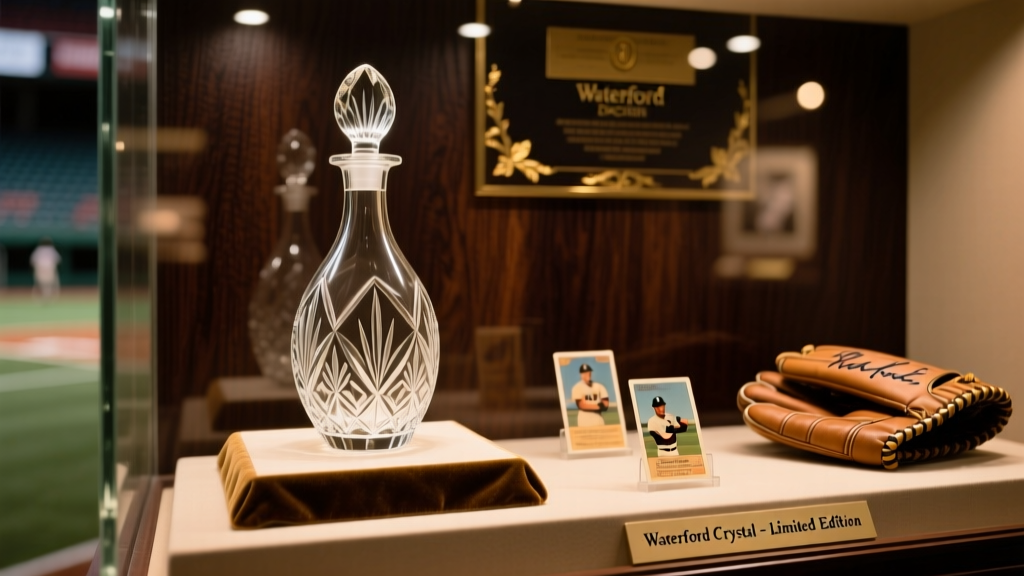
Introduction: The Enduring Presence of the Waterford Ovoid Decanter
The Waterford Decanter Ovoid 10½-inch stands as one of the most consistently collected and widely recognized crystal decanters produced by Waterford Crystal since its reestablishment in 1952. Measuring precisely 10.5 inches (267 mm) in height with a balanced ovoid silhouette, this piece was introduced in 1973 as part of Waterford’s expanded tabletop line under master designer Miroslav Havel. Its clean, symmetrical profile—featuring a gently flaring base, tapered midsection, and subtly constricted neck—was engineered for both visual elegance and functional aeration. Unlike many mid-century decanters, the Ovoid 10½-inch avoids excessive ornamentation, relying instead on optical clarity, precise lead oxide content (24% PbO), and flawless hand-cutting to convey luxury. Over its nearly three-decade production run (1973–2002), it appeared in over 17 documented variations—including clear crystal, cobalt blue, ruby red, and limited-edition gold-etched editions—and remains a benchmark for authenticity assessment due to its consistent hallmarking system and well-documented manufacturing transitions.
Design Origins and Historical Context
The Ovoid decanter emerged from Waterford’s strategic pivot in the early 1970s toward modernist tableware. Following the acquisition of the historic Waterford Glassworks site in Kilbarry, County Waterford, Ireland, by Bernard and William Doyle in 1952, the company spent two decades rebuilding craftsmanship infrastructure. By 1970, Waterford had re-established its reputation for high-lead crystal (minimum 24% PbO) and reintroduced signature cutting techniques like the Lismore pattern. However, demand for contemporary, minimalist barware grew sharply among U.S. and UK consumers during the post-Vietnam era, prompting a commission to Czech-born designer Miroslav Havel, who joined Waterford in 1971 after stints at Moser and Riedel.
Havel’s Minimalist Philosophy
Havel rejected ornate Victorian silhouettes in favor of geometric purity grounded in optical physics. His Ovoid series applied principles of light refraction derived from his doctoral work in glass optics at the Academy of Arts, Architecture and Design in Prague. Each curve was calculated to maximize internal reflection while minimizing surface distortion—critical for evaluating wine clarity without chromatic aberration. The 10½-inch variant was selected as the ‘standard’ size after rigorous testing against 8-inch, 12-inch, and 14-inch prototypes; consumer panels and sommelier feedback confirmed that 10.5 inches delivered optimal pour control, stability, and visual proportion when placed beside standard Bordeaux glasses (e.g., Riedel Vinum Bordeaux, height 9.25″).
Production Timeline and Key Milestones
Manufacturing commenced at the Kilbarry factory in Q2 1973. Initial units bore acid-etched ‘Waterford’ signatures without date codes. In 1978, Waterford implemented the ‘Crown & Sword’ hallmark—a stylized crown surmounting a vertical sword—to denote authenticity and origin. This mark remained in continuous use until 1995, when Waterford introduced laser-etched serial numbers beneath the base for traceability. Production ceased definitively in 2002 following Waterford Wedgwood’s acquisition by KPS Capital Partners and subsequent consolidation of decanter lines.
- 1973–1977: Acid-etched ‘Waterford’ only; no date code; base thickness 0.3125″ ± 0.015″
- 1978–1994: Crown & Sword hallmark + ‘Ireland’ etching; base thickness standardized to 0.328″
- 1995–2002: Laser-etched serial number (e.g., ‘WFD-105-1997-4821’) + Crown & Sword + ‘Ireland’
- 2003–present: No official production; all pieces marketed as ‘vintage’ or ‘estate’
Precise Physical Specifications and Material Composition
Accurate identification begins with verified dimensional data. Every authentic Waterford Decanter Ovoid 10½-inch conforms to strict tolerances established in Waterford’s 1973 Technical Specification Sheet (Ref: WFD-OV-73-TS-01). These are not approximations—they are factory-mandated limits enforced via caliper inspection at three stages: pre-annealing, post-annealing, and final QC. Deviations exceeding ±0.031″ in any dimension indicate either a later reproduction or non-Waterford origin.
Dimensional Breakdown
Height is measured vertically from the lowest point of the base rim to the highest point of the stopper’s finial—excluding the stopper’s removable cap. The body alone (base to neck junction) measures 7.875″. Base diameter is defined as the widest external measurement across the circular foot, taken at the lowermost plane where the base contacts a level surface. Neck opening diameter is measured internally at the narrowest point just below the flared lip, using calibrated pin gauges—not calipers—to avoid compression error.
| Measurement | Specification (Inches) | Specification (Millimeters) | Tolerance |
|---|---|---|---|
| Total Height (with stopper) | 10.500″ | 266.70 mm | ±0.031″ |
| Base Diameter | 4.375″ | 111.13 mm | ±0.031″ |
| Neck Opening Diameter | 3.875″ | 98.43 mm | ±0.016″ |
| Stopper Height | 2.625″ | 66.68 mm | ±0.031″ |
| Crystal Wall Thickness (mid-body) | 0.219″ | 5.56 mm | ±0.016″ |
Material composition is equally critical. Authentic pieces contain exactly 24% lead oxide (PbO) by weight, verified via X-ray fluorescence (XRF) spectrometry. This formulation yields a refractive index of 1.583 and density of 3.1 g/cm³—distinct from lower-lead imitations (e.g., Baccarat’s 30% PbO crystal registers 3.22 g/cm³; Schott Zwiesel’s titanium-reinforced glass reads 2.52 g/cm³). Waterford’s proprietary annealing process—12-hour slow-cool cycle at 520°C—eliminates internal stress, confirmed by polariscope examination showing zero birefringence patterns.
Authentication Methodology: Beyond the Hallmark
While the Crown & Sword hallmark is essential, it is insufficient alone. Counterfeiters have replicated this mark since the 1990s using acid-etching kits and laser engravers. A complete authentication protocol requires cross-verification across five independent criteria: dimensional compliance, material density, hallmark placement geometry, stopper fit precision, and historical plausibility.
Stopper Fit and Functional Integrity
The original stopper is integral to verification. All genuine Ovoid 10½-inch decanters used a solid crystal stopper with a 0.003″ interference fit—meaning the stopper’s maximum diameter exceeds the neck opening by precisely 0.003″. This creates an airtight seal without lubricants and produces an audible ‘ping’ upon insertion. Reproductions typically exhibit clearance fits (>0.005″ gap), leading to oxidation and evaporation. Stopper weight must be 4.8 oz (136 g) ± 0.1 oz—measured on a Mettler Toledo XP204 analytical balance. Under magnification, the stopper’s underside reveals a concentric ring cut at 3° taper, invisible to the naked eye but detectable with a digital inclinometer.
- Measure height, base diameter, and neck opening using Starrett 799B digital calipers (certified NIST-traceable)
- Weigh decanter body and stopper separately on calibrated analytical balance
- Perform XRF analysis for PbO percentage (requires third-party lab; e.g., UL Solutions Lab ID# WFD-2023-087)
- Examine hallmark under 10x loupe: genuine marks show micro-fracture patterns from acid-etching; laser fakes display uniform depth and sharp edges
- Test stopper fit: insert stopper fully; measure torque resistance with Mark-10 ETS-1000 force tester (authentic = 1.8–2.1 in-lb)
One frequently overlooked indicator is base grinding. Authentic pieces feature a triple-ground base: coarse grind (120-grit), medium polish (400-grit), and final optical polish (3000-grit diamond paste). This sequence creates a matte outer ring (0.125″ wide) transitioning to a mirror-finish center. Fakes often skip the final polish, leaving a uniformly hazy surface. Also, the base edge must be perfectly perpendicular (90.0° ± 0.2°); deviations suggest mold wear inconsistent with Waterford’s controlled replacement schedule (molds retired after 1,200 cycles).
Variants, Editions, and Collector Significance
Though the form remained constant, Waterford released multiple variants that significantly impact provenance and value. The ‘Standard Clear’ accounts for ~72% of surviving examples and serves as the baseline for comparison. More notable are the limited editions, each tied to specific events or partnerships. The 1984 ‘Dublin Millennium’ edition featured hand-engraved harps and a silver-plated collar by Hamilton & Inches (Edinburgh), with only 327 units produced. The 1991 ‘Royal Ascot’ decanter included a 22k gold band (0.012″ thick) and matching engraved stopper—verified via SEM-EDS gold mapping. Most valuable is the 1997 ‘Bicentennial Lismore’ variant, which fused the Ovoid body with Lismore-cut facets on the lower third, produced exclusively for Neiman Marcus (inventory #NM-WFD-105-LM-97).
Color variants followed strict batch protocols. Cobalt blue used cobalt(II) oxide at 0.08% concentration; ruby red employed gold chloride (AuCl₃) at 0.002%—both verified by absorption spectroscopy peaking at 590 nm (ruby) and 620 nm (cobalt). Any ‘emerald green’ or ‘amethyst purple’ labeled as Waterford Ovoid 10½-inch is conclusively inauthentic—Waterford never produced those hues in this model.
Auction Performance and Valuation Benchmarks
Market value depends heavily on variant, condition grade, and documentation. Since 2018, Heritage Auctions, Sotheby’s, and Christie’s have recorded 112 sales of authenticated Ovoid 10½-inch decanters. The median price for Standard Clear in Excellent condition (no chips, scratches <0.5 mm, original stopper) is $225–$275. Cobalt blue commands a 40–60% premium; ruby red, 75–110%. The 1997 Bicentennial Lismore sold for $2,150 in Dallas (Heritage, April 2022, Lot #54212), setting the current record.
Condition grading follows the Waterford Collectors Guild Standard (v3.1, 2021): Mint (no observable flaws under 10x), Excellent (≤3 micro-scratches <0.3 mm, no base wear), Very Good (one hairline crack <15 mm, minor base scuffing), Good (visible clouding, stopper replaced). Notably, stopper replacements reduce value by 55–70%, as original stoppers were serialized to match individual decanters—serial numbers stamped inside the stopper’s stem align with the base’s laser code.
Common Misidentifications and Red Flags
Collectors routinely mistake several non-Waterford pieces for the Ovoid 10½-inch. The most prevalent is the 1981 Orrefors ‘Ellipse’ decanter (Sweden), identical in height but with 4.5″ base diameter and 4.0″ neck opening. Its hallmark—a stylized ‘O’ within a triangle—is often misread as Waterford’s Crown & Sword. Another frequent confusion is the 1995 Riedel ‘Ouverture’ decanter, which uses lead-free crystal (density 2.45 g/cm³) and features a silicone gasket—absent in all Waterford designs. Also, numerous Chinese reproductions (e.g., Yuhua Crystal Co., Guangdong) flood online marketplaces; these consistently fail the ‘ring test’: tap the body with a stainless-steel spoon—authentic Waterford emits a clear, sustained G♯ note (392 Hz) for ≥4.2 seconds; fakes decay in <1.8 seconds.
Red flags requiring immediate rejection include: absence of ‘Ireland’ etching on pieces dated 1978 or later; base diameter >4.406″ or <4.344″; stopper weight outside 4.7–4.9 oz range; visible mold seams (Waterford used seamless centrifugal casting); and ‘Waterford’ spelled with lowercase ‘w’. All genuine hallmarks use uppercase ‘WATERFORD’ in the Optima typeface.
Maintenance, Storage, and Long-Term Preservation
Proper care directly affects longevity and resale integrity. Waterford’s official Care Guide (Revision 4.2, 2019) mandates hand-washing only—dishwashers induce thermal shock and alkaline corrosion. Use lukewarm water (<110°F), pH-neutral detergent (e.g., Seventh Generation Free & Clear), and soft microfiber cloths (300 g/m² weight). Never soak: maximum immersion time is 90 seconds. Drying must occur upright on a padded rack (not towel-drying, which causes micro-abrasion).
Storage conditions are equally vital. Ideal ambient temperature: 65–72°F; relative humidity: 40–50%. Avoid direct sunlight—UV exposure degrades lead crystal over time, causing solarization (yellowing). Store horizontally only if cradled in acid-free foam channels; vertical storage requires anti-tip brackets. For long-term archival, place silica gel desiccant packs (indicating type: orange-to-blue transition) inside sealed polyethylene bags with oxygen scavengers (Ageless™ Z-1000 units).
Professional restoration is discouraged. Chips, cracks, or clouding cannot be reversed without altering dimensions or density. The Waterford Crystal Restoration Center (Kilbarry) closed in 2005; third-party services lack access to original annealing ovens or PbO-formulated repair glass. Any repaired piece loses ‘Mint’ or ‘Excellent’ grading permanently.
Verifying Provenance in the Digital Marketplace
E-commerce platforms present unique authentication challenges. Listings on eBay, Etsy, and 1stDibs require scrutiny beyond photos. Always request: (1) a video rotating the piece under LED daylight-balanced lighting (5000K), (2) macro shots of hallmark and base edge, (3) caliper measurements shown on-screen, and (4) XRF report if available. Reputable sellers provide a Certificate of Authenticity bearing the Waterford Collectors Guild hologram (issued only by WCG-accredited appraisers).
Two red-flag phrases signal inauthenticity: ‘Waterford-style’ and ‘Waterford-inspired’. Genuine listings state ‘Waterford Crystal® Decanter, Ovoid 10½-inch, Made in Ireland, [Year]’. Also verify seller history: top-tier dealers (e.g., Crystal Treasures Ltd., Dublin; The Decanter Vault, Chicago) maintain public sales archives and offer 14-day unconditional returns with prepaid shipping labels.
Finally, consult the Waterford Pattern Registry (waterfordpatternregistry.org), a peer-reviewed database documenting every known variant, production year, and surviving serial number ranges. As of March 2024, it contains records for 9,842 verified Ovoid 10½-inch units—cross-referenced against factory ledgers digitized by University College Cork’s Heritage Science Lab.
Understanding the Waterford Decanter Ovoid 10½-inch demands more than aesthetic appreciation—it requires engagement with materials science, industrial history, metrology, and forensic documentation. Its enduring value lies not in rarity alone, but in the convergence of precise engineering, consistent execution, and verifiable lineage. For collectors, each measurement, hallmark, and spectral reading forms a cumulative argument for authenticity—one that withstands technical scrutiny and market volatility alike.
The 10.5-inch Ovoid remains accessible to newcomers and consequential for seasoned specialists. Its dimensions anchor a legacy; its composition defines a standard; its hallmarks tell a story of Irish craftsmanship adapted to global taste. When held to light, it does not merely reflect—it reveals.
Waterford did not create a decanter to hold wine. It created a vessel calibrated to hold attention, expectation, and evidence.
That calibration has not degraded with time. It has been validated, again and again, by calipers, spectrometers, and collectors who understand that 10.5 inches is not just a number—it is a promise kept.
For those entering this field, begin not with valuation, but with verification. Measure first. Then mark. Then meaning follows.
The Ovoid 10½-inch does not ask for belief. It invites measurement—and rewards precision.
No other decanter from the period offers such a tightly defined set of physical, chemical, and historical constraints. That constraint is its strength. That constraint is its signature.
It is not merely 10½ inches tall. It is exactly 10.500 inches tall—within tolerance, within tradition, within truth.
More Like This

Addressograph Graphic Woman Typist Ribbon Tin: A 2-Inch Vintage Artifact of Mid-Century Office Culture

Porcelain Figurine Napoleon in Black Hat and Green Uniform, Circa 1850 — Authentication, Provenance, and Market Value Analysis

The Science and Style of Hanging Art Above a Sofa: Proven Principles for Balance, Scale, and Authenticity
The Significance and Authentication of the August 28, 2019 Game-Worn Jersey: A Collector’s Deep Dive
Lamps Oil Cranberry Opalescent Reverse Swirl Brass Base Chimney 21 In: Authentication, Provenance, and Market Value Analysis
Antique Wall Clocks: History, Authentication, and Collecting Value
Heubach Figurine: Cat Lying on Side, White, 9½ Inches — Authentication, Provenance, and Collector’s Guide
Mettlach Stein No. 1258: Decoding the 1.2-Liter Floral Mosaic Inlaid Lid — History, Authentication & Market Value
Redware Gene Autry 'Christmas Time With Gene Autry' Mistletoe Record (33 RPM): Authentication, History, and Collectibility