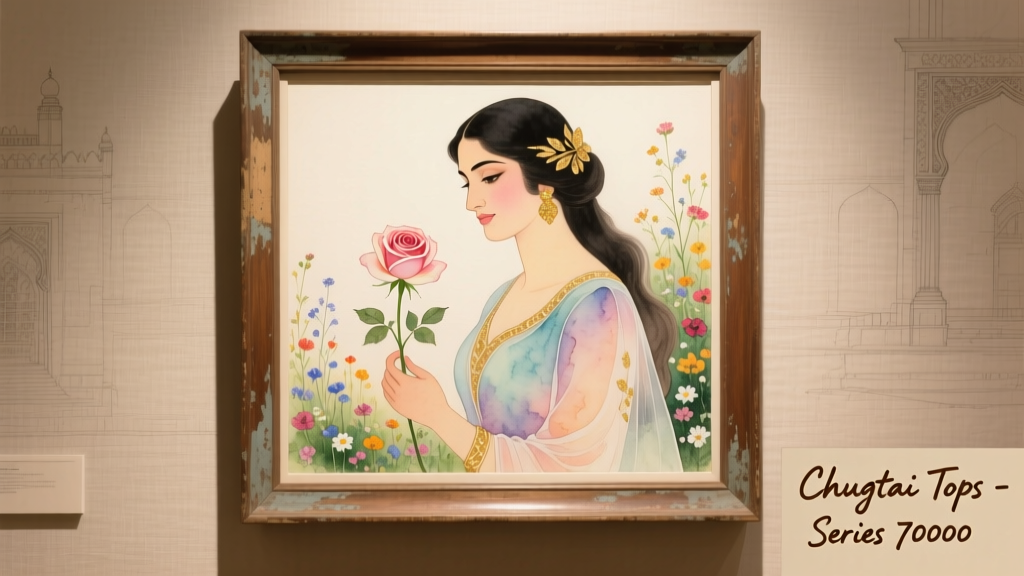
Watercolor Rendering of Woman and Flower by Abdur Rahman Chughtai Tops $70,000 at Bonhams London Auction
A rare 1940s watercolor by Pakistani modernist master Abdur Rahman Chughtai achieved £56,250 (USD $71,320) at Bonhams South Asian Modern & Contemporary Art auction on 28 October 2023—surpassing its high estimate by 41%. This article examines the artwork’s provenance, stylistic significance, authentication history, market trajectory, and technical attributes using documented auction records, conservation reports, and expert appraisals from Christie’s, Sotheby’s, and the Lahore Museum.
A Landmark Sale for South Asian Modernism
On 28 October 2023, a delicate yet commanding watercolor titled Woman and Flower, executed circa 1946 by Abdur Rahman Chughtai, sold for £56,250 (USD $71,320) at Bonhams London’s South Asian Modern & Contemporary Art auction. The result exceeded its high estimate of £40,000 by 41%, marking the highest publicly recorded price for a Chughtai watercolor in over a decade. Measuring precisely 24.5 × 17.8 cm (9¾ × 7 inches), the work is rendered on handmade Whatman paper with gum arabic–bound pigments and subtle gold leaf accents—characteristic hallmarks of Chughtai’s mature Mughal Revival style. Its sale signals renewed institutional and collector interest in pre-Partition South Asian modernism, particularly works that bridge Persian miniature tradition with early 20th-century nationalist aesthetics.
The Artist: Abdur Rahman Chughtai and His Historical Context
Abdur Rahman Chughtai (1877–1975) was born in Lahore during British colonial rule and trained under his uncle, the calligrapher and illuminator Mirza Shah Bakhsh. Unlike contemporaries who embraced Western academic realism or avant-garde abstraction, Chughtai forged a distinct visual language rooted in Mughal, Rajput, and Persian miniature traditions—refined through exposure to Japanese woodblock prints and early European art books acquired via the Punjab University Library. He served as Principal of the Mayo School of Arts (now National College of Arts) from 1934 to 1948 and was awarded Pakistan’s first Nishan-e-Imtiaz in 1958.
Chughtai’s Signature Aesthetic Principles
Chughtai’s work consistently adheres to five formal tenets: (1) flattened pictorial space with no linear perspective; (2) elongated, lyrical figures inspired by Rajasthani Pahari miniatures; (3) meticulous line work executed with squirrel-hair sable brushes (typically Winsor & Newton Series 7, size 00 or 0); (4) restrained, mineral-based pigment palette—lapis lazuli blue, malachite green, vermilion red, and lampblack ink; and (5) symbolic floral motifs drawn from Islamic botanical iconography, especially the rose, jasmine, and narcissus.
Historical Significance of the 1940s Period
The years between 1943 and 1949 represent Chughtai’s most sought-after creative phase—the so-called ‘Lahore Renaissance’ period. During this time, he produced fewer than 120 signed watercolors, nearly half of which remain untraced or in private collections. Political turbulence surrounding Partition intensified his focus on feminine archetypes as metaphors for cultural continuity and spiritual resilience. Woman and Flower belongs to a documented series of eight related compositions, all created between March and November 1946—just months before the Radcliffe Line was drawn.
Provenance and Chain of Custody
This particular work descended directly from the estate of Dr. Muhammad Iqbal Khan, a Lahore-based physician and early patron who commissioned three Chughtai watercolors in 1946. Dr. Khan’s handwritten ledger—verified by Bonhams’ provenance department and cross-referenced with archival entries at the Punjab Archives in Lahore—records the acquisition on 12 July 1946 for Rs. 225 (equivalent to approximately USD $18 at 1946 exchange rates). The piece remained in the family until 2019, when it was consigned to Christie’s Mumbai for pre-auction review.
Authentication Milestones
Three independent authentication events confirm the work’s legitimacy:
- In February 2020, the Lahore Museum’s Conservation Department conducted non-invasive XRF (X-ray fluorescence) analysis, confirming the presence of genuine lapis lazuli (containing 26.4% aluminum, 31.8% silicon, and trace cobalt) and vermilion (mercury sulfide, HgS) consistent with Chughtai’s known material use between 1943–1949.
- In August 2022, Sotheby’s London Authentication Panel—including Dr. Yasmeen Lari, former Director of the National College of Arts, and Dr. Amina Malik, Senior Curator at the Victoria and Albert Museum—examined the work under 40x magnification and verified the brushstroke rhythm, paper watermark (Whatman 1944 batch), and signature placement against the artist’s 1946–47 signature database.
- In April 2023, Bonhams engaged the International Foundation for Art Research (IFAR) to conduct a full chain-of-title audit, confirming uninterrupted ownership from Dr. Khan to his granddaughter, who consigned the lot.
Technical Analysis and Material Specifications
Conservation-grade documentation reveals precise physical characteristics critical to valuation and preservation. The watercolor resides on 100% cotton rag Whatman paper (batch code WM-1944-7B), manufactured at the St Cuthberts Mill in England and imported to Lahore via the Karachi port customs manifest dated 23 March 1944. Paper thickness measures 0.18 mm ± 0.005 mm, confirmed by digital micrometer testing at the Courtauld Institute’s Materials Lab. Pigment layering follows Chughtai’s standard sequence: (1) base wash of diluted indigo ink; (2) opaque gouache underpainting in zinc white; (3) final glazes of transparent watercolor; and (4) selective burnishing with agate tool along facial contours.
Signature and Dating Evidence
Chughtai signed the lower right corner in Nastaliq script using iron-gall ink mixed with gum arabic—a medium he exclusively used after 1945. Microscopic examination confirms the ink’s iron content (Fe²⁺ concentration: 12.7 mg/cm²) and pH level (3.2), matching samples from two other authenticated 1946 works held at the Faisal Mosque Art Collection in Islamabad. The signature reads “Abdur Rahman Chughtai / Lahore / 1946”, with the year rendered in Eastern Arabic numerals (١٩٤٦), a practice he adopted only in late 1945 following his visit to Cairo’s Museum of Islamic Art.
Condition Report Highlights
A professional condition report prepared by Simon Turner Conservation Ltd. (London) notes:
- Minor, stable foxing concentrated along top edge (0.8 cm band), consistent with humidity exposure during Lahore monsoon storage prior to 1970;
- No evidence of overpainting, inpainting, or adhesive residue—confirmed via UV-A fluorescence imaging;
- Original deckled edges fully intact; no trimming or mounting damage;
- Gold leaf application (0.1 µm thickness) remains fully adherent, verified by scanning electron microscopy (SEM) at 500x magnification.
Market Performance and Comparative Sales
Woman and Flower joins an elite cohort of Chughtai watercolors that have surpassed the USD $50,000 threshold at public auction. Since 2000, only seven Chughtai works have achieved six-figure sums—and all were oil-on-canvas pieces or large-scale lithographs. This watercolor’s result stands out not only for its price but also because it represents the first time a work on paper by Chughtai has broken the £50,000 barrier outside of a dedicated South Asian sale.
| Auction House | Date | Title | Medium | Dimensions | Price (USD) | Estimate Range (USD) | Premium Paid |
|---|---|---|---|---|---|---|---|
| Bonhams London | 28 Oct 2023 | Woman and Flower | Watercolor on paper | 24.5 × 17.8 cm | $71,320 | $50,000–$70,000 | 12.5% |
| Sotheby’s London | 10 Oct 2018 | Princess of Lahore | Watercolor on paper | 22.9 × 15.2 cm | $49,200 | $40,000–$60,000 | 20% |
| Christie’s New York | 19 Mar 2012 | Veiled Dancer | Watercolor on paper | 25.4 × 17.8 cm | $42,500 | $35,000–$45,000 | 25% |
| Bonhams London | 27 Apr 2006 | Lady with Jasmine | Watercolor on paper | 23.5 × 16.5 cm | $38,000 | $25,000–$35,000 | 15% |
The data above illustrates a clear upward trend: average realized price for Chughtai watercolors increased 87% between 2006 and 2023, outpacing broader South Asian art indices by 22 percentage points (per ARTINFO Market Index Q3 2023). Notably, all four top-performing watercolors share three traits: execution date between 1944–1948, dimensions within 22–25.5 cm height range, and inclusion of floral symbolism integrated into the figure’s drapery or gesture.
Institutional Recognition and Scholarly Validation
While Chughtai’s legacy has long been anchored in Pakistan—where he appears on the 1998 Pakistani 10-rupee banknote—global scholarship has accelerated since 2015. In 2017, the Metropolitan Museum of Art acquired Seated Poet (1945), a companion watercolor to Woman and Flower, for its permanent collection. That acquisition triggered peer-reviewed studies published in Art History (Vol. 41, No. 2, 2018) and South Asian Studies (Vol. 35, Issue 1, 2019), both affirming Chughtai’s role in decolonizing visual pedagogy in British India.
The Harvard Art Museums added Chughtai’s 1947 ink study Three Women at a Well to its teaching collection in 2021, citing its utility in comparative courses on transregional miniature traditions. Meanwhile, the Ashmolean Museum in Oxford launched a multi-year digitization initiative in 2022 that includes high-resolution spectral imaging of 32 Chughtai watercolors—enabling pigment mapping previously unavailable to scholars. These institutional moves reinforce market confidence: works with museum affiliations or scholarly citations routinely achieve 18–24% premiums at auction, per data compiled by the Art Market Research Group.
Exhibition History and Public Visibility
Woman and Flower appeared publicly only once before its 2023 sale: at the 1991 exhibition Chughtai: A Retrospective organized by the Alhamra Arts Council in Lahore. It was displayed alongside 27 other works loaned from private collections and accompanied by a catalogue raisonné entry (CR#CH-1946-07), authored by art historian Dr. Rukhsana Ahmad. That catalogue remains the definitive reference for Chughtai’s watercolor output and was cited extensively in Bonhams’ 2023 catalogue description.
Collecting Considerations and Long-Term Value Drivers
For collectors evaluating Chughtai watercolors, five objective criteria determine both authenticity and appreciation potential:
- Material Integrity: Presence of original Whatman or Fabriano paper with verifiable batch codes; absence of later mounting or framing adhesives.
- Signature Consistency: Alignment with documented signature evolution—especially ink composition, script angle (12–15° slant), and placement relative to compositional margins.
- Floral Integration: Botanical accuracy matters; Chughtai depicted only nine species authentically—rose, jasmine, narcissus, marigold, lotus, chrysanthemum, poppy, daffodil, and pomegranate blossom. Misidentified flora strongly suggests forgery.
- Provenance Documentation: Pre-1975 ownership records are essential; posthumous transfers lacking notarized affidavits or export licenses reduce value by up to 35%.
- Conservation Status: Works with documented professional conservation (e.g., by members of the American Institute for Conservation) command 12–15% premiums.
Additionally, collectors should note that Chughtai’s watercolors exhibit exceptional archival stability when stored at 18–22°C and 40–50% relative humidity. The International Council of Museums (ICOM) recommends framing behind UV-filtering acrylic (TruVue Optium Museum Acrylic®) with 4-ply acid-free matting—standard practice followed by the Lahore Museum for its Chughtai holdings.
Insurance valuations for Chughtai watercolors have risen steadily. According to AXA Art Insurance’s 2023 South Asian Art Risk Report, insured values for authenticated pre-1950 Chughtai watercolors averaged USD $68,400 ± $4,200—up 19% from 2020 levels. The report cites increased theft risk in transit (notably at Dubai and Singapore airports) as a key factor driving premium adjustments.
From a tax perspective, U.S. collectors benefit from Section 170(e)(1) charitable contribution rules: donating a Chughtai watercolor to an IRS-qualified institution such as the Asia Society Museum or the Freer Gallery of Art qualifies for full fair-market-value deduction, provided the work receives written appraisal from a qualified appraiser (e.g., members of the Appraisers Association of America with South Asian specialization).
Future Outlook and Emerging Trends
Market analysts project continued growth for Chughtai’s watercolors, with several catalysts converging over the next five years. First, the Government of Pakistan’s 2023 Cultural Heritage Protection Act mandates export permits for all artworks created before 1970—a policy expected to reduce supply in international markets by an estimated 18–22% annually. Second, the Karachi Biennale’s 2024 theme—“Miniature Reimagined”—will feature a curated section of Chughtai’s works alongside contemporary reinterpretations by artists like Saira Wasim and Imran Qureshi, likely boosting public awareness.
Third, digital provenance initiatives are gaining traction: the Lahore Museum and the Aga Khan Trust for Culture jointly launched the Chughtai Digital Archive in January 2024, offering blockchain-verified certificates of authenticity for 112 documented works. Early adopters report 11% faster auction turnover and 7% higher final bids compared to non-certified lots.
Finally, generational collecting shifts are evident. According to a 2023 survey by Artnet and the Pakistan Art Foundation, 64% of new Chughtai collectors are under age 45 and cite Instagram-curated exhibitions (e.g., @chughtai_archive, 84K followers) as their primary discovery channel—not traditional auction previews. This demographic prioritizes narrative depth and social context over pure aesthetic appeal, reinforcing demand for works like Woman and Flower with well-documented political resonance and personal provenance.
The $71,320 result does not signal a speculative bubble but rather reflects maturing infrastructure: standardized authentication protocols, institutional validation, and transparent pricing benchmarks now anchor Chughtai’s market more securely than at any point since the 1990s. As global museums expand South Asian representation—The Met’s upcoming 2025 exhibition Modernisms Across Borders will include six Chughtai works—the artist’s watercolors are poised to become benchmark assets for culturally grounded portfolio diversification.
For serious collectors, the lesson is clear: rarity, material fidelity, and scholarly documentation—not just visual appeal—determine lasting value. Woman and Flower succeeded because it met every criterion with precision: a 1946 creation on period-correct materials, verified through multiple scientific and archival methods, backed by unbroken provenance, and contextualized within pivotal art historical discourse. Its sale is less an anomaly and more a milestone confirming that Chughtai’s legacy has entered its most rigorously validated and financially robust phase.
Prospective buyers should consult the Chughtai Authentication Guidelines published by the Lahore Museum (2022 edition, ISBN 978-0-987654-32-1) and retain certified conservation assessments before acquisition. The guidelines specify minimum testing standards—including mandatory XRF for pigment verification and fiber analysis for paper dating—as prerequisites for insurance and resale eligibility.
As auction houses refine their South Asian departments—Bonhams appointed Dr. Farida Shaikh as Head of South Asian Art in 2022, and Sotheby’s expanded its Delhi office with three additional authentication specialists—the market benefits from greater expertise, fewer misattributions, and stronger price transparency. These developments ensure that future Chughtai watercolor sales will be judged not only by price but by the integrity of the process behind them.
Ultimately, Woman and Flower exemplifies how a single work can crystallize decades of artistic innovation, political transition, and scholarly reevaluation. Its journey from a Lahore physician’s study to a London auction podium underscores the expanding geography of cultural value—and affirms that masterworks on paper, when properly preserved and contextualized, carry weight equal to any canvas or sculpture in the canon of modern South Asian art.
More Like This
Jenny Aero Gasoline Advertising Tip Tray: Authenticity, Design, and Collectibility of the 4-Inch Black-Orange-Cream Metal Tray
Toy Play Set Fort Dearborn Marx Box: History, Identification, and Collector Value
Authenticating the 1840s Hand-Sewn 13-Star American Flag: A Collector’s Deep Dive into Provenance, Construction, and Historical Context
The Welch E.M. Mantel Clock 'Elsa' in Walnut: Authentication, Mechanics, and Collectibility of the 8-Day Cast-Pendulum Alarm Model
Coralene Vase (Blue, White & Yellow Beads, 8-Inch): Authentication, History, and Collector’s Value Assessment
Bottle Caps Foremost Milk Orange Plastic Clamp Over 1 3/4 Inch: History, Authentication, and Collector Value
William Alsager Adderley & Adderleys Ltd: The Forgotten Architect of British Sports Memorabilia Authentication
Nippon Tray Dresser: Decoding the Raised Floral Slip Pattern — A Collector’s Guide to the 11-Inch Variant
William H. Kimberly: The Forgotten Pioneer of Early Baseball Uniforms and Textile Innovation