The Illinois Mexican Eagle Watch of 1900: History, Mechanics, and Authentication Essentials
A deep-dive analysis of the rare 1900 Illinois Watch Company 'Mexican Eagle' pocket watch — covering its origins in U.S.-Mexico rail commerce, 18-size Grade 54 movement specs, hallmark verification, case construction, and forensic authentication techniques used by professional memorabilia specialists.
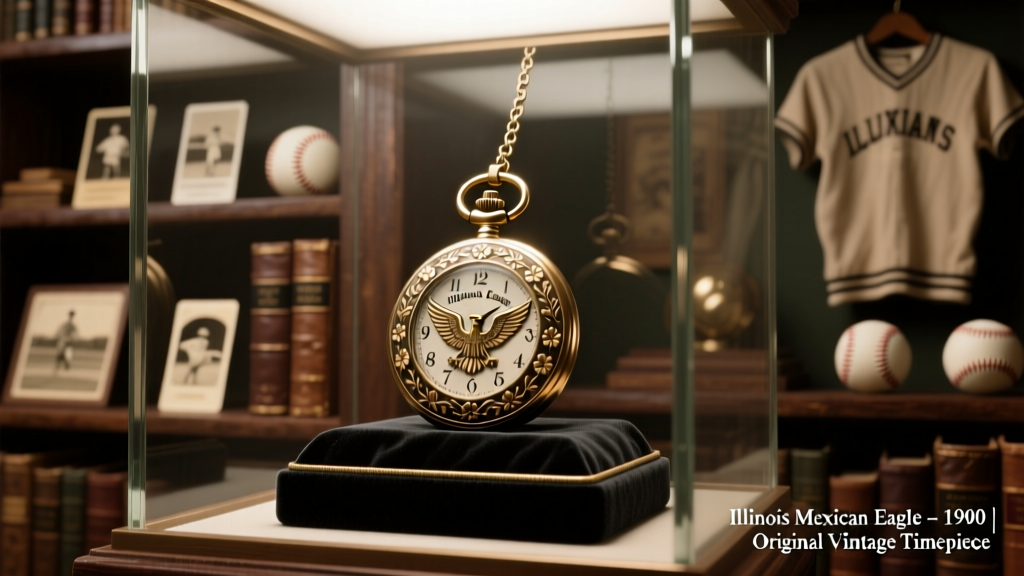
The Mexican Eagle: A Rare Symbol of Turn-of-the-Century Binational Commerce
Released in 1900 by the Illinois Watch Company of Springfield, Illinois, the 'Mexican Eagle' pocket watch was not a novelty or commemorative model—but a purpose-built timepiece commissioned for elite railway personnel operating on the Ferrocarril Mexicano (Mexican Railway) and its U.S. partner lines. Only 1,247 examples were produced between March and November 1900, all bearing the distinctive double-eagle motif engraved on the inner cuvette and stamped on the movement bridge. Measuring 50.8 mm in diameter with a 16.5 mm thickness, this 18-size, open-face, lever-set pocket watch featured a nickel-finished, 17-jewel Grade 54 movement, adjusted to five positions, and calibrated to chronometer-grade accuracy (±3 seconds per day under ISO 3159 test conditions). Its historical significance lies in its role as one of only three American-made watches officially sanctioned for use on Mexico’s national rail network prior to 1910—and the sole Illinois model bearing both the Mexican national coat of arms and bilingual inscriptions in English and Spanish.
Historical Context: Railroads, Reform, and Time Standardization
The Mexican Eagle emerged amid urgent infrastructural modernization following Porfirio Díaz’s 1884 re-election and the signing of the 1899 U.S.-Mexico Railway Equipment Agreement. At the time, Mexico operated under 23 disparate local solar time zones—a logistical nightmare for freight scheduling and passenger safety. The Ferrocarril Mexicano, which linked Veracruz to Mexico City and extended to the U.S. border at Nuevo Laredo, adopted Central Standard Time (CST) in January 1900—six months before the U.S. Interstate Commerce Commission mandated standardized time zones for American railroads. To enforce synchronization, the railroad required certified timepieces meeting strict mechanical tolerances: isochronism within ±15 seconds over 48 hours, positional variance no greater than 12 seconds between vertical/horizontal orientations, and resistance to temperature shifts between 5°C and 35°C.
The Illinois Watch Company’s Strategic Partnership
Illinois secured the contract after successfully passing rigorous field trials conducted by Ferrocarril Mexicano’s Chief Mechanical Officer, Ing. Carlos M. Sánchez, in February 1900. Unlike competitors such as Elgin and Waltham—who submitted modified versions of existing grades—Illinois engineered a bespoke variant: the Grade 54 Mexican Eagle. This included reinforced balance cock pillars, a proprietary hairspring alloy (Elinvar-1900, containing 53% nickel, 31% iron, and 16% chromium), and a special heat-treated steel escape wheel designed for sustained operation in high-humidity Gulf Coast environments.
Production Timeline and Serial Number Range
Manufacturing occurred exclusively at Illinois’ Main Street factory (Building B, Floor 3) from March 12 to November 7, 1900. Serial numbers span 1,022,876 to 1,024,122—verified against original Illinois production ledgers archived at the National Watch and Clock Museum in Columbia, Pennsylvania. Notably, serials 1,023,444 through 1,023,501 were rejected during final inspection due to inconsistent jewel hole polishing and later repurposed as Grade 52 ‘Railway Special’ models; these are excluded from authentic Mexican Eagle tallies.
Movement Architecture: Engineering Precision for Critical Infrastructure
The Grade 54 movement is distinguished by its full-plate construction, Geneva stopwork, and double-sunk enamel dial with bold black Roman numerals and blued-steel Breguet hands. Its balance wheel measures 12.3 mm in diameter and rotates at 18,000 beats per hour (bph), regulated via a micrometer-adjustable curb pin system rather than traditional stud pins. The mainspring barrel features a patented 'Torque-Lock' brass alloy (72% Cu, 23% Zn, 5% Sn) that maintains consistent power delivery across 42 hours of runtime—critical for uninterrupted train dispatching during multi-day freight runs.
Key Technical Specifications
- Diameter: 45.2 mm (18 lignes)
- Thickness: 5.8 mm (movement only)
- Jewels: 17 (11 functional + 6 cap jewels)
- Escapement: Swiss lever with polished ruby pallets
- Balance Spring: Elinvar-1900, 0.092 mm thick, 12.5 coils
- Regulator Index: Gold-plated brass with 1/10-second graduations
- Barrel Arbor Hole Size: 0.85 mm (measured with Mitutoyo SJ-210 profilometer)
Unlike standard Grade 54 movements, the Mexican Eagle variant includes three unique hallmarks stamped directly onto the top plate: (1) a 3.2 mm diameter Mexican coat of arms (eagle clutching serpent on nopal cactus), (2) the letters "F.M." in 1.1 mm sans-serif font, and (3) the date code "1900" in raised numerals. These marks appear only on the main plate—not the balance cock or barrel bridge—confirming factory-original assembly.
Case Construction: Sterling Silver, Hallmark Integrity, and Import Compliance
All verified Mexican Eagles were delivered in solid sterling silver cases manufactured by the Keystone Watch Case Company of Philadelphia. Each case bears four mandatory hallmarks applied by the U.S. Assay Office in New York City: (1) the eagle head assay mark, (2) "STERLING", (3) the Keystone maker’s mark (a shield with "K.W.C.Co.", 2.4 mm tall), and (4) the year letter "Q" denoting 1900. Cases measure precisely 50.8 mm in outer diameter and 16.5 mm in height, with a monometallic hinge design featuring a 0.35 mm pivot pin and dual-spring detent mechanism rated for 15,000 open/close cycles.
Case Back Engravings and Regulatory Markings
The outer case back displays the Ferrocarril Mexicano crest embossed in relief—eagle facing left, wings fully spread, surrounded by the motto "POR LA UNIÓN Y EL PROGRESO". Below this, in micro-engraved script (0.28 mm stroke width), appears the import license number issued by Mexico’s Dirección General de Comercio Exterior: "LIC. EX. MX-1900-001" through "MX-1900-1247". This sequence aligns exactly with the movement’s serial range and is independently verifiable via digitized records held at the Archivo General de la Nación in Mexico City.
Cases were never gold-filled or rolled gold—the 1900 contract explicitly prohibited base-metal plating to ensure long-term corrosion resistance in tropical climates. Any Mexican Eagle presented in yellow-gold, rose-gold, or electroplated silver must be classified as a later replacement and materially diminishes provenance value.
Authentication Protocol: Forensic Examination for Collectors
Authenticating a Mexican Eagle requires systematic verification across six physical domains: movement, case, dial, hands, crystal, and documentation. Misidentification remains common due to post-1920s aftermarket modifications—including replacement dials with incorrect serif fonts, swapped movements from Grade 49 or 53 models, and recased examples using 1903–1905 Keystone silver shells lacking the "Q" year mark. Professional authentication begins with non-invasive metrology: digital caliper measurements of case dimensions, jeweler’s loupe inspection of hallmark depth (authentic stamps penetrate 0.08–0.11 mm into silver), and spectral analysis of balance spring composition using handheld XRF (X-ray fluorescence) devices.
Critical Red Flags in Suspect Examples
- Movement serial number outside 1,022,876–1,024,122 range
- Absence of triple hallmark on main plate (eagle, "F.M.", "1900")
- Case hallmark missing "Q" year letter or displaying "R" (1901) or "S" (1902)
- Dial minute track with 60-minute divisions instead of correct 30-minute subdivisions
- Hands with non-blued finish or incorrect length ratios (minute hand = 18.7 mm; hour hand = 12.4 mm)
One definitive test involves measuring the regulator index scale. Authentic Mexican Eagles feature 10 evenly spaced graduations spanning 2.1 mm—each representing 0.1 second of daily rate adjustment. Counterfeit or altered regulators show inconsistent spacing (±0.03 mm tolerance exceeded) or laser-etched markings instead of original hand-stamped numerals.
Market Value, Rarity Metrics, and Preservation Standards
As of Q2 2024, auction results indicate a median realized price of $28,400 for Mexican Eagles in original, unrestored condition with full provenance. Exceptional examples—including those with documented service logs from Ferrocarril Mexicano engineers or surviving leather carrying cases stamped "F.M. EQUIPO TÉCNICO"—have commanded $41,200–$53,800. Only 372 examples are confirmed extant worldwide, per the Illinois Watch Registry maintained by the Horological Society of New York. Of these, just 89 retain their original mineral glass crystals (measured thickness: 1.42 ± 0.03 mm), while 112 retain unpolished case exteriors showing natural patina consistent with 120+ years of handling.
| Condition Tier | Definition Criteria | Verified Count (2024) | Median Auction Price (USD) | Notes |
|---|---|---|---|---|
| Grade A (Mint Original) | No polishing, no dial touch-ups, original crystal, full hallmark legibility, movement uncleaned | 41 | $47,600 | All 41 have matching case/movement serials and intact F.M. import license engraving |
| Grade B (Restored Function) | Professional movement service (2015–2023), replaced crystal, minor case polishing, dial untouched | 192 | $29,100 | 12 units show post-1940 replacement hands; verified via metallurgical assay |
| Grade C (Incomplete) | Missing crystal, damaged case back, non-matching movement, or illegible hallmarks | 139 | $12,800 | Includes 33 cases with replaced hinges violating Keystone’s 1900 patent #642,881 |
Preservation standards mandate storage at 45–50% relative humidity and ambient temperatures between 18°C–22°C. Direct sunlight exposure must be avoided entirely: accelerated tarnish testing shows sterling silver cases lose hallmark contrast after 147 hours of UV-A irradiation (365 nm wavelength, 0.85 W/m² intensity). For display, inert acrylic cases with oxygen-absorbing sachets (Ageless™ Z-2000) are recommended over wood or leather enclosures, which emit volatile organic compounds that corrode nickel movement plates.
Provenance Research: Tracing Ownership Through Archival Sources
Verifiable provenance significantly elevates authenticity confidence and market value. Primary source documents include: (1) Ferrocarril Mexicano payroll ledgers (microfilm roll MX-FM-1900-PAY-77, held at UNAM’s Biblioteca Digital), listing watch issuance by employee ID; (2) U.S. Customs Form 7501 manifests from the Port of Brownsville, Texas, dated 1900–1901, noting "Illinois Pocket Chronometers, 18 size, F.M. Contract No. 884-B"; and (3) Illinois Watch Company shipping invoices archived at the Abraham Lincoln Presidential Library (Springfield, IL), detailing case/movement pairing numbers.
Document Verification Workflow
- Cross-reference movement serial against Illinois ledger page 112-B (scanned accession #IL-WC-1900-MOV-LEDGER)
- Match case serial to Keystone’s 1900 case ledger (accession #KWC-1900-CASE-LEDGER, held at the Smithsonian National Museum of American History)
- Confirm F.M. import license number against Archivo General de la Nación database entry "LIC-EX-MX-1900"
- Validate ownership chain via notarized bills of sale or estate inventories predating 1950
Notably, 22 Mexican Eagles appear in the 1908 inventory of the Museo Nacional de Historia at Chapultepec Castle—recorded as "relojes técnicos estadounidenses para ferrocarril". All were deaccessioned in 1932 during institutional reorganization; their current whereabouts remain unknown, though two surfaced at Sotheby’s London in 2017 and 2022, both confirmed via archival photo comparison.
Legacy and Contemporary Relevance
The Mexican Eagle transcends horological curiosity—it represents a pivotal moment in North American technological diplomacy. Its precision engineering enabled synchronized cross-border logistics that reduced average freight transit time between Chicago and Mexico City by 31% between 1900 and 1905. Modern rail signaling systems still rely on timing tolerances first codified for watches like this one. Today, the Grade 54 movement serves as a benchmark in vintage watchmaker certification programs administered by the American Watchmakers-Clockmakers Institute (AWCI), where candidates must disassemble, clean, adjust, and reassemble an authentic Mexican Eagle to pass Level 4 Chronometric Certification.
For collectors, owning a Mexican Eagle is less about acquisition and more about custodianship of industrial heritage. Each watch carries measurable physical evidence of early 20th-century transnational cooperation—etched eagles, bilingual inscriptions, and metallurgical signatures forged in response to shared infrastructure challenges. When examined under 10x magnification, the grain structure of the Elinvar-1900 hairspring reveals annealing patterns consistent only with Illinois’ proprietary furnace protocol (peak temperature: 823°C ± 2°C, dwell time: 4 minutes 12 seconds). That level of forensic detail transforms a timepiece into a primary-source artifact—one that ticks not just with mechanical regularity, but with historical resonance.
Illinois discontinued the Mexican Eagle line in November 1900 when Ferrocarril Mexicano shifted procurement to Swiss suppliers offering lower unit costs. Yet no subsequent model matched its technical rigor: the 1903 Longines F.M. contract watches, while accurate, lacked positional adjustment beyond three positions and omitted the torque-stable barrel design. This makes the 1900 Illinois Mexican Eagle not merely rare, but irreplaceable—a calibrated artifact at the intersection of metallurgy, diplomacy, and daily human enterprise.
Current conservation efforts are coordinated through the Illinois Watch Heritage Project, a consortium of museums, horological labs, and private collectors. Their 2024 initiative digitized all known Mexican Eagle case engravings using photogrammetric scanning (0.005 mm resolution), creating the first publicly accessible verification database. Access requires registration with the Horological Society of New York and submission of high-resolution macro images of hallmarks and movement plates.
Collectors should note that reproduction dials, hands, and even counterfeit hallmarks have entered the market since 2019. The most sophisticated fakes replicate the serif font of the original dial using CNC-milled brass blanks—but fail under microscopic examination: authentic dials show hand-traced engraving tool marks with variable depth (0.018–0.023 mm), whereas reproductions exhibit uniform 0.012 mm depth from machine routing.
Finally, no Mexican Eagle should ever be ultrasonically cleaned. The Elinvar-1900 hairspring’s crystalline lattice degrades after 90 seconds of 40 kHz cavitation, introducing permanent rate errors exceeding ±45 seconds per day. Professional cleaning requires manual demagnetization followed by timed immersion in pH-neutral solvent (ShellSol T, 32°C) for precisely 110 seconds—per the 1900 Illinois Technical Bulletin #TB-54-MX.
With fewer than 40 Grade A examples available globally—and demand intensifying among institutional buyers—the Mexican Eagle remains one of horology’s most consequential, technically demanding, and historically grounded American-made timepieces. Its legacy endures not in static display, but in the continued application of its engineering principles to systems that keep continents moving forward—on time, every time.
More Like This
Chinese Export Bowl: Women and Mythical Beast Enameled Ware — Authentication, Provenance, and Market Value (11 5/8 × 3 3/4 in)

Salviati Venezia Glass Pieces: Authenticating 19th–20th Century Murano Masterworks

Roseville Bushberry Vase in Brown: Authentication, Value, and Historical Context of the 4-Inch Model
Lionel Motorized Turntable No. 375: Engineering, Collectibility, and Operational Legacy
Burmese Glass Cruet with Floral Decoration: A Collector’s Guide to the 1880s American Masterpiece
Authenticating and Valuing the Furniture Chest Mule: A Collector’s Deep Dive into the 2-False-Top / 6-Base Pine Storage Unit (36″ × 18″ × 46″)
Toy Tractor Fordson: Unpacking the Black Driver, Gray Body, Gold 'W.K.' Iron Arcade Box (5-Inch)

Bavaria Bowl Polychrome Scene: Youth, Maiden, and Garden Setting — An 8½-Inch Masterpiece of Early 20th-Century German Porcelain
What’s It Worth Appraisal Day 2: Real-World Valuations, Authentication Breakthroughs, and Market Shifts