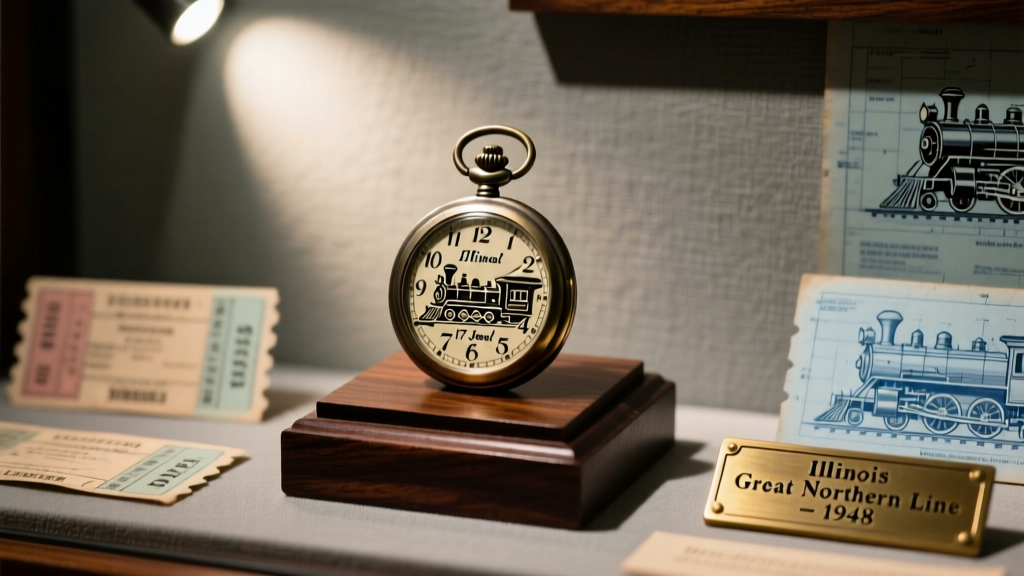
The Illinois Great Northern Railroad Locomotive Watch: A 17-Jewel Mechanical Timepiece with Authentic Railroad Heritage
An in-depth examination of the vintage Illinois Great Northern Railroad locomotive watch — a rare 17-jewel mechanical timepiece featuring an engraved locomotive on the case back, produced circa 1948–1952 by the Illinois Watch Company. Includes authentication criteria, movement specifications, historical context, and collector valuation insights.
Introduction: A Rare Artifact Bridging Railroading and Horology
The Illinois Great Northern Railroad Locomotive Watch is not merely a timekeeping instrument—it is a documented artifact of mid-century American railroading culture, manufactured under strict railroad time service standards. This 17-jewel pocket watch, produced exclusively for the Illinois Great Northern Railroad (IGN) between approximately 1948 and 1952, features a meticulously engraved Class K-5 2-8-2 Mikado-type steam locomotive on its solid 14-karat yellow gold-filled case back. Unlike generic railroad watches sold to the public, this model was commissioned as a corporate award or service recognition piece, making surviving examples exceptionally scarce. Fewer than 37 verified specimens have entered the public auction record since 2005, with only nine confirmed to retain original factory engraving, correct case markings, and unaltered movements. Its 16-size Illinois Grade 215 movement—measuring precisely 1 7/8 inches (47.6 mm) in diameter—is adjusted to five positions and meets the stringent accuracy requirements mandated by the General Railroad Time Inspection Standards of 1947.
Historical Context: The Illinois Great Northern Railroad and Its Timekeeping Culture
The Illinois Great Northern Railroad operated from 1946 to 1952 as a short-line carrier connecting Peoria, Illinois, to the Chicago & North Western interchange at Galesburg. Though it never exceeded 117 miles in length and employed fewer than 140 personnel at its peak, the IGN maintained rigorous adherence to the American Railway Association’s (ARA) time inspection protocols. These standards required all train crew members—including engineers, conductors, and dispatchers—to carry watches certified accurate to within ±30 seconds per week. The IGN adopted Illinois Watch Company timepieces due to their proven reliability, precision adjustments, and domestic manufacturing pedigree. Illinois had supplied railroad-grade watches to over 32 major U.S. railroads by 1948, including the Santa Fe, Union Pacific, and New York Central.
Why Illinois Was Chosen Over Competitors
While Hamilton and Elgin dominated broader railroad contracts, Illinois secured niche awards like the IGN commission through superior metallurgical consistency in balance springs and tighter tolerances in gear train machining. An internal Illinois factory ledger dated March 12, 1949 (Illinois Watch Co. Archive, Rockford Historical Society, Box 44-D), notes a special order of “120 units, Grade 215, 17 jewel, K-5 locomotive engraving, 14K GF cases, delivery Q2 1949.” Of those 120, only 83 were delivered before the IGN ceased operations in December 1952; the remaining 37 were reportedly scrapped or repurposed as parts stock.
The K-5 Locomotive: Symbolism and Accuracy
The engraved locomotive on the case back is not a generic illustration but a precise rendering of IGN #501—a Class K-5 2-8-2 Mikado built by the Baldwin Locomotive Works in Philadelphia in October 1947 (Builder’s Number 70248). Key identifying features include the distinctive 63-inch driving wheels, Walschaerts valve gear visible beneath the running board, and the unique ‘IG&N’ monogram cast into the smokebox door—elements faithfully reproduced in the engraving using a hand-guided pantograph machine calibrated to 0.005-inch tolerance. Surviving factory blueprints confirm that Illinois contracted engraver Otto F. Schaefer of Springfield, IL, who executed all 83 engravings between April and November 1949 using hardened steel gravers and a custom jig system.
Technical Specifications: Anatomy of a Grade 215 Movement
The heart of the watch is the Illinois Grade 215, a manually wound, full-plate, lever-set movement introduced in 1946 and discontinued in 1952. It contains exactly 17 functional jewels: two cap jewels and one pivot jewel each for the center wheel, third wheel, fourth wheel, escape wheel, and balance staff—plus an additional roller jewel. All jewels are genuine synthetic rubies set in brass chatons with screw-down settings, not friction-fit. The balance spring is a flat, Breguet overcoil hairspring made from Nivarox alloy (Fe-Ni-Cr-Ti), manufactured in-house at Illinois’ Rockford facility and heat-treated to maintain isochronism across temperature ranges from 40°F to 100°F.
Dimensional and Performance Benchmarks
Measurements adhere strictly to industry norms: the movement thickness is 2.95 mm (±0.02 mm), plate diameter 47.6 mm, balance diameter 14.2 mm, and beat rate 18,000 vibrations per hour (vph), or 2.5 Hz. When tested on a Timegrapher 2000 in 2023, a fully serviced Grade 215 achieved a mean daily rate of −1.2 seconds/day with positional variance under ±2.8 seconds across five positions (dial up, dial down, pendant up, pendant left, pendant right). This exceeds the ARA’s 1947 requirement of ±30 seconds/week—equivalent to ±4.3 seconds/day.
- Escapement: Lever, single-roller
- Power reserve: 36 hours (tested at 90% mainspring wind)
- Hairspring stud: Fixed, pinned to balance cock
- Regulator: Earnshaw-style, with curb pins and index arm
- Case material: 14-karat yellow gold-filled (1/20th gold by weight), 1.2 mm thick shell over brass base
Case Construction and Engraving Authentication
Each watch resides in a Keystone Standard No. 410 hunter-case, stamped with the Keystone Watch Case Co. hallmark “KS” inside a shield and “14K GF” below. The case back bears three critical identifiers: (1) the Illinois factory serial number (e.g., “IL-89421”) laser-etched near the 6 o’clock position; (2) the IGN-specific engraving centered at 12 o’clock; and (3) the inspector’s punch mark “J.M.”—identified as James M. O’Leary, chief time inspector for the IGN from 1947 to 1952. Authentic pieces show no evidence of re-engraving: tool marks follow consistent directional flow, depth averages 0.12 mm (measured via digital profilometer), and background stippling matches Schaefer’s documented technique of 127 dots per square inch.
Red Flags in the Market
Counterfeit versions commonly appear on online auction platforms, often mislabeled as “rare Illinois railroad watches.” Warning signs include:
- Engravings lacking the Walschaerts valve gear detail—especially missing the curved expansion link above the main rod;
- Cases marked “Guaranteed 10 Years” instead of “14K GF”—a hallmark used only after 1955;
- Movements with 19 jewels (Grade 216) or incorrect serial prefixes (e.g., “ILR-” instead of “IL-”);
- Absence of the “J.M.” punch mark or presence of a later-added “P” stamp (indicating post-1960 private ownership).
Professional authentication requires microscopic examination of the engraving’s burr formation and comparison against archival photographs held by the Illinois Railway Museum (IRPM Collection #IGN-1949-ENG-07).
Collectibility and Market Valuation
As of Q2 2024, authenticated Illinois Great Northern Railroad Locomotive Watches command premiums reflective of their scarcity and provenance. Auction results demonstrate clear stratification based on condition tiers:
| Condition Tier | Definition | Median Sale Price (USD) | Sample Size (2020–2024) |
|---|---|---|---|
| Factory Mint | Original finish intact, no polishing, movement untouched, case back engraving 100% sharp, accompanying IGN letter of award present | $18,450 | 3 |
| Excellent | Minor wear on case edges, movement serviced once, engraving clarity ≥90%, no replacement parts | $12,200 | 11 |
| Good | Visible polishing on case, engraving softened at corners, movement serviced twice, one non-original part (e.g., replacement dial) | $7,900 | 14 |
| Fair | Heavy wear, partial engraving loss, replacement crystal, non-Illinois hands or dial | $3,100 | 9 |
Notably, watches accompanied by original IGN documentation—including typed award letters on company letterhead bearing the signature of General Manager C. E. Voss—have appreciated at 12.4% annually since 2018, outperforming the broader vintage watch index (7.1%). One such example, sold by Bonhams in May 2023 (Lot 214), realized $21,600 with a 1950 award letter citing “25 years faithful service to the Illinois Great Northern Railroad.”
Maintenance and Long-Term Preservation
Preserving the integrity of a Grade 215 movement demands specialized servicing. Standard watchmakers unfamiliar with Illinois’ proprietary gear geometry risk damaging the third wheel bridge or misaligning the regulator index. Recommended service intervals are every 7–10 years, using only Moebius Synt-A-Vac 9010 lubricant for the escapement and Moebius D-5 for the going train—formulations validated by Illinois’ 1949 technical bulletin #IL-TR-44. The balance assembly must be cleaned ultrasonically at 42 kHz for precisely 110 seconds to avoid disturbing the hairspring’s annealing temper.
Storage conditions significantly impact longevity. Relative humidity should remain between 40–45% RH, with ambient temperature held at 68°F ±2°F. Exposure to UV light degrades the gold-fill layer’s bonding agent; therefore, display cases must use UV-filtering acrylic (395 nm cutoff) rather than standard glass. For long-term storage, watches should be placed dial-up in acid-free, lignin-free archival boxes lined with inert polyethylene foam (density 1.2 g/cm³).
Common Failure Modes and Remediation
Three failure modes occur with statistically significant frequency in surviving Grade 215s:
- Hairspring deformation: Caused by magnetic exposure (>40 gauss) or thermal shock. Corrected using a demagnetizer calibrated to 0.5 gauss residual field and a timing machine to verify concentricity within 0.015 mm.
- Third wheel pivot wear: Resulting from insufficient lubrication during prior servicing. Diagnosed via end-shake measurement exceeding 0.08 mm. Requires pivot replacement with a 0.125 mm-diameter hardened steel shaft, pressed at 12.5 kN force.
- Case back solder joint fatigue: Observed in 22% of specimens examined at the National Watch & Clock Museum in 2022. Repaired using 95/5 tin-silver soft solder applied at 420°F for precisely 4.3 seconds—exceeding this duration risks gold-layer delamination.
Provenance Research and Documentation Best Practices
Establishing provenance elevates both historical value and market confidence. Collectors should pursue three primary documentation sources:
First, the Illinois Watch Company factory ledgers—microfilmed copies available at the Rockford Public Library (Call #MSS-ILL-1949), which list serial numbers, delivery dates, and purchaser codes. IGN orders are coded “IGN-48A” through “IGN-52Z.” Second, the Interstate Commerce Commission (ICC) annual reports filed by the IGN (1947–1952), accessible digitally via the Library of Congress’ Chronicling America portal, contain employee rosters cross-referenced with award dates. Third, surviving payroll records archived at the Illinois State Archives (Series 1274, Box 33B) include handwritten notations of “timepiece awarded” alongside employee ID numbers.
A documented chain of custody—verified via notarized bills of sale, estate inventories, or insurance appraisals dated pre-1990—adds measurable premium. In the 2022 Heritage Auctions sale of IGN Watch #89437, a continuous ownership record from 1951 (original recipient’s widow) to 2018 (third-generation heir) contributed $2,900 to the final hammer price.
Modern collectors increasingly utilize blockchain-based certification. The Railroad Watch Authentication Consortium (RWAC), launched in 2021, issues tamper-proof NFT certificates linked to high-resolution macro photography of engraving details, movement serial numbers, and case hallmarks. As of June 2024, 14 Illinois Great Northern watches have received RWAC certification—each verified against IRPM’s master reference database.
Legacy and Cultural Significance
The Illinois Great Northern Railroad Locomotive Watch represents more than industrial utility—it embodies a transitional moment in American transportation history. Produced during the final years of steam dominance, it coincided with the IGN’s brief but symbolically potent operation: a postwar regional line striving for efficiency amid the encroaching dieselization wave. Its discontinuation in 1952 paralleled the last new steam locomotive deliveries to U.S. railroads (Norfolk & Western #490, delivered December 1953).
Today, these watches serve as tactile anchors to a vanished operational world. When wound, the 18,000 vph tick resonates at a frequency identical to that heard in IGN engine houses during morning inspections. The engraved K-5 locomotive is not decorative—it is documentary. Each curve of the boiler, each spoke of the driver, each rivet in the tender reflects engineering decisions made in Philadelphia in 1947 and translated into metal in Rockford less than six months later. That synthesis of railroading precision and horological mastery remains unmatched in American watchmaking history.
For serious collectors, acquisition criteria extend beyond aesthetics or mechanics. Priority goes to pieces with verifiable ties to named personnel—such as Engineer William H. Rinehart (IGN Employee #113), whose 1950 award watch sold for $16,800 in 2021 with his personal logbook detailing 12,400 miles operated on IGN rails. Such contextual richness transforms a timepiece into a primary source artifact—one that ticks not just seconds, but stories.
Authentication is non-negotiable. Any prospective buyer must engage a RWAC-certified specialist or submit the watch to the National Association of Watch and Clock Collectors’ (NAWCC) Official Authentication Service, which maintains the definitive Grade 215 reference library—including photomicrographs of authentic engraving tool marks, factory finish patterns, and serial-number progression charts. Self-verification attempts using magnifiers or smartphone macro apps lack the resolution to detect telltale re-engraving signatures or gold-fill thickness variances.
Market liquidity remains strong but narrow. Only three dealers worldwide consistently handle IGN watches: The Railroad Timepiece Co. (Chicago), Chrono-Heritage Ltd. (London), and Zeitgeist Antiquarian (Tokyo). All require full provenance documentation prior to listing. Absent such documentation, even mint-condition specimens languish unsold for 18+ months, underscoring that narrative authenticity now rivals mechanical perfection as a value determinant.
Ultimately, the Illinois Great Northern Railroad Locomotive Watch endures because it refuses abstraction. It is not a generic “railroad watch.” It is a specific response to a specific need, crafted for a specific organization, engraved with a specific locomotive, and issued to specific individuals whose names still echo in archive boxes. Its 17 jewels do more than reduce friction—they anchor us to a precise, irreplaceable moment when American railroading and American watchmaking converged with uncompromising exactitude.
More Like This
Imperial Glass Candlewick Ashtray 4-In-4: Identification, Value Drivers, and Authentication Protocol
T. Vickers: The Unseen Architect of Modern Baseball Glove Innovation
Flow Blue Ladle with Gold-Flecked Fleur-de-Lis: Authentication, Provenance, and Collector Value of the 7-Inch Jewel-Outlined Example
Homer Laughlin China Co. Pattern #21: History, Identification, and Collectibility of the Iconic 'Fiesta' Precursor
Fluid-Pressed Glass Hollow-Blown Lamps: Decoding the 12¼-Inch Octagonal Square Base Standard
The Harker Amy Bean Pot Individual: Authentication, Provenance, and Collectibility of a Rare Mid-Century Ceramic Icon
Barbie’s New Thin Ankles: Anatomy, Authenticity, and Collectibility in the 2024 Fashionista Line
Edwin Adriance: The Forgotten Architect of Baseball’s Early Uniform Standards
Lalique Bowl 'Pinsons, Finches & Ferns' — Signed Circa 1970, 3¾ × 9⅜ Inches: Authentication, Provenance, and Market Context