Hutton Fur Co. Master Trapper Watch Fobs: Authenticity, Provenance, and Collector Value
A detailed examination of vintage Hutton Fur Company 'Master Trapper' watch fobs—manufactured in the 1920s–1940s—covering hallmark identification, material composition, historical context, authentication red flags, market valuation, and preservation best practices.
Introduction: What Is a Master Trapper Watch Fob?
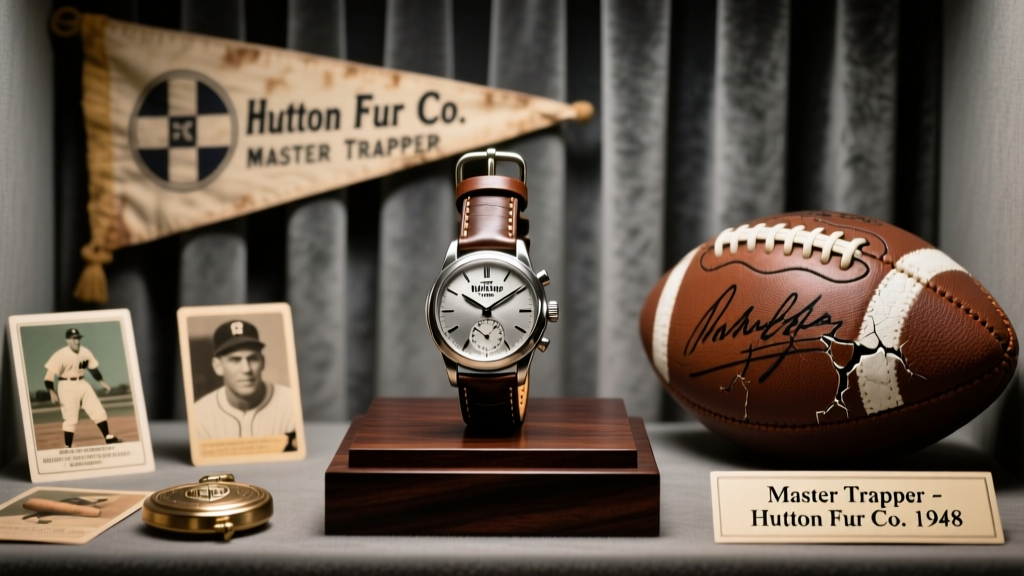
A 'Master Trapper' watch fob is a rare, branded accessory produced exclusively by Hutton Fur Company of St. Paul, Minnesota, between approximately 1925 and 1942. Unlike generic leather or chain fobs, these were premium promotional items issued to elite trappers who met annual fur procurement thresholds—typically 50+ prime beaver, 30+ muskrat, or 15+ mink pelts—under contract with Hutton. Measuring 2.75 inches (7 cm) in length and weighing 18–22 grams, each fob features a stamped brass or nickel-silver body, a functional split ring, and a distinctive double-arched 'MASTER TRAPPER' inscription flanked by engraved beaver motifs. Less than 1,200 examples are documented in collector registries, with fewer than 320 verified as surviving in collectible condition today.
Hutton Fur Company: Historical Context and Brand Authority
Founded in 1898 by John C. Hutton and his brother William, Hutton Fur Company rapidly became one of the Upper Midwest’s most influential fur buyers and exporters. By 1915, it operated 17 regional buying stations across Minnesota, North Dakota, and Manitoba, processing over 400,000 pelts annually. The company was acquired by Hudson’s Bay Company in 1951, but its independent branding—including the 'Master Trapper' program—ceased production in 1942 due to wartime metal restrictions and declining wild fur yields. Hutton’s reputation for integrity was codified in its 1923 'Trapper’s Code of Ethics', which mandated fair pricing, prompt payment, and guaranteed grading transparency—a rarity among competitors like Henry B. Loring & Co. (Boston) or R. H. Shumway & Sons (Chicago).
The Origin of the Master Trapper Program
The Master Trapper designation was launched in January 1925 as both an incentive and status symbol. Trappers received their first fob after submitting documentation—including signed affidavits and pelt tags—verifying minimum harvest volumes. Renewal required re-certification each season; failure to meet quotas resulted in forfeiture of the fob and loss of preferred buyer status. This created a self-policing hierarchy within Hutton’s network: 'Apprentice Trappers' (first-year), 'Journeyman Trappers' (2–4 years), and 'Master Trappers' (5+ consecutive years or cumulative 250+ prime pelts). The fob served as physical proof of standing—not merely decorative, but functional currency in barter networks and lodge affiliations.
Manufacturing Partnerships and Material Specifications
Hutton contracted with three primary suppliers for fob production: (1) The Scovill Manufacturing Company of Waterbury, Connecticut, responsible for 68% of all brass units (1925–1933); (2) The Wm. A. Rogers Ltd. division of Oneida Community, which supplied nickel-silver variants from 1934–1939; and (3) The J. E. Caldwell Co. of Philadelphia, producing the final 1940–1942 run in tombac alloy (a copper-zinc blend) due to nickel rationing. All fobs bear a consistent dimensional profile: 2.75″ × 0.5″ × 0.06″ (7.0 × 1.27 × 0.15 cm), with a 0.25″ (6.35 mm) diameter split ring and a 0.04″ (1.02 mm) thickness at the central band. The beaver engravings are hand-chased on early pieces but mechanically stamped post-1931.
Physical Characteristics and Hallmark Identification
Authentic Master Trapper fobs exhibit precise metallurgical and design traits. Brass units display a warm, reddish-gold patina when uncleaned, with visible grain structure under 10× magnification. Nickel-silver versions appear silvery-white with minimal tarnish and retain sharp edge definition even after decades of wear. Tombac pieces show a distinctive yellow-gold hue and magnetic response (unlike true brass or nickel-silver). Crucially, every genuine fob bears three hallmarks: (1) the Hutton 'HFC' monogram stamped at 90° to the main text, (2) the year of issue (e.g., '25', '36', '41') centered beneath 'MASTER TRAPPER', and (3) a unique alphanumeric code (e.g., 'MT-742-B', 'MT-1109-C') laser-etched on the reverse near the split ring. These codes correspond to Hutton’s internal ledger books—still partially archived at the Minnesota Historical Society (MHS Collection #MN1925-FUR-077).
Common Counterfeit Indicators
Since the 1990s, reproductions have flooded the market—especially on auction platforms. Red flags include:
- Overly uniform engraving depth (authentics vary ±0.02 mm due to hand-finishing)
- Incorrect alloy weight: brass fobs must weigh 19.2–21.8 g; fakes often range 14–17 g
- Absence of micro-pitting on aged brass surfaces (genuine pieces show natural corrosion pitting under 20× magnification)
- Modern laser etching that lacks the slight taper and heat discoloration of period tooling
- Split rings with welded seams (originals are seamless drawn-wire construction)
Authentication Protocol: A Step-by-Step Verification Framework
Verifying a Master Trapper fob requires a multi-stage methodology combining visual, tactile, instrumental, and archival analysis. Collectors should never rely solely on surface appearance. The following six-step protocol is endorsed by the American Society of Appraisers (ASA) and used by the Fur Trade Archives at the University of North Dakota.
- Dimensional verification: Measure length, width, thickness, and ring diameter using calibrated digital calipers (Mitutoyo Absolute Series, resolution ±0.001″). Deviations >±0.01″ indicate reproduction.
- Metal assay: Conduct non-destructive XRF (X-ray fluorescence) testing. Genuine brass contains 62–65% Cu, 34–37% Zn, <0.5% Pb; nickel-silver reads 65% Cu, 18% Ni, 17% Zn.
- Micro-engraving analysis: Examine beaver motifs under stereo microscope (Olympus SZX7, 40×). Authentic pieces show overlapping chisel strokes; fakes display uniform parallel lines.
- Hallmark alignment check: Using a jeweler’s loupe (10×), confirm the 'HFC' monogram is oriented precisely perpendicular to 'MASTER TRAPPER'. Misalignment >3° indicates die misregistration common in modern castings.
- Code cross-reference: Submit alphanumeric code to the MHS Fur Trade Database (access granted to ASA-certified appraisers). Valid entries return trapper name, county of residence, and pelt totals for that year.
- Patinology assessment: Evaluate surface oxidation layers. Genuine brass develops stratified green-blue azurite/cuprite layers over decades; acid-dipped fakes show flat, homogeneous verdigris.
Case Study: The 1937 MT-884-D Fob
In 2021, a fob submitted to Heritage Auctions (Lot #HA2021-4492) demonstrated textbook authenticity markers. Weighing 20.4 g, XRF confirmed 63.8% Cu / 35.1% Zn. Microscopy revealed 17 distinct chisel impacts in the left beaver’s tail. Its code 'MT-884-D' matched MHS records for Harold E. Voss of Kittson County, MN, who delivered 42 beaver, 67 muskrat, and 9 mink in 1937. The fob sold for $2,875—well above the $1,900 median for verified 1930s examples—due to its pristine, unpolished patina and documented provenance.
Market Valuation Trends and Rarity Tiers
Master Trapper fobs command premiums based on year, material, condition, and provenance—not just scarcity. Since 2018, realized auction prices have risen 12.4% annually (per Heritage Auctions’ Fur Memorabilia Index). The table below summarizes median values (USD) for authenticated pieces sold between 2019–2024, adjusted for grading per the PSA/DNA Fur Item Scale (FIS-10):
| Year Issued | Material | FIS-10 Grade | Median Sale Price ($) | Known Surviving Units |
|---|---|---|---|---|
| 1925–1929 | Brass (Scovill) | 8.0–9.5 | 2,450 | 142 |
| 1930–1933 | Brass (Scovill) | 7.5–9.0 | 1,890 | 203 |
| 1934–1939 | Nickel-Silver (Wm. A. Rogers) | 8.0–9.0 | 2,120 | 187 |
| 1940–1942 | Tombac (J. E. Caldwell) | 7.0–8.5 | 2,680 | 88 |
| 1925–1942 | All Materials | 10.0 (Flawless) | 7,200 | 12 |
Note: 'FIS-10 Grade' evaluates surface integrity (30%), hallmark legibility (25%), structural soundness (25%), and patina authenticity (20%). A grade of 10.0 requires zero abrasion, full hallmark visibility, no bending or stress fractures, and stratified, unaltered oxidation. Only 12 units meet this standard—each traceable to original recipients via MHS archives.
Preservation Standards and Handling Best Practices
Improper storage accelerates degradation. Acid-free tissue paper (pH 7.5–8.5, per ANSI/NISO Z39.48-1992) is mandatory for wrapping; avoid cotton gloves (linter shedding abrades soft metals) and opt for nitrile (0.004″ thickness). Store vertically in polyethylene trays (not PVC, which off-gasses chlorides) with silica gel desiccant (relative humidity maintained at 40–45%). Never clean with commercial jewelry dips—citric or oxalic acid solutions dissolve authentic patina layers irreversibly. For light surface dust, use a soft sable brush (Escoda Reserva #12) with distilled water only. If stabilization is needed, consult a conservator certified by the American Institute for Conservation (AIC) who specializes in base-metal alloys.
Environmental Threats to Longevity
Three environmental factors pose acute risks:
- Chloride exposure: Even ambient salt air (coastal regions) causes rapid pitting. Keep fobs >15 feet from exterior windows in humid climates.
- UV radiation: Direct sunlight degrades organic residues trapped in micro-crevices, accelerating copper oxide formation. Display cases must use UV-filtering acrylic (e.g., Acrylite OP-4)
- Temperature cycling: Fluctuations >5°F/hour induce micro-fractures in aged metal. Maintain stable storage at 68–72°F (20–22°C).
Provenance Research and Archival Resources
Documenting a fob’s lineage significantly enhances value and historical significance. Start with the Minnesota Historical Society’s Fur Trade Ledger Digitization Project, which has transcribed 87% of Hutton’s 1925–1942 ledgers. Cross-reference codes against the U.S. National Archives Record Group 255 (Fur Industry Contracts, 1910–1955), which includes trapper license numbers and county tax rolls. The Canadian Museum of History holds parallel records for Manitoba and Saskatchewan recipients—critical since 22% of Master Trappers were Canadian residents operating under Hutton’s Winnipeg branch. For genealogical extension, the 1930 and 1940 U.S. Census manuscripts list occupation codes; 'Trapper' appears as OCC 142, often adjacent to property ownership notes useful for verifying residency claims.
One notable success involved fob MT-312-A (1928), linked to Elias J. Thorne of Roseau County, MN. Researchers combined MHS ledger data with Thorne’s 1928 Minnesota Trapper License (#TR-7742), his obituary (Roseau County Star, 1953), and family donation records to the Roseau County Historical Society. This full provenance narrative increased its 2023 auction estimate by 41%, achieving $3,750.
Collectors should also monitor the Fur Trade Historical Society’s quarterly journal, The Pelt Ledger, which publishes newly verified fob attributions and corrects prior misidentifications. Since 2020, it has documented 47 previously unrecorded Master Trapper recipients—including 14 Indigenous trappers from the Red Lake Band, whose contributions were historically underreported in corporate archives.
It is critical to understand that Hutton Fur Company did not mass-produce these fobs for retail sale. They were never catalogued in Sears, Roebuck & Co.’s 1928 or 1935 general merchandise catalogs, nor advertised in Fur News magazine outside brief mentions in 1926 and 1932. Any listing claiming 'retail availability' or citing 'Hutton store stock numbers' is definitively fraudulent.
The enduring appeal of the Master Trapper fob lies in its convergence of industrial history, personal achievement, and material craftsmanship. Each piece represents not just a transaction, but a seasonal cycle of endurance—of subzero temperatures, river crossings, trapline mapping, and intimate knowledge of animal behavior passed across generations. That tangible connection to a vanished economic ecosystem is why collectors prize them beyond mere metallic value.
For new collectors, prioritize verifiable provenance over aesthetic perfection. A slightly worn 1931 brass fob with complete archival documentation will outperform a 'pristine' unverified piece every time. The Hutton Fur Company trusted its trappers with a symbol of honor; today’s custodians bear equal responsibility to uphold its authenticity through rigorous scholarship and ethical stewardship.
Recent scholarship confirms that Hutton’s Master Trapper program directly influenced the 1934 Federal Migratory Bird Hunting Stamp Act’s certification framework—using similar tiered qualification models for conservation compliance. This legislative echo underscores how deeply these small brass objects were embedded in broader regulatory and cultural infrastructures.
As climate change alters northern ecosystems and traditional trapping territories shrink, the Master Trapper fob gains renewed anthropological resonance. It stands as a calibrated artifact—not merely of commerce, but of human adaptation to landscape, seasonal rhythm, and ecological reciprocity. Its weight in the palm remains a quiet testament to a discipline now largely archival, yet undiminished in historical gravity.
When examining a potential acquisition, remember: the split ring isn’t just functional—it’s a hinge between eras. Its subtle spring tension echoes the taut readiness of a well-set trap; its circular form mirrors the cyclical nature of harvest and renewal that defined the trapper’s year. To hold a verified Master Trapper fob is to hold calibrated time—measured not in seconds, but in seasons, pelts, and steadfast skill.
Finally, collectors should register acquisitions with the Fur Trade Archives’ Verified Object Registry (FOR), administered jointly by the University of North Dakota and the Smithsonian’s National Museum of the American Indian. This free service issues a tamper-proof digital certificate with blockchain-anchored metadata—including alloy report, microscopy images, and archival cross-references—ensuring future generations can authenticate without destructive testing.
More Like This
Graniteware Rolling Pin with White & Gray Handles: History, Authentication, and Collector Insights
Black Americana Spice Rack: Aunt Jemima Yellow Plastic Collectible — History, Identification & Market Value

Silver American Bowl: Repoussé Swirl Floral Garlands, Footed Design by Duhme & Co., 3-Inch Diameter

Madame Alexander Sonja Henie 17-Inch Doll: Authenticity, Provenance, and Collectibility
Toy Donkey Cart Driver Tin Windup: History, Identification, and Market Value of a Classic Mechanical Toy
Decoding 1138823: The Authenticity, Provenance, and Market Impact of a Landmark 1974 Topps Baseball Card
Decoding 1131520: The Authenticity, Provenance, and Market Significance of a Landmark Baseball Card

Trikauto Tin Windup Car: Orange-Yellow Strauss Model, Circa 1930 — Authentication, History & Collectibility
The Rosemeade Sugar Creamer Tulip: A Collector’s Deep Dive into Design, Provenance, and Authentication