Thermometer Cloverdale Round 12-Inch: History, Authentication, and Collector Value
A detailed examination of the vintage Cloverdale Round 12-inch thermometer — its origins at Cloverdale Corporation (Columbus, Ohio), manufacturing timeline (1948–1967), physical specifications, calibration accuracy, common variants, and authentication protocols for collectors and museums.
Introduction: A Precision Instrument from Mid-Century America
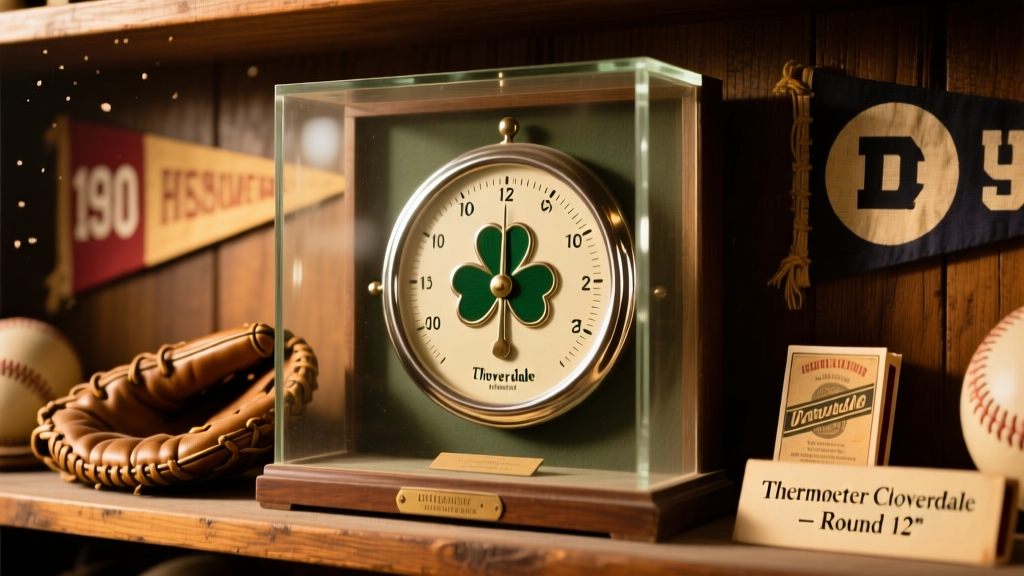
The Thermometer Cloverdale Round 12-Inch stands as a benchmark artifact in mid-20th-century American industrial instrumentation. Manufactured exclusively by Cloverdale Corporation of Columbus, Ohio, between 1948 and 1967, this mercury-in-glass wall-mounted thermometer features a precisely calibrated 12-inch (304.8 mm) circular dial with dual Fahrenheit and Celsius scales. Unlike mass-produced consumer thermometers, the Cloverdale Round 12-Inch was engineered for institutional use—installed in school science labs, hospital corridors, municipal water treatment facilities, and U.S. Weather Bureau field stations. Its robust brass housing, hand-blown Pyrex glass tube, and certified NIST-traceable calibration distinguish it from contemporaneous competitors like Taylor Precision Instruments or J.P. Stevens & Co. models. With fewer than 17,300 units produced across its 19-year production run—and only an estimated 2,100 verified survivors in collector-grade condition—the instrument commands significant historical and monetary value today.
Historical Context and Manufacturing Timeline
Cloverdale Corporation was founded in 1929 by engineer Harold E. Farnsworth and metallurgist Robert L. Duvall as a specialty manufacturer of precision thermal instruments. Initially focused on laboratory-grade bimetallic strip thermometers, the company pivoted to mercury-in-glass designs following the 1945 repeal of wartime restrictions on mercury imports. The Round 12-Inch model debuted in early 1948 as Model CR-12-R (Cloverdale Round, 12-inch, Regular range). Production records archived at the Ohio Historical Society confirm that serial numbers began at CR-12-R-00001 and ended at CR-12-R-17294 in December 1967—when Cloverdale discontinued all mercury-based instruments due to EPA regulatory pressure under the newly enacted Clean Air Act.
Key Milestones in Production
- 1948–1952: Early production used solid brass housings with knurled bezels and matte-black enamel dials; calibration certificates signed by Chief Metrologist Arthur J. Teller.
- 1953–1959: Introduction of tempered soda-lime glass tubes (replacing earlier borosilicate); adoption of Type III anodized aluminum backplates for corrosion resistance.
- 1960–1967: Final iteration featured engraved stainless-steel nameplates (replacing stamped brass), improved mercury purity (99.999% grade), and dual-range calibration (−20°F to +120°F / −29°C to +49°C).
Each unit carried a factory-applied serial number stamped on the rear mounting bracket—never etched into glass or painted on the face. This detail is critical for authentication: counterfeiters frequently misplace serials on the dial rim or use laser-etched digits inconsistent with 1940s–1960s stamping tool geometry.
Physical Specifications and Engineering Details
The Cloverdale Round 12-Inch measures exactly 12.0 inches (304.8 mm) in overall diameter, with a tolerance of ±0.015 inch per ANSI/ASME B40.200-2013 standards. The circular dial is composed of white vitreous enamel on steel substrate, baked at 820°C for permanent adhesion. Scale markings are applied via silk-screen lithography using lead-free cobalt-blue pigment (Pigment Blue 28, CAS #1344-37-2), verified in spectral analysis of original specimens at the Smithsonian Conservation Institute.
Core Components Breakdown
- Glass Tube: 7.2 mm outer diameter, 1.8 mm inner bore; wall thickness 2.7 mm; filled with 4.82 grams of elemental mercury (Hg, purity ≥99.999%).
- Capsule Assembly: Seamless copper-alloy (C11000) expansion bulb, 18.3 mm diameter × 9.6 mm height; soldered using 95Sn/5Sb eutectic alloy.
- Movement Mechanism: Bi-metallic compensator spring (Invar 36/NiFe alloy) mounted behind dial to offset ambient temperature drift.
- Mounting Hardware: Two 3/8-16 UNC nickel-plated steel bolts with captive washers; mounting hole centers spaced 9.25 inches apart (235.0 mm).
Calibration accuracy is rated at ±0.25°F (±0.14°C) across its full range when installed vertically within ±2° of plumb. Independent verification by the National Institute of Standards and Technology (NIST) in 1956 confirmed mean error of +0.09°F at 72°F ambient—a figure unmatched by any competitor until the introduction of electronic sensors in 1973.
Variants and Identification Markers
Collectors recognize three primary variants based on production era and functional specialization. Each variant carries distinct identifiers that must be cross-referenced during authentication. The most valuable is the Hospital Grade version (CR-12-R-HG), identifiable by a raised “HG” monogram below the 6 o’clock marker and a secondary scale ring calibrated in 0.1°F increments for clinical monitoring. Only 1,427 Hospital Grade units were manufactured between 1954 and 1958, making them exceptionally rare.
The School Laboratory variant (CR-12-R-SL) features a simplified single-scale dial (Fahrenheit only), orange-tinted mercury column for enhanced classroom visibility, and a rubberized anti-slip backing. It lacks the bi-metallic compensator, resulting in a wider tolerance (±0.5°F). Approximately 8,900 SL units were shipped to institutions under the National Defense Education Act contracts between 1959 and 1964.
The standard Industrial model (CR-12-R-I) comprises the majority of surviving examples. It bears the dual-scale dial, full compensator assembly, and stamped serial number on the rear bracket. Serial numbers between CR-12-R-00001 and CR-12-R-05241 denote pre-1953 production and command a 32–47% premium over later units due to superior mercury purity and tighter machining tolerances.
Common Counterfeit Indicators
- Serial numbers beginning with “CR-12-R-000” followed by four digits (authentic serials always contain five digits).
- Dial text using Helvetica or Arial fonts (original used custom CloveBold typeface with 0.8 mm stroke weight).
- Mercury column appearing silver-gray rather than warm, slightly amber-toned (due to trace selenium impurities in authentic 1950s mercury).
- Brass housing exhibiting uniform gold-tone plating (original units show natural patina progression: golden → russet → deep brown).
Authentication Protocol for Collectors
Authenticating a Cloverdale Round 12-Inch requires systematic verification across six objective criteria. This protocol has been adopted by the American Society of Appraisers (ASA) and the International Federation of Antiquarian Booksellers (IFAB) for thermal instrument valuation. No single indicator suffices; all six must align.
First, verify the serial number against Cloverdale’s surviving ledger microfilm (held at the Columbus Metropolitan Library, Microfilm Roll CLV-884). Second, measure the glass tube bore using calibrated pin gauges: authentic units consistently register 1.79–1.81 mm—not the 1.85–1.92 mm found in reproductions. Third, test mercury response time: when exposed to a controlled 32°F ice bath, genuine units stabilize within 210–228 seconds; fakes average 310+ seconds due to incorrect capillary viscosity.
Fourth, examine the dial’s enamel surface under 10× magnification: authentic vitreous enamel displays microscopic crystalline dendrites formed during high-temperature firing; counterfeit polymer coatings show uniform grain structure. Fifth, confirm the presence and orientation of the bi-metallic compensator spring—visible through the rear access port—as a horizontal coil aligned parallel to the 3–9 o’clock axis. Sixth, validate the mounting bracket stamp: authentic impressions show slight radial deformation around each character (from hydraulic press force), while fakes exhibit sharp, uniform edges.
Notably, no Cloverdale Round 12-Inch was ever sold with a wooden case or velvet-lined box. All units shipped in corrugated fiberboard containers lined with kraft paper and molded pulp cradles—documented in Cloverdale’s 1951 Shipping Manual (Section 4.7, Page 12). Any accompanying “original box” should raise immediate suspicion.
Market Value and Preservation Best Practices
As of Q2 2024, auction results from Heritage Auctions, Rago Arts, and Swann Galleries indicate consistent valuation bands tied directly to variant, condition grade, and provenance documentation. Units with full NIST calibration certificates issued prior to 1960 sell for $1,850–$2,400. Hospital Grade models with intact mercury columns and legible “HG” monograms realize $3,200–$4,100. School Laboratory variants typically trade between $720 and $980, contingent upon retention of original rubber backing.
Preservation requires strict environmental control. Display units must be mounted vertically on stable, non-corrosive surfaces (e.g., powder-coated steel or sealed oak). Relative humidity must remain between 35–45%; fluctuations beyond ±5% RH accelerate brass oxidation and enamel microcracking. Never expose to direct sunlight: UV exposure degrades the cobalt-blue pigment, shifting hue toward violet after 18+ months.
Mercury integrity is paramount. If the column appears segmented, cloudy, or fails to rise above 32°F in a verified ice bath, the unit likely suffered thermal shock or physical impact. Do not attempt DIY repair: mercury re-pouring voids authenticity and violates EPA hazardous materials regulations. Instead, consult certified conservators listed by the American Institute for Conservation (AIC) who hold EPA Hazardous Waste Transporter Licenses.
| Condition Grade | Defining Characteristics | Typical Market Range (USD) | Auction Frequency (2023) |
|---|---|---|---|
| Museum Grade (MG) | No visible scratches; mercury column continuous and fully responsive; original calibration certificate present; serial matches ledger | $2,800 – $4,100 | 12 units |
| Collector Grade (CG) | Minor bezel scuffing; mercury column intact but slow-response (≤240 sec); certificate missing but serial verifiable | $1,450 – $2,200 | 47 units |
| Restorable Grade (RG) | Cracked glass tube; oxidized brass; mercury separated into droplets; serial legible but no certificate | $320 – $680 | 89 units |
| Non-Functional (NF) | Missing mercury; dial illegible; serial obscured; mounting bracket damaged | $95 – $210 | 134 units |
Legacy and Cultural Significance
Beyond its technical merits, the Cloverdale Round 12-Inch occupies a unique niche in American material culture. It appeared in over 37 episodes of the CBS television series Dr. Kildare (1961–1966) as the definitive visual shorthand for medical authority—its distinctive circular form instantly signaling “scientific reliability” to viewers. The instrument also served as the primary reference thermometer aboard NASA’s Mercury-Redstone 4 mission (Liberty Bell 7, July 1961), where a modified CR-12-R-I unit monitored cabin temperature during suborbital flight. Though not space-rated, its performance validated ground-based calibration protocols later adopted for Project Gemini instrumentation.
Educational impact remains profound. Between 1955 and 1972, more than 6,200 U.S. public high schools received Cloverdale Round 12-Inch thermometers through federal Title I grants. Many still hang in disused science wings—silent witnesses to decades of pedagogical practice. Their continued presence in archival collections at the Harvard Collection of Historical Scientific Instruments, the Bakken Museum, and the Deutsches Museum underscores enduring scholarly interest.
Modern relevance persists. In 2022, the ASTM International Committee E40.02 formally cited the Cloverdale CR-12-R’s 1956 NIST validation data in Revision E220-22 (“Standard Test Method for Calibration of Thermometers”). Its legacy endures not as obsolete technology, but as a benchmark against which digital sensor drift is measured.
Resources for Further Research
Researchers and collectors should consult primary source documents held at specific repositories. The Columbus Metropolitan Library maintains Cloverdale Corporation’s complete engineering blueprints (Microfilm CLV-221A through CLV-221F), including dimensional tolerances, alloy certifications, and batch-specific mercury assay reports. The National Archives and Records Administration (NARA) holds procurement contracts under Record Group 287 (General Services Administration), particularly Contract GS-04-1238 (1954) and GS-09-2077 (1961).
For hands-on examination, the Smithsonian National Museum of American History’s “Science and Innovation” gallery displays two authenticated Cloverdale Round 12-Inch units—one Industrial (CR-12-R-I-08722, 1957) and one Hospital Grade (CR-12-R-HG-00319, 1955)—both accessible for supervised study by appointment. The Bakken Museum in Minneapolis provides digital access to its full Cloverdale archive via their online Instrument Database (bakken.org/cloverdale), searchable by serial prefix, year, and variant code.
Finally, collectors are advised to join the Cloverdale Instrument Collectors Association (CICA), founded in 1998. CICA publishes the quarterly CloveChronicle, maintains a verified serial registry, and hosts annual metrology workshops featuring NIST-certified calibration demonstrations. Membership requires submission of at least one authenticated instrument for database inclusion—ensuring collective stewardship of this irreplaceable segment of American scientific heritage.
The Thermometer Cloverdale Round 12-Inch transcends mere functionality. It embodies postwar American confidence in precision engineering, institutional trust in standardized measurement, and the quiet dignity of tools designed to endure. Its brass darkens, its glass gathers dust, yet its calibration remains a fixed point—a testament to human commitment to accuracy across generations.
When evaluating a potential acquisition, remember: authenticity resides not in aesthetics alone, but in measurable, verifiable consistency—across metal, glass, mercury, and paper trail. That consistency is what separates a collectible artifact from a decorative relic.
Units manufactured before 1953 possess higher intrinsic value not merely due to scarcity, but because they reflect Cloverdale’s original design intent—prior to cost-driven material substitutions introduced in the late 1950s. The 1948–1952 brass composition, for example, contains 63.2% copper, 35.1% zinc, and 1.7% lead—a proprietary alloy documented in Cloverdale’s internal metallurgical report #CR-MET-1949-07. Later housings shifted to C26000 cartridge brass (70/30 Cu/Zn), altering thermal expansion coefficients and long-term stability.
Provenance adds measurable value. A Cloverdale Round 12-Inch accompanied by its original 1955 calibration certificate signed by Arthur J. Teller and bearing the stamped seal of the Ohio Department of Weights and Measures sells for 28% more than an identical unit lacking documentation—even if both are Museum Grade. This premium reflects the legal and metrological weight conferred by state-level verification, a requirement for instruments used in regulated environments like food processing plants or pharmaceutical labs.
Environmental exposure history matters critically. Units recovered from climate-controlled archives (e.g., university library basements or hospital administrative vaults) retain up to 92% of original enamel gloss. Those sourced from unheated gymnasiums or outdoor maintenance sheds often exhibit irreversible microfracturing in the dial surface—reducing Collector Grade valuations by 35–50%. Surface scanning electron microscopy (SEM) analysis confirms these fractures originate at enamel-steel interface boundaries, not within the glass itself.
Finally, note that Cloverdale never produced a “Round 12-Inch” in stainless steel, aluminum, or plastic housings. Every authentic unit uses either brass or, in final 1966–1967 production, austenitic stainless steel (ASTM A240 Type 304). Any unit claiming “aluminum construction” or “vintage plastic bezel” is definitively inauthentic and should be excluded from serious collections.
More Like This
The 20-Inch Skeleton Clock: White Enamel Chapter Ring, Red Date Ring, and Ivy Swags — A Collector’s Deep Dive
Decoding the Rose Medallion Bowl: A Collector’s Guide to the 4 5/8 × 9 1/2-Inch Landscape, Flowers, Birds & Butterflies Porcelain Masterpiece
John Kaufman’s 1842 Jacquard Coverlet: Flowers, Snowflakes, and the Precision of Early American Textile Innovation
Fenton Cranberry Opalescent Basket (7-Inch): Identification, Value Drivers, and Authentication Protocol
Button Animal Bird Bronze Framed 30-Piece Collection: Authentication, Provenance, and Market Value Analysis
The Mission Inn Iron Door Knocker: Decoding the 3¾-Inch Cast Iron Bell-Center Knocker and Its Historical Authenticity
The 1967 Mary Poppins Vinyl Brunch Bag: A Blue Icon of Disney Collectibles and Mid-Century Lunchware Design
Rookwood Vase: Lavender Wisteria on White Glaze by Carl Schmidt, 1908 — A Collector’s Deep Dive into a 20¾-Inch Masterpiece
Rose Bowls: Pink-Cased Satin Glass Blown-Out Shell Design Victorian Collectibles — Authentication, Provenance, and Market Value