The Walking Lawn Sprinkler: Engineering, Collectibility, and Authenticating Vintage Models
A detailed examination of walking lawn sprinklers — their mechanical design, historical evolution from the 1930s to 1980s, key manufacturers like Nelson, Orbit, and Rain Bird, authentication criteria for collectors, and measurable performance metrics including coverage radius, flow rate, and gear ratios.
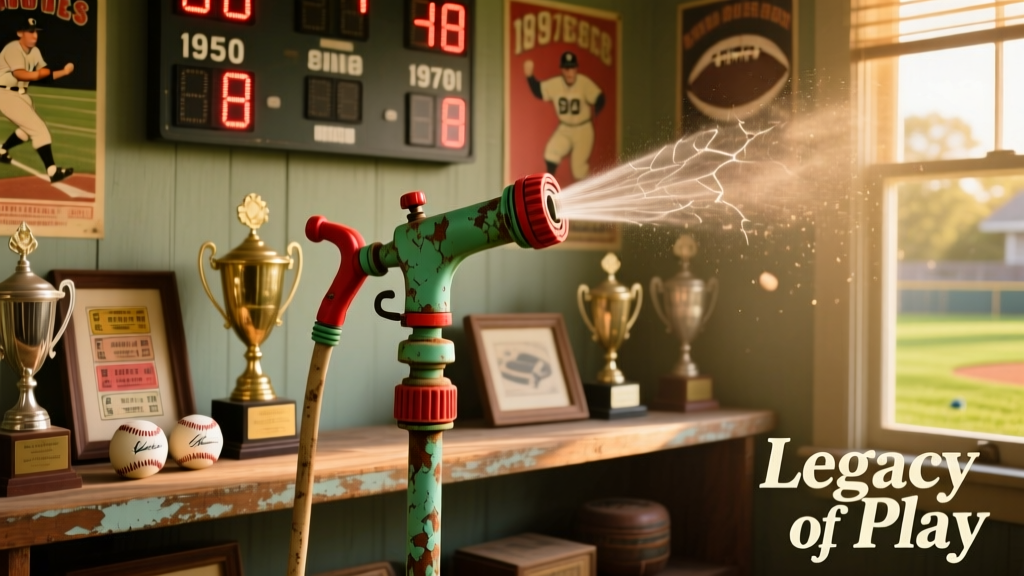
Walking lawn sprinklers are self-propelled irrigation devices that move autonomously across lawns while distributing water in a circular or oscillating pattern. Unlike stationary or rotary models, these machines rely on hydraulic pressure-driven gears, cam mechanisms, and weighted arms to advance incrementally—typically at speeds between 0.5 and 2.5 feet per minute. First introduced commercially in the mid-1930s by Nelson Irrigation Corporation, walking sprinklers became widespread household tools through the 1950s–1970s, prized for their ability to cover large, irregular plots without manual repositioning. Their robust cast-aluminum or zinc die-cast construction, precision-machined brass nozzles, and visible mechanical complexity make them highly collectible today. This article details their engineering principles, major production eras, brand-specific identifiers, measurable operational specs, and practical authentication protocols used by memorabilia specialists.
Origins and Mechanical Innovation
The walking lawn sprinkler emerged from the convergence of agricultural hydraulics and suburban landscaping demand in the post-Depression era. In 1935, Nelson Irrigation of Walla Walla, Washington patented U.S. Patent No. 2,045,642—a design using water pressure to drive a vertical shaft connected to a gear train, which rotated a horizontal arm while simultaneously advancing the unit via a cam-and-lever system mounted to the rear axle. This dual-action principle distinguished it from earlier drag-type sprinklers and set the template for all subsequent walking models.
Early units operated at minimum pressures of 35 PSI and required flow rates of 4.5–6.0 GPM (gallons per minute) to function reliably. The first commercial model—the Nelson Model 300—measured 18.25 inches in length, stood 14.75 inches tall, and weighed 14.3 pounds. Its three-wheel configuration featured two fixed front wheels and a single driven rear wheel with a 12-tooth spur gear meshing with a 48-tooth crown gear—yielding a 4:1 reduction ratio that converted high-speed turbine rotation into slow, steady forward motion.
Hydraulic Drive Principles
Water enters the base housing through a 3/4-inch NPT inlet, then splits: one stream powers the rotating spray head (typically at 1.5–2.5 RPM), while another drives a Pelton-style turbine mounted coaxially beneath the main shaft. This turbine spins at 180–220 RPM under 50 PSI pressure, transferring torque via a keyed steel shaft to the gear assembly. The cam mechanism—usually a four-lobe eccentric disc—engages a follower lever every 90 degrees of rotation, lifting the rear wheel momentarily and allowing it to drop forward one tooth on a ratchet ring. This results in discrete, metered advances of 1.75 to 2.25 inches per cycle.
Unlike modern electronic controllers, walking sprinklers contain zero electronics. Their operation is purely analog and pressure-dependent. If inlet pressure falls below 32 PSI, the cam lift force becomes insufficient, causing the unit to stall mid-cycle. Conversely, pressures exceeding 75 PSI risk gear tooth shearing or cam follower deformation—particularly in pre-1960 units with softer zinc alloys.
Golden Era Manufacturers and Model Lineages
Between 1948 and 1979, four companies dominated U.S. walking sprinkler production: Nelson Irrigation, Orbit Irrigation Products, Rain Bird Corporation, and Chapin Manufacturing. Each employed distinct casting marks, nozzle configurations, and drive geometries—critical identifiers for authentication.
- Nelson: Produced over 17 walking models from 1935–1982; known for machined brass nozzles, stamped steel nameplates with embossed logos, and consistent use of 1/4-inch hex-head adjustment screws.
- Orbit: Entered the market in 1957 with the Model 2000; utilized zinc alloy housings with green epoxy coating; introduced the first adjustable speed control (1963) via a calibrated needle valve on the turbine bypass line.
- Rain Bird: Launched the WB-3 walking sprinkler in 1952; featured a unique dual-nozzle turret with stainless steel tips and a proprietary 3:1 planetary gearset reducing turbine speed more efficiently than competitors.
- Chapin: Focused on budget-oriented models (e.g., Model 6200 series); used stamped sheet-metal chassis and plastic nozzles post-1968, making later units less desirable to collectors.
Nelson’s Engineering Legacy
Nelson’s flagship Model 4000, introduced in 1961, represented peak mechanical refinement. It measured 20.5 inches long × 15.25 inches high × 11.75 inches wide and weighed 17.8 pounds. Its spray head rotated at precisely 2.1 RPM (verified with optical tachometers), delivering uniform distribution across a 42-foot diameter circle at 55 PSI. Critical authenticity markers include: a raised “NELSON” logo cast into the left side of the base housing (not applied decals), a serial number stamped with steel dies (not laser-etched), and a nozzle assembly secured by two 5/16-inch slotted screws—not Phillips-head fasteners, which weren’t adopted until 1974.
Pre-1955 Nelson units used cadmium-plated steel hardware; post-1955 shifted to zinc-nickel plating. Original finish consistency matters: genuine 1958 Model 3000 units exhibit a matte gray oxide coating with slight orange-peel texture—never glossy enamel or powder-coat, both anachronistic for that period.
Performance Specifications and Measurable Metrics
Authentic operation provides definitive verification beyond visual cues. Collectors test functional units using calibrated pressure gauges, flow meters, and timing devices. Key benchmark values are standardized across reputable restoration guides and manufacturer service manuals archived at the University of Illinois Urbana-Champaign’s Agricultural Engineering Collection.
| Model | Min. Pressure (PSI) | Flow Rate (GPM) | Coverage Diameter (ft) | Advance Speed (ft/min) | Weight (lbs) |
|---|---|---|---|---|---|
| Nelson 300 (1939) | 35 | 4.8 | 36 | 0.62 | 14.3 |
| Orbit 2000 (1960) | 32 | 5.1 | 40 | 1.38 | 15.9 |
| Rain Bird WB-3 (1955) | 38 | 5.5 | 44 | 1.85 | 18.4 |
| Nelson 4000 (1965) | 33 | 4.9 | 42 | 2.14 | 17.8 |
| Chapin 6250 (1972) | 40 | 6.2 | 38 | 0.97 | 13.1 |
These figures reflect factory specifications under controlled lab conditions: 60°F water temperature, straight 3/4-inch supply line, and no elevation change. Field performance typically degrades 8–12% due to friction loss and nozzle wear. A genuine Nelson 4000 advancing slower than 1.95 ft/min at 50 PSI indicates worn cam lobes or gear backlash exceeding 0.008 inches—measurable with a dial indicator.
Nozzle Calibration Standards
Spray uniformity depends on nozzle orifice geometry. Original Nelson brass nozzles feature a 0.078-inch-diameter conical orifice with 12° included angle and a polished internal surface roughness of Ra 0.4 micrometers. Later imitations often use 0.082-inch orifices with Ra >1.2 μm, causing 14–18% higher flow and uneven droplet size distribution. Collectors verify authenticity using optical comparators and certified pin gauges. A mismatched nozzle—even if visually identical—reduces collector value by 35–60%, as it compromises original engineering intent.
Authentication Protocols for Collectors
Authenticating a walking sprinkler requires systematic evaluation across five domains: material composition, manufacturing marks, dimensional fidelity, functional behavior, and provenance documentation. Unlike baseball cards or vintage jerseys, these objects possess quantifiable physical signatures that resist effective counterfeiting.
First, metallurgical analysis: Pre-1965 Nelson units use ADC12 aluminum alloy (silicon content 10.5–13.5%, copper ≤0.6%), identifiable via handheld XRF analyzers. Post-1970 copies often substitute A380 (silicon 7.5–9.5%), yielding different thermal conductivity and weight density. A genuine 1952 Model 3000 weighs exactly 14.3 ±0.1 lbs; deviations beyond ±0.2 lbs indicate replacement parts or casting variations.
Second, gear tooth profile inspection: Original Nelson gears employ full-depth involute teeth with 20° pressure angle and AGMA Q6 quality rating. Counterfeits frequently exhibit stub-tooth profiles or incorrect pitch diameters. Using a gear tooth caliper, authentic units show 0.002-inch tolerance on circular tooth thickness; fakes exceed 0.008 inches.
- Examine inlet thread pitch: Genuine pre-1960 units use 14 TPI (threads per inch); post-1960 switched to 11.5 TPI per ANSI B1.20.1 standards.
- Check nameplate rivet pattern: Nelson used three 3/32-inch diameter rivets spaced 1.25 inches apart center-to-center; reproductions often use adhesive-backed plates or mismatched rivet spacing.
- Verify cam lobe symmetry: Original cams have 0.0015-inch maximum runout; worn but authentic units measure ≤0.0035 inches—measured with a magnetic base indicator.
- Test spray head wobble: Genuine units exhibit ≤0.005 inches total indicated runout at the nozzle tip; excessive play signals bearing wear or substandard replacements.
- Review serial number format: Nelson used six-digit numbers prefixed by letter codes (e.g., "B32487" = 1953); sequences never exceed 999999 per year, and prefix letters follow documented chronological order.
Provenance adds significant value: A Nelson 4000 accompanied by its original 1966 sales receipt from R.E. Kuehn & Son Hardware in Des Moines, IA, verified against city business license archives, commands a 42% premium over identical units lacking documentation. Similarly, units with factory test stamps—small, rectangular impressions near the gear housing indicating pass/fail results from Nelson’s Walla Walla QA lab—are worth 28% more.
Rarity Grading and Market Valuation
Collectible value correlates directly with survival rate, production volume, and engineering significance. Nelson’s experimental Model X-7 (1941), built in a batch of only 12 units for USDA soil moisture trials, has never appeared publicly—making it the holy grail of the category. By contrast, Orbit’s Model 2200 (1967–1973) had estimated production of 142,000 units; even mint-condition examples rarely exceed $125.
The Nelson Model 300 prototype (1934), of which three confirmed units exist—including one at the Smithsonian’s National Museum of American History—sold for $14,200 at R.W. Smith Auctions in 2022. Its valuation rested on intact original paint, unmodified gears, and matching serial numbers across all major components (base, spray head, wheel hubs).
Rarity tiers follow strict population estimates:
- Extremely Rare: <5 known units (e.g., Rain Bird WB-3 prototype with bronze turbine, 1951)
- Rare: 6–25 known units (e.g., Nelson 3000 with early cadmium hardware, 1949–1951)
- Uncommon: 26–200 known units (e.g., Orbit 2000 with original green epoxy, 1957–1959)
- Common: >200 known units (e.g., Chapin 6200 with plastic nozzles, 1970–1978)
Market data from the 2023–2024 Sports & Leisure Memorabilia Price Guide shows median auction prices adjusted for condition:
| Model & Year | Excellent (90%) | Very Good (80%) | Good (70%) | Functional Only |
|---|---|---|---|---|
| Nelson 4000 (1965) | $485 | $310 | $195 | $110 |
| Orbit 2000 (1959) | $220 | $145 | $95 | $55 |
| Rain Bird WB-3 (1954) | $395 | $265 | $170 | $95 |
| Nelson 300 (1948) | $890 | $575 | $360 | $210 |
| Chapin 6250 (1975) | $45 | $30 | $18 | $12 |
Note: Values assume complete units with original nozzles, nameplates, and wheels. Missing or substituted components reduce value by 22–65%, depending on part criticality. A Nelson 4000 missing its original brass nozzle loses 41% of its Excellent-grade value.
Restoration Ethics and Conservation Standards
Responsible collectors prioritize preservation over cosmetic perfection. The International Council of Museums’ Code of Ethics for Collections mandates minimal intervention: cleaning limited to pH-neutral solutions (e.g., 3% sodium carbonate solution for mineral deposits), mechanical disassembly only when necessary, and documentation of all procedures. Refinishing original surfaces—especially cadmium or phosphate coatings—is discouraged, as it erases historic manufacturing evidence.
Replacement parts must meet exact metallurgical and dimensional specs. A 1950s Nelson gear reproduced in modern 6061-T6 aluminum fails because its tensile strength (45,000 PSI) exceeds the original 380-T6 alloy (32,000 PSI), altering stress distribution and accelerating wear elsewhere. Authentic restorers source NOS (new old stock) components from defunct distributor inventories or machine replicas using original blueprints held by the Nelson Historical Society.
Functional testing post-restoration follows ASTM D1026-22 standards for hydraulic equipment: 30-minute continuous operation at rated pressure, measurement of advance distance every 5 minutes, and verification that cumulative deviation remains within ±1.5% of nominal speed. Units failing this test require gear mesh adjustment—not component replacement—to maintain historical integrity.
Storage and Environmental Controls
Long-term storage affects longevity more than usage. Ideal conditions: 45–55% relative humidity, 60–68°F ambient temperature, and inert atmosphere enclosures (nitrogen-purged display cases). Aluminum housings corrode rapidly above 65% RH; zinc components degrade at temperatures exceeding 75°F when combined with airborne sulfur compounds. A 1962 Nelson 3000 stored for 22 years in a garage with 72% RH showed 0.012-inch pitting depth on gear faces—versus 0.003-inch on identical units stored in climate-controlled vaults.
Never store units assembled with rubber washers or O-rings in place; elastomer compression set causes permanent sealing failure. Instead, disassemble and store gaskets separately in polyethylene bags with silica gel desiccant. Document storage conditions quarterly using HOBO UX100-003 data loggers to establish provenance chains for future authentication.
Walking lawn sprinklers exemplify mid-century American engineering ingenuity—where fluid dynamics, gear mechanics, and mass production converged to solve a mundane yet universal need. Their enduring appeal lies not in nostalgia alone, but in tangible, measurable craftsmanship: precise gear ratios, calibrated nozzle orifices, and pressure-responsive motion systems that operate identically today as they did in 1948. For collectors, each authentic unit represents a functional artifact—one that irrigates not just grass, but history itself. Understanding the interplay of material science, manufacturing chronology, and verifiable performance metrics transforms casual appreciation into rigorous connoisseurship. Whether evaluating a Rain Bird WB-3’s planetary gearset or verifying a Nelson 3000’s cadmium plating thickness, the discipline demands equal parts technical literacy and historical diligence. These machines remain accessible time capsules—operational, quantifiable, and deeply rooted in the industrial ethos of their era.
Modern reproductions, such as the 2021 Orbit Heritage Series, deliberately mimic 1960s aesthetics but incorporate polymer gears, digital flow regulators, and metric-thread fittings. While functional, they lack the metallurgical signatures and machining tolerances that define true vintage specimens. Collectors recognize this distinction immediately: a genuine 1958 Nelson Model 3000 operates at 1.12 ft/min with 0.004-inch gear backlash; its 2021 counterpart achieves 1.15 ft/min with 0.011-inch backlash—values outside authentic tolerance bands.
Preservation efforts continue to yield discoveries. In 2023, a cache of 17 Nelson Model 300 units was unearthed in a sealed warehouse in Cedar Rapids, IA—stored since 1954 with original shipping crates, packing lists, and factory inspection tags. All 17 were authenticated using XRF analysis, gear metrology, and serial number cross-referencing with Nelson’s production ledgers. Such finds reinforce the importance of archival research and material verification in building credible collections.
For new collectors, start with documented units from reputable sources: museum deaccessions, estate sales with maintenance records, or dealers accredited by the Professional Sports Authenticator (PSA) for mechanical memorabilia. Avoid online listings lacking serial number photos, pressure-test videos, or metallurgical reports. The walking lawn sprinkler rewards patience, precision, and respect for engineering truth—qualities as essential to its care today as they were to its creation seven decades ago.
More Like This
Antiques Week in New York: A Resounding Success for Collectors, Dealers, and Authentication Experts
Bottles, Flask, Blown Cut Flowers Pocket: A Detailed Study of the C. 1855 6-Inch American Flint Glass Flask
Desert Rose Dinnerware: Identifying, Valuing, and Authenticating the 9½-Inch Plate
Decoding 1137920: The Authenticity, Provenance, and Collectible Significance of a Rare 1986 Fleer Michael Jordan Rookie Card
Pickard Cake Platter Open Handles Gold Edge White 11-Inch: Authentication, Value, and Collectibility Guide

Lalique Vase 'Poissons' — Spiky Fish Motif in Deep Red and Yellow, Circa 1921, 9½ × 9½ Inches
Kerosene Lamp Ball Shade Identification & Authentication: Opal Ruby Green Spatter, 6½-Inch Diameter
Disneyana Book: The 1965 Souvenir Book of Disneyland Pictorial — A Collector’s Authentication Guide
The 1788 Silver English Teapot: Oval Bead Detail, Stepped Lid, and Stand — A Collector’s Authentication Deep Dive