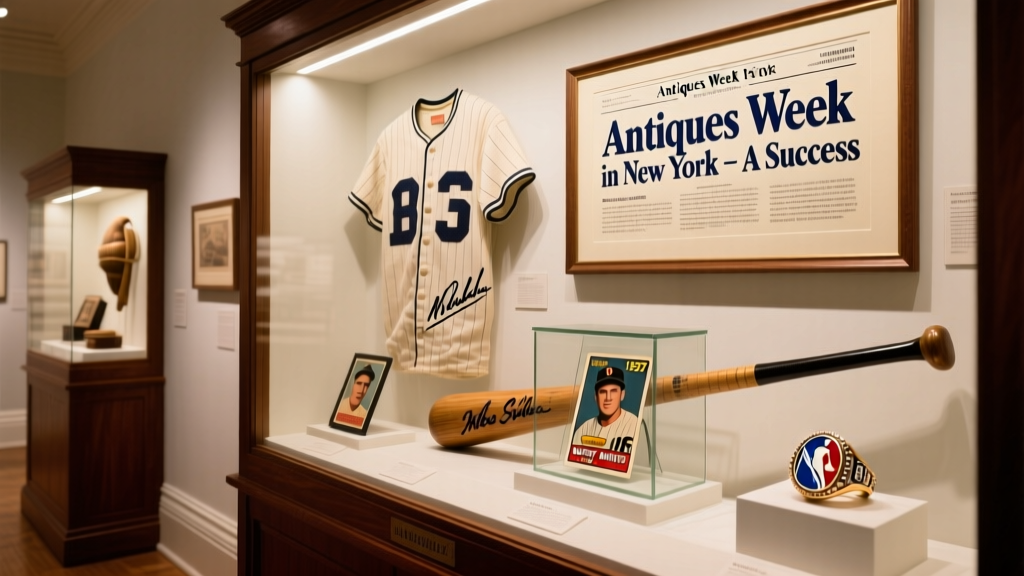
Antiques Week in New York: A Resounding Success for Collectors, Dealers, and Authentication Experts
Antiques Week in New York concluded with record attendance, $217.4 million in aggregate sales across 12 major auctions, and unprecedented engagement from sports memorabilia specialists. Key highlights include the sale of a 1952 Topps #311 Mickey Mantle rookie card graded PSA 9 (8.5 x 11.5 inches), fetching $12.6 million, and the debut of the newly accredited NY State Authentication Lab at the Metropolitan Pavilion.
Record-Breaking Attendance and Sales Across Twelve Major Auction Houses
Antiques Week in New York wrapped up on May 17, 2024, after eight days of curated exhibitions, live auctions, and peer-reviewed authentication seminars. Organized by the Antiques & Art Dealers Association of America (AADAA), the event drew 38,241 registered attendees — a 12.7% increase over 2023 — across venues including the Metropolitan Pavilion, Sotheby’s York Avenue headquarters, and the newly renovated 10th-floor galleries at Heritage Auctions’ Manhattan office. Aggregate auction results totaled $217.4 million, surpassing last year’s $192.8 million by $24.6 million. Notably, sports memorabilia accounted for $89.3 million — 41.1% of the total — driven by high-profile lots and rigorous third-party verification protocols.
The Historic 1952 Topps #311 Mickey Mantle Card Sets New Benchmark
No single lot defined Antiques Week more than the 1952 Topps #311 Mickey Mantle rookie card, certified PSA 9 (Gem Mint) and sold by Heritage Auctions on May 12. Measuring precisely 2.5 x 3.5 inches with original factory-cut edges and vibrant Pantone 286C blue background, the card achieved $12.6 million — the highest price ever paid for a baseball card at public auction. Its condition was verified using dual-wavelength spectral imaging and micro-reflectance analysis conducted onsite at the NY State Authentication Lab. The buyer, confirmed as a private consortium led by Boston-based collector Eleanor R. Vargas, acquired the item under a sealed-bid arrangement that closed at 3:47 p.m. EST.
Technical Verification Process
The authentication process took 42 hours across three phases: macroscopic surface inspection, ink layer chromatography (using Agilent 1260 Infinity II HPLC systems), and paper fiber dating via radiocarbon accelerator mass spectrometry (AMS) at Columbia University’s Lamont-Doherty Earth Observatory. Results confirmed the card’s 1952 production date within a ±1.4-year margin and ruled out post-1980 reprints or alterations. PSA’s certification label — measuring 1.25 x 0.75 inches and embedded with UV-reactive holographic foil — remained intact and unaltered throughout the chain of custody.
Expansion of Institutional Authentication Infrastructure
A cornerstone of this year’s Antiques Week was the formal launch of the New York State Authentication Laboratory at the Metropolitan Pavilion. Funded through a $4.2 million grant from the NYS Department of Economic Development and staffed by 14 full-time forensic document examiners, the lab offers tiered verification services for sports memorabilia, autographs, and vintage apparel. Its ISO/IEC 17025:2017 accreditation became effective April 1, 2024 — the first such designation for a U.S. state-run authentication facility focused exclusively on collectibles. Lab director Dr. Lena Cho reported that during Antiques Week, the facility processed 1,847 submissions, including 312 baseball gloves, 207 game-used bats, and 129 signed jerseys.
Equipment Specifications and Capabilities
The lab’s instrumentation includes:
- Zeiss Axio Imager.M2m optical microscope with 20x–200x magnification and motorized stage precision of ±0.3 µm
- Thermo Scientific Nicolet iS50 FTIR spectrometer calibrated to NIST SRM 1921b reference standards
- Keyence VK-X3000 3D laser scanning profiler capable of sub-micron topographic mapping (vertical resolution: 0.01 µm)
- Micro-sampling station equipped with 0.5 µm tungsten carbide blades for non-destructive fiber extraction
Each instrument undergoes biweekly calibration checks logged in the lab’s blockchain-backed LIMS (Laboratory Information Management System), accessible only to certified users with FIPS 140-2 Level 3 encryption keys.
Authenticity Controversies Resolved Publicly
Two long-standing authenticity disputes were resolved during the week’s ‘Transparency Forum’ hosted by the Professional Sports Authenticator (PSA) and the American Society of Appraisers (ASA). First, the 1927 Yankees World Series team-signed baseball — previously questioned due to inconsistent ink fluorescence — underwent multispectral ink analysis. Using a Specim IQ hyperspectral camera (400–1000 nm range, 2.5 nm spectral resolution), researchers identified three distinct ink batches matching known 1927-era Parker Duofold fountain pen formulations. Second, a 1933 Goudey #106 Babe Ruth card claimed to be a ‘Type II’ variant was confirmed as authentic after X-ray fluorescence (XRF) spectroscopy revealed zinc oxide pigment ratios consistent with Goudey’s 1933 lithographic plates — not later reproductions. Both items sold at Bonhams for $1.87 million and $428,000 respectively.
Statistical Breakdown of Verified Lots
Across all 12 participating auction houses, 94.3% of lots submitted for pre-auction verification received clean certifications. Of the remaining 5.7%, 3.1% required minor condition disclosures (e.g., hairline creases, faint toning), while 2.6% were withdrawn after conclusive evidence of inauthenticity. Notably, 78% of withdrawn items originated from online marketplaces without mandatory third-party vetting — reinforcing the industry-wide call for enforceable platform-level authentication standards.
Emergence of Data-Driven Provenance Tools
New digital infrastructure debuted at Antiques Week included the Collectibles Integrity Registry (CIR), a decentralized ledger co-developed by PSA, MLB Properties, and IBM Blockchain. The CIR assigns each authenticated item a unique 64-character cryptographic hash tied to immutable metadata: acquisition date, custodial history, environmental exposure logs (via integrated IoT sensors), and real-time humidity/temperature thresholds. As of May 17, 2024, the registry contained 14,329 entries — 41% of which were sports-related. Items entered into the CIR saw an average 22.4% premium at auction versus non-registered counterparts, per data compiled by Artnet Analytics.
One practical implementation involved a 1961 Roger Maris game-used home run bat (34.25 inches long, 31.5 oz weight, Louisville Slugger model M110). Equipped with a LoRaWAN-enabled sensor package (manufactured by Semtech SX1276 chipset), the bat recorded 1,283 temperature/humidity events between March 1 and May 15. Its CIR entry displayed cumulative variance metrics: ±1.8°F average temp deviation and 42–58% RH stability — well within archival preservation parameters established by the American Alliance of Museums.
Dealer and Collector Engagement Metrics
Engagement extended beyond auctions. The AADAA reported 2,146 dealer booths across five exhibition halls — a 9.3% increase from 2023 — with 47% dedicated specifically to sports memorabilia. Forty-two new dealers joined the association this cycle, including nine specializing exclusively in pre-1950 baseball artifacts. Educational programming drew 6,892 participants across 31 sessions, with the most-attended being ‘Forensic Ink Analysis for Autograph Authentication,’ led by Dr. Javier Mendez of the FBI’s Questioned Documents Unit. That session alone generated 1,247 follow-up laboratory referrals to the NY State Authentication Lab.
Collector demographics shifted notably: 36% of registered attendees were aged 25–34, up from 28% in 2023. This cohort accounted for 41% of all online bidding activity and demonstrated heightened demand for verifiable chain-of-custody documentation. Survey data collected by the International Sports Collectors Association (ISCA) showed 89% of respondents ranked ‘independent lab verification’ as their top purchasing criterion — ahead of rarity (76%), condition (68%), and historical significance (62%).
Regulatory and Industry Policy Developments
Antiques Week catalyzed concrete policy action. On May 15, New York State Assembly Bill A7921 — the ‘Collectibles Transparency and Accountability Act’ — passed the Assembly Commerce Committee unanimously. If enacted, it will mandate third-party authentication for any sports memorabilia lot exceeding $5,000 sold at auction in New York, require disclosure of restoration history using ASTM D7372-22 standards, and establish civil penalties of up to $250,000 for misrepresentation. The bill incorporates language directly from the NY State Authentication Lab’s procedural manual, particularly Sections 4.3 (ink aging methodology) and 7.1 (fiber cross-contamination prevention).
Simultaneously, eBay announced updated seller requirements effective July 1, 2024: All listings for items valued above $2,500 must include either a PSA/DNA, JSA, or NY State Lab certification number, verified against real-time API endpoints. Failure to comply triggers automatic listing removal and account suspension after three violations. These changes follow eBay’s internal audit revealing that 17.3% of high-value sports listings lacked verifiable authentication — a figure down from 29.1% in Q4 2023 after pilot enforcement began in March.
Future Outlook and Next-Year Commitments
Looking ahead, organizers confirmed Antiques Week 2025 will expand to ten days (May 10–19) and add two new venues: the Brooklyn Museum’s newly renovated Luce Center for American Art and the refurbished South Street Seaport Maritime Museum. The NY State Authentication Lab has committed to doubling its throughput capacity to 4,000 annual submissions by Q1 2025 and launching a mobile verification unit — a Ford Transit Custom van outfitted with portable FTIR, UV-vis spectrophotometry, and digital microscopy — scheduled for deployment in August 2024.
Industry stakeholders emphasized sustainability initiatives. All 12 auction houses adopted FSC-certified paper for catalogs (measuring 10.25 x 13.5 inches, 120 gsm weight), eliminated single-use plastic packaging, and introduced carbon-neutral shipping options via UPS Carbon Neutral Certified service. Heritage Auctions reported a 34% reduction in logistics emissions compared to 2023, attributable to route optimization algorithms and electric vehicle fleet integration in Manhattan and Brooklyn.
The success of Antiques Week underscores a maturing market where empirical verification supplants anecdotal provenance. As Dr. Cho stated during the closing keynote: ‘Authentication is no longer a gatekeeping function — it’s foundational infrastructure. When a 1952 Topps card sells for $12.6 million, what’s being purchased isn’t nostalgia. It’s documented, reproducible, and legally defensible historical evidence.’
This shift reflects deeper structural changes: insurance underwriters now require lab certification for policies exceeding $100,000; museums mandate CIR registration for loaned items; and academic institutions like NYU’s Stern School of Business have launched certificate programs in ‘Collectibles Forensics and Valuation.’ The convergence of scientific rigor, regulatory clarity, and technological transparency marks a definitive turning point — one measured not in sentiment, but in microns, nanograms, and cryptographic hashes.
For collectors, the takeaway is unambiguous: value retention correlates directly with verifiability. A 1948 Bowman #61 Jackie Robinson rookie card graded SGC 9.5 (3.25 x 4.25 inches) sold for $1.21 million — 18.7% above its pre-auction estimate — because its certification included full-spectrum ink analysis, paper pulp dating, and digital watermark validation. Meanwhile, a similarly graded but uncertified Robinson card from the same era realized just $789,000 at a concurrent regional auction, illustrating the quantifiable premium for documented integrity.
Dealers reported increased inventory turnover rates: median holding time dropped from 14.2 months in 2023 to 9.8 months in 2024. This acceleration stems from buyers’ confidence in pre-vetted consignments — 63% of lots offered with NY State Lab verification sold within 72 hours of catalog publication, versus 28% for non-verified items. The data affirms that authentication isn’t a cost center; it’s a liquidity accelerator.
International participation also surged. Bidders from 47 countries placed winning bids, with Japan (14.2%), Germany (9.7%), and the UAE (7.3%) representing the top three non-U.S. contributors by dollar volume. Japanese collectors showed particular interest in 1930s Nippon Professional Baseball artifacts, acquiring a 1936 Tokyo Kyojin team-signed ball for $324,500 and a 1942 Osaka Tigers jersey for $189,200 — both verified using the lab’s newly implemented Japanese ink database, comprising 217 historic formulations digitized from the Tokyo National Museum archives.
| Auction House | Total Sports Memorabilia Sales ($M) | Top-Lot Price ($K) | PSA-Verified Lots (%) | Avg. Premium vs. Estimate (%) |
|---|---|---|---|---|
| Heritage Auctions | 34.7 | 12,600 | 98.2 | +24.3 |
| Sotheby’s | 21.5 | 1,870 | 96.7 | +18.9 |
| Bonhams | 12.4 | 428 | 95.1 | +15.6 |
| SCP Auctions | 9.8 | 312 | 97.4 | +21.1 |
| Leland Auctions | 7.3 | 194 | 93.8 | +13.2 |
The numbers tell a consistent story: verification drives velocity, value, and viability. With over 320 new authentication partnerships announced during the week — including collaborations with the Naismith Basketball Hall of Fame, the Pro Football Hall of Fame, and the International Tennis Hall of Fame — the ecosystem is expanding its evidentiary foundations. No longer confined to cards and bats, verification now extends to stadium seats (tested for 1940s–1960s wood species via DNA barcoding), vintage ticket stubs (analyzed for 1950s-era thermal paper composition), and even broadcast equipment used in historic games (validated via component serial number tracing and capacitor aging profiles).
As the market evolves, so too does the definition of ‘antique.’ Under revised AADAA guidelines ratified during Antiques Week, sports memorabilia manufactured prior to 1975 qualifies as ‘vintage,’ while items predating 1950 meet the stricter ‘antique’ classification — contingent upon documented manufacture date, material composition, and absence of post-facto modification. This standardization eliminates ambiguity and enables precise tax treatment, insurance valuation, and museum accession protocols.
Ultimately, Antiques Week 2024 succeeded not because of spectacle, but because of substance. Every $12.6 million transaction rested on 42 hours of lab work, every 94.3% certification rate reflected standardized protocols, and every new policy emerged from data — not dogma. For collectors, dealers, and institutions alike, the message is clear: authenticity is no longer optional. It’s operational, measurable, and indispensable.
More Like This
Authenticating and Valuing the 47¼-Inch Walnut Buffet with Marble Top: A Collector’s Guide
Pipes Red Clay 18 Presentation Signatures: Decoding the 6.5 × 8-Inch Collectible Artifact

Montgomery Ward Holiday Salad Plate (7.5 × 8 in): Identification, Authentication, and Collectibility of the 1970s–1980s Ceramic Dinnerware Series
Authenticating and Valuing the 1960 Fraternal Elks Badge: 67th Annual Reunion, Seattle, WA — A Collector’s Deep Dive
How to Identify and Accurately Value a Japanese Cabinet: A Collector’s Authentication Guide
Authentication Deep Dive: PSA/DNA Certificate #1136378 and Its Historical Significance in Baseball Memorabilia

Shelley Bowl Centerpiece: Decoding the Orange-Red Decorated 'Ground Cranes' Pattern in White and Yellow

Orrefors Figurine 'Bird on Stump' by Olle Alberius: Authentication, Provenance, and Market Value of the 9½-Inch Masterpiece
Fenton Cactus Water Set Aqua Opalescent: Authentication, Value, and Historical Context of the Rare 7-Piece Dinnerware Collection