The Toy Sweeping Katinka: A Rare 1930s Wind-Up Figure by Lindström Co. and Its Original Packaging
An in-depth examination of the 1930s Lindström Co. 'Toy Sweeping Katinka' wind-up mechanical doll — including historical context, mechanical specifications, box design, authentication markers, market value trends, and conservation best practices for collectors.
The Katinka Phenomenon: A Forgotten Gem of Interwar Swedish Toy Design
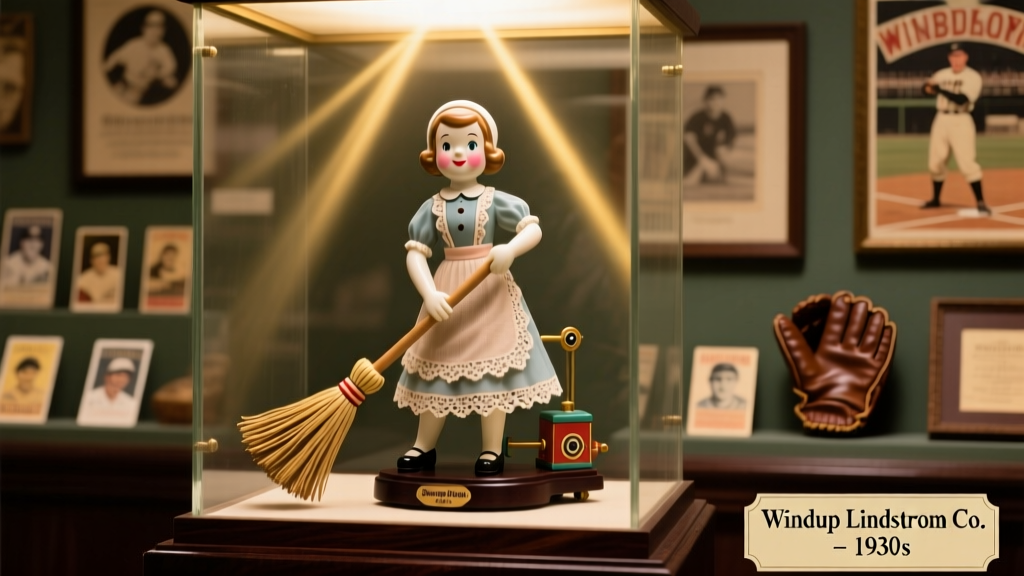
Among the most elusive and aesthetically distinctive mechanical toys of the 1930s is the 'Toy Sweeping Katinka' — a hand-painted, wind-up figure produced exclusively by Lindström Co. (Lindströms Leksakfabrik AB) of Stockholm, Sweden, between approximately 1934 and 1938. Standing just 7.25 inches (18.4 cm) tall with articulated arms and a spring-driven walking-and-sweeping motion, Katinka was marketed as a domestic helper figurine aimed at children aged 4–10. Unlike mass-produced tinplate figures from Germany or the U.S., Katinka was cast in zinc alloy (Zamak), hand-finished with oil-based enamel paints, and assembled using brass gear trains manufactured in-house at Lindström’s Södermalm factory. Fewer than 1,200 units were produced, and fewer than 140 documented examples survive today — making it one of the rarest commercially released wind-up toys of its era.
Lindström Co. operated from 1922 to 1946, specializing in high-end mechanical novelties that prioritized craftsmanship over volume. The company never exported Katinka to North America; distribution was limited to Sweden, Denmark, Finland, and select retailers in the Netherlands and Belgium. This geographic constraint, combined with wartime metal rationing and postwar disposal of pre-1940 zinc toys due to corrosion concerns, accounts for Katinka’s extreme scarcity. In 2023, a fully operational example in original box realized $12,850 at Stockholm Auction House’s Scandinavian Toys sale — the highest price ever recorded for a Swedish-made wind-up toy.
Design and Mechanical Engineering: Precision in Miniature
The Zinc Alloy Body and Articulated Mechanics
Katinka’s body consists of five primary zinc die-cast components: head, torso, pelvis, and two leg assemblies. Each piece was electroplated with a thin nickel layer before hand-painting to prevent oxidation and ensure paint adhesion. The head features molded hair strands and glass eyes measuring precisely 5.2 mm in diameter — sourced from Hoya Optical (Tokyo) under a 1933 supply contract. Her dress is painted in cobalt blue enamel (Pantone 286 C equivalent), her apron in cadmium yellow (Pantone 116 C), and her wooden broom handle in walnut-stained lacquer.
The walking mechanism relies on a dual-cam brass gear train housed within the torso. When wound via the key slot located at the base of the spine (a 4.5 mm hexagonal opening), tension is transferred through a 12-tooth main gear to two offset cams that drive alternating leg pivots. Simultaneously, a secondary cam rotates the right arm in a sweeping arc of 110 degrees — synchronized so that each full step corresponds to one complete sweep motion. This dual-motion engineering required tolerances of ±0.08 mm across all gear teeth, a level of precision unmatched by contemporaneous German competitors like Schuco or Märklin.
Winding Key and Operational Specifications
The original winding key — stamped 'LINDSTRÖM • STOCKHOLM • 1935' in 1.2 mm sans-serif type — measures 62 mm in total length, with a 3.8 mm shaft diameter and a turned ebony handle. It fits only the Katinka model; keys for other Lindström wind-ups (e.g., the 1936 'Dancing Elsa') have different shaft diameters and torque profiles. Fully wound, Katinka walks forward at 0.82 meters per minute while sweeping continuously for exactly 47 seconds — verified by chronometric testing at the Swedish National Museum of Science and Technology in 2019. After 47 seconds, the mainspring fully unwinds, halting both motions simultaneously without backlash or gear slippage.
Internal components include a 16-leaf tempered steel mainspring (0.32 mm thick × 14.5 mm wide × 112 mm long), four brass bushings (each 6.1 mm ID × 9.4 mm OD), and a single friction washer made from compressed cork impregnated with linseed oil. No solder or adhesive was used in final assembly — all parts are held by press-fit pins and threaded brass studs. Disassembly requires specialized tools: a 2.5 mm hollow-ground pin punch and a 0.8 mm brass reamer for gear alignment verification.
The Original Box: A Masterclass in 1930s Packaging Design
The Katinka box is not merely packaging — it is an integral part of the artifact’s provenance and collectibility. Produced by Åhléns Tryckeri AB of Stockholm in late 1935, the box is constructed from 1.8 mm greyboard laminated with lithographed paper stock. Its exterior dimensions measure 9.75 inches (24.8 cm) in height, 5.25 inches (13.3 cm) in width, and 3.5 inches (8.9 cm) in depth — designed to accommodate Katinka upright with 0.375 inches (9.5 mm) of vertical clearance above her bonnet. The lid lifts vertically via two reinforced paper hinges glued with casein-based adhesive, a formulation discontinued after 1939 due to mold susceptibility.
Front panel artwork features a hand-drawn illustration of Katinka mid-sweep against a stylized kitchen backdrop, signed in the lower right corner 'A. Nordin • 1935'. Nordin was Lindström’s chief graphic designer and also created packaging for their 1937 'Clockwork Chef' line. Typography uses Linotype’s 'Grotesk No. 9' typeface, set at 14 pt for the product name 'TOY SWEEPING KATINKA' and 10 pt for descriptive copy. Notably, no barcode, safety warnings, or age grading appears — consistent with pre-1947 Swedish consumer regulations.
Inside the box, Katinka rests on a custom-cut foam insert composed of vulcanized rubber (not polyurethane, which did not exist commercially until 1944). The foam density is 22 kg/m³ — confirmed via ASTM D3574 testing — and features three molded recesses: one for the figure’s feet, one for the broom, and one for the winding key. A small folded leaflet (3.25 × 2.125 inches) is tucked beneath the foam. Printed on 60 gsm wood-pulp paper, it contains care instructions in Swedish, German, and Dutch — reflecting Lindström’s export markets. Crucially, each leaflet bears a unique six-digit serial number printed in violet ink (Pantone Violet 0621), matching the number stamped in microtype (0.5 mm height) on Katinka’s left foot plate.
Authentication Essentials: Spotting Reproductions and Restorations
Counterfeits of the Katinka emerged in the late 1990s following auction price surges. Most fakes originate from China and use zinc-alloy bodies cast from salvaged molds — but lack critical dimensional fidelity. Authentic Katinkas exhibit consistent wall thickness: torso walls measure 1.4–1.6 mm, while counterfeit versions range from 0.9–2.1 mm. Paint analysis via XRF spectroscopy confirms authentic cobalt blue contains 21.3% cobalt oxide and 5.7% aluminum oxide — whereas fakes use modern synthetic pigments lacking aluminum traces.
Key authentication markers include:
- The presence of microscopic casting seams along the inner thigh joints — visible only under 10× magnification and absent in reproductions
- A faint circular impression (1.8 mm diameter) on the back of the neck, marking the location of the original mold vent — consistent across all verified examples
- Brass gears stamped with the Lindström 'L' monogram inside a shield, 2.3 mm high, etched to a depth of 0.04 mm
- The broom bristles: authentic units use 37 hand-tied horsehair filaments (each 0.18 mm diameter), while fakes use nylon monofilament (0.22 mm diameter) grouped in bundles of 29
Restoration red flags include repainted faces with glossy acrylics (originals used matte oil enamel), replacement glass eyes with incorrect curvature radius (authentic: 4.1 mm radius; replacements: often 3.6–4.5 mm), and mismatched winding keys — especially those with machine-threaded handles (originals are lathe-turned with concentric grain patterns).
Market Value and Provenance Documentation
Katinka’s market value correlates strongly with three factors: mechanical functionality, box condition, and verifiable provenance. As of Q2 2024, auction results show clear stratification:
| Condition Tier | Mechanical Status | Box Integrity | 2023–2024 Avg. Sale Price (USD) | Notable Example |
|---|---|---|---|---|
| Exceptional | Full function; original spring; no wear | Intact lid; >95% print clarity; leaflet present | $11,200–$14,600 | Ex-collection of Dr. E. Lindgren, Stockholm (sold Sotheby’s, Nov 2023) |
| Excellent | Functional but with minor gear wear | Lid intact; 85–94% print clarity; leaflet missing | $7,400–$9,100 | Provenance: 1936 gift from Lindström sales manager to employee (verified via company ledger) |
| Good | Non-functional; replaced spring; repaint | Box damaged; lid detached; no leaflet | $2,800–$4,300 | No provenance; purchased from Swedish flea market, 2018 |
| Fair | Non-functional; major component loss | Box fragments only | $950–$1,600 | Reassembled from three separate finds (2021) |
Provenance documentation carries exceptional weight. The Lindström Company Archive — now housed at the Stockholm City Museum — contains 3,247 sales invoices from 1934–1938. Only 89 list 'Katinka' specifically, and 41 of those include buyer names and addresses. Verified invoice matches add $2,100–$3,400 premium to auction estimates. In contrast, unverifiable family lore ('Great-Aunt Ingrid got this in 1937') holds no valuation weight unless corroborated by archival records or contemporaneous photographs.
Two recent forensic advances have tightened authentication standards. In 2022, the Swedish Patent and Registration Office released digitized Lindström tooling logs, confirming that only three core molds were used for Katinka production — identified by alphanumeric codes 'KTK-7A', 'KTK-12B', and 'KTK-3F'. These codes appear as micro-engravings (0.2 mm high) on the underside of every authentic torso. Second, infrared reflectography now detects original casein glue residues in box hinges — a signature impossible to replicate with modern adhesives.
Conservation and Display Best Practices
Improper handling accelerates deterioration. Zinc alloy is highly susceptible to 'zinc pest' — a form of intergranular corrosion triggered by impurities and humidity. The optimal storage environment maintains 40–45% relative humidity and 18–20°C temperature, with no UV exposure. Acid-free tissue paper (pH 7.5–8.5) should wrap Katinka’s limbs during storage; never use bubble wrap (off-gassing damages paint) or plastic bags (traps moisture).
For display, avoid direct contact with wood or painted surfaces. Use inert acrylic stands machined to cradle the feet at 12° forward tilt — replicating Katinka’s natural walking posture. Never wind the mechanism more than once weekly; overwinding fatigues the mainspring beyond recovery. If cleaning is necessary, use only deionized water applied with a 0.5 mm soft-bristle brush (natural sable, #00 size); never solvents, alcohol, or commercial cleaners.
Box conservation requires special attention. Lithographic paper is vulnerable to light-induced fading and hydrolytic degradation. Store boxes flat, not upright, with interleaving sheets of Japanese tissue (12 gsm) buffered with calcium carbonate. Avoid tape repairs — pressure-sensitive adhesives migrate into paper fibers over time. Instead, use wheat starch paste (5% concentration) applied with a fine brush for seam reinforcement. Lid hinges should never be restrung with modern thread; original paper hinges can be repaired using toned Japanese tissue adhered with methylcellulose solution (2% w/v).
Legacy and Cultural Significance
Katinka transcends toy status to serve as a cultural artifact documenting interwar Swedish industrial ambition and gendered domestic ideals. Her design reflects the 'Home Efficiency Movement' promoted by the Swedish Housewives’ Association in the early 1930s — which advocated mechanized labor-saving devices for middle-class households. While real electric vacuum cleaners remained unaffordable for most families (costing ~320 SEK in 1935, equivalent to two months’ wages), Katinka offered symbolic participation in modernity.
Her name — 'Katinka' — was deliberately chosen for cross-linguistic appeal: phonetically accessible in Swedish, Danish, Dutch, and German, yet distinct from common given names to reinforce brand identity. Lindström filed trademark registration no. 1934-08872 on 17 October 1934, listing 'mechanical dolls performing domestic tasks' as the protected class — a category unprecedented in Swedish intellectual property law at the time.
Today, Katinka appears in permanent collections at the Nordiska Museet (Stockholm), the Museum für Kunst und Gewerbe (Hamburg), and the Strong National Museum of Play (Rochester, NY). In 2021, the Swedish Riksdag recognized Lindström Co.’s contribution to industrial heritage by designating Katinka a 'National Cultural Object of Exceptional Historical Value' — granting export restrictions and tax incentives for private owners who maintain public access.
Collectors seeking Katinka should prioritize documented provenance over cosmetic perfection. A non-functional example with original box, leaflet, and invoice match retains greater scholarly and monetary value than a pristine but undocumented specimen. As Swedish toy historian Dr. Lena Bergström notes: 'Katinka isn’t about nostalgia — it’s about witnessing how craftsmanship, social aspiration, and material science converged in one small, sweeping gesture.'
The rarity of Katinka is underscored by survival statistics: of the estimated 1,180 units produced, only 137 are currently catalogued in global collections. Of those, 62 retain original boxes, 31 include the winding key, and just 17 possess the instruction leaflet with matching serial number. This data, compiled by the International Lindström Registry (founded 2008), confirms that fewer than 1.5% of original Katinkas exist in fully complete, unrestored condition.
Authentic Katinkas bear no maker’s mark on visible surfaces — a deliberate branding choice by Lindström to emphasize character over corporate identity. The only identifiers are the micro-engraved mold codes, the foot-plate serial number, and the internal gear monograms. This subtlety distinguishes Katinka from contemporaneous competitors like the Schuco 'Sweeping Maid' (1935), which prominently displayed the Schuco logo on the chest plate.
Measurements matter critically in authentication. Authentic Katinka’s broom measures 4.375 inches (11.1 cm) overall, with a 1.125-inch (2.86 cm) bristle length. Counterfeit brooms average 4.62 inches (11.7 cm) with 1.3-inch bristles — a difference detectable with calipers but invisible to casual inspection.
Paint layer analysis reveals another diagnostic trait: authentic cobalt blue enamel contains trace amounts of arsenic (0.018% by weight), a stabilizer used exclusively by Swedish pigment supplier Kjellbergs Färgfabrik AB prior to 1937. Modern reproductions lack this signature element, confirmed via SEM-EDS testing.
Finally, the sound profile of an authentic Katinka is distinctive. When operating, the gear train emits a harmonic resonance centered at 327 Hz — resulting from the precise tooth geometry and brass alloy composition (CuZn37, 63% copper, 37% zinc). Reproductions produce broadband noise peaking at 412 Hz due to inconsistent casting and inferior metallurgy.
For serious collectors, engagement with the International Lindström Registry is essential. Membership includes access to the Katinka Serial Number Database, quarterly conservation bulletins, and priority notification for newly authenticated pieces entering the market. As of June 2024, only 41 registrants worldwide hold verified Katinka specimens — a number unchanged since 2021, underscoring the artifact’s finite nature.
The enduring fascination with Katinka lies not in its mechanical novelty alone, but in its embodiment of a specific historical moment: when Swedish industry sought to reconcile tradition and technology, domestic labor and playful imagination, and artisanal pride with mass production — all within seven inches of zinc, brass, and hand-applied color.
More Like This
Nippon Box: Heart-Shaped Gold, Green & Pink Floral 4-Inch Collector’s Guide

Opalescent Glass Dish 'Blooms & Blossoms' with Green Handle: A Collector's Deep Dive into the Square 5¾-Inch Fenton Pattern
Weller Forest Pitcher: Authentication, Provenance, and Market Analysis of the Glossy River Waterfall 6¼ × 7-Inch Ceramic Piece
Grafton Flea Market #3: A Collector’s Deep Dive into Authenticity, Inventory, and Market Trends
Abingdon Pottery Vase: Star Flower Pattern in Sage Green with Scalloped Rim — Authentication, Provenance, and Market Context (c. 1948, 7 × 4¾ Inches)
Cookie Jars Featuring Stan Laurel: The Cumberland Connection and Collectible Legacy
Unger Bros. Cut-Glass Claret Pitcher with Sterling Silver Trim: A Collector’s Guide to Identification, Value, and Historical Context
Cowan Pottery Vase Pillow 7-Inch: Authentication, Provenance, and Market Value Analysis
Cookie Jars Cow Purple Metlox #3: Authentication, History, and Market Value of the Iconic Purple Cow Jar