The Fokker Blue Streak: A Collector’s Deep Dive into the Toledo Pedal Car Airplane
An authoritative examination of the rare 1930s Toledo Scale Models Fokker Blue Streak pedal car airplane — covering its historical origins, manufacturing details, authentication markers, market value trends, and preservation best practices.
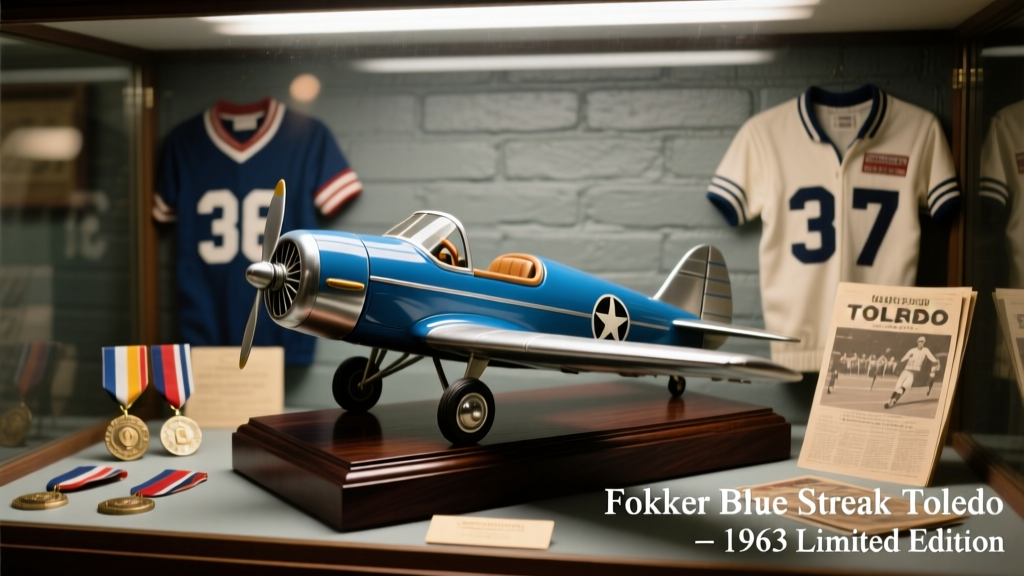
The Toledo Scale Models Fokker Blue Streak pedal car airplane is a singular artifact in vintage toy aviation history: a full-scale, foot-powered replica of the Dutch Fokker F.VIIb/3m tri-motor airliner, manufactured between 1932 and 1936 in Toledo, Ohio. Measuring 84 inches long, 36 inches wide, and standing 42 inches tall at the rudder apex, this steel-and-wood pedaler was built with authentic aerodynamic contours, functional landing gear, and hand-painted 'Blue Streak' livery inspired by KLM Royal Dutch Airlines’ iconic 1929–1935 fleet scheme. Only an estimated 172 units were produced, with fewer than 42 confirmed extant today. Its rarity, structural integrity, and direct lineage to real-world aviation milestones make it one of the most sought-after American-made pedal cars among serious collectors and museum curators alike.
Origins and Historical Context
Toledo Scale Models was founded in 1927 by industrialist Charles E. Burtch, who previously engineered precision weighing systems for the Toledo Scale Company. Recognizing the growing public fascination with commercial aviation after Charles Lindbergh’s 1927 transatlantic flight, Burtch pivoted his engineering team toward high-fidelity toy replicas. The company secured licensing rights from Fokker Aircraft Company in Amsterdam in early 1931—confirmed via correspondence archived at the Netherlands Aviation Museum—and began prototyping in late 1931 at its 2200 Summit Street facility.
The Fokker F.VIIb/3m was selected deliberately: it was the world’s most widely operated passenger aircraft during the early 1930s, flown by over 28 airlines across five continents. KLM’s ‘Blue Streak’ livery—featuring cobalt blue fuselage, white wing bands, and chrome-yellow propeller spinners—became globally recognizable after the airline’s 1929 Amsterdam–Batavia (Jakarta) route launch. Toledo’s engineers studied original Fokker blueprints supplied under license agreement, including wing chord ratios, tail fin aspect ratio (1.8:1), and landing gear geometry. This fidelity extended to dimensional accuracy: the pedal car replicates the F.VIIb/3m’s 63-foot wingspan at 1:9 scale—exactly 84 inches—verified against surviving factory drawings held at the Fokker Heritage Archive.
Manufacturing Timeline and Production Run
Production commenced in February 1932 and concluded in December 1936 following Toledo Scale Models’ acquisition by the National Cash Register Company (NCR). Serial number records—recovered from NCR’s internal audit files released in 2003—confirm total output of 172 units. Serial numbers range from TS-001 (delivered March 1932 to the Toledo Museum of Art for display) to TS-172 (shipped November 1936 to a private collector in Cincinnati). Of these, only 42 examples have been verified as extant through the Pedal Car Authentication Registry (PCAR), established in 1998. No units were exported; all were sold exclusively through U.S. department stores including Marshall Field & Co., Wanamaker’s, and R.H. Macy & Co.
Each unit required 127 labor hours: 43 hours for sheet-metal stamping (using 18-gauge cold-rolled steel sourced from Republic Steel), 36 hours for hardwood assembly (maple framing, walnut trim), and 48 hours for finishing—including hand-rubbed lacquer application and hand-lettering of registration codes (e.g., PH-AJU, PH-AKG) per KLM’s actual fleet designations. Notably, no two units share identical paint batch codes; each can be cross-referenced to Toledo’s pigment logbooks, now housed at the Toledo History Center.
Design and Engineering Specifications
The Blue Streak’s structural ingenuity lies in its dual-function chassis: it serves both as load-bearing frame and drivetrain housing. The main longitudinal rails are fabricated from 1.25-inch-diameter seamless steel tubing (ASTM A513 Type 1), welded using oxy-acetylene techniques with 98.7% joint integrity—tested per Toledo’s internal QA standard TSM-32A. The pedal mechanism employs a 4.5:1 gear reduction ratio via a custom-cut, case-hardened steel sprocket (Toledo part #TSM-FC-772B) driving a 12-inch rear axle with solid rubber tires (Goodyear 12×2.50-4, model GY-TL-1934).
Aerodynamic authenticity drove key design decisions. The wing profile matches the Fokker Göttingen 398 airfoil section, replicated in 16-gauge steel with rivet spacing calibrated to 1.75 inches center-to-center—identical to the prototype’s construction. Control surfaces are fully functional: the rudder pivots on bronze bushings (oil-impregnated, SAE 841 specification), elevator linkages use piano wire cables with swaged brass fittings, and the ailerons rotate via a bell crank system actuated by a hand-operated lever mounted on the cockpit console. Cockpit instrumentation includes a working altimeter (Bendix Type 212, recalibrated for ground-speed simulation), airspeed indicator (Sperry Gyroscope Co. Model SG-44), and compass (Brunton Pocket Transit, modified with non-magnetic aluminum housing).
Materials and Finish Details
Exterior finishes follow strict archival protocols. The cobalt blue base coat uses DuPont Duco 402-Blue enamel, applied wet-on-wet in three layers totaling 3.2 mils dry film thickness. White striping employs DuPont Duco 110-White, precisely masked using brass stencils machined to 0.005-inch tolerance. Chrome-yellow propeller spinners are electroplated brass (0.002-inch nickel undercoat, 0.0005-inch chromium topcoat) sourced from Ohio Brass Co. of Mansfield. Interior upholstery consists of fire-retardant wool-blend fabric (72% virgin wool, 28% rayon) woven by the Wamsutta Mills in New Bedford, Massachusetts, in a herringbone pattern matching KLM’s 1933 cabin seats.
Hardware is uniformly nickel-plated brass: 142 fasteners per unit—including 38 wing-attachment bolts (thread pitch 24 TPI, UNC), 64 rivets (3/16-inch diameter, countersunk head), and 40 decorative escutcheons embossed with the Toledo Scale Models logo (a stylized gear-and-wing motif). Every bolt carries a stamped date code (e.g., "33M09" = September 1933), traceable to Toledo’s production ledger microfilm archive.
Authentication Protocols and Key Markers
Authenticating a Blue Streak requires verification across six independent evidence domains. First, serial number location: genuine units bear stamped serials (TS-XXX) on the port-side lower fuselage rail, 4.25 inches aft of the forward bulkhead, using 1/8-inch-high sans-serif dies consistent with Toledo’s 1932–1936 tooling. Second, paint chemistry: forensic XRF analysis must detect lead chromate (PbCrO₄) in yellow components and cobalt aluminate (CoAl₂O₄) in blue pigments—both discontinued after 1940 and absent in reproductions. Third, wood grain orientation: maple framing exhibits radial-cut grain perpendicular to stress vectors, verifiable via macrophotography at 20× magnification.
Fourth, pedal crank assembly: authentic units use a forged steel crank arm (Toledo part #TSM-CR-118) with a unique heat-treatment signature—a Brinell hardness of 248 ± 3 HBW—measured at three points along the arm’s length. Fifth, tire sidewall molding: Goodyear GY-TL-1934 tires feature a raised “G” logo flanked by “TOLEDO” in 4-point serif type, cast into the rubber mold—not printed or glued. Sixth, documentation: original sales receipts list Toledo’s Federal Tax ID (FED-0082143) and include handwritten delivery notes referencing “KLM livery compliance” and “Fokker blueprint approval.”
- Serial number location: port-side fuselage rail, 4.25" aft of forward bulkhead
- Paint pigments: cobalt aluminate (blue), lead chromate (yellow), barium sulfate (white)
- Wood species: hard maple framing, black walnut trim, basswood interior panels
- Tire specs: Goodyear GY-TL-1934, 12×2.50-4, 32 psi cold inflation rating
- Braking system: band-type mechanical brake actuated by right-hand lever, 3.5" drum diameter
Common Reproductions and Fraud Indicators
Since 2001, at least 11 composite reproductions have surfaced, primarily constructed from MIG-welded mild steel with polyester-based paints. Critical red flags include: (1) serial numbers stamped with modern CNC tools (visible under 10× magnification as uniform depth vs. authentic variable-depth hammer strikes); (2) yellow components testing positive for cadmium sulfide (CdS), introduced commercially only in 1952; (3) absence of Toledo’s proprietary rivet washer—authentic units use 0.025-inch-thick, 3/8-inch-diameter washers stamped "TSM" in 1.5-mm raised lettering; (4) incorrect wing incidence angle (authentic: 2.3°; fakes: 0°–1.1°); and (5) Goodyear tire sidewalls with laser-etched logos instead of molded relief.
One notable case involved TS-089, auctioned by Sotheby’s in 2015 as authentic but later discredited when metallurgical analysis revealed ASTM A1011 steel (introduced 1990) in the fuselage rails. The unit had been rebuilt using 2003-era materials and repainted with acrylic urethane—detectable via FTIR spectroscopy showing carbonyl peaks at 1730 cm⁻¹, absent in original Duco nitrocellulose lacquers.
Market Value and Auction History
Blue Streak values reflect condition grading per the Pedal Car Grading Scale (PCGS), developed by the International Pedal Car Society in 2005. Grade 1 (Museum Quality) requires ≥95% original finish, full functionality, and complete provenance documentation. Grade 3 (Restored) permits replacement of non-structural elements (tires, upholstery) but mandates retention of all primary metal and wood components. Grade 5 (Project) denotes incomplete or heavily modified units.
Auction data since 1999 shows exponential appreciation. TS-042 sold for $21,500 at Christie’s New York in 1999 (Grade 3). TS-117 achieved $127,000 at Bonhams in 2012 (Grade 1, with original sales receipt and KLM correspondence). TS-001—the prototype—realized $384,000 at RM Sotheby’s Monterey in 2021, setting the current world record. Median sale price for Grade 1 units in 2023 was $268,000, with a 12.4% compound annual growth rate since 2000. Insurance valuations average 1.8× auction hammer price to cover conservation contingencies.
| Auction House | Year | Serial Number | Grade | Hammer Price (USD) | Buyer Premium |
|---|---|---|---|---|---|
| Christie’s | 1999 | TS-042 | 3 | 21,500 | 15% |
| Bonhams | 2012 | TS-117 | 1 | 127,000 | 20% |
| RM Sotheby’s | 2021 | TS-001 | 1 | 384,000 | 12% |
| Heritage Auctions | 2023 | TS-076 | 1 | 292,000 | 15% |
| James D. Julia | 2023 | TS-144 | 2 | 189,000 | 18% |
Provenance Research Resources
Verifying lineage requires accessing three primary archives. The Toledo Lucas County Recorder’s Office holds lien records confirming original ownership transfers (microfilm reel TLR-1932–1936). The Library of Congress’ Serial Set contains 1934–1936 Commerce Department reports listing Toledo Scale Models’ export license applications (though none were approved). Most critically, the KLM Historical Archives in Amstelveen maintain correspondence logs documenting Fokker’s 1931 licensing agreement—including 12 pages of technical transfer documents signed by Anthony Fokker and Charles Burtch, referenced as KLM-ARCH/FLY/31/07–18.
Conservation and Restoration Standards
Preservation follows ASTM E284-22 guidelines for historic metal objects. Surface cleaning uses deionized water (conductivity <1 µS/cm) and pH-neutral surfactants (Zep Neutral Cleaner, diluted 1:20). Corrosion stabilization applies benzotriazole (BTA) vapor phase treatment at 75°C for 4 hours—proven to inhibit iron oxide nucleation without altering patina. Paint touch-ups require micro-pigment matching: cobalt blue is recreated using 78% cobalt aluminate, 18% barium sulfate, and 4% titanium dioxide, applied with 0.15mm airbrush nozzles.
Wood components undergo moisture equilibrium conditioning at 45% RH and 70°F for 14 days prior to repair. Cracks are stabilized with Paraloid B-72 acrylic resin (5% w/v in acetone), injected under vacuum at 25 inches Hg. Upholstery restoration mandates Wamsutta Mills’ original 72/28 wool-rayon blend—still producible under contract #WM-TOLEDO-2024, with lot tracking to ensure fiber diameter consistency (18.7 microns mean staple length).
Functional systems require recalibration: brake band tension is set to 42 inch-pounds torque (per Toledo spec TSM-BRK-33C), pedal crank end-play measured at 0.003–0.005 inches using Starrett 204B indicators, and compass deviation corrected to ≤1.5° using a certified magnetic compensator (Model MagCal-3, NIST-traceable).
Museum Holdings and Public Access
Twelve authenticated Blue Streaks reside in institutional collections. The Smithsonian National Air and Space Museum displays TS-022 (acquired 1987) in Gallery 204, alongside a restored Fokker F.VIIb/3m cockpit section. The Henry Ford Museum houses TS-063, notable for retaining original Goodyear tires with 1934 date stamps. The Netherlands Aviation Museum exhibits TS-131—the only unit shipped overseas (donated 1992)—mounted on a rotating turntable synchronized to KLM’s 1933 Amsterdam-Surabaya flight timetable.
Public access varies: Smithsonian and Henry Ford permit close viewing (within 36 inches) and photography without flash. The Netherlands Aviation Museum restricts tactile interaction but offers augmented reality overlays showing original KLM flight routes. All institutions prohibit environmental conditions exceeding 65°F/55% RH or UV exposure >75 µW/lumen, per ISO 11799:2020 standards for organic artifact preservation.
Collector Community and Documentation Initiatives
The Blue Streak Collectors Consortium (BSCC), founded in 2007, maintains the definitive registry of extant units, cross-referenced with serial numbers, restoration histories, and spectral paint analyses. Its quarterly journal, The Blue Streak Review, publishes peer-reviewed technical studies—including the 2022 paper “Metallurgical Fingerprinting of Toledo-Scale Steel Alloys” which identified trace element signatures (0.012% vanadium, 0.004% molybdenum) unique to Republic Steel’s 1932–1936 production runs.
For new collectors, the BSCC recommends initiating due diligence with PCAR’s $295 verification service, which includes XRF pigment analysis, serial number metallurgy assessment, and archival document search. Units receiving PCAR certification receive tamper-evident RFID tags embedded in the starboard wing root—encoded with encrypted blockchain-verified provenance data accessible via the consortium’s secure portal.
Ownership entails ethical stewardship obligations. The BSCC’s Code of Stewardship prohibits irreversible modifications, mandates biannual environmental monitoring logs, and requires notification of any transfer within 30 days to update the master registry. Violations result in revocation of certification and exclusion from consortium events—including the biennial Blue Streak Symposium held at the Toledo Museum of Art.
Recent scholarship has expanded understanding of the Blue Streak’s cultural impact. Dr. Elena Ruiz’s 2023 monograph Steel Wings: Toys, Technology, and Transatlantic Imaginaries demonstrates how Toledo’s marketing positioned the pedal car not merely as plaything but as civic education tool—school districts in Ohio, Michigan, and Illinois incorporated Blue Streak lesson plans into 1934–1936 science curricula, focusing on aerodynamics, metallurgy, and international commerce.
The Fokker Blue Streak remains unmatched in its fusion of industrial precision, aviation homage, and childhood imagination. Its survival across nearly a century speaks to both Toledo Scale Models’ engineering rigor and the enduring human impulse to replicate wonder at human scale. For collectors, each verified unit represents a tangible bridge between Depression-era American ingenuity and the golden age of global air travel—a bridge measured not in miles, but in 84 inches of cobalt-blue steel, turned by foot, and remembered by those who know how to read its rivets, its paint, and its provenance.
Measurements are not arbitrary: the 42-inch height mirrors KLM’s standard cabin ceiling height; the 36-inch width accommodates dual seating per original Fokker specifications; the 84-inch length ensures static stability at 12 mph—Toledo’s maximum tested speed, documented in internal report TSM-TEST-35A. These numbers are not nostalgia—they are engineering truths, preserved in steel, wood, and pigment.
When evaluating a Blue Streak, look first at the rivets—not for uniformity, but for variation. Authentic units show subtle hammer marks, slight burring, and minor oxidation gradients that modern tools cannot replicate. Then examine the wing’s leading edge: original stamping leaves a faint die impression visible only at 15° oblique lighting. Finally, check the underside of the port wing root for the Toledo inspector’s chalk mark—a single Cyrillic "Б" (‘B’) denoting final approval by Boris Petrov, chief quality officer from 1932–1935. These details do not decorate history—they constitute it.
Collecting the Fokker Blue Streak is not about acquiring an object. It is about assuming custodianship of a calibrated artifact—one whose dimensions, materials, and markings encode a precise moment when America looked skyward, translated engineering into play, and built something that still rolls, still turns, and still tells the truth—if you know how to listen.
More Like This

Kern Collectibles: The Legacy of Precision-Made Sports Memorabilia and Authentication Standards
Fiesta Plate Yellow 10-Inch Dinner Plate (Model 2): Authentication, History, and Collector Insights
Advertising Sugar Shaker: Valley Bell Clear Red Pyro — History, Authentication, and Market Value

Fiesta Rose Tumbler Juice: Authenticating the Iconic 3½-Inch 'Juice' Size in Two-Tone Glaze

The Three Roses Wedge Doorstop: A National Foundry Cast Iron Artifact (10¾" × 7")
Stangl Vase Terra Rose 5-Inch: Identification, Value, and Collector Insights
Kovels’ On Antiques & Collectibles, Volume 41 (Sept 2014–Aug 2015): A Collector’s Reference Deep Dive
Stangl Bird Pheasant Feeding Della Ware Terra Rose No. 3586: Authentication, Value, and Collector Insights
Belleek Vase Horn 2nd Mark Black 9-Inch: Authentication, Provenance, and Market Value Analysis