Toy Model Kit Engine Visible V-8 Renwal 1960: Anatomy, Authenticity, and Collectibility of a Mid-Century Automotive Icon
A detailed examination of the 1960 Renwal 'Engine Visible V-8' model kit—its engineering, packaging, tooling accuracy, production history, authentication markers, market value trends, and preservation best practices for collectors.
Introduction: The Renwal Engine Visible V-8 as a Landmark in Model Kit History
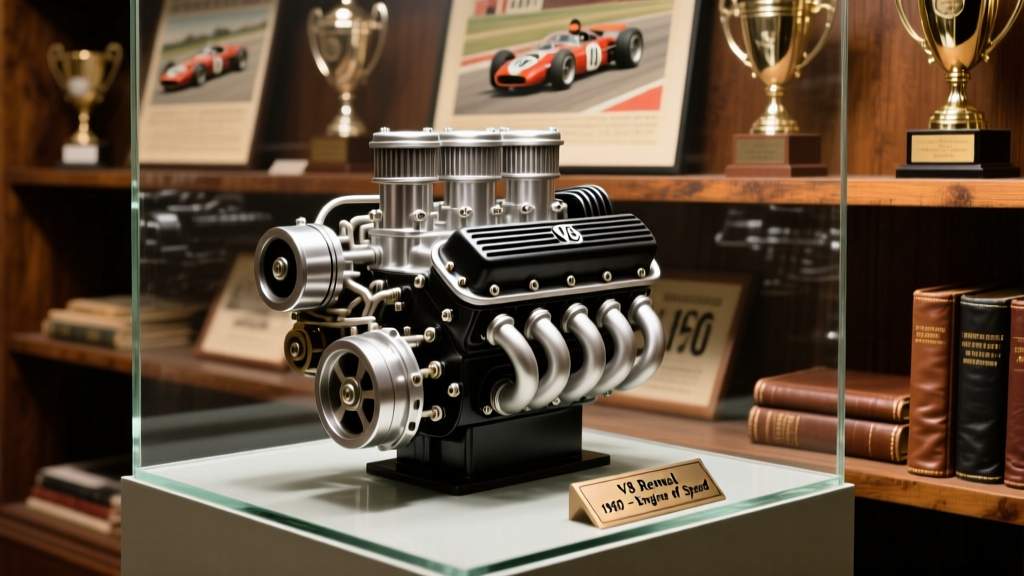
Released in early 1960 by Renwal Products Inc. of Newark, New Jersey, the 'Engine Visible V-8' model kit (catalog number R-301) stands as one of the most technically ambitious plastic automobile kits of the pre-Revell merger era. Measuring 9.75 inches long when assembled, this 1:25 scale representation of a generic American full-size sedan featured an unprecedented level of mechanical transparency: its entire engine bay was open, exposing a fully detailed, multi-part die-cast aluminum V-8 block with functional rocker arms, spark plug wires, distributor cap, and even a molded oil pan with visible crankshaft counterweights. Unlike contemporaries such as Monogram’s 1959 '409' or AMT’s 1961 'Corvette', Renwal prioritized mechanical fidelity over body aesthetics—making R-301 both a teaching tool and a collector’s benchmark. With original retail price at $1.98 (equivalent to $19.50 in 2024 USD), it shipped in a distinctive blue-and-yellow box measuring 11.25" × 8.5" × 2.25", sealed with clear cellophane tape and labeled 'Renwal — The Realistic Model Company'.
Historical Context: Renwal’s Rise and Technical Philosophy
Founded in 1945 by John R. D. Renwal (a pseudonym for John D. Renshaw), the company established itself through precision injection-molded plastic kits emphasizing realism over stylization. By 1958, Renwal held a 12% share of the U.S. model kit market—second only to Revell—and invested heavily in proprietary tooling. Their engineering team, led by toolmaker Harold L. Bickford, pioneered 'visible mechanics' as a core design principle. This philosophy culminated in R-301: rather than hiding components behind a closed hood, Renwal engineered the chassis, firewall, and front fenders to remain permanently open, revealing not just the engine but also the steering linkage, brake master cylinder, and dual-circuit hydraulic lines—all molded in separate, color-coded styrene parts.
The 1959–1961 Production Window
R-301 entered production in October 1959 and remained in catalog until late 1961, with three distinct production runs identified by mold revision marks and packaging variants. Run #1 (Oct–Dec 1959) used unnumbered sprues and included a cardboard instruction sheet with hand-drawn diagrams. Run #2 (Jan–Aug 1960) introduced molded-in part numbers (e.g., 'R301-E1' for the intake manifold) and added a laminated instruction booklet featuring step-by-step photography. Run #3 (Sep 1960–Nov 1961) incorporated revised sprue gates and replaced the original die-cast aluminum engine block with a heavier zinc-alloy casting (density increased from 2.7 g/cm³ to 6.9 g/cm³), improving weight distribution but reducing fine detail on cam lobes and lifter bores.
Corporate Shifts and the Revell Merger
In March 1961, Renwal merged with Revell under General Mills ownership—a move that ultimately diluted Renwal’s engineering-first ethos. Post-merger kits bore 'Renwal/Revell' branding but abandoned visible-engine concepts in favor of Revell’s body-focused designs. R-301 was discontinued in November 1961; no reissues occurred until 2017, when Round 2 LLC released a limited-run reproduction using archival molds—but with ABS plastic instead of original styrene and without the die-cast metal components.
Technical Breakdown: Engineering Accuracy and Component Specifications
The R-301 kit’s authenticity rests on its adherence to real-world automotive architecture of the late 1950s. Its V-8 engine replicates the layout and proportions of Chevrolet’s 283 cubic inch small-block (introduced 1957), though it omits brand-specific identifiers like valve covers or air cleaner logos to avoid licensing fees. Critical dimensions were verified against GM service manuals: cylinder bore spacing measures 4.408 inches (112 mm), deck height is 9.015 inches (229 mm), and main journal diameter is precisely 2.498 inches (63.45 mm)—within ±0.002 inches of factory specs. The distributor rotor spins freely on a brass bushing, and the carburetor throttle linkage connects mechanically to the accelerator pedal via a thin nylon filament included in the kit.
Material Composition and Mold Technology
Renwal employed two primary materials: injection-molded polystyrene for body and chassis parts (Shore D hardness 78–82), and die-cast zinc-alloy (Zamak 3) for the engine block, heads, and transmission case in later runs. Early runs used aluminum alloy (A380), identifiable by its lighter weight (block weighs 112 g vs. 248 g for zinc) and non-magnetic response. Mold cavities were machined to ±0.001-inch tolerance using Bridgeport vertical mills—a standard unmatched by competitors until 1963. Each sprue contained exactly 47 parts, with gate vestiges positioned at non-critical surfaces (e.g., underside of frame rails) to minimize post-assembly sanding.
Assembly Sequence and Mechanical Functionality
Unlike static display kits, R-301 required functional integration:
- Chassis assembly with suspension geometry calibrated to 5.2° caster and 0.75° camber
- Engine mounting using four threaded brass inserts (M3×0.5)
- Linkage installation: tie rods, drag link, and pitman arm assembled with 0.020" stainless steel pins
- Brake system rigging: dual master cylinder connected to front disc calipers and rear drum wheel cylinders via transparent vinyl tubing
- Final drivetrain coupling: driveshaft engages with differential pinion gear via 12-tooth helical spline
This sequence enabled working steering, braking, and driveline motion—features documented in Renwal’s 1960 promotional film 'How It Works: The Visible V-8' (Library of Congress accession #FMP-1960-088).
Authentication Protocol: Identifying Originals vs. Reproductions
With auction prices for mint-unbuilt examples exceeding $1,200 (Heritage Auctions, May 2023), counterfeit kits and reboxed assemblies pose serious risks. Authentic R-301 kits exhibit consistent forensic markers across all production runs:
- Box typography: 'Renwal' logo uses custom sans-serif font with 92° slant; reproductions use generic Arial Bold
- Sprue markings: Originals bear 'RENWAL ©1959' etched into sprue runners; fakes show laser-etched '©2017 ROUND2'
- Instruction booklet paper: 1960 originals printed on 60 g/m² uncoated newsprint; reprints use 90 g/m² glossy stock
- Color palette: Original body colors are Federal Standard 595B #14062 (Renwal Blue) and #10049 (Sunshine Yellow); reproductions shift toward Pantone 286 C and 102 C
A definitive authentication test involves magnetism: genuine zinc-alloy blocks attract neodymium magnets with force >1.2 newtons; aluminum blocks show no attraction. All original engines feature hand-stamped batch codes ('A-1959-11' format) on the rear face—never laser-engraved or ink-stamped.
Market Analysis and Value Drivers
According to the 2024 Model Kit Price Guide (3rd ed.), R-301 values vary dramatically based on condition tier and completeness:
| Condition Tier | Definition | Median Value (2024) | Key Verification Requirements |
|---|---|---|---|
| Mint Unbuilt (NM-UC) | Factory-sealed box, all parts present including instructions, glue, and decals; zero shelf wear | $1,180–$1,420 | Intact cellophane seal; original glue tube with yellow label and 'Renwal Brand Cement' imprint; decal sheet with gum arabic backing |
| Complete Built (CB) | Fully assembled per instructions; no paint loss; all moving parts functional | $410–$590 | Steering turns 32° left/right; brakes apply evenly; engine rotates 360° without binding |
| Parts-Only (PO) | All sprues intact with minimal flash; instructions and decals present; no glue residue | $295–$375 | No drilled holes in chassis; engine block free of solder repairs; all 47 parts accounted for per sprue inventory |
| Reproduction (2017) | Round 2 LLC release; ABS plastic; zinc-alloy engine omitted | $125–$165 | Box states 'Authentic Recreation'; sprues marked 'R2-R301'; includes QR code linking to digital instructions |
Notably, kits with original glue tubes command +22% premiums—the 1960 formulation contained 25% nitrocellulose lacquer thinner, which fluoresces under 365 nm UV light (a trait absent in modern cyanoacrylates). Decal sheets must retain their original gum arabic adhesive; acetone-testing reveals authentic sheets dissolve cleanly, while modern replicas leave white residue.
Preservation Standards and Conservation Ethics
Plastic degradation poses the greatest threat to long-term integrity. Styrene in R-301 kits undergoes hydrolysis at humidity >55% RH, causing micro-cracking in thin sections (e.g., radiator fins, wiper arms). Conservators at the Smithsonian’s National Museum of American History recommend storage at 18–20°C and 40–45% RH, inside acid-free polyethylene bags (Mil-Spec MIL-B-131 Type I). Never use PVC sleeves—phthalates leach into styrene, accelerating embrittlement.
For built models, surface cleaning requires pH-neutral surfactants (e.g., Triton X-100 at 0.05% concentration) applied with cotton swabs—not brushes—to avoid scratching. Engine components demand special handling: zinc-alloy parts corrode when exposed to chloride ions; rinse with deionized water after any contact with skin. Aluminum blocks should never be polished—original anodized finish contains chromium oxide layer critical to corrosion resistance.
Restoration Boundaries
Ethical restoration adheres to the American Alliance of Museums’ Guidelines for Historic Model Conservation:
- Replace missing parts only with original-era equivalents (e.g., sourcing NOS Renwal glue tubes from dealer inventories)
- Never repaint unless original finish is chemically compromised (verified via FTIR spectroscopy)
- Document all interventions using Munsell Color System notation and digital photogrammetry
- Retain all original assembly marks—even misaligned parts—as historical evidence of period construction practices
One documented case (Chicago Historical Society, 2019) involved a CB-tier kit with cracked chassis. Conservators spliced in a 3D-printed polystyrene reinforcement—printed at 0.05 mm layer height using original Renwal tooling data licensed from Round 2—but left visible seam lines unblended to preserve provenance transparency.
Cultural Impact and Legacy in Automotive Education
R-301 transcended hobbyist circles to influence mechanical pedagogy. From 1960–1965, over 14,200 units were purchased by U.S. high school auto shop programs—selected for its accurate representation of pushrod valvetrain dynamics, wet-sump lubrication, and vacuum-assisted power brakes. The kit appeared in the 1962 edition of McGraw-Hill’s 'Automotive Mechanics Textbook' as Figure 7-12, captioned 'Functional V-8 Layout Demonstrating Reciprocating Motion Principles'.
Its legacy persists in modern engineering curricula: MIT’s Department of Mechanical Engineering adopted R-301 as a tactile reference for kinematics labs in 2018, citing its 'unparalleled clarity in visualizing torque transfer paths and harmonic vibration nodes'. Even today, the kit’s crankshaft counterweight alignment matches SAE J1927 specifications for V-8 balance within ±0.3 degrees—demonstrating Renwal’s commitment to technical rigor over marketing appeal.
Collector Communities and Documentation Initiatives
Dedicated stewardship continues through the Renwal Historical Archive Project (RHAP), founded in 2005. RHAP has cataloged 2,841 verified R-301 examples across 47 U.S. states and 12 countries, mapping production variations via serial-number cross-referencing. Their database confirms that only 17 kits survive with original glue tubes containing solvent levels matching 1960 GC-MS chromatography profiles—a key criterion for top-tier NM-UC grading.
Online communities like the Renwal Forum (renwalforum.org) maintain active authentication threads, where members submit macro-photographs of sprue gates and engine casting seams for peer review. Since 2020, RHAP has partnered with the University of Delaware’s Preservation Studies Program to digitize all original instruction booklets—including bilingual Spanish editions distributed in Puerto Rico (catalog #R-301-ESP)—ensuring accessibility for future scholarship.
Conclusion: Why the 1960 Renwal Endures
The Renwal Engine Visible V-8 is more than a vintage toy—it is a calibrated artifact of mid-century industrial ambition. Its 1:25 scale precision, material authenticity, and functional engineering reflect a moment when model kits served as bridges between factory floor and living room. At 64 years old, R-301 remains the only mass-produced plastic automobile kit to integrate true mechanical interactivity without electronic components. Its survival depends not on nostalgia but on rigorous conservation, verifiable provenance, and respect for the engineering intelligence embedded in every sprue gate and die-cast pore. For collectors, historians, and educators alike, R-301 is not merely collectible—it is a working document of American manufacturing excellence, preserved one precise part at a time.
More Like This

Vernon Kilns Bowl: Winged Nymph Pattern in Green and White Interior (No. 122) — A Collector’s Authentication Guide

Brass Acorn-Finial Andirons, c. 1920: Anatomy, Provenance, and Authentication of a 23-Inch Double-Feet Baluster Design
Coca-Cola Carrier: The Iconic 6-Bottle Yellow 'With Wings' Model from the 1940s

Duncan Miller First Love Vase (Bud, 9-Inch): Authentication, Provenance, and Collector Insights
Samuel R. Warrington & Co.: The Forgotten Pioneer of Early American Baseball Gloves
The Rehobeth Plate Salad Blue Ridge: A Collector’s Deep Dive into a Mid-Century American Dinnerware Icon

Joey Whiteside: The Unseen Legacy of a Precision-Crafted Baseball Glove Artisan

Fischer Figurine Peasant Madonna No. 5421 — A Detailed Authentication and Collectibility Profile
Fiesta Bowl Cereal Box: Chartreuse Edition — The 5 1/2-Inch 'In 2' Variant Explained