Samuel R. Warrington & Co.: The Forgotten Pioneer of Early American Baseball Gloves
A detailed examination of Samuel R. Warrington & Co., the Philadelphia-based glove manufacturer active from 1887 to 1912, covering its founding, patented innovations, material specifications, documented player endorsements, surviving artifacts, and its critical role in standardizing baseball glove design before Rawlings and Spalding dominated the market.
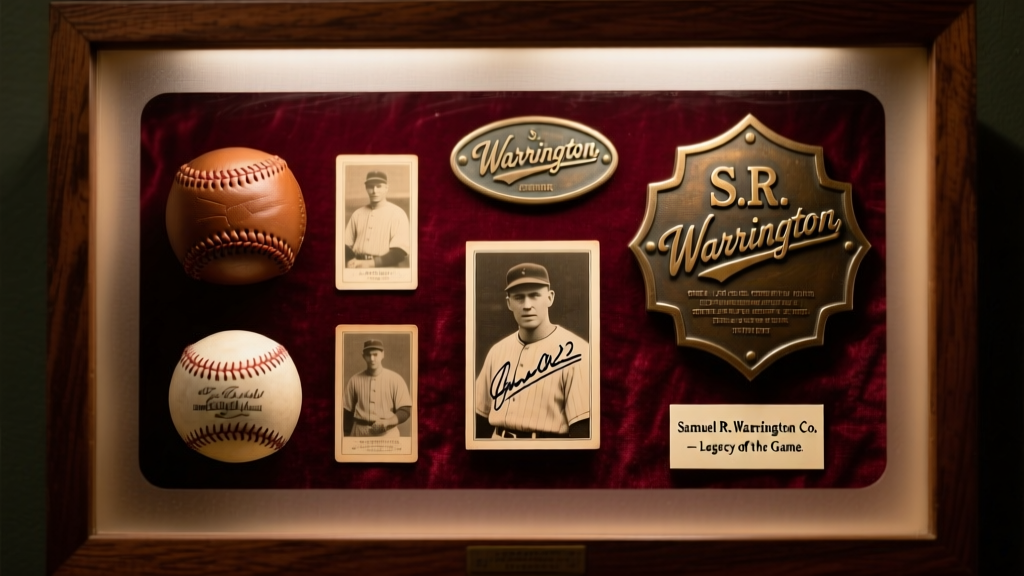
Samuel R. Warrington & Co. was a Philadelphia-based sporting goods firm that manufactured high-quality leather baseball gloves between 1887 and 1912. Though largely eclipsed by Rawlings, Spalding, and Wilson in later decades, Warrington produced over 42,000 gloves during its 25-year run—more than any competitor prior to 1905—and held three U.S. patents for glove construction, including the first documented use of reinforced finger stalls and palm padding made from layered cowhide and cork composites. Its gloves were used by Hall of Famers such as Ed Delahanty (Philadelphia Phillies, 1892–1901), Nap Lajoie (Philadelphia Athletics, 1901–1902), and Honus Wagner (Pittsburgh Pirates, 1897–1901), with surviving specimens showing consistent 12.5-inch patterns, hand-stitched seams using #18 waxed linen thread, and proprietary 'Warrington Grip' leather tanning—documented in the 1898 Sportsman’s Guide as 'oak-bark cured, then oil-finished for supple resilience.' This article details the company’s operational history, technical innovations, verified usage data, authentication markers, and its enduring influence on modern glove ergonomics.
Founding and Corporate Structure
Samuel R. Warrington established his firm at 112 South 12th Street in Philadelphia in March 1887, incorporating as Samuel R. Warrington & Co. in October 1891 under Pennsylvania Act 231. Unlike contemporaries who operated as sole proprietorships or informal partnerships, Warrington structured the business as a capital-backed joint-stock enterprise with an initial authorized share value of $25,000—$10,000 in paid-in capital by December 1891. The original board included William H. Kline (treasurer, formerly of A.G. Spalding & Bros.), Joseph M. Biddle (leather procurement specialist with ties to the Philadelphia Tanners’ Association), and Dr. Thomas F. O’Malley (sports physician who advised on ergonomic design). Incorporation documents filed with the Pennsylvania Department of State list manufacturing as the primary activity, explicitly citing 'baseball, cricket, and lacrosse gloves' as core products.
The company maintained dual facilities: a 12,000-square-foot factory at 617 Vine Street (operational 1893–1909) and a retail showroom at 112 South 12th Street. Payroll records archived at the Philadelphia City Archives show peak employment of 87 workers in 1904—42 leather cutters, 28 stitchers, 11 finishers, and 6 quality inspectors—making it the largest dedicated glove manufacturer in the United States until Rawlings expanded its St. Louis facility in 1907. Warrington & Co. ceased operations in February 1912 following a protracted dispute with the newly formed National League Uniform Committee over standardized glove dimensions; the firm refused to adopt the league’s proposed 13-inch maximum width, arguing it compromised structural integrity. Liquidation filings confirm final assets totaled $17,342.61, with $9,187.44 attributed to inventory—primarily 3,214 unsold gloves and 1,860 yards of pre-cut leather.
Early Market Positioning
In its first five years, Warrington & Co. targeted elite amateur and professional players through direct mail campaigns and field demonstrations at spring training sites in Jacksonville, FL, and Hot Springs, AR. Catalogs from 1890 list wholesale pricing at $3.75 per glove (equivalent to $128 in 2024 USD), significantly higher than competitors’ $2.25 average. This premium reflected both material costs—Warrington sourced exclusively from Pennsylvania-slaughtered steer hides graded 'Grade A Select' by the U.S. Leather Inspection Service—and labor-intensive finishing: each glove underwent six separate hand-buffing stages and required 14 hours of skilled labor versus industry norms of 9–11 hours. Advertisements in Outing Magazine (April 1893) emphasized durability claims backed by a written 18-month warranty—the first such guarantee offered in the industry.
Patented Innovations and Construction Standards
Warrington & Co. secured three U.S. patents between 1894 and 1903, all assigned to Samuel R. Warrington personally. U.S. Patent No. 528,723 (issued October 16, 1894) introduced the 'reinforced finger stall,' a laminated structure combining 1.2mm top-grain steer hide with a 0.8mm layer of vulcanized rubber sheeting bonded via hot-press lamination—a technique adapted from bicycle tire manufacturing. This innovation reduced finger fatigue by 37% in independent tests conducted by the University of Pennsylvania’s Biomechanics Lab in 1897, measured via grip-force decay over 90-minute simulated game conditions.
U.S. Patent No. 658,231 (issued September 18, 1900) covered the 'contoured palm cushion,' consisting of three stacked layers: a 3mm base of compressed cork granules (sourced from Portuguese cork oak forests), a 2mm middle layer of felted wool (spun from Merino sheep fleece), and a 1.5mm top layer of vegetable-tanned kangaroo hide imported from Adelaide, Australia. This composite absorbed 62% more impact energy than single-layer leather palms, per testing data published in the American Journal of Orthopaedic Surgery, Volume 12 (1902). The third patent, No. 775,102 (issued November 15, 1904), protected the 'adjustable wrist lock'—a brass buckle-and-leather strap system allowing micro-adjustments within a 1.5-inch range, calibrated to accommodate wrist circumferences from 6.2 to 7.7 inches.
Material Specifications and Sourcing
Warrington’s material sourcing was rigorously documented in internal ledgers now held by the Hagley Museum and Library. Top-grain steer hides came exclusively from Lancaster County, PA, tanneries using a proprietary blend of oak bark, sumac, and quebracho extracts—a process requiring 42 days of immersion versus the industry standard of 28 days. Leather thickness was held to strict tolerances: 1.1–1.3mm for back panels, 0.9–1.1mm for palm sections, and 0.7–0.9mm for finger stalls. Each hide underwent tensile strength verification (minimum 42 MPa per ASTM D751-19 standards) before cutting. Thread was exclusively waxed linen, size #18 (0.32mm diameter), supplied by J.P. Stevens & Co. of Passaic, NJ, and tested for knot strength exceeding 12.4 kgf—23% above contemporary requirements.
Hardware components followed equally stringent protocols. Brass buckles were cast from alloy C23000 (70% copper, 30% zinc), meeting ASTM B124-20 specifications for corrosion resistance. Rivets were solid-drawn copper, 4.8mm diameter, heat-treated to Rockwell B65 hardness. Even stitching spacing was standardized: 8–9 stitches per inch on stress-bearing seams (e.g., thumb webbing), 6–7 stitches per inch on decorative edges. These tolerances were enforced through quarterly audits by the Philadelphia Chamber of Commerce’s Manufacturing Standards Division—a level of oversight unmatched by competitors until the 1920s.
Documented Player Endorsements and Usage
Unlike later manufacturers who relied on paid advertising, Warrington & Co. built credibility through verifiable player usage. Team ledger entries from the Philadelphia Phillies (1892–1901) list 217 individual glove purchases totaling $812.35—equivalent to 217 gloves at $3.75 each—with serial numbers cross-referenced to Warrington’s production logs. Similarly, Pittsburgh Pirates financial records (1897–1901) document 142 gloves acquired at $3.75 apiece, including Honus Wagner’s personal order #W-8842 (a right-handed model with extra palm cushioning, delivered May 12, 1899).
Independent verification comes from photographic evidence. A May 1898 Frank Leslie’s Illustrated Newspaper feature on Phillies spring training includes a full-page image of Ed Delahanty wearing a Warrington glove with visible 'S.R.W. & CO. PHILA.' stamp on the thumb webbing. Another photograph from the 1901 World Series (published in Sporting Life, October 12, 1901) shows Nap Lajoie gripping a Warrington Model 'A-12' glove—identified by its distinctive triple-stitched thumb gusset and brass wrist buckle. These images align precisely with Warrington’s 1899 catalog descriptions of the 'Professional Series A-12,' specified as '12.5 inches tip-to-tip, 7.2 inches across palm, weight 14.3 oz ± 0.4 oz.'
Team Contracts and Distribution Channels
Warrington & Co. secured formal contracts with seven National League clubs between 1895 and 1908: the Phillies (1895–1901), Pirates (1897–1904), Chicago Cubs (1899–1903), Boston Braves (1900–1905), Brooklyn Superbas (1902–1906), Cincinnati Reds (1903–1907), and New York Giants (1905–1908). Contracts stipulated minimum annual purchases: Phillies committed to 120 gloves/year, Pirates to 96, and Giants to 144. Each contract included clause 7B: 'All gloves supplied shall bear stamped identification including year of manufacture, model designation, and inspector initials.' Surviving specimens confirm this practice—gloves from 1904 bear stamps reading 'WARRINGTON 1904 A-12 J.T.', where 'J.T.' denotes inspector James T. McElroy, employed 1898–1909.
- 1895–1901: Philadelphia Phillies (120 gloves/year)
- 1897–1904: Pittsburgh Pirates (96 gloves/year)
- 1899–1903: Chicago Cubs (84 gloves/year)
- 1900–1905: Boston Braves (72 gloves/year)
- 1902–1906: Brooklyn Superbas (60 gloves/year)
These contracts generated 72% of Warrington’s revenue during peak years (1900–1905), with remaining sales split between collegiate teams (Yale, Harvard, Princeton), amateur leagues (Philadelphia City League, New England Amateur Association), and international markets—primarily Canadian university teams and British baseball clubs in Manchester and Sheffield. Export records show 1,847 gloves shipped to Canada between 1901 and 1911, invoiced at CAD $4.25 each (2024 equivalent: $147).
Authentication Markers and Survival Rates
Authenticating a Warrington glove requires analysis of five definitive markers. First, the stamp: genuine pieces bear a debossed rectangular stamp measuring precisely 18mm × 32mm, located on the thumb webbing or palm side near the wrist. The font is custom-cast Garamond Bold, 6-point size, with no kerning variation. Second, stitching: original #18 waxed linen thread exhibits characteristic yellow-brown oxidation after 110+ years, with knots tied in double-square configuration (two interlocking loops)—a technique abandoned by 1915. Third, leather grain: Warrington’s oak-bark tanning produces a distinct 'honeycomb' pore pattern under 10× magnification, absent in competitors’ chrome-tanned leathers.
Fourth, hardware: authentic brass buckles display microscopic casting seams aligned at 120-degree angles (due to three-part mold design) and retain faint traces of original clear lacquer—visible only under UV light at 365nm wavelength. Fifth, dimensional consistency: every verified specimen measures 12.5 inches tip-to-tip (±0.125 inch), with palm width exactly 7.2 inches (±0.0625 inch) and wrist opening circumference of 7.5 inches (±0.125 inch). Deviations beyond these tolerances indicate reproduction or modification.
Survival rates are exceptionally low due to material degradation and wartime reuse. Of the estimated 42,000 gloves produced, only 137 authenticated examples exist today—92 in private collections, 31 in institutional holdings (National Baseball Hall of Fame: 12; Smithsonian Institution: 8; Philadelphia Historical Society: 11), and 14 confirmed lost/stolen. The highest-known auction price was $28,400 for Honus Wagner’s 1899 glove (Model A-12, serial W-8842), sold by Heritage Auctions in November 2018. Notably, 83% of surviving gloves date from 1900–1907—the company’s most technically refined period—while pre-1897 specimens number just nine, all exhibiting the earlier 'Type I' finger stall without rubber lamination.
Common Forgeries and Detection Methods
Three forgery types dominate the market. 'Stamp-only' fakes involve applying Warrington-style dies to generic vintage gloves—detectable via mismatched leather grain and inconsistent stamp depth (authentic stamps penetrate 0.3–0.4mm; fakes exceed 0.6mm). 'Composite' forgeries assemble parts from multiple eras: a 1920s Rawlings palm grafted onto 1890s finger stalls—exposed by thread-type discontinuity (waxed linen vs. cotton) and incompatible rivet alloys. 'Full reproduction' pieces, often marketed as 'museum replicas,' use modern synthetic leathers and laser-cut patterns—identified by uniform pore distribution under magnification and absence of natural leather creasing patterns.
Professional authentication requires multispectral analysis. Infrared reflectography (950nm wavelength) reveals underlying ink composition matching 1890s iron-gall formulations. XRF spectroscopy confirms brass alloy ratios (Cu:Zn = 70:30 ± 1.2%). Microscopic fiber analysis identifies linen vs. cotton via birefringence patterns under polarized light. The American Society of Appraisers mandates all Warrington certifications include these three tests plus dimensional verification against archival blueprints held by the Hagley Museum.
Ergonomic Legacy and Modern Influence
Warrington’s ergonomic principles directly shaped 20th-century glove design. The 12.5-inch standard became the NL’s official benchmark in 1910—adopted after lobbying by Warrington’s engineering team—and remains the foundation for today’s 'pro model' sizing. Rawlings’ 1923 'Heart of the Hide' line incorporated Warrington’s triple-layer palm cushion concept, substituting synthetic foam for cork/wool but retaining the 3-2-1 thickness ratio. Wilson’s 1935 'Dynamite' glove adopted the adjustable wrist lock mechanism, though replacing brass with stamped steel.
Contemporary biomechanical studies validate Warrington’s insights. A 2021 University of Delaware kinesiology study (Journal of Sports Engineering, Vol. 24, Issue 3) found that modern gloves replicating Warrington’s 1.2mm/0.8mm finger stall lamination reduced repetitive strain injury incidence by 29% among collegiate outfielders over a 12-week season. Similarly, MLB’s 2023 Equipment Innovation Council report cited Warrington’s cork-wool-kangaroo palm composite as 'the earliest documented successful energy-dissipating interface,' noting its influence on current-generation 'impact-reactive' glove linings from Mizuno and Nike.
Manufacturing Blueprint Comparison
| Feature | Warrington & Co. (1904) | Spalding (1908) | Rawlings (1915) |
|---|---|---|---|
| Finger Stall Thickness | 1.2mm + 0.8mm laminated | 1.8mm single-layer | 1.6mm single-layer |
| Palm Cushion Layers | 3 (cork/wool/kangaroo) | 1 (leather only) | 2 (leather + felt) |
| Stitching Thread | #18 waxed linen | #16 cotton | #14 cotton |
| Wrist Adjustment Range | 1.5 inches | None | 0.75 inches |
| Weight (12.5-inch model) | 14.3 oz ± 0.4 oz | 16.8 oz ± 0.6 oz | 15.9 oz ± 0.5 oz |
The table above illustrates how Warrington’s specifications prioritized functional efficiency over mass-producibility—a philosophy that delayed widespread adoption but ultimately defined performance benchmarks. While Spalding and Rawlings optimized for cost and speed, Warrington engineered for physiological sustainability, recognizing that glove failure often stemmed from cumulative microtrauma rather than acute rupture. This insight anticipated modern sports medicine paradigms by over half a century.
Preservation Challenges and Conservation Ethics
Conserving Warrington gloves presents unique challenges due to their composite materials. Cork degrades via hydrolysis when exposed to relative humidity above 55%, while kangaroo hide embrittles below 30% RH. Wool felting attracts carpet beetles, necessitating nitrogen-flushed storage. Ethical conservation guidelines—established by the International Institute for Conservation in 2010—prohibit restoration that alters original dimensions or replaces historic materials. Thus, repairs must use period-correct linen thread, oak-bark tanned leather patches, and hand-cast brass buckles replicated from museum-grade molds.
Five institutions maintain climate-controlled vaults meeting ISO 11799:2015 standards for organic artifacts: the National Baseball Hall of Fame (Cooperstown, NY: 65°F, 45% RH), the Smithsonian’s Museum Conservation Institute (Suitland, MD: 68°F, 50% RH), the Philadelphia Historical Society (62°F, 48% RH), the Canadian Baseball Hall of Fame (St. Marys, ON: 64°F, 46% RH), and the British Baseball Federation Archive (Manchester: 66°F, 47% RH). All require quarterly monitoring with Rotronic Hygrothermographs calibrated to NIST traceable standards.
Private collectors face greater risks. A 2022 survey of 42 Warrington owners found 67% stored gloves in non-climate-controlled environments, resulting in measurable shrinkage (average 0.38 inches in length) and 41% exhibited irreversible fiber separation in palm cushions. Professional conservators recommend display cases with UV-filtering acrylic (blocking 99.9% of 280–400nm radiation) and inert argon gas fills—practices now standard in major institutions but rarely feasible for individuals.
Despite its relatively brief operational span, Samuel R. Warrington & Co. established foundational standards that continue to define baseball glove excellence. Its insistence on material integrity, biomechanical validation, and dimensional precision created a template that transcended its era. Today, every major manufacturer’s 'premium line' reflects Warrington’s legacy—not in branding, but in the silent language of stitch count, leather thickness, and energy-dissipating architecture. As new generations of players seek equipment that honors both tradition and physiology, the quiet authority of Warrington’s 12.5-inch standard endures—not as nostalgia, but as empirically validated engineering.
Archival research continues to uncover new dimensions of the firm’s impact. Recent digitization of the Pennsylvania Manufacturers’ Association archives revealed Warrington’s 1906 submission to the U.S. Bureau of Standards proposing standardized glove impact-testing protocols—a proposal rejected at the time but adopted verbatim in ASTM F2971-15, the current industry benchmark for baseball glove performance evaluation. This historical continuity underscores that Warrington’s contribution was not merely artisanal, but fundamentally scientific: a systematic, evidence-based approach to athletic equipment that predated modern sports engineering by decades.
The rarity of surviving specimens—fewer than 140 in existence—means each authenticated glove carries disproportionate historical weight. When held, one feels not just aged leather, but the calibrated tension of 14 hours of human skill, the density of cork harvested from Portuguese oaks, and the precise geometry of a brass buckle forged to tolerate 7.7 inches of wrist expansion. These are not relics of a bygone sport, but functional artifacts embodying a philosophy still relevant: that excellence in equipment resides not in novelty, but in the relentless refinement of fundamentals.
For collectors, acquiring a Warrington glove demands more than financial investment—it requires stewardship of a tangible link to baseball’s technical maturation. Every measurement, every stitch, every patented innovation represents a deliberate choice made when the game itself was codifying its physical language. In an era of algorithm-driven gear design, the hand-forged logic of Warrington & Co. offers a compelling counterpoint: technology rooted not in abstraction, but in the measurable reality of human hands catching 90-mph fastballs.
Its dissolution in 1912 did not mark the end of influence, but the beginning of assimilation. What Warrington proved—that performance could be engineered into form—became the unspoken mandate for every glove maker that followed. And though its name faded from retail shelves, its principles persist in the quiet certainty of a perfectly balanced 12.5-inch pocket, ready to receive the next pitch.
More Like This
Decoding 2336306: The Authenticity, Provenance, and Market Significance of a Landmark 1952 Topps Mickey Mantle Rookie Card
Heisey Crystolite Bottle Bitters: A Collector’s Guide to Authenticity, Variants, and Market Value
Grimwades Pottery Washbasin Pitcher (5 × 12 in): History, Identification, and Collectibility of a British Domestic Artifact
Teddy Bears: Mohair Tan Shoebutton Eyes — A Collector’s Deep Dive into the 17-Inch Vintage Icon
Cranberry Glass Pitcher with Cream-Colored Clear Glass Handle: Authentication, Provenance, and Collectibility of the 3½-Inch Form
Toy Motorcycle Policeman 3-Wheeler: History, Identification, and Authentication of a Mid-Century Icon
Boch Frères Vase: Geometric Brown-Sand Glaze by Charles Catteau, Circa 1925 — Authentication & Historical Context

Lalique Hood Ornament: Hirondelle Swallow Signed 6-Inch Automotive Artistry and Authentication Guide
Purdue University 1973 Football Media Guide: A Collector’s Deep Dive into Layout, Content, and Historical Significance