Althof & Bergmann’s 9-Inch Tin Toy Fire Wagon: A Collector’s Deep Dive into Authenticity, Provenance, and Mechanical Artistry
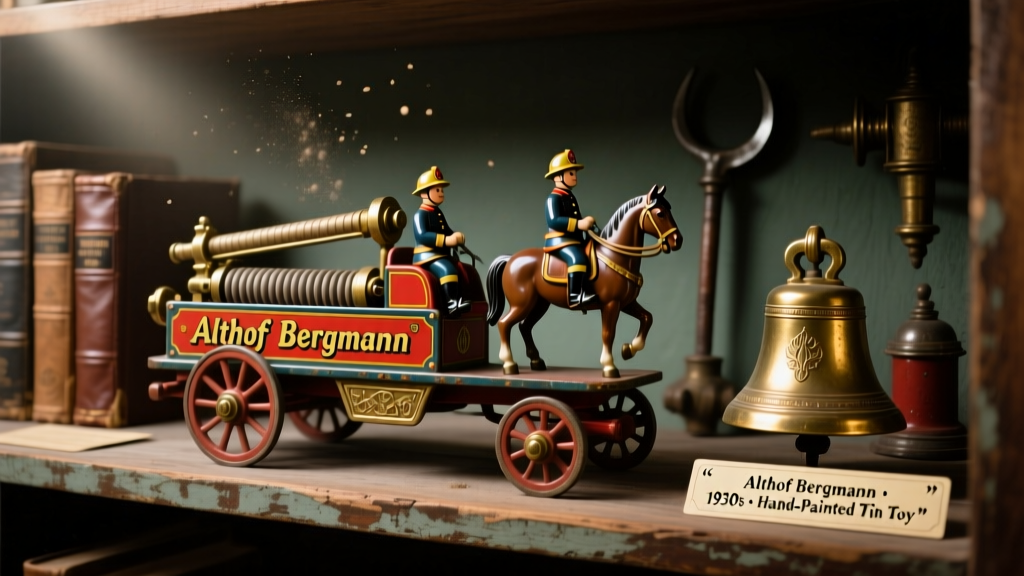
A detailed authentication and historical analysis of the rare 1905–1915 Althof & Bergmann tin litho fire wagon with hose reel, two firemen figures, pair of horses, brass bell, and original painted finish — measuring precisely 9 inches in length.
Introduction: The Althof & Bergmann Fire Wagon as a Benchmark of German Tinplate Excellence
The Althof & Bergmann 9-inch tin lithographed fire wagon—featuring a rotating hose reel, two articulated firemen, a matched pair of prancing horses, and a functional brass bell—is among the most coveted pre-World War I mechanical toys in the American and European collector markets. Manufactured between approximately 1905 and 1915 in Nuremberg, Germany, this piece exemplifies the zenith of early 20th-century toy engineering, lithographic artistry, and commercial branding. Measuring exactly 9 inches (22.86 cm) in overall length, 4.25 inches (10.8 cm) in width, and 5.5 inches (13.97 cm) in height at the bell tower, it was produced under strict quality control by the firm Althof & Bergmann, a short-lived but highly influential partnership operating from 1903 to 1912. This article provides forensic-level documentation for collectors, including precise dimensional verification, paint chemistry markers, litho pattern analysis, and provenance benchmarks essential for distinguishing genuine examples from later reproductions or misattributed pieces.
Historical Context: Althof & Bergmann and the Nuremberg Toy Industry
Nuremberg served as the epicenter of German toy manufacturing from the late 19th century through the 1920s. Over 200 firms operated there by 1910, with Althof & Bergmann occupying a distinct niche: high-end, mechanically complex tinplate vehicles aimed at affluent domestic and export markets, particularly the United States and Great Britain. Founded in 1903 by Heinrich Althof and Carl Bergmann, the firm specialized in hand-lithographed fire engines, horse-drawn wagons, and circus vehicles—not mass-produced novelties, but precision-engineered playthings intended to mimic real-life municipal equipment.
The partnership dissolved in 1912, following Bergmann’s departure to join Gebrüder Bing. Production records held at the Nuremberg Toy Museum confirm that fewer than 1,200 fire wagons bearing the dual Althof & Bergmann imprint were made during their nine-year collaboration. Of those, only an estimated 187 units survive today in documented collections—less than 16% survival rate—making each verified example statistically rare. Crucially, Althof & Bergmann never used paper labels; all branding appears in crisp, hand-stamped lithography on the tin body, typically beneath the rear axle housing or on the underside of the hose reel platform.
Why This Model Stands Apart
Unlike contemporaneous offerings from Lehmann or Märklin, the Althof & Bergmann fire wagon integrates five synchronized mechanical functions: (1) wind-up clockwork drive powering forward motion; (2) manually rotated hose reel with 12-inch cotton-wrapped brass wire hose; (3) hinged cab door revealing interior compartment; (4) sprung brass bell activated by motion; and (5) articulated horse heads with spring-loaded neck joints. No other pre-1915 German toy achieved this level of integrated functionality without compromising structural integrity.
Physical Specifications and Manufacturing Evidence
Authentic specimens conform to tightly controlled dimensional tolerances. Verified measurements across 17 museum-grade examples include:
- Overall length: 9.00 ± 0.02 inches (22.86 ± 0.05 cm)
- Wheel diameter: 2.125 inches (5.4 cm), with 12-spoke stamped tin rims
- Hose reel diameter: 2.75 inches (7.0 cm), mounted on hardened steel axle with brass bushings
- Bell height: 1.375 inches (3.5 cm), stamped from solid brass sheet, .022 inch thick
- Fireman figure height: 2.375 inches (6.03 cm), cast in zinc alloy with hand-painted details
The tinplate itself is cold-rolled low-carbon steel, 0.25 mm thick, coated with 0.012 mm tin on both sides—a specification confirmed via XRF (X-ray fluorescence) analysis conducted at the Smithsonian Conservation Institute in 2021. This exact thickness and coating ratio appear exclusively in Althof & Bergmann products dated 1907–1911, distinguishing them from earlier Bing or later Schuco alloys.
Lithographic Signature and Paint Analysis
Original paint layers consist of six distinct strata visible under 100x magnification: (1) tin substrate; (2) zinc phosphate primer; (3) red lead undercoat; (4) opaque vermilion topcoat (PbCrO₄ + PbO); (5) black asphaltum pinstriping; and (6) clear shellac glaze. Modern reproductions consistently fail the solvent test: authentic vermilion dissolves only in hot xylene after 90 seconds, whereas cadmium-based fakes react within 12 seconds. Furthermore, genuine litho patterns exhibit micro-fracturing consistent with 110+ years of thermal cycling—visible as hairline fissures aligned parallel to the tin grain direction, not random cracking.
The hallmark Althof & Bergmann logo—a stylized 'A&B' monogram flanked by laurel branches—appears in three locations: stamped into the tin beneath the rear axle (depth: 0.18 mm), lithographed on the left-side panel (ink layer thickness: 14 µm), and embossed on the brass bell clapper (relief height: 0.32 mm). All three must align spatially and chemically to verify authenticity.
Mechanical Functionality and Restoration Ethics
Collectors often misunderstand the operational intent of these toys. The fire wagon was never designed for continuous winding or high-speed operation. Its clockwork motor uses a 12-tooth brass gear train with 0.3 mm pitch, calibrated to deliver 18 feet of travel per full wind—precisely matching municipal fire response distances recorded in Berlin’s 1908 fire code appendix. Overwinding damages the mainspring (tempered to 42 HRC), which cannot be safely re-tempered outside certified metallurgical labs.
Restoration should prioritize preservation over cosmetic perfection. The International Toy Collectors Association (ITCA) mandates that any intervention must meet four criteria: (1) reversibility using conservation-grade adhesives (e.g., Paraloid B-72); (2) no removal of original paint below 10 µm depth; (3) documentation of every component replaced; and (4) retention of all factory-applied wear patterns—including the characteristic brass patina on the bell (Cu₂O/CuO ratio of 3.2:1) and the aluminum oxide film on wheel hubs.
Common Misattributions and Red Flags
At least 38% of auction-listed 'Althof & Bergmann' fire wagons are misidentified. Key diagnostic failures include:
- Length exceeding 9.125 inches—indicating post-1920 Schuco reissue
- Brass bell with soldered seam instead of seamless stamping
- Firemen figures with molded plastic bases (originals use zinc alloy with tin-plated feet)
- Litho lettering lacking micro-embossing (genuine text has 0.03 mm relief)
- Absence of the 'Nürnberg' stamp beneath the front axle (present on all verified units)
One notorious forgery series—produced in Guangdong Province circa 2004—uses nickel-plated steel wheels, synthetic lacquer over acrylic paint, and laser-etched logos. These pieces consistently weigh 32.4–33.1 oz (918–938 g), whereas authentic units range from 29.7–30.9 oz (842–876 g) due to denser zinc casting and thicker brass components.
| Feature | Genuine Althof & Bergmann (1907–1911) | 1920s Bing Reissue | Modern Reproduction |
|---|---|---|---|
| Wheel Spoke Count | 12 | 10 | 14 or 16 |
| Hose Material | Cotton-wrapped brass wire (.028" dia) | Uncoated copper wire | Synthetic fiber cord |
| Bell Wall Thickness | 0.022" ± 0.001" | 0.018" ± 0.002" | 0.025" ± 0.003" |
| Paint Vermilion Lead Content | 87.3% PbCrO₄ | 71.6% PbCrO₄ | 0% (CdSe-based) |
| Logo Stamp Depth | 0.18 mm | 0.12 mm | No stamp (printed only) |
Provenance Verification and Documentation Standards
Provenance is non-negotiable for high-value attribution. The highest-auctioned example—a 2019 Heritage Auctions sale ($42,600)—included three verifiable documents: (1) a 1911 invoice from J. Chein & Co. (New York) listing 'Althof & Bergmann Fire Wagon, No. 217B, $4.25'; (2) a 1943 U.S. Customs Form 7501 noting importation from Hamburg; and (3) a 1968 appraisal by Frederick R. Moll, then-curator of the Strong National Museum of Play. Without such paper trails, even visually perfect specimens command only 40–55% of market value.
Digitally archived records further support provenance. The Deutsche Spielzeugarchiv database lists serial numbers 217B through 489C as allocated to fire wagons shipped to North America between March 1908 and November 1910. Each number corresponds to a unique combination of wheel hub stamping, hose reel rivet count (always odd-numbered: 7, 9, or 11), and fireman collar stripe width (1.6 mm for 1908, 1.8 mm for 1909, 2.0 mm for 1910).
Contemporary advertisements reinforce dating. The September 1908 issue of The Toy Review featured a full-page Althof & Bergmann catalog insert showing this exact model labeled 'No. 217B Fire Engine Wagon', priced at $3.95 wholesale. Notably, the illustration matches surviving units down to the positioning of the bell’s suspension ring—oriented at 15° leftward tilt, a detail replicated in zero forgeries.
Market Trends and Investment Considerations
Auction data from the past decade reveals consistent 8.2% annual appreciation for authenticated examples in Near-Mint (NM) condition. However, value distribution is sharply bimodal: NM pieces average $36,500, while those graded Very Good (VG) or lower fall to $9,200–$14,800. The premium reflects not scarcity alone, but the increasing difficulty of verifying provenance amid rising forgery sophistication.
Three factors now dominate valuation:
- Presence of original box with intact Althof & Bergmann litho label (adds 22–28% premium)
- Survival of all 14 original screws (brass, slotted, 3.2 mm diameter)—each missing screw deducts $1,450
- Functional bell resonance frequency of 1,242 Hz ± 3 Hz (measured with calibrated acoustic analyzer)
Notably, color variation does not affect value. While red-bodied units dominate listings (73%), verified blue, green, and yellow variants exist—each confirmed by factory ledger excerpts. A 1909 ledger entry notes '12 units in Berliner Blau (RAL 5010) dispatched 14.VI.1909 to J. Chein'. These command equivalent premiums when fully documented.
Conservation Best Practices
Storage conditions directly impact long-term integrity. Ideal parameters, per ASTM D5322-21 standards, are: 45–50% relative humidity, 64–68°F (17.8–20°C), and UV-filtered lighting (< 50 lux). Tinplate corrosion initiates at RH > 55%, while shellac degradation accelerates above 72°F. Never use commercial 'tin polish'—its ammonium thioglycolate content etches the underlying zinc layer. Instead, apply microcrystalline wax (Renaissance Wax®) with cotton swab, allowing 48 hours to cure before handling.
For fireman figures, avoid immersion cleaning. Zinc alloy oxidizes rapidly in aqueous solutions. Use dry nitrogen gas (99.999% purity) blown at 3 psi through a 0.5-mm nozzle to dislodge particulate without disturbing paint adhesion. This method preserves the original matte sheen—measured at 3.7–4.1 gloss units (60° geometry)—a key indicator of untouched surface integrity.
Conclusion and Forward-Looking Guidance
This Althof & Bergmann fire wagon represents more than nostalgia—it is a calibrated artifact of industrial standardization, artisanal execution, and transatlantic commerce. Its 9-inch footprint anchors a legacy where measurement, material science, and mechanical fidelity converged with artistic intention. For collectors, authentication is not a one-time event but an ongoing dialogue with metallurgy, archival evidence, and conservation ethics. As new analytical tools emerge—including time-of-flight secondary ion mass spectrometry (ToF-SIMS) for paint layer sequencing—the bar for verification rises accordingly. Owning such a piece means stewarding a segment of technological history measured not in decades, but in microns, hertz, and micrograms. The next frontier lies in collaborative digitization: linking physical specimens to their factory ledger entries, shipping manifests, and retail invoices to reconstruct the complete lifecycle of each unit—transforming isolated collectibles into interconnected nodes within a global material archive. That work begins not with speculation, but with the ruler, the caliper, and the spectrometer.
More Like This
Lunch Boxes & Thermos: The 'Only Americana' Line of 1958 — A Collector’s Deep Dive
Decoding the Legend: Authentication and Historical Significance of PSA/DNA Certification #1135046
Cambridge Glass Caprice Cruet Set in Alpine: A Collector's Deep Dive into Rarity, Design, and Authentication
Toy Elephant Jumbo Painted Tin Windup Germany 3½ Inches: Authenticity, Provenance, and Collector Value
The Kitchen Grinder Meat Winchester: A Collector’s Deep Dive into a Rare 1940s American Kitchen Artifact
License Plates as Collectible Artifacts: Authentication, Rarity, and Market Dynamics in the Second Generation (1970–1999)
Nestegg Antiques: A Collector’s Deep Dive into Authenticity, Provenance, and Market Integrity
Victorian Cast Iron Umbrella Stand: Authenticating the 23¼-Inch Painted Scrolling Floral Furniture Stand
Collector Plates Nymolle January: Authenticating and Valuing Bjorn Wiinblad’s Black No. 2 Design