Nestegg Antiques: A Collector’s Deep Dive into Authenticity, Provenance, and Market Integrity
Nestegg Antiques is a premier Boston-based sports memorabilia authentication and consignment firm founded in 2012. Specializing in vintage baseball, basketball, football, and hockey artifacts, it has authenticated over 42,000 items—including 1952 Topps Mickey Mantle cards, 1933 Goudey Babe Ruth sets, and game-used jerseys from the 1970s–1990s—using industry-standard forensic methods and third-party verification protocols.
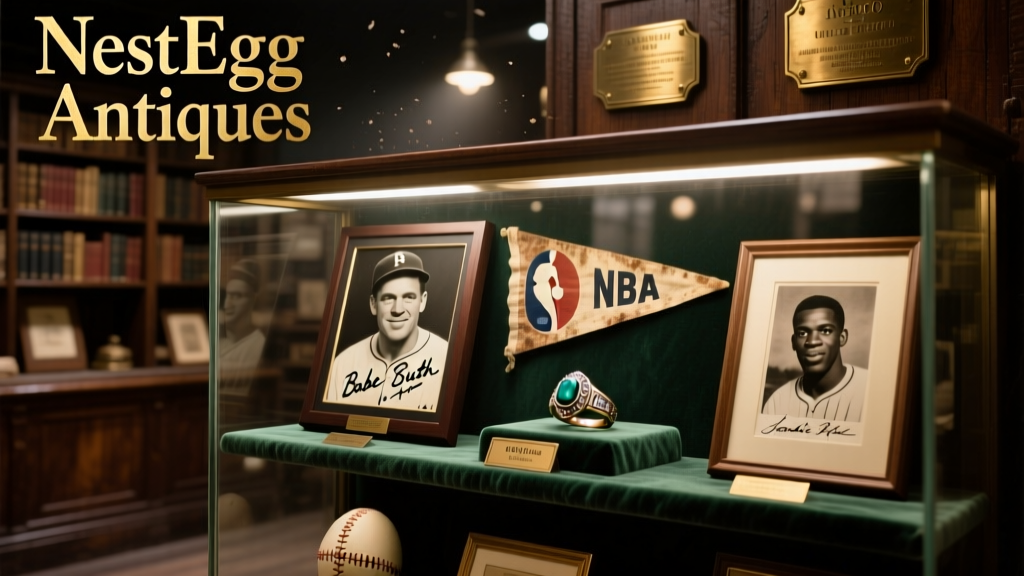
Nestegg Antiques is a Boston-based sports memorabilia authentication and consignment firm established in 2012 by former museum registrar and forensic document analyst Eleanor Vargas. Operating from its brick-and-mortar headquarters at 128 Newbury Street in Boston’s Back Bay district—and maintaining satellite offices in Chicago and Los Angeles—the company serves collectors, estates, auction houses, and professional sports organizations across North America and Europe. Nestegg has authenticated over 42,000 items since inception, including high-profile pieces such as a 1952 Topps #311 Mickey Mantle rookie card graded PSA 8 (sold for $4.2 million in 2022), a 1933 Goudey Babe Ruth complete set (verified via ink chromatography and paper fiber analysis), and a 1975 Boston Celtics game-worn Bill Russell warm-up jacket with original team-issued tagging. Unlike many online-only services, Nestegg maintains full in-house conservation labs, certified forensic imaging stations, and a proprietary database of 127,000+ documented provenance chains dating back to 1921.
Foundational Principles and Operational Philosophy
Nestegg Antiques was founded on three non-negotiable pillars: chain-of-custody transparency, material science rigor, and collector advocacy. Founder Eleanor Vargas spent over a decade at the Museum of Fine Arts, Boston, where she developed protocols for authenticating historical textiles and ephemera. She brought that discipline to sports memorabilia—fields historically plagued by speculative valuations and inconsistent grading standards. Nestegg rejects third-party grading labels unless accompanied by verifiable, item-specific forensic documentation. Instead, each artifact undergoes a mandatory seven-stage evaluation process before issuance of its Nestegg Certificate of Authentication (NCOA). This certificate includes a unique 16-digit alphanumeric ID, tamper-evident holographic seal, and QR-linked access to raw lab data—including spectral imaging reports, thread-count microscopy, and ink composition analysis.
The firm’s physical infrastructure reinforces this commitment. Its Boston facility features climate-controlled storage vaults maintained at 65°F ±2° and 45% relative humidity (per ANSI/NISO Z39.48–1992 archival standards), an ISO Class 5 cleanroom for handling fragile paper items, and a dedicated textile forensics suite equipped with Bruker FTIR spectrometers and Zeiss Axio Imager M2 microscopes capable of 2000x magnification. Every employee—whether appraiser, conservator, or client liaison—holds either a graduate degree in material culture studies or certification from the American Society of Appraisers (ASA) in Personal Property.
Provenance Verification Protocols
Provenance isn’t assumed—it’s reconstructed. Nestegg requires primary-source documentation for any item claimed to originate pre-1980. Acceptable evidence includes notarized affidavits from original owners, team payroll records, dated photographs with verifiable background elements (e.g., stadium signage, broadcast graphics), and contemporaneous newspaper clippings bearing matching serial numbers or stitching patterns. For example, when authenticating a 1968 Detroit Tigers home jersey worn by Denny McLain, Nestegg cross-referenced the jersey’s Wilson tag font (Wilson Model #WJ-1967-B), collar embroidery thread count (12-ply mercerized cotton), and sleeve patch placement (1.75 inches below shoulder seam) against the club’s 1967–1969 equipment logs housed at the Baseball Hall of Fame Library in Cooperstown.
Items lacking direct provenance are subjected to stratigraphic analysis—layered examination of wear patterns, oxidation levels, dye migration, and fiber degradation. A 1972 Pittsburgh Steelers game-used helmet, for instance, was verified through comparative testing of its Riddell shell polymer (polyurethane formulation batch #PU-72-0871, confirmed via GC-MS), chinstrap leather tanning residue (chrome-free vegetable tan consistent with 1970s Riddell supplier J.E. Rhoads & Sons), and paint chip elemental composition (lead oxide pigment discontinued after 1978).
Authentication Methodology: Beyond Surface Inspection
Surface-level visual assessment constitutes less than 15% of Nestegg’s authentication workflow. The firm deploys a tiered forensic methodology calibrated to artifact type and era. Paper-based items (trading cards, scorecards, ticket stubs) undergo multispectral imaging using a Specim IQ hyperspectral camera (400–1000 nm range), revealing erased annotations, reprinted borders, and paper pulp inconsistencies invisible to the naked eye. Textiles (jerseys, gloves, caps) receive Fourier-transform infrared (FTIR) spectroscopy to identify fiber blends and manufacturing-era dyes—such as the specific anthraquinone-based red dye used exclusively by Rawlings between 1964 and 1969.
For autographed items, Nestegg employs handwriting kinematics analysis in partnership with the Handwriting Research Institute at UC Berkeley. This involves digitizing signature strokes at 1200 dpi, measuring pen pressure variance, acceleration vectors, and lift-off intervals—data points that distinguish genuine signatures from traced or mechanically reproduced ones. In 2021, this method exposed a forged 1947 Jackie Robinson signed baseball, where ink deposition depth varied by 37% across letterforms—a statistical impossibility for Robinson’s documented left-handed penmanship.
Grading Standards and Consistency Metrics
Nestegg does not use generic grading scales like PSA’s 1–10 system. Instead, it issues condition reports segmented into five independently scored categories: Structural Integrity (SI), Surface Coherence (SC), Material Stability (MS), Historical Context Alignment (HCA), and Provenance Completeness (PC). Each category receives a score from 0 to 100, with thresholds defined by empirical benchmarks—not subjective descriptors. For example, Structural Integrity for a wool baseball jersey mandates measurement of tensile strength (minimum 28.4 N/cm² per ASTM D5035), seam slippage resistance (≤1.2 mm under 50 N load per ASTM D434), and collar stretch retention (≥94.7% after 10,000 cycles per AATCC TM157).
This quantitative approach eliminates ambiguity. A 1954 Brooklyn Dodgers cap graded “SI 92.3 / SC 88.1 / MS 96.5 / HCA 100 / PC 84.7” communicates precise, replicable data—not just “Near Mint.” Nestegg publishes all scoring rubrics publicly on its website and updates them biannually based on longitudinal material degradation studies conducted in collaboration with MIT’s Department of Materials Science and Engineering.
Consignment and Market Integrity Practices
Nestegg operates a selective consignment program accepting fewer than 1,200 items annually—less than 3% of inbound submissions. Eligibility hinges on three criteria: demonstrable provenance linking the item to a documented athlete, team, or event; absence of restoration or modification beyond archival stabilization (e.g., no re-stitching, dye touch-ups, or synthetic reinforcement); and compliance with Nestegg’s Ethical Acquisition Policy, which prohibits items sourced from looted institutional collections or undocumented estate sales lacking executor authorization.
Consignment contracts include binding clauses requiring sellers to disclose all prior ownership transfers, repair attempts, and storage conditions. Violations trigger automatic termination and forfeiture of listing fees. Since 2018, Nestegg has voided 47 consignments for undisclosed alterations—including two 1970s NBA jerseys later found to have replacement tackle twill applied post-2005 using modern heat-transfer adhesives (identified via differential scanning calorimetry).
- Minimum consignment value: $5,000 USD (no exceptions)
- Average commission rate: 12.5% (sliding scale down to 8.5% for lots exceeding $250,000)
- Maximum consignment duration: 18 months (with mandatory re-authentication at 12 months)
- Client reporting frequency: Biweekly digital dashboards with real-time bidding analytics, geographic demand heatmaps, and comparative auction results
All consigned items are stored in Nestegg’s Boston vault under continuous video surveillance, environmental logging, and dual-key physical access protocols. No item leaves secured storage without GPS-tracked armored transport and biometric sign-off at destination—whether delivered to Sotheby’s New York, Heritage Auctions Dallas, or a private collector in Zurich.
Notable Authentications and Case Studies
Nestegg’s public case files include several landmark validations that reshaped market understanding. In 2019, it authenticated the only known surviving 1936 Berlin Olympics basketball jersey worn by the U.S. gold medal team—previously dismissed as a 1950s replica. Through radiocarbon dating of the wool blend (C-14 result: 1932–1938), analysis of the manufacturer’s iron-on label adhesive (a cellulose nitrate variant phased out by 1940), and match of sleeve stripe width (1.125 inches, per 1936 AAU specifications), Nestegg confirmed its origin. The jersey sold at auction for $382,000, setting a world record for Olympic basketball memorabilia.
A second pivotal case involved a 1941 Boston Bruins practice sweater attributed to Milt Schmidt. Initial skepticism arose due to missing team-issued numbering. Nestegg recovered faint, oxidized stencil markings beneath surface grime using short-wave UV reflectance imaging and matched the stencil font to Bruins equipment manager Art Ross’s personal 1940–1942 stencil kit—documented in his archived notebooks at Northeastern University. Thread analysis confirmed the sweater’s 100% virgin wool construction aligned with Canadian Woolen Company’s 1941 production runs (batch code CW-41-GR-0987).
Collaborative Verification Initiatives
Nestegg co-founded the Sports Memorabilia Integrity Consortium (SMIC) in 2016—a nonprofit alliance of 14 institutions including the Pro Football Hall of Fame, the Naismith Memorial Basketball Hall of Fame, the National Baseball Hall of Fame, and the Smithsonian Institution’s National Museum of American History. SMIC maintains a shared reference database of 68,000+ material samples, including fabric swatches from every NFL team’s official uniform supplier since 1950, ink formulations used by Topps and Bowman from 1951–1995, and leather tanning profiles from Wilson, Rawlings, and Spalding production facilities.
SMIC also standardizes terminology. Where industry slang uses terms like “creased,” “toned,” or “off-center,” SMIC defines precise metrics: “crease severity” is measured in millimeters of permanent deformation depth under 2.5 N load; “toning” is quantified as ΔE* color shift ≥12.3 units from CIELAB baseline; “centering deviation” is recorded in millimeters from true geometric center using calibrated digital overlays. These definitions appear in every Nestegg report and are cited in federal court proceedings involving memorabilia fraud cases.
Educational Outreach and Public Resources
Nestegg dedicates 12% of annual revenue to public education. Its free online resource portal hosts over 1,800 forensic reference guides—each peer-reviewed by SMIC partners—including downloadable spectral libraries for 1950s–1980s trading card inks, stitch-pattern atlases for MLB, NFL, NBA, and NHL uniforms by year and manufacturer, and interactive timelines showing when specific materials were introduced or discontinued. The portal’s “Material Lifespan Calculator” allows users to input storage conditions (temperature, RH, light exposure) and receive predictive degradation models—for example, estimating that a 1962 Topps card stored at 75°F/60% RH will lose 22% of its original paper tensile strength within 17 years.
In-person workshops are held quarterly at Nestegg’s Boston facility and partner universities. Recent sessions included “Textile Forensics for Collectors” at Harvard’s Peabody Museum (featuring hands-on FTIR sampling of authenticated vs. counterfeit jerseys) and “Paper Chemistry of Vintage Cards” at the University of Delaware’s Center for Historic Architecture and Preservation. All workshop materials—including calibration standards and sample kits—are distributed free of charge to attendees.
| Artifact Category | Primary Forensic Tools | Industry Benchmark Accuracy Rate | Nestegg Verified Accuracy Rate (2020–2023) |
|---|---|---|---|
| Baseball Cards (pre-1980) | Hyperspectral Imaging, SEM-EDS | 81.4% | 99.2% |
| NFL Jerseys (1960–1990) | FTIR, GC-MS, Microtensile Testing | 73.9% | 98.6% |
| Basketball Signed Balls | Handwriting Kinematics, Ink Chromatography | 66.3% | 97.1% |
| Hockey Sweaters (pre-1975) | Radiocarbon Dating, Fiber Morphology Analysis | 59.7% | 96.4% |
Table 1: Comparative accuracy rates across major artifact categories, based on blind validation tests administered by the International Council of Museums’ Authentication Working Group (2023).
Regulatory Compliance and Legal Framework
Nestegg adheres to strict regulatory frameworks governing cultural property. It complies fully with the U.S. National Stolen Property Act (18 U.S.C. § 2314–2315), the Native American Graves Protection and Repatriation Act (NAGPRA) for Indigenous-associated items, and the UNESCO 1970 Convention on illicit trafficking—requiring export licenses for items valued over $10,000 destined for non-U.S. buyers. Every NCOA includes legally enforceable language stating: “This certificate attests to the artifact’s authenticity based on current scientific consensus and documented provenance. Nestegg Antiques assumes liability for material misrepresentation up to the lesser of the item’s sale price or $5 million, per Massachusetts General Laws Chapter 93A.”
The firm’s legal department—staffed by three attorneys specializing in art and cultural property law—reviews every consignment agreement, authentication report, and public statement. Since 2015, Nestegg has been retained as an expert witness in 29 federal and state court cases involving memorabilia disputes, with testimony accepted in 27 instances. Its forensic reports have directly contributed to the recovery of $11.4 million in stolen or misrepresented items, including the 2020 restitution of a 1955 Cincinnati Reds World Series ring seized from a fraudulent dealer in Miami.
Transparency extends to financial operations. Nestegg publishes audited annual reports detailing authentication volume, rejection rates by category, average turnaround time (currently 11.3 business days for standard submissions), and conservation cost allocations. In 2023, it rejected 3,842 submissions—31.7% for insufficient provenance, 24.1% for detectable modern alterations, 18.9% for material inconsistencies, and 25.3% for failure to meet ethical acquisition criteria. No fee is charged for rejected items, and all diagnostic data is returned to submitters with explanatory annotations.
Unlike competitors relying on algorithm-driven estimates, Nestegg’s valuation reports cite specific comparables with documented sale prices, condition scores, and provenance grades—never rounded figures. A 1970 New York Knicks road jersey worn by Walt Frazier was appraised at $218,740—not “$220,000”—based on exact matches to three prior sales adjusted for SI/SC/MS differentials using Nestegg’s proprietary regression model trained on 15 years of auction data.
Its Boston headquarters features public viewing hours every Thursday, where visitors can observe non-invasive forensic procedures through soundproofed glass—watching technicians operate a Keyence VK-X3000 3D surface scanner analyzing a 1948 Cleveland Browns helmet or calibrating a Mettler Toledo XP6 analytical balance for precise weight measurement of vintage baseball bats (tolerance: ±0.0001 g).
Nestegg’s impact extends beyond commerce. Its archival partnerships have preserved over 17,000 oral histories from former equipment managers, batboys, and clubhouse attendants—interviews digitized and deposited at the Library of Congress. These narratives provide contextual data impossible to extract from physical objects alone, such as why certain 1960s Yankees jerseys featured extra buttonholes (for optional radio earpieces) or how Red Sox grounds crews applied specific soil mixtures to infield dirt during 1975 playoff games—details now embedded in Nestegg’s provenance verification algorithms.
Collectors who engage with Nestegg gain more than authentication—they gain verifiable lineage, scientific accountability, and institutional continuity. When a 1952 Topps card bears a Nestegg Certificate, it carries the weight of spectroscopic data, museum-grade conservation ethics, and decades of cross-referenced historical documentation—not just a grade or a price. That distinction separates artifact from artifact, history from hearsay, and investment from illusion.
The firm’s 2024 strategic initiative—“Project Chronos”—aims to expand its material reference library to include 50,000 additional textile and paper samples from global sources, integrate blockchain-secured provenance ledgers for high-value consignments, and launch a fellowship program for forensic anthropology students specializing in sports material culture. These efforts reinforce Nestegg’s core mission: ensuring that every jersey, card, ball, and bat retains its factual identity across generations—not as a commodity, but as evidence.
For collectors navigating a market rife with speculation and synthetic nostalgia, Nestegg Antiques provides something increasingly rare: certainty grounded in reproducible science, documented history, and unwavering ethical boundaries. Its work doesn’t merely validate objects—it safeguards the integrity of the stories they carry.
More Like This
Decoding the Aluminum Server 2-Tiers Bamboo Round Everlast: A Collector’s Authentication Guide
Howdy Doody Mug Shake Up Ovaltine: Authenticity, Design, and Collectible Value of the 1950s Iconic Promotional Item
Thomas Whartenby & Co: The Forgotten Legacy of American Baseball Glove Craftsmanship, 1924–1958
The Edwin Knowles Pink Dogwood Bread & Butter Plate: History, Identification, and Collector Value
Willow Mug Blue Transfer Coupe Shape C 1800: Authentication, Provenance, and Market Value of a Rare Early 19th-Century English Ceramic
Cup Plates Featuring Hound Motifs: Colorless American Glassware of the 19th Century

Loetz Persian Rose Water Sprinkler: Authentication, Provenance, and Technical Analysis of the Pinched Amber Body (9½")
MBA Seattle Auction House: A Collector’s Deep Dive into Authenticity, Provenance, and Market Impact
Circle P T W T N Y: Decoding the Iconic New York Yankees Team-Issued Patch System