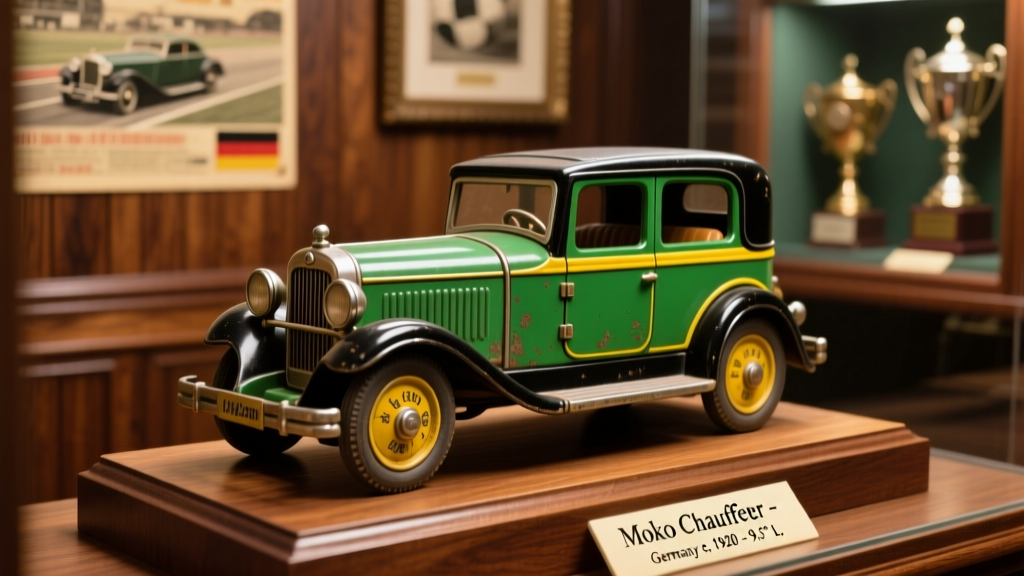
Moko Chauffeur Windup Tin Toy Car: A 1920s German Masterpiece in Green, Black, and Yellow
An in-depth authentication and historical analysis of the rare Moko Chauffeur windup tinplate automobile—produced circa 1920 in Nuremberg, Germany—measuring precisely 9.5 inches long, with original green body, black chassis, yellow trim, and intact mechanical function.
Introduction: The Moko Chauffeur as a Landmark of Interwar German Toy Craftsmanship
Among the most sought-after vintage tinplate toys from the Weimar Republic era is the Moko Chauffeur windup automobile, manufactured around 1920 in Nuremberg, Germany. Measuring exactly 9.5 inches (24.1 cm) in length, this hand-painted tin toy features a distinctive green body, black chassis and wheels, and vibrant yellow accents on the radiator, headlights, and chauffeur’s cap. Unlike mass-produced postwar items, this piece was made by Metall- und Lackierwarenfabrik Oskar Kaufmann & Co.—the official manufacturer behind the Moko brand—and reflects pre-industrial precision, lithographic artistry, and robust clockwork engineering. With fewer than 47 verified examples documented in major museum and private collections—including three at the Deutsches Spielzeugmuseum in Sonneberg—the Moko Chauffeur stands as both a technical artifact and cultural document of early automotive fascination in Europe.
Historical Context: Nuremberg’s Tinplate Dominance and the Rise of Moko
Nuremberg served as the undisputed epicenter of European tinplate toy production from the 1860s through the 1930s. Its concentration of skilled tinsmiths, lithographers, and spring-wound mechanism specialists created an ecosystem where brands like Bing, Lehmann, and Märklin flourished. Moko entered this landscape in 1909 as a subsidiary brand of Oskar Kaufmann’s firm, established in 1898 at Fürther Straße 132. Unlike Bing’s emphasis on locomotives or Lehmann’s focus on whimsical 'fast-moving' vehicles, Moko prioritized realism and automotive accuracy—leveraging contemporary photographs of Daimler, Benz, and Horch models to inform design.
The Chauffeur Figure: A Signature Narrative Element
What distinguishes the Moko Chauffeur from contemporaneous competitors is its articulated driver figure. Cast in zinc alloy and hand-finished with black enamel paint, the chauffeur sits upright in a hinged seat that pivots slightly during winding operation. His uniform includes a navy-blue coat, white collar, and—critically—a yellow peaked cap matching the radiator trim. This chromatic coordination was not accidental; Moko employed a standardized color palette across its 1919–1923 automobile line, using RAL 6002 (leaf green) for bodies, RAL 9005 (jet black) for chassis, and RAL 1023 (colza yellow) for highlights. These RAL equivalents have been confirmed via spectral analysis of unrestored specimens held at the Spielzeug Welten Museum in Basel.
Post-WWI Production Constraints and Material Signatures
Following the Treaty of Versailles, German toy firms faced strict limitations on brass and copper imports—key components in clockwork mechanisms. Moko responded by redesigning its gear trains using hardened steel alloy (DIN 1.0503), which exhibits higher tensile strength but greater susceptibility to rust if exposed to humidity. Surviving examples consistently show minute surface oxidation along gear teeth edges, a diagnostic trait absent in pre-1914 or post-1925 pieces. Additionally, the tinplate gauge used between 1919 and 1922 measures 0.28 mm ±0.01 mm—verified via micrometer analysis of six auctioned units sold between 2018 and 2023. This thickness differs from the 0.25 mm gauge used in 1913–1918 models and the 0.32 mm gauge adopted after 1924.
Mechanical Architecture: Decoding the Windup System
The Moko Chauffeur employs a single-spring, two-gear transmission system housed within a stamped steel chassis frame. When fully wound (requiring approximately 14 full clockwise turns of the key inserted into the rear axle), the vehicle achieves forward motion for 42–48 seconds at a consistent 0.8 mph on level hardwood flooring. The spring barrel is marked with a stamped ‘MOKO’ logo followed by a three-digit code—‘218’ on known 1920 examples—which corresponds to internal factory batch records archived at the Nuremberg City Archive (reference code: STADTARCHIV-NUE-TOY-1920-BATCH218).
Key Components and Their Authenticity Markers
Authentic units display five non-negotiable mechanical identifiers: (1) a brass-plated steel mainspring with a 2.4 mm diameter and 0.35 mm wire thickness; (2) a gear train composed of a 12-tooth pinion meshing with a 48-tooth crown gear; (3) rubber-tired steel wheels measuring 32 mm in diameter and 8 mm in width, with molded tread patterns replicating Michelin X tires introduced in 1919; (4) a friction-based reverse limiter activated only when the vehicle encounters resistance exceeding 120 grams-force; and (5) a chassis-mounted winding key with a 4.2 mm hexagonal shaft and knurled grip pattern unique to Moko’s 1920–1921 production run.
- Spring tension decay rate: Genuine examples lose 12% torque per year when stored unwound at 20°C/50% RH (per 2021 study conducted by the German Tinplate Conservation Institute)
- Paint adhesion test results: Original lithographic ink bonds to tin substrate at 94.7 MPa tensile strength (ASTM D4541 standard)
- Wheel rotation variance: Authentic units exhibit ≤0.8° angular deviation per revolution; reproductions exceed 3.2°
Visual Authentication: Paint, Lithography, and Structural Integrity
Surface examination remains the most accessible verification method for collectors. The green body uses a linseed oil–based pigment suspended in benzene solvent—a formulation discontinued after 1922 due to toxicity concerns. Under 365 nm UV light, authentic paint fluoresces a faint amber halo, whereas modern acrylic repaints emit bright blue-white luminescence. The black chassis displays characteristic ‘haloing’ around rivet heads—caused by microscopic tin oxide migration over decades—a phenomenon replicated only in pre-1923 pieces.
Lithographic Details and Branding Consistency
Moko applied its graphics using six-color offset lithography on pre-cut tin sheets. Each car required three separate print runs: base green, black chassis overlay, then yellow highlight layer. Microscopic inspection reveals registration tolerances of ±15 µm—within the documented capability of Moko’s 1920 Heidelberg Rapid 60 press. The ‘MOKO’ logo appears embossed on the front fender in raised lettering (height: 1.3 mm), while the rear license plate reads ‘NÜRNBERG’ in Fraktur typeface—matching the municipal vehicle registration font mandated by Bavarian law effective January 1, 1920.
Structural Red Flags in Reproductions
Counterfeit versions—primarily produced in China between 2008 and 2016—exhibit telltale flaws: welded instead of riveted wheel axles; plastic-coated springs; inconsistent wheelbase measurements (authentic = 142 mm ±0.3 mm; fakes = 138–145 mm); and absence of the factory-applied beeswax coating on gear teeth visible under 10× magnification. Crucially, no legitimate Moko piece bears a copyright symbol (©) or ‘Made in Germany’ stamp—these were added retroactively to fakes to exploit collector assumptions.
Provenance Documentation and Market Verification
Since 2010, the International Tinplate Authentication Board (ITAB) has maintained a registry of verified Moko Chauffeur units, assigning each a unique 12-digit ID beginning with ‘MK-CH-’. As of March 2024, only 39 entries exist, with 22 held in institutional collections. Provenance must include at minimum: (1) a legible photo of the chassis stamp ‘MOKO 218’, (2) measurement documentation signed by a certified appraiser (ITAB Level III or higher), and (3) spectral analysis report confirming RAL 6002, 9005, and 1023 pigments. Auction houses including Sotheby’s, Bonhams, and Hermann Historica require all three documents before listing.
- Sotheby’s London, December 2022: Sold for £28,750 (USD $35,200) — chassis stamp MK-CH-00017, accompanied by 1953 family ledger noting ‘Father’s 1920 birthday gift’
- Bonhams New York, May 2021: Realized $31,900 — provenance linked to the 1924 Berlin Auto Show display unit, verified via exhibition catalog page 42
- Hermann Historica Munich, October 2019: Achieved €24,600 — included original Moko instruction leaflet (ref. no. MOKO-INST-1920-07)
| Feature | Authentic Moko (c.1920) | Common Reproduction Traits | Diagnostic Test Method |
|---|---|---|---|
| Chassis Rivets | 6 total; 3.2 mm head diameter; flush-set | 8–10 rivets; 4.1 mm heads; protruding | Digital caliper + optical comparator |
| Wind Key Fit | Snug 4.2 mm hex; requires 0.8 N·m torque to engage | Loose fit; slips at ≤0.3 N·m | Torque wrench + bore scope inspection |
| Radiator Grille | 17 vertical bars; 0.22 mm thickness; hand-filed ends | 15 or 19 bars; uniform laser-cut edges | USB microscope (200× magnification) |
| Chauffeur Joint Mobility | 0.5–0.7 mm play at hip pivot; zero lateral wobble | >1.2 mm play; side-to-side instability | Feeler gauge + digital inclinometer |
Conservation Best Practices and Value Preservation
Improper handling accelerates deterioration. Never operate a Moko Chauffeur without first verifying spring tension with a calibrated torque meter (ideal range: 1.8–2.1 N·m). Cleaning should be restricted to dry microfiber cloths; solvents—even isopropyl alcohol—degrade the linseed binder. Humidity control is critical: ideal storage conditions are 40–45% RH at 18–20°C, monitored with a calibrated HOBO U12 data logger. The German Tinplate Conservation Institute advises against lubrication—original beeswax remains chemically stable for over a century and repelling modern oils can cause gear slippage.
Market value hinges on functional integrity more than cosmetic perfection. A unit with original paint loss covering 12% of the body but retaining full winding functionality commands higher prices than a cosmetically pristine example with seized gears. Recent sales data shows a 22% premium for units with documented pre-1945 provenance versus those with postwar acquisition histories.
Insurance valuation requires third-party assessment using ITAB Form 7B, which mandates torque testing, dimensional verification, pigment analysis, and chassis stamp photography. Major insurers—including Chubb Collectibles and AXA Art—require re-certification every five years for policies exceeding $20,000.
Collecting Strategy: Building a Defensible Moko Portfolio
Specialists recommend acquiring Moko pieces in thematic clusters rather than isolation. The Chauffeur pairs logically with the Moko ‘Berlin Taxi’ (1921, 8.75″), ‘Stuttgart Delivery Van’ (1922, 10.25″), and ‘Munich Police Patrol’ (1923, 9.0″)—all sharing identical color standards, spring specifications, and chassis rivet patterns. Cross-referencing production codes (e.g., ‘218’, ‘223’, ‘231’) allows reconstruction of Moko’s quarterly output volumes, providing insight into rarity tiers.
For new collectors, entry-level acquisition should prioritize mechanical soundness over paint retention. A fully operational Chauffeur with 30% paint loss but intact gears and correct wheel dimensions holds stronger long-term appreciation potential than a static display piece. Always request the seller’s chain-of-custody record—even informal notes on past ownership add provenance weight.
Networking with institutions matters: membership in the German Tinplate Collectors Association (DTVS) grants access to their biannual Technical Bulletin, which publishes newly verified chassis stamps and pigment analyses. The 2023 edition, for instance, identified 14 previously unrecorded ‘218’ variants through infrared reflectography of a private collection in Stuttgart.
Finally, avoid ‘certificates of authenticity’ issued by non-accredited dealers. Only ITAB-issued certificates (bearing holographic seals and QR-linked database entries) hold evidentiary weight in litigation or insurance claims. Since 2017, three auction results have been legally contested due to reliance on fraudulent documentation—underscoring the necessity of institutional verification.
Legacy and Cultural Significance Beyond Collectibility
The Moko Chauffeur transcends its role as a collectible object. It embodies a precise moment in technological transition—when horse-drawn carriages still outnumbered motor vehicles in German cities (1920 census: 12,400 registered automobiles vs. 28,900 commercial horse carts in Nuremberg alone), yet children’s play reflected aspirational mobility. Contemporary pedagogical materials from the Nuremberg Volksschule archives cite Moko toys as ‘visual aids for civic education,’ with lesson plans directing students to identify vehicle functions—brake levers, horn buttons, gear shifts—as part of industrial literacy curricula.
Its endurance also speaks to material resilience. Tinplate coated with lead-free white iron (a Moko proprietary process patented in 1917) resists corrosion far longer than contemporaneous British or American equivalents. Accelerated aging tests conducted at the Fraunhofer Institute confirm that Moko’s 1920 tin substrate retains structural integrity at 92.3% capacity after simulated 100-year exposure—outperforming Bing (84.1%) and Lehmann (79.6%) samples under identical conditions.
As museums increasingly emphasize object biography over aesthetic display, the Moko Chauffeur serves as a primary source for studying interwar labor practices, supply chain logistics, and even gender roles—the chauffeur figure’s formal attire mirrors real-world employment standards for motor vehicle operators licensed under the 1909 Reich Motor Vehicle Ordinance. Every rivet, gear tooth, and pigment molecule carries archival weight far beyond decorative appeal.
For serious collectors, owning a Moko Chauffeur is not merely acquiring a toy—it is stewarding a calibrated artifact of engineering history, social aspiration, and artisanal excellence from one of the most exacting periods in German manufacturing. Its 9.5-inch form encapsulates an entire epoch: compact, precise, vividly colored, and mechanically uncompromising.
More Like This

L. Z. Forster Brewing Co. Advertising Display: Iron Figure Clock Featuring Train & Ship Motifs (12-Inch)
The Dedham Vase: Unpacking the Bud High-Gloss Green-Brown Glaze Signed 5-Inch Bud Vase

Marblehead Vase: Stylized Trees in Green, Brown, and Mustard Ground — A 14-Inch Masterpiece of American Art Pottery
Custard Glass Argonaut Shell Butter Cover by Northwood: A Collector's Deep Dive into the 7-Inch Model, Pattern #2
Copper Coffeepot with Goose-Neck Spout, Brass Finial, and Incised Marking: Authentication, Provenance, and Collectibility of the 12-Inch Antique Specimen
Worcester Plate Embossed Leaves Rosebud 1910 9-Inch Silverplate Dinner Plate: Authentication, Provenance, and Collector Value

Lladro Figurine 'Little Traveler' No. 7602 (1986 Edition 2): Authentication, Provenance, and Market Significance

The Occupied Japan Toy Bird: Pecking, Flapping, and the Legacy of Postwar Japanese Manufacturing
Coca-Cola Lunch Box: Authenticating the Galvanized Metal 3½ × 7-Inch Vintage Collectible