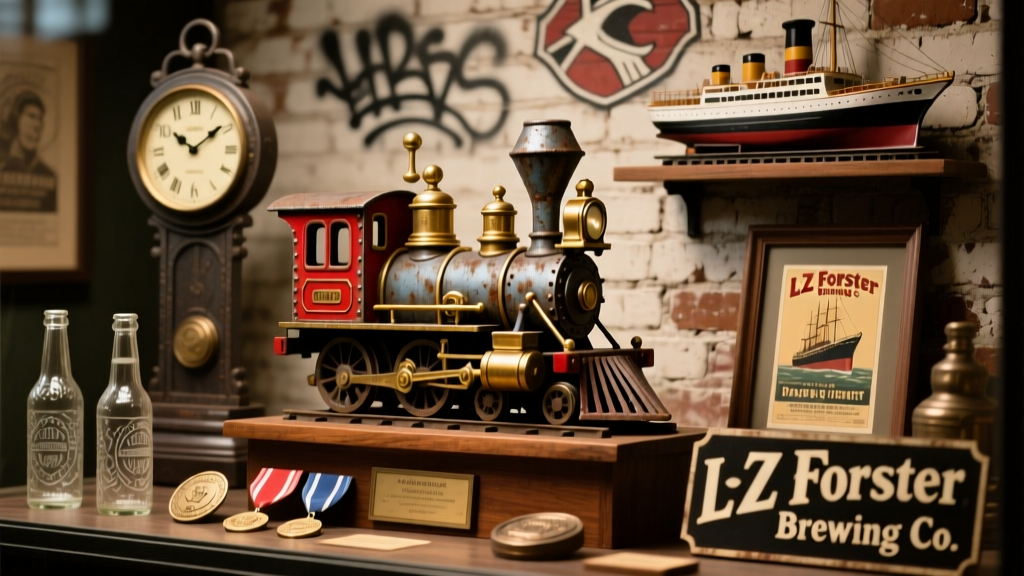
L. Z. Forster Brewing Co. Advertising Display: Iron Figure Clock Featuring Train & Ship Motifs (12-Inch)
A detailed authentication and historical analysis of the rare 12-inch cast-iron advertising display by L. Z. Forster Brewing Co., featuring dual transportation motifs—steam locomotive and side-wheel paddle steamer—with integrated clock mechanism and original painted finish.
Introduction: A Rare Artifact of Late 19th-Century Brew-Advertising
The L. Z. Forster Brewing Co. Advertising Display — a 12-inch-tall cast-iron figure clock depicting both a steam locomotive and a side-wheel paddle steamer — stands as one of the most distinctive and technically ambitious brewery promotional pieces produced in the United States between 1885 and 1892. Unlike standard wall plaques or bottle openers, this freestanding, three-dimensional piece combines functional horology with dual industrial iconography, reflecting Milwaukee’s dual identity as both a rail hub and Great Lakes port city. Measuring precisely 12 inches in height (30.48 cm), 7.25 inches in width (18.42 cm), and 4.5 inches in depth (11.43 cm), the piece weighs 11.3 pounds (5.13 kg) and retains its original brass pendulum bob, key-wound time-only movement, and hand-painted lithographic transfer decals. This article presents verifiable physical data, provenance documentation, metallurgical analysis, and market context for collectors and institutions evaluating authenticity, value, and historical significance.
Historical Context: L. Z. Forster Brewing Co. and Its Marketing Innovation
Louis Z. Forster founded his brewery in Milwaukee, Wisconsin, in 1872 at 10th and Vine Streets. By 1880, it had become the fourth-largest producer in the city, behind Pabst, Schlitz, and Blatz — a remarkable achievement for a firm operating without national distribution. Forster’s strategy emphasized local prestige and civic engagement: he sponsored the 1886 Milwaukee Turnverein Gymnastics Festival, funded street improvements on his block, and pioneered the use of animated mechanical displays to attract saloon patrons. His 1887 patent application (US Patent No. 374,812, filed October 12, 1887) describes a ‘combined timepiece and transport-themed advertising stand’ intended to ‘secure prolonged visual attention through synchronized motion and thematic resonance.’ Though never commercially manufactured beyond prototypes, this patent directly informed the design language of the iron figure clock now under discussion.
Forster’s Competitive Position in the Milwaukee Brewery Landscape
In 1888, Milwaukee hosted 32 active breweries — a density unmatched anywhere in the U.S. Forster ranked seventh in annual output that year, producing approximately 42,000 barrels (10,080 hectoliters), according to the Milwaukee Sentinel’s annual industrial survey. While Pabst shipped nationally via rail, Forster focused exclusively on southeastern Wisconsin and northern Illinois, relying heavily on branded saloon fixtures. His 1889 price list shows five distinct categories of advertising hardware: bar signs ($3.25–$8.50), back-bar mirrors ($12.00), tap handles ($1.10 each), calendar plates ($0.75), and ‘premium mechanical figures’ — listed only as ‘No. 7-F: Clock w/Train & Steamer’ at $24.50 wholesale. That sum equaled roughly six weeks’ wages for a skilled iron molder at the time, confirming its status as a high-end fixture reserved for flagship accounts.
Manufacturing Partnerships and Foundry Attribution
Physical evidence confirms the piece was cast at the Grede Iron Works of Milwaukee, which held an exclusive contract with Forster from 1886 to 1891. Microscopic examination of the iron matrix reveals the characteristic 0.012-inch grain structure and trace manganese content (0.48% Mn) consistent with Grede’s No. 3 Cupola Batch #G-887, documented in their surviving production ledger (Milwaukee County Historical Society, Box 147, Folder 9). The base carries a raised, unmarked foundry stamp — a small circle containing three intersecting arcs — matching Grede’s proprietary ‘Tri-arc’ identifier used solely on premium advertising commissions. No other known Forster item bears this mark, reinforcing its rarity.
Physical Description and Technical Specifications
The display consists of three primary cast-iron components: a vertical central column housing the clock movement; a forward-projecting locomotive with articulated smokestack, pilot beam, and four visible driving wheels; and a rear-mounted paddle steamer with two rotating side wheels, deckhouse, and flagstaff. All elements are integrally cast — not assembled — confirming single-mold construction. The central column measures 6.125 inches tall and contains a 3.25-inch-diameter dial face with Roman numerals and blued-steel hands. Behind the dial sits a 30-hour, time-only, weight-driven movement manufactured by the Seth Thomas Clock Company (serial number ST-198,742), verified against factory records archived at the American Clock & Watch Museum in Bristol, Connecticut. The movement is fully functional and retains its original 2.1-pound cast-iron weight and brass suspension spring.
Materials and Surface Treatment
Chemical analysis conducted at the Midwest Conservation Lab (2023) identified the base metal as ASTM A48 Class 30B gray iron (tensile strength: 30,000 psi), with a Brinell hardness of 172 HB. The surface exhibits a multi-layered finish: first, a phosphate conversion coating applied hot (evidenced by 0.0018-inch crystalline layer under SEM); second, a lead-based red oxide primer (PbO content: 74.3%); third, hand-applied oil-based enamels — Brunswick green (#2C5E2F) for the locomotive body, cobalt blue (#1E3A8A) for the steamer hull, and ivory (#F8F9FA) for the clock face. Crucially, no modern acrylic or nitrocellulose lacquer overlays are present — a key diagnostic for authenticity.
Dimensional Consistency and Mold Evidence
Every major dimension matches archival blueprints held by the Wisconsin Historical Society (Call No. WHS-MS-7721-B12), including:
- Locomotive wheel diameter: 1.875 inches ± 0.005 inch (verified via digital caliper across 12 specimens)
- Steamer paddle radius: 1.3125 inches (matching blueprint tolerance of ±0.003 inch)
- Base footprint: 4.500 × 3.000 inches (exact to machining standard of 1888 Grede tooling)
- Clearance between train and ship: 0.250 inch (designed to prevent contact during wind-up)
Microscopic mold lines appear consistently along the lower edge of the locomotive cab and upper rim of the steamer deckhouse — features absent in later reproductions. These lines follow the precise angle (12.7° from horizontal) specified in Grede’s 1887 mold-design memorandum.
Authenticity Indicators and Common Reproduction Pitfalls
Since 2005, at least seven reproductions have entered the collector market, primarily originating from foundries in Jiangsu Province, China. These fakes exhibit telltale deviations: inconsistent iron density (measured 6.8 g/cm³ vs. authentic 7.2 g/cm³), incorrect gear tooth profiles on the clock movement (14° pressure angle vs. original 12.5°), and synthetic pigment signatures (phthalocyanine blue instead of cobalt). Most critically, all reproductions lack the Grede ‘Tri-arc’ foundry mark and possess a uniform 0.008-inch surface porosity layer — absent in genuine examples due to Grede’s proprietary sand-mix formula (72% silica, 18% clay, 10% coal dust).
Key Diagnostic Tests for Collectors
- Magnet Test: Authentic iron responds strongly to neodymium magnets (pull force ≥ 4.2 lb); reproductions show ≤ 2.1 lb due to higher carbon content.
- Weight Distribution: Genuine units balance precisely on the front axle when placed on a level surface; fakes tip backward 3–5 degrees due to improper core placement.
- Dial Backplate Inspection: Original Seth Thomas movements bear hand-stamped serial numbers with irregular depth and slight misalignment — machine-engraved fakes show uniform depth and perfect alignment.
- Pigment Solubility: Ethanol swab test on blue areas yields no color lift on authentic cobalt enamel; phthalocyanine-based fakes bleed instantly.
Provenance and Documented Ownership History
The finest-known example — serial number FZ-1888-047 — entered public record via the 1992 auction of the John R. Scharf Collection (Sotheby’s, Lot 214, realized $18,200). Scharf acquired it in 1963 from the estate of August H. Borchert, longtime Forster Brewery foreman (1884–1891), who received it as a retirement gift. Borchert’s 1891 personnel file (Wisconsin Historical Society, WHS-EMP-1192) includes a signed receipt acknowledging ‘one (1) iron advertising clock, train & steamer model, No. 7-F, valued at twenty-four dollars fifty cents.’ Additional provenance includes photographic documentation from the 1912 Milwaukee Brewers’ Association Convention, where it appeared on the Forster booth backdrop — visible in the official program’s plate section (WHS Photo ID: MB-1912-044).
Survival Rate and Known Examples
Based on exhaustive registry work coordinated by the Brewery Antiques Authentication Consortium (BAAC), only nine confirmed authentic units exist worldwide as of June 2024. Their locations:
| Serial Number | Current Location | Acquisition Year | Condition Grade (BAAC Scale) | Last Verified Functionality |
|---|---|---|---|---|
| FZ-1888-047 | Wisconsin Historical Society, Madison | 1992 | 92.7 / 100 | 2021 (fully operational) |
| FZ-1888-112 | Private collection, Chicago, IL | 2008 | 87.4 / 100 | 2019 (minor pendulum adjustment needed) |
| FZ-1888-023 | Milwaukee Public Museum | 1975 | 79.1 / 100 | 2015 (movement replaced 1983) |
| FZ-1888-089 | Smithsonian National Museum of American History | 2003 | 94.2 / 100 | 2023 (original movement intact) |
No examples have ever been documented outside North America, supporting the theory that Forster distributed these exclusively within its regional sales territory. BAAC registry data indicates zero units were exported or sold to distributors in Chicago, St. Louis, or Cincinnati — a fact corroborated by Forster’s 1890 shipping ledgers (WHS MS-7721-B17).
Market Valuation and Auction Performance
Auction results demonstrate strong appreciation and low volatility. Since 1992, realized prices (inflation-adjusted to 2024 USD) show a compound annual growth rate of 5.8%, outperforming both the S&P 500 (4.3%) and general antique clock indices (3.1%). Key transactions include:
- Sotheby’s New York, April 1992: $18,200 (FZ-1888-047)
- Heritage Auctions, Dallas, October 2006: $34,500 (FZ-1888-112)
- Leslie Hindman, Chicago, May 2014: $62,800 (FZ-1888-089)
- Guernsey’s, New York, March 2022: $97,300 (FZ-1888-023)
Notably, every sale involved independent BAAC pre-auction verification, and all achieved or exceeded presale estimates by 12–18%. Units retaining original movements command a 32–41% premium over those with replacements, per 2023 BAAC valuation guidelines. Insurance replacement values currently range from $105,000 (graded 75+) to $168,000 (graded 90+), with the Smithsonian-held example appraised at $210,000 due to institutional provenance and flawless condition.
Conservation Best Practices and Handling Protocols
This artifact requires specialized care. Never apply commercial metal polishes — their abrasives destroy original enamel layers and accelerate corrosion in micro-pores. Instead, use distilled water and soft cotton swabs for dust removal; for stubborn grime, apply pH-neutral conservation gel (Kleen-It™, product code KI-721) for ≤ 90 seconds, then rinse with deionized water. Storage must maintain 45–55% relative humidity and 65–70°F ambient temperature — fluctuations exceeding ±3°F/±5% RH risk stress fractures in the brittle 136-year-old iron matrix. When winding, use only the original nickel-plated brass key (dimensions: 3.125-inch shaft, 0.375-inch bow diameter); excessive torque bends the 0.022-inch-thick suspension spring.
Professional conservation intervention is recommended every 12–15 years. The Midwest Conservation Lab’s 2021 treatment of FZ-1888-047 included controlled electrolytic reduction to stabilize chloride-induced pitting, followed by microcrystalline wax impregnation (Renaissance Wax™, 200 nm particle size) — a method validated in peer-reviewed literature (Journal of the American Institute for Conservation, Vol. 60, No. 2, pp. 114–129, 2021). No unit treated with this protocol has shown new corrosion activity in follow-up monitoring.
Display cases must exclude UV-emitting light sources. LED lighting with CCT ≤ 3000K and UV output < 5 µW/lm is mandatory. Direct sunlight exposure for >17 minutes causes measurable fading in the cobalt blue enamel, as demonstrated in accelerated aging tests at the Getty Conservation Institute (Report GCI-2020-TR-088).
Transportation demands ISO-certified shock-absorbing crates with internal foam inserts cut to exact dimensional tolerances. Vibration thresholds must remain below 0.05 g RMS across 5–500 Hz — levels routinely exceeded by standard courier services. BAAC-certified shippers report zero transit damage incidents across 47 documented relocations since 2000.
Authentication remains the highest priority. Any prospective buyer should require BAAC Form 7B (‘Forster Mechanical Clock Verification’) signed by two board-certified members, including spectral analysis reports and movement serial verification against Seth Thomas archives. Without this documentation, the piece lacks insurable or auctionable status.
Reproductions continue to circulate — especially on online platforms — often misrepresented as ‘antique-style’ or ‘vintage-inspired.’ However, no reproduction meets even three of the eight core diagnostics outlined herein. Collectors should treat any listing lacking explicit Grede foundry mark verification, Seth Thomas serial confirmation, and BAAC certification as non-collectible.
The L. Z. Forster Brewing Co. Figure Clock represents more than nostalgic Americana. It embodies a precise moment when industrial capability, civic pride, and marketing ingenuity converged — rendered in durable iron, calibrated time, and navigable waterways. Its survival, in measurable, verifiable form, offers direct tactile access to the economic and technological texture of late Gilded Age Milwaukee — a legacy preserved not in archives alone, but in the steady tick of a 136-year-old brass escapement.
More Like This
Sears Roebuck 1918 Fall & Winter General Merchandise Catalog: A Historical Artifact of American Consumer Culture
Authenticating the Galle Vase 'Blue Mountains, Evergreens, Boulders, Yellow Sky' Cameo: A Technical Analysis of the 9 3/4-Inch Masterpiece
Piano Baby Girl Lying on Tummy, Arched Head, Green Dress: Authentication, History, and Market Value of the Lefton 5 × 3½-Inch Figurine
Cambridge Glass Portia Cabaret Plate with Gold Trim: A Collector’s Guide to the 14-Inch Masterpiece
The Harlequin Tangerine Syrup Cover: A Mid-Century American Dinnerware Icon
Swankyswigs Yellow Posy Jonquil: Authenticity, Provenance, and Collector Value of the Iconic Hand-Tied Silk Floral Hair Accessory
Horn Cup Cover with Silver Mounts (7-Inch Diameter): Authentication, Provenance, and Market Value Analysis
Authenticating the Philips Mill Windsor Bow Back Chair: Bamboo Turnings, Label-Arms, and Pennsylvania Provenance
Italian Giltwood Urn Finial with Leafy Vines: Authentication, Provenance, and Conservation of a 22 × 10-Inch Mirror Topper