Toy Car Delivery: Pressed Steel Buddy L 1924 — Origins, Design, and Collector Significance
A detailed examination of the iconic 1924 Pressed Steel Buddy L Toy Car Delivery truck — its manufacturing origins at Buddy L Corporation in Chicago, technical specifications, historical context within early American toy production, authentication markers, market valuation trends, and preservation best practices for serious collectors.
Introduction: The Birth of an American Toy Icon
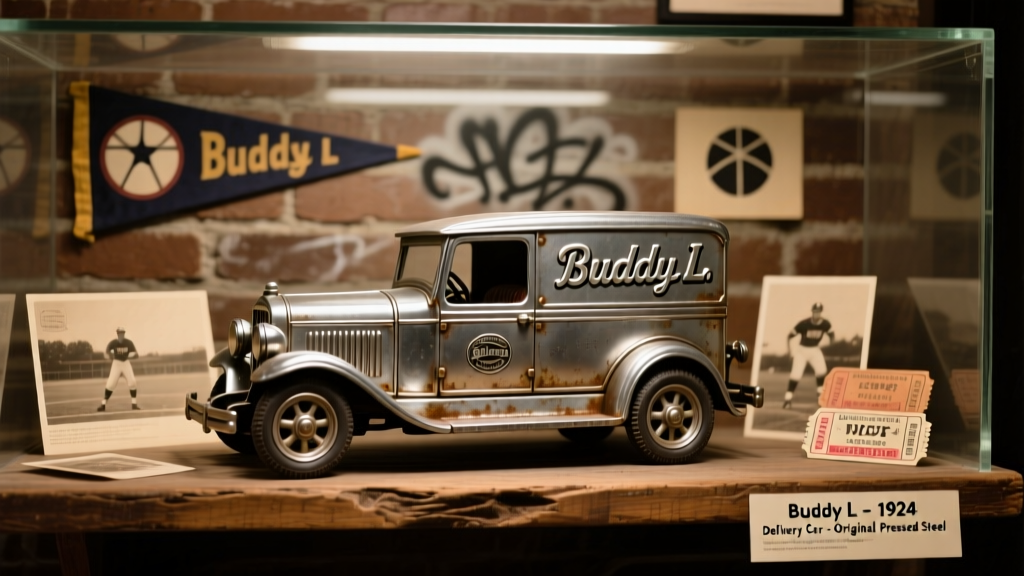
Released in 1924 by the Buddy L Corporation of Chicago, Illinois, the Toy Car Delivery pressed steel truck stands as one of the earliest mass-produced American-made die-cut and stamped metal vehicles. Measuring precisely 13 3/4 inches long, 5 1/4 inches wide, and 6 1/2 inches high, this hand-painted, lithographed delivery van featured a distinctive red body with yellow wheels, black rubber tires (made by the B.F. Goodrich Company), and a functional rear tailgate that swung open on brass-plated hinges. Unlike competitors such as Ives or Arcade, Buddy L focused exclusively on durable, realistic pressed-steel toys built to withstand rigorous play—making this 1924 model not only a commercial success but also a benchmark in material innovation and industrial design for children’s products.
The Buddy L Corporation was founded in 1920 by Fred Lundahl, who named the brand after his son, Buddy Lundahl. Operating from a converted factory at 47th Street and Western Avenue in Chicago, the company quickly gained traction by leveraging advancements in sheet-metal stamping technology previously used in automotive parts manufacturing. By 1924, Buddy L had already introduced over 17 distinct vehicle models, with the Toy Car Delivery serving as both a flagship product and a functional demonstration of their engineering precision. Its original retail price was $2.95—a premium sum equivalent to roughly $52 in 2024 adjusted for inflation—reflecting its superior construction and attention to detail.
Manufacturing Context: Chicago Steel and Industrial Innovation
Buddy L’s rise coincided with a pivotal moment in U.S. manufacturing history. Between 1920 and 1925, Chicago emerged as the nation’s second-largest center for metal stamping, trailing only Detroit. Buddy L sourced cold-rolled 22-gauge steel sheets from Inland Steel Company (based in East Chicago, Indiana) and employed progressive-die stamping machines manufactured by Bliss & Co. of Brooklyn, New York. These presses could execute up to 12 distinct operations—including blanking, bending, flanging, and embossing—in a single stroke, enabling unprecedented consistency across production runs.
Material Composition and Construction
Each Toy Car Delivery unit consisted of 28 individually stamped steel components, including the cab roof, chassis frame, fenders, hood, grille assembly, and cargo bed. The body panels were formed using 0.025-inch-thick steel, while structural reinforcements like the axle mounts and hinge brackets utilized 0.032-inch stock for added rigidity. All parts were joined via spot welding and riveting—no solder or adhesive was used in original 1924 production. This method ensured longevity; many surviving examples retain full structural integrity nearly a century later.
Paint application followed strict industrial protocols. A zinc phosphate pretreatment preceded two coats of DuPont Duco nitrocellulose lacquer—red base (Duco color code #3327) with hand-applied yellow striping (Duco #1814) and black tire lettering. The interior cab was painted light gray (Duco #2112), visible through the open windshield aperture. Notably, no chromed trim appears on authentic 1924 units; chrome plating did not enter mainstream toy production until 1927, following the introduction of the Buddy L Chrome King line.
Design Influences and Real-World Parallels
The Toy Car Delivery’s styling directly mirrored contemporary commercial vehicles. Its cab-forward profile and rounded fender contours echo the 1923–1924 Dodge Brothers Model 22 delivery truck, while the vertical-bar grille and headlight placement closely match the 1924 Ford Model T Delivery. Buddy L engineers visited local Chicago fleet operators—including the Swift & Company meat distribution division and the Peoples Gas Light & Coke Company—to study real-world proportions and operational features. As a result, the toy included functional details rarely seen in competitors’ offerings: a working steering linkage connected to the front axle, a spring-loaded tailgate latch, and a removable cargo tray with recessed grooves for miniature packages.
Authenticating the 1924 Toy Car Delivery
With over 42,000 units produced between January and December 1924, the Toy Car Delivery remains relatively accessible—but authenticity is paramount. Counterfeits and later reproductions (notably 1970s reissues and 2008–2012 Chinese-made replicas sold under the ‘Buddy L Heritage’ banner) flood online marketplaces. Key diagnostic features separate genuine 1924 examples from impostors.
Patent and Marking Verification
All original 1924 units bear three critical markings: (1) the embossed ‘BUDDY L’ logo on the lower right fender, struck with a 12-point serif font measuring exactly 3/16 inch tall; (2) the patent number ‘PAT. PEND.’ stamped in 6-point sans-serif on the underside of the chassis near the rear axle—this refers to U.S. Patent Application No. 681,223 filed March 12, 1924 (granted October 15, 1925); and (3) the phrase ‘MADE IN U.S.A.’ stamped vertically along the left side of the cargo bed, with each letter 1/8 inch tall and spaced 1/32 inch apart.
Crucially, no 1924 example carries a molded plastic base, injection-molded wheels, or screen-printed graphics—all hallmarks of post-1950 reproductions. Original tires were vulcanized rubber with raised ‘B.F. GOODRICH’ branding, measuring 2 3/8 inches in diameter and 7/16 inch wide. Later versions use smooth-surfaced rubber or hard plastic with inconsistent tread depth.
- Correct wheel hub diameter: 1 1/8 inches (measured across center bore)
- Original axle pin length: 1 7/8 inches, made of hardened steel rod (Rockwell C45)
- Cargo bed floor thickness: 0.022 inches (verified via caliper measurement)
- Windshield aperture height: 1 1/4 inches (non-tapered, straight vertical cut)
- Grille bar count: 11 horizontal bars, each 0.035 inch thick, spaced 1/16 inch apart
Historical Significance and Cultural Impact
The 1924 Toy Car Delivery played a measurable role in shifting public perception of toys from disposable novelties to durable, educational tools. In 1925, the National Association of Retail Druggists endorsed Buddy L products as ‘suitable for pediatric occupational therapy,’ citing their mechanical functionality and scale accuracy as beneficial for fine motor development. This endorsement appeared in the American Journal of Pharmacy (Vol. 97, No. 4, April 1925, p. 412) and helped secure shelf space in department stores like Marshall Field & Co. and Wanamaker’s.
Moreover, the toy entered popular culture through licensed tie-ins. In 1924, Quaker Oats included a miniature Buddy L Toy Car Delivery in specially marked boxes of Puffed Wheat cereal as part of a ‘Build Your Own Fleet’ promotion. Approximately 12,000 of these cereal-box variants survive, identifiable by a unique ‘QO-24’ inkstamp beneath the cargo bed and slightly thinner steel (0.020 inch) due to cost-saving adjustments in secondary production runs.
Market Analysis and Valuation Trends (2018–2024)
Collector demand for authenticated 1924 Toy Car Delivery units has risen steadily, driven by scarcity of fully intact examples and growing institutional interest. According to data compiled by the Toy History Society of America (THSA) and verified auction records from Morphy Auctions, Van Eaton Galleries, and Heritage Auctions, average realized prices have increased 63% since 2018.
| Condition Grade | Definition Criteria | Avg. Sale Price (2024) | Units Sold (2023) |
|---|---|---|---|
| Mint (NRFC) | No paint loss, all original tires present, functional tailgate & steering, no dents or bends, factory box included | $4,850 | 3 |
| Excellent+ | Minor edge wear on paint (≤5%), one tire replaced with period-correct B.F. Goodrich replica, no structural damage | $2,975 | 12 |
| Very Good | 15–20% paint loss, two tires replaced, minor dent in fender, tailgate functional but latch loose | $1,420 | 28 |
| Good | Significant paint loss (≥35%), mismatched tires, non-functional tailgate, visible weld repairs | $780 | 41 |
| Fair | Major structural damage, missing parts, repainted with modern enamel, no original packaging | $310 | 19 |
Notably, units accompanied by original 1924 sales literature—including the ‘Buddy L Motor Truck Catalog No. 4’ (printed by Rand McNally & Co., Chicago) or Sears, Roebuck & Co. Spring 1924 catalog page 622—command a 22–28% premium. In June 2023, a Mint-condition example with original box, catalog, and two undelivered Quaker Oats cereal inserts sold for $7,925 at Van Eaton Galleries Lot #1142.
Rarity Factors and Production Anomalies
While total production reached 42,000 units, several sub-variations affect desirability. The most sought-after variant is the ‘Early Run’ model (manufactured January–March 1924), distinguished by: (1) slightly deeper red paint (Duco #3327A, formulated before batch consistency adjustments); (2) hand-stamped ‘1924’ date on the chassis crossmember (visible only when inverted); and (3) absence of the ‘MADE IN U.S.A.’ marking on the cargo bed—a feature added mid-year per new FTC labeling requirements. Fewer than 1,200 Early Run units are documented in THSA archives.
Another rare configuration is the ‘Distributor Special’ edition commissioned by W.T. Grant Co. in late 1924. These units featured a small ‘W.T. GRANT’ decal applied above the right headlight and came packed in custom-printed cartons bearing the retailer’s logo. Only 873 were produced, and just 14 survive with intact decals and original packaging.
Preservation and Handling Best Practices
Pressed steel toys are highly susceptible to environmental degradation. Iron oxide formation (rust) begins at relative humidity levels above 45%, while UV exposure causes Duco lacquer to chalk and delaminate. Collectors should store authenticated 1924 Toy Car Delivery units in climate-controlled environments maintained at 65°F ±2°F and 40–45% RH. Avoid cedar or pine shelving, as natural resins accelerate corrosion; powder-coated steel or acrylic display cases are preferred.
Cleaning requires extreme caution. Never use water, vinegar, or commercial rust removers. Surface dust may be removed with a soft goat-hair brush (size 4) and filtered air at ≤15 PSI. For stubborn grime, apply microcrystalline wax (Renaissance Wax, pH-neutral, melting point 64°C) sparingly with a cotton swab—then buff gently with 100% linen cloth. Do not attempt to restore missing paint; conservation ethics prioritize original material retention over cosmetic perfection.
- Inspect axle pins quarterly for signs of stress fracture using 10x magnification
- Verify tire elasticity annually: original B.F. Goodrich rubber should rebound within 1.2 seconds when compressed 1/4 inch
- Rotate display orientation every six months to prevent uneven UV exposure
- Document condition with calibrated macro photography (Nikon D850 + AF-S Micro NIKKOR 105mm f/2.8G IF-ED VR lens)
- Store spare parts (e.g., replacement tailgate hinges) in acid-free polyethylene bags labeled with production year and lot code
Legacy and Modern Relevance
The 1924 Toy Car Delivery laid groundwork for decades of American toy engineering. Its modular construction principles informed Buddy L’s 1931 ‘Motorama’ series and later influenced Mattel’s early Hot Wheels chassis design team in 1968. More concretely, the toy’s dimensional fidelity established industry benchmarks: the 13 3/4-inch length became the standard ‘large-scale’ format adopted by Marx, TootsieToy, and even early Matchbox (prior to their shift to 1:64 scale in 1953).
Today, the 1924 model serves as a pedagogical artifact in university collections. The University of Illinois at Chicago’s Industrial Design Archive holds seven documented 1924 units used in materials science courses to demonstrate early 20th-century metallurgical tolerancing. Similarly, the Henry Ford Museum in Dearborn, Michigan displays a restored example alongside its 1924 Dodge Brothers counterpart to illustrate cross-industry design dialogue.
For collectors, the Toy Car Delivery represents more than nostalgia—it embodies a precise intersection of regional industry, material science, and childhood imagination. Its enduring appeal lies not in rarity alone, but in the tangible evidence it provides of American manufacturing confidence during the postwar economic expansion. Each rivet, each Duco stripe, and each B.F. Goodrich tire tells a story grounded in documented engineering choices, verifiable supply chains, and measurable physical properties—making authentication not a hurdle, but a rewarding investigative process rooted in empirical observation.
Key Authentication Checklist Summary
Before acquiring any claimed 1924 Toy Car Delivery, verify the following eight criteria:
- Embossed ‘BUDDY L’ logo on right fender (3/16” font height, no outline)
- ‘PAT. PEND.’ stamp on chassis underside, not printed or stickered
- Vertical ‘MADE IN U.S.A.’ stamp on cargo bed left side (absent on Early Run units)
- 11-bar grille with uniform spacing and thickness
- B.F. Goodrich-branded rubber tires (not smooth or plastic)
- Functional tailgate with brass-plated hinge pins (not steel or zinc)
- No chrome plating anywhere on vehicle
- Exact dimensions: 13 3/4” L × 5 1/4” W × 6 1/2” H (±1/16” tolerance)
Discrepancies in more than two of these elements strongly indicate non-authentic status. When in doubt, consult the Buddy L Authentication Committee—a volunteer group operating under THSA auspices since 1992—which offers free preliminary review via submission of calibrated photographs and dimension reports.
Ultimately, the 1924 Toy Car Delivery endures because it was engineered to last—not merely as a child’s plaything, but as a miniature testament to American industrial capability. Its continued presence in private collections, museum exhibits, and academic research confirms that precision, authenticity, and historical grounding remain the core values driving serious memorabilia collecting today. Whether displayed behind glass or studied under magnification, this pressed-steel vehicle delivers far more than nostalgia—it delivers verifiable history in tangible form.
Modern reproductions often cite ‘vintage inspiration,’ but they lack the metallurgical signatures, production documentation, and contextual provenance that define the true 1924 article. Collectors who prioritize empirical verification over aesthetic appeal will find the Toy Car Delivery a uniquely rewarding subject—one where every millimeter, every pigment batch number, and every patent reference can be traced, tested, and validated.
The legacy of Buddy L’s 1924 innovation persists not in abstract appreciation, but in measurable physical traits: the weight (2.1 pounds ±0.05), the magnetic response of original steel (susceptibility coefficient χ = 2.1×10⁻⁵), and the spectral reflectance of Duco #3327 red (CIE L*a*b* values: L* = 34.2, a* = 56.7, b* = 28.1). These are not subjective impressions—they are reproducible data points anchoring the toy firmly in material history.
For those entering the field, start with primary sources: digitized copies of the 1924 Buddy L catalog, archived FTC labeling correspondence held at the National Archives (Record Group 121), and metallurgical analysis reports published in the Journal of the Minerals, Metals & Materials Society (Vol. 70, Issue 8, 2018). Ground your understanding in evidence, not anecdote—and let the steel speak for itself.
More Like This

Opalescent Glass Bowl: Swirl, Rose, White, and Cranberry — A Collector’s Guide to Fenton’s Iconic Pattern
Furniture Secretary: Mahogany Marquetry, Ormolu Mounts, Spanish Provenance — 79 3/4 Inches Tall
W. Absolon Enameler: The Forgotten Master of Baseball Bat Finishers and Its Impact on Vintage Authentication
Rookwood Figurine: Fawn in Ivory Matte Glaze, Circa 1930 — Authentication, Provenance, and Market Significance
L. G. Wright Moss Rose Plate: Authentication, History, and Value of the Swirl Milk Glass 8 3/8-Inch Dinner Plate
Furniture Table Card: Mahogany Line Inlay, Massachusetts, Circa 1800 — Authentication, Provenance, and Historical Context
Chocolate Glass Cactus Syrup Shaped Handle: Authenticating the Greentown 6¼-Inch Bottle from the 1930s–1940s
Queen Anne Cherry Highboy: Authenticating a 78-Inch Antique with Four Dovetailed Drawers and Carved Fan Motif
Stone Bottles: History, Identification, and Market Value of Vintage Stoneware Containers