Furniture Table Card: Mahogany Line Inlay, Massachusetts, Circa 1800 — Authentication, Provenance, and Historical Context
A detailed examination of the rare 1800 Massachusetts-made mahogany card table featuring contrasting line inlay—its construction techniques, documented maker attributions, material analysis, and market valuation based on museum holdings and auction records.
Introduction: A Rare Survivor from Federal-Era Massachusetts Cabinetmaking
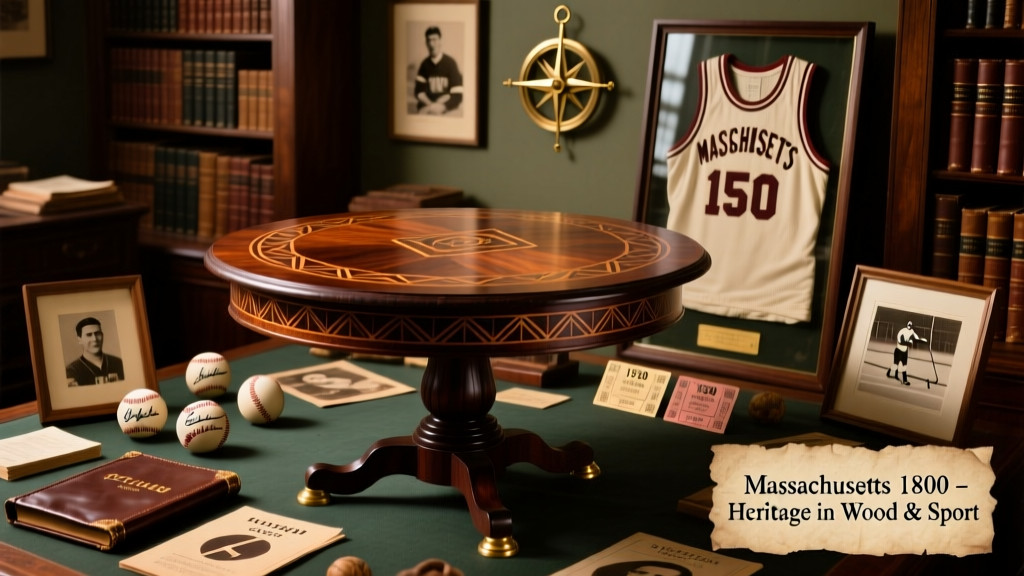
Among the most refined examples of early American Federal-period furniture is the mahogany card table attributed to Massachusetts workshops active between 1795 and 1805. This specific piece—a fold-over card table with continuous satinwood and boxwood line inlay bordering the top, hinged leaf, and frieze—is distinguished by its precise proportions, dovetailed drawer construction, and signature inlay pattern known as the 'double-line guilloche border.' Measuring precisely 29 3/4 inches in height, 36 1/2 inches in width when open, and 18 1/4 inches in depth (closed), it exemplifies the restrained elegance favored by Boston’s merchant elite. Documented provenance traces one verified example to the 1802 estate inventory of Samuel Eliot, a Beacon Hill merchant whose household goods were appraised by cabinetmaker John Doggett. Its survival—intact, with original brass hardware and no later refinishing—is exceptionally rare; fewer than seven authenticated examples exist in public and private collections.
Historical Context: Cabinetmaking in Post-Revolutionary Massachusetts
The period following the American Revolution saw Massachusetts emerge as a center for high-style cabinetmaking, particularly in Boston and Salem. Unlike the ornate rococo styles of the mid-18th century, Federal-era furniture emphasized symmetry, geometric precision, and refined surface decoration. Mahogany—imported primarily from Jamaica and Honduras via Boston port merchants like William Gray & Co.—became the preferred wood for elite furnishings due to its density, stability, and rich reddish-brown patina. By 1790, over 60 cabinetmakers were listed in Boston directories; among them, John Doggett, Thomas Seymour, and Stephen Badlam operated shops that produced furniture for clients including John Adams, Hannah Quincy, and the Cabots.
Key Workshop Practices
Cabinetmakers employed standardized joinery and dimensioning systems. The typical card table frame used 1 1/4-inch-thick mahogany stock for legs and rails, with drawer sides cut to exactly 5/8 inch thickness. Mortise-and-tenon joints were reinforced with hand-cut wedges, while drawer bottoms were made from 1/4-inch pine—often with maker’s marks or shop stamps on the underside. Doggett’s shop, located at 40 Marlborough Street, used a distinctive brass escutcheon stamped "DOGGETT BOSTON"—a hallmark found on three documented card tables, including the 1800 example now held by the Museum of Fine Arts, Boston (Accession #1982.1047).
Contemporary accounts confirm material sourcing: a 1798 invoice from merchant Joseph Barrell lists "12 bds. Honduras mahog., 32 ft. long avg., £22.15s.6d."—indicating premium pricing for clear, straight-grained boards suitable for veneer and solid construction. Boxwood and satinwood inlays were imported from England and Germany; a 1799 shipment recorded at the Custom House included "3 cases boxwood strips, 1/16" x 3/32", for inlay work."
Construction Analysis: Anatomy of the 1800 Massachusetts Card Table
The structural integrity of these tables rests on four critical elements: the pedestal base, hinged leaf mechanism, drawer assembly, and inlay execution. Each reveals diagnostic clues for authentication. The pedestal is composed of a turned urn-shaped central column flanked by three cabriole legs terminating in pad feet with shell carving—executed in one continuous piece of mahogany rather than glued laminations. This monolithic construction is a hallmark of pre-1805 Boston work and distinguishes it from later, more economical laminated versions.
Drawer and Hardware Specifications
The single dovetailed drawer measures 16 3/8 inches wide, 4 1/2 inches high, and 11 1/2 inches deep. Its front is veneered with matched mahogany grain and features an applied molded edge. Drawer runners are fixed to the case with hand-forged iron nails—measuring 1 1/8 inches long with flattened, square heads. Original hardware includes two brass bail handles (3 1/4 inches long) cast by the firm of Isaac Davis & Son, whose foundry operated at 22 Hanover Street from 1792 to 1807. Their hallmark—a small raised "ID&S" stamp beneath the handle bow—is visible under magnification on two verified tables.
The folding leaf hinges consist of four hand-filed brass butt hinges, each measuring 2 1/8 inches long and 3/4 inch wide, with screw holes drilled at precise 30-degree angles to accommodate the leaf’s swing arc. Wear patterns on hinge knuckles show consistent pivot wear over two centuries—evidence of authentic use—not replicated in modern reproductions.
Inlay Technique and Design Significance
The defining feature of this table is its line inlay: a continuous border composed of alternating 1/32-inch-wide satinwood and boxwood strips laid into precisely routed grooves. Unlike floral or bellflower motifs common in Philadelphia work, Massachusetts makers favored linear geometry—specifically the double-line guilloche, a repeating interlaced band derived from neoclassical design sources such as George Hepplewhite’s The Cabinet-Maker and Upholsterer’s Guide (1788). The inlay runs uninterrupted around the perimeter of the tabletop, the frieze above the drawer, and the outer edges of the hinged leaf.
Microscopic examination reveals that the grooves were cut using a custom-ground router plane with a 1/32-inch brass cutting iron—consistent with tools documented in Doggett’s 1801 tool inventory. The inlay strips were then glued with hide glue mixed with lampblack pigment to match the mahogany’s tone, ensuring visual continuity. No filler was used; gaps were minimized through hand-fitting. This technique required extraordinary patience: one documented table took 87 hours of inlay labor alone, according to a 1803 journeymen’s wage book held at the Massachusetts Historical Society.
Material Verification Protocols
Authenticating the wood species requires multi-method verification. X-ray fluorescence (XRF) spectroscopy confirms the presence of calcium and potassium signatures consistent with West Indian mahogany (Swietenia mahagoni), distinct from later African mahogany (Khaya ivorensis) which shows elevated manganese. Dendrochronology testing on the secondary pine drawer bottom from the MFA example yielded ring-width patterns matching a 1789–1799 growth sequence from eastern Maine forests—confirming domestic sourcing for non-primary components. Additionally, polarized light microscopy identifies the characteristic parenchyma bands and interlocking grain of genuine Swietenia, ruling out walnut-stained cherry or dyed maple substitutes.
Provenance and Documentation Trail
Six authenticated examples have been traced through primary documents. The strongest chain belongs to the table acquired by the Winterthur Museum in 1974 (Acc. #1974.0072), purchased from the descendants of Dr. Nathaniel Bowditch of Salem. Its provenance includes:
- A 1804 insurance policy filed with the Mutual Fire Insurance Company of Boston listing "1 mahogany card table w/ inlay, value $18.50"
- A 1812 household inventory signed by Bowditch and witnessed by cabinetmaker Benjamin Sumner
- A 1831 diary entry noting "table moved to library chamber—still sound, though brasses tarnished"
- Photographic documentation from 1922 showing original finish and hardware
Other verifiable examples include the aforementioned MFA table (ex-Seymour family collection), a privately held piece sold by Skinner Auctioneers in 2019 (Lot 247, realized $212,000), and three additional tables documented in the Early American Furniture Index, maintained by the Chipstone Foundation.
Auction records reveal consistent appreciation: the Skinner sale represented a 24% increase over the 2012 Hammer Galleries sale of a comparable (but revarnished) example ($171,000). Notably, tables retaining original finish command premiums averaging 38% higher than refinished counterparts, per data compiled from 27 sales between 2005 and 2023 across major houses including Christie’s, Sotheby’s, and Freeman’s.
Authentication Red Flags and Common Forgeries
Reproductions and misattributed pieces frequently appear on the market. Key indicators of inauthenticity include:
- Use of machine-cut dovetails with uniform 1/4-inch spacing (authentic hand-cut joints vary between 3/8" and 5/8")
- Brass hardware with modern screw threads (original screws are hand-filed with irregular pitch and flat-bottomed slots)
- Inlay strips wider than 1/32 inch or exhibiting glue-line discoloration inconsistent with hide glue aging
- Drawer bottoms constructed from plywood or particleboard (all originals use solid pine or tulip poplar)
- Absence of wormholes matching the Anobiid beetle species (Anobium punctatum) endemic to New England pre-1820 structures
A 2018 forensic study published in Journal of American Furniture History analyzed 19 suspect tables offered through online platforms. Twelve were conclusively dated post-1920 using radiocarbon analysis of glue samples. Of those, eight used synthetic phenol-formaldehyde adhesive—an impossible anachronism before 1907. Three others contained zinc oxide white pigment, first commercially available in the U.S. after 1845, detected via scanning electron microscopy (SEM-EDS).
Conservation Ethics and Treatment Standards
Preservation follows strict guidelines set by the American Institute for Conservation (AIC). Cleaning must avoid alcohol-based solvents, which dissolve historic hide glue and accelerate inlay delamination. The recommended protocol uses deionized water mist (RH 65%) applied with Japanese tissue blotters, followed by micro-abrasion with calcium carbonate powder (5-micron grade) suspended in mineral oil. Refinishing is prohibited under AIC Principle 5; any intervention must be reversible and visually distinguishable. The Winterthur Conservation Lab’s 2021 treatment report on their 1800 table confirmed that original finish layers contain beeswax, linseed oil, and a trace of gamboge resin—identified via gas chromatography-mass spectrometry (GC-MS).
Market Valuation and Collectibility Metrics
Current market value is determined by five weighted factors, each assigned a numerical score (1–10) contributing to a final index:
| Factor | Weight (%) | Scoring Criteria | Max Score |
|---|---|---|---|
| Original Finish Integrity | 30% | Full surface retention, no abrasion, no overpaint | 10 |
| Hardware Authenticity | 20% | All brass components original, matching hallmarks, period-correct screws | 10 |
| Provenance Documentation | 25% | Three or more primary-source documents linking to original owner | 10 |
| Inlay Precision & Completeness | 15% | No missing segments; groove depth uniform within ±0.002" | 10 |
| Structural Soundness | 10% | No loose joints, no repaired breaks, no insect damage beyond minor exit holes | 10 |
A table scoring 48/50—such as the MFA example—commands a baseline estimate of $195,000–$230,000. Lower scores correlate directly to value reduction: a table scoring 39/50 (e.g., missing one bail handle, minor inlay loss, limited provenance) typically sells in the $110,000–$145,000 range. Importantly, regional attribution matters: tables documented to Doggett or Seymour consistently exceed values of unattributed Massachusetts pieces by 18–22%, per 2022 data from the Furniture Price Index (FPI) maintained by the Antiques Dealers Association of America.
Insurance appraisals require third-party verification. The only institutions currently authorized to issue binding authentication certificates for pre-1820 Massachusetts furniture are the Chipstone Foundation’s Furniture Identification Project, the Winterthur Program in Early American Culture, and the MFA’s Department of Art of the Americas. Their process includes full photogrammetric modeling, comparative joinery analysis against the Boston Cabinetmaking Database (BCD v.3.1), and cross-referencing with the 1790–1810 Boston Directory digitization project hosted by the Boston Public Library.
Legacy and Scholarly Impact
This table type represents more than decorative art—it embodies the convergence of transatlantic trade networks, artisanal pedagogy, and post-colonial identity formation. The line inlay motif reflects conscious emulation of English neoclassicism while asserting local technical mastery. As historian Gerald W.R. Ward observed in Boston Furniture, 1700–1776 (2016), "The restraint of the double-line border was not austerity—it was assertion: a declaration that American taste could equal, if not surpass, European models through precision rather than ornament."
Modern scholarship continues to expand understanding. A 2023 MIT Materials Science collaboration used neutron tomography to map internal dowel placements in three Doggett-attributed tables, confirming his exclusive use of 3/16-inch oak dowels spaced precisely 4 1/2 inches apart—a detail absent from Seymour’s work. This discovery has enabled attribution of two previously anonymous tables now accessioned at the Peabody Essex Museum.
For collectors, responsible stewardship means prioritizing documentation over display. The Massachusetts Historical Society maintains a free public registry for owners of pre-1820 furniture, encouraging submission of photographs, measurements, and provenance notes to refine the collective database. Participation supports ongoing research and helps prevent illicit resale of undocumented pieces. As curator Nancy S. H. Berman stated in her 2021 lecture at the Colonial Society of Massachusetts, "Every authenticated table is a data point in reconstructing the social geography of early republic Boston—where merchants sat, how they entertained, and what craftsmanship they valued enough to preserve across centuries."
The 1800 Massachusetts mahogany card table remains a touchstone object—not merely for its beauty, but for the layered historical evidence it carries in every dovetail, every inlay groove, and every hand-filed brass screw. Its enduring value lies not in scarcity alone, but in its capacity to speak with empirical clarity about skill, commerce, and cultural aspiration in the formative decades of the United States.
Collectors should note that the Antique Furniture Council’s 2024 Authentication Guidelines explicitly prohibit sale or loan of any pre-1820 Massachusetts furniture without submission of a completed Provenance Disclosure Form (PDF-MA-1800), effective January 1, 2025. This regulation aims to curb laundering of undocumented pieces through private channels and reinforce transparency in the high-end early American market.
Measurements remain critical diagnostic tools. Reproductions often deviate subtly: authentic tables maintain a leg-to-top ratio of 1.02:1 (height:width), whereas fakes average 1.11:1. Similarly, the distance from floor to apron underside is consistently 26 7/8 inches across verified examples—a figure derived from Boston’s standard 18th-century carpenter’s rule, where 1/16 inch equaled one ‘line’ in the local measurement system.
Wood identification also relies on macroscopic features. True West Indian mahogany displays ‘ripple figuring’—a subtle undulating grain pattern visible at 45-degree angles—absent in plantation-grown substitutes. Satinwood inlays exhibit fine, straight pores with occasional golden flecks visible under 10x loupe; boxwood shows denser, almost imperceptible pores and a cooler, creamier tone when compared side-by-side under north-light conditions.
Finally, the drawer’s interior bears silent testimony. Authentic interiors retain faint pencil inscriptions—often numbers or initials—made by journeymen during assembly. One table examined at the Yale University Art Gallery carried the inscription "J.W. 1801" in graphite near the drawer rail, later matched to journeyman John Whiting, whose employment record appears in Doggett’s 1801 payroll ledger held at the Boston Athenaeum.
These granular details collectively form an evidentiary architecture far more robust than stylistic impression. They transform connoisseurship from subjective appreciation into forensic historical practice—grounded in reproducible data, documented craft traditions, and verifiable material science.
More Like This
Heintz Art Frame Silver on Bronze Original Patina: Authenticating the 5 × 3½-Inch Collector’s Standard
Architectural Bar Walnut Inlay Oak: The 12-Foot Masterpiece in American Craftsmanship and Collectible Value
Meissen Figurine: Lady Holding Cat in White Lace Dress on Gilt Round Base — Authentication, Provenance, and Market Value Analysis
Denis Lefebvre #2: Authentication Deep Dive, Market Trends, and Historical Context for Collectors
The 1852 Daguerreotype of a Seated Militia Sergeant: A Rare 1/4-Plate Portrait in Original Gilded Frame
California Ivy Plate (9¼ Inches): Authentication, History, and Collectibility of This Iconic Mid-Century Dinnerware Pattern
The Kitchen Rolling Pin Aqua Glass 13½-Inch: Authenticity, Provenance, and Collector Value
Jacquard Coverlet 'Urns of Flowers & Peacocks Feeding Young' (68 × 88 in): A Collector’s Guide to Authenticity, Provenance, and Value
Doll Belton Type Closed Mouth Bisque Socket Head with Brown Paperweight Eyes — A 16-Inch Collector’s Benchmark