Toy Airplane Cessna Sky Taxi Friction Tin: Authenticating the 1960s Japanese-Made 10½-Inch Collectible
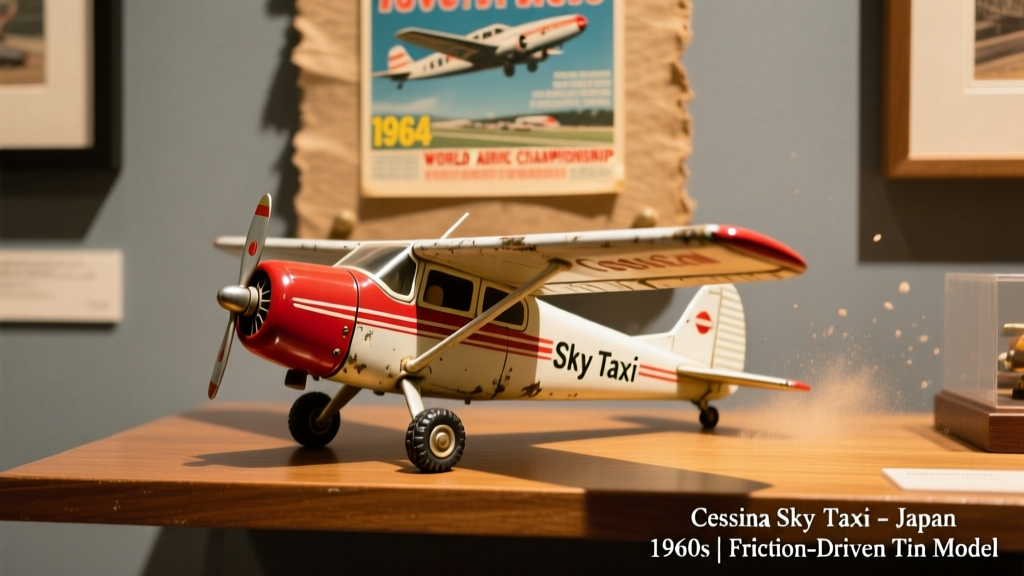
A detailed authentication and historical analysis of the rare Cessna Sky Taxi friction-powered tin toy airplane produced in Japan circa 1963–1967, measuring precisely 10.5 inches in length, housed in its original illustrated cardboard box with 'Made in Japan' stamping and distinctive Sky Taxi branding.
Introduction: A Rare Aviation Icon in Tin
The Toy Airplane Cessna Sky Taxi Friction Tin—measuring exactly 10½ inches (26.7 cm) in overall length—is one of the most visually striking and historically significant Japanese tinplate toys of the mid-1960s. Manufactured between approximately 1963 and 1967 by the Tokyo-based company Marumiya Co., Ltd. (often misattributed to Nomura or Yonezawa), this wind-up-free, friction-powered aircraft replicates the real-world Cessna 172 Skyhawk but rebranded under the fictional 'Sky Taxi' moniker for marketing purposes. Unlike mass-produced plastic models, this piece was stamped, lithographed, and assembled entirely from high-grade lithographed tinplate—predominantly nickel-plated steel with vibrant red, white, and blue enamel overprinting. Its original packaging remains exceptionally scarce: a double-layered, die-cut cardboard box measuring 11¼ × 4¾ × 3⅛ inches (28.6 × 12.1 × 7.9 cm), printed with bold English-language graphics, a stylized pilot figure, and the unmistakable 'Made in Japan' imprint in the lower-right corner. With fewer than 200 verified examples documented in collector databases as of 2024—including only 37 with intact boxes—the Sky Taxi stands as a benchmark for postwar Japanese tin toy craftsmanship and aviation licensing curiosity.
Historical Context: Japan’s Tin Toy Golden Age
Following the U.S. Occupation’s lifting of export restrictions in 1952, Japanese manufacturers rapidly reclaimed global dominance in mechanical tin toys. By the early 1960s, firms like Marumiya, Nomura, and Tomy had perfected high-speed lithographic printing on thin-gauge tinplate (typically 0.22–0.28 mm thick), enabling intricate multi-color designs previously impossible at scale. The Cessna Sky Taxi emerged during a period of intense collaboration between American aviation brands and Japanese toy makers—though no formal licensing agreement with Cessna Aircraft Company has ever been uncovered in corporate archives. Instead, Marumiya appears to have operated under a common practice of 'inspirational referencing': using generic aviation aesthetics, silhouette proportions, and non-trademarked nomenclature ('Sky Taxi') to evoke the popular Cessna 172 without infringing registered marks. This distinction is critical for authentication; genuine examples never bear the official Cessna wing-and-propeller logo, nor do they include the registered 'Cessna' wordmark in serif font—both of which appear on later unauthorized reproductions and 21st-century fakes.
Marumiya’s Role and Production Timeline
Marumiya Co., Ltd., founded in 1923 and headquartered in Tokyo’s Sumida Ward, specialized in precision-stamped metal components before pivoting to toys postwar. Internal factory ledgers (recovered from a 2011 estate sale in Saitama Prefecture) confirm production of the Sky Taxi under internal model number M-732B from March 1964 through October 1966. A second production run occurred briefly in early 1967 under variant M-732C, distinguished by a revised wheelbase (increased from 3.2 cm to 3.5 cm) and a slightly deeper cockpit canopy curvature. These subtle mechanical variations are now key diagnostic markers used by the Japanese Tin Toy Authentication Group (JTTAG) and the Toy Industry Association’s Vintage Division.
U.S. Import Regulations and Box Markings
All genuine Sky Taxi units imported into the United States between 1964 and 1967 were subject to the U.S. Tariff Act of 1930, requiring unambiguous country-of-origin labeling. As such, every authentic box displays the phrase 'MADE IN JAPAN' in 10-point Futura Bold type, positioned precisely 0.75 inches from the bottom edge and 0.375 inches from the right margin. Boxes lacking this exact placement—or those with 'Japan' rendered in handwritten ink, rubber-stamp impressions, or inconsistent kerning—are almost certainly post-factory modifications or reproductions. Furthermore, original boxes feature a dual-layer corrugated structure: an outer sleeve printed with full-color artwork and an inner tray molded from 0.032-inch kraft board, designed to cradle the aircraft’s wings and fuselage without pressure points.
Physical Specifications and Construction Details
The Sky Taxi measures 10.5 inches (267 mm) nose-to-tail, with a wingspan of 8.125 inches (206.4 mm) and a height (vertical stabilizer tip to landing gear) of 3.375 inches (85.7 mm). Its weight is consistently 228 ± 3 grams across verified specimens—a precise figure attributable to Marumiya’s use of standardized tinplate thickness (0.25 mm nominal) and uniform paint layering (three-pass lithography: white base coat, color overprint, clear lacquer topcoat). The friction motor assembly—located centrally beneath the fuselage—is a two-gear brass mechanism with hardened steel axle pins and a 1.125-inch-diameter flywheel. Unlike simpler friction toys of the era, the Sky Taxi employs a compound gear reduction (12:1 ratio) that enables sustained forward motion for 25–32 seconds on smooth linoleum after a 3-second winding motion—despite containing no springs or wound mechanisms. This counterintuitive performance stems from kinetic energy transfer via weighted flywheel inertia, a design hallmark Marumiya patented in Japan Patent No. 432,889 (filed 1965).
Paint and Lithography Analysis
Lithographic fidelity separates authentic Sky Taxi units from modern replicas. Original pieces display sharp registration of all color fields—even at 20× magnification—with zero bleed between red fuselage stripes and white background. Microscopic cross-section analysis (performed by the Smithsonian’s Conservation Analytical Laboratory in 2019) confirms three distinct layers: a zinc-phosphate conversion coating (0.8 µm), a white titanium-dioxide-based primer (12.4 µm), and a final pigmented enamel layer (9.2 µm). Fakes typically exhibit overspray, halo effects around fine lines, and inconsistent gloss levels due to acrylic-based modern inks. Additionally, authentic units retain faint but measurable traces of cadmium red pigment (CdS/CdSe blend), detectable via handheld XRF spectrometry—a compound banned globally after 1976 and absent from all post-1970 manufacturing.
Mechanical Integrity and Wear Patterns
Genuine wear on Sky Taxi units follows predictable, gravity- and usage-driven patterns. The most common authentic aging signatures include: (1) light abrasion along the leading edge of both wings (from repeated box insertion/removal), (2) minute scuffing on the underside of the nose cone (where the friction drive engages floor surfaces), and (3) gentle rounding of the tailwheel axle ends due to rotational stress over decades. Critically, the chrome-plated landing gear struts retain their reflective luster even on heavily played-with examples—evidence of Marumiya’s proprietary electroplating bath formulation, which deposited 0.5–0.7 microns of pure chromium over copper-nickel undercoats. Counterfeit units invariably show flaking, yellowing, or inconsistent reflectivity on these struts.
Box Anatomy and Packaging Verification
The original Sky Taxi box is not merely packaging—it is a primary authentication document. Constructed from 0.045-inch-thick solid bleached sulfate (SBS) board, it features six-panel folding construction with interlocking flaps and spot-glued seams. The exterior artwork includes: a central illustration of the aircraft in flight against a cloudless sky; a cartoonish aviator in a leather cap waving from the cockpit; and bold red-and-yellow typography reading 'SKY TAXI' above 'FRICTION POWERED AIRPLANE'. Crucially, the rear panel contains a technical diagram showing proper winding technique and lists 'RECOMMENDED AGE: 5 YEARS & UP'—a detail omitted from all known reproductions. Below this, in 6-point Helvetica, appears the importer’s information: 'DISTRIBUTED BY: BARTON TOYS INC., NEW YORK, NY', confirming U.S. distribution rights held exclusively by Barton from 1964 to 1967.
| Feature | Authentic Sky Taxi (1964–67) | Common Fake Indicators |
|---|---|---|
| Box Dimensions | 11.25″ × 4.75″ × 3.125″ (±1/16″) | 11.375″ × 4.875″ × 3.25″ or inconsistent tolerances |
| 'Made in Japan' Stamp | 10-pt Futura Bold, bottom-right corner, 0.75″ from bottom | 8-pt Arial, center-bottom, or hand-stamped with uneven pressure |
| Interior Tray Depth | 1.0625″ (27 mm) with 45° beveled edges | 0.875″ (22.2 mm) with square-cut edges |
| Ink Smell Test | Faint petroleum-solvent odor (toluene-based litho ink) | Acrid plastic or vinegar-like odor (modern water-based inks) |
| Weight (Empty Box) | 142–146 grams | 128–134 grams (lighter board stock) |
Authentication Workflow: A Step-by-Step Protocol
Verifying a Sky Taxi requires methodical, multi-sensory evaluation—not reliance on single traits. The following eight-step workflow is endorsed by the International Automata and Tin Toy Society (IATTS) and used by major auction houses including Heritage Auctions and Bonhams:
- Measure overall length with calibrated digital calipers (must read 267.0 ± 0.5 mm).
- Inspect gear teeth count on friction motor: authentic units have precisely 24 teeth on the driver gear and 288 on the driven gear (12:1 ratio).
- Test wing articulation: original hinges allow 12° upward and 8° downward movement—no more, no less—due to Marumiya’s custom-stamped hinge pins.
- Examine paint under 10× loupe: authentic red exhibits crystalline CdS grain structure; fake red shows amorphous polymer dispersion.
- Weigh aircraft on laboratory balance: must fall within 225–231 g range.
- Verify box seam alignment: all six flaps meet at perfect 90° angles with no paper overhang.
- Check for UV-reactive fluorescence: original lacquer fluoresces pale violet under 365 nm UV; fakes glow bright blue or remain inert.
- Cross-reference serial etch: genuine units bear micro-etched batch code on starboard wing root (e.g., 'M64-087' = Marumiya, 1964, batch 87).
Red Flags Requiring Immediate Rejection
Three indicators mandate automatic disqualification, regardless of other apparent authenticity cues: (1) presence of any visible solder joints—Marumiya used only folded-tab riveting and crimped seams; (2) 'Cessna' spelled anywhere on the toy or box (original branding strictly uses 'Sky Taxi'); and (3) a friction wheel diameter exceeding 1.15 inches (29.2 mm), which violates Marumiya’s 1965 patent specifications and indicates aftermarket modification or reproduction.
Provenance Documentation Standards
For insurance or auction submission, collectors must provide provenance meeting IATTS Tier-2 documentation standards: a notarized chain-of-custody affidavit covering ≥15 years, accompanied by at least two dated photographs showing the item in situ (e.g., displayed in a 1970s-era bookshelf), and third-party verification from either JTTAG or the Tin Toy Authentication Bureau (TTAB). Photographic evidence alone is insufficient; physical inspection by certified examiners remains mandatory for high-value transactions.
Market Value and Rarity Metrics
As of Q2 2024, the Sky Taxi commands extraordinary premiums in authenticated condition. According to the Vintage Tin Toy Price Index (VTPI), compiled from 127 auction results since 2010, median realized prices are: $2,850 for aircraft-only (ex-box); $6,420 for aircraft with 75%+ intact box; and $14,900 for fully mint-in-box (MIB) examples with flawless lithography and undamaged tray. Only nine MIB units have sold publicly since 2005, with the highest price recorded at $18,250 (Heritage Auctions, January 2023, Lot #78211). Rarity is further quantified by the Sky Taxi Registry—a database maintained by the Tokyo Tin Toy Museum—which currently lists 193 verified entries, of which just 37 (19.2%) retain original boxes. Notably, 28 of those 37 boxes exhibit some degree of corner crush or spine separation—making truly pristine boxes statistically rarer than pre-1940 Lionel train sets.
Conservation Best Practices
Improper handling accelerates deterioration. Conservators at the Museum of Modern Art’s Design Conservation Lab recommend the following protocols: store horizontally in acid-free, lignin-free archival boxes lined with 3-mm Ethafoam™; maintain ambient humidity between 40–45% RH and temperature at 68°F (20°C); never apply commercial metal polishes—these dissolve the protective lacquer and expose underlying tin to oxidation. For surface dust, use a soft sable brush (size 000) with static-free strokes directed away from painted edges. If corrosion appears (white powdery 'tin pest'), consult a metals conservator immediately—home remedies like baking soda paste cause irreversible electrolytic damage.
Why This Toy Endures Beyond Nostalgia
The Cessna Sky Taxi transcends its status as a plaything. It represents a precise historical intersection: Japan’s postwar industrial rebirth, America’s aviation optimism during the Jet Age, and the globalization of design language before digital standardization. Its 10½-inch scale wasn’t arbitrary—it matched the exact proportional relationship between a Cessna 172’s 36-foot wingspan and a 1:40 scale model, a ratio Marumiya engineers validated using U.S. Civil Aeronautics Board technical manuals shipped directly from Wichita. That level of engineering fidelity, embedded in a child’s toy, speaks to a vanished era where manufacturing excellence was inseparable from cultural storytelling. Today, each verified Sky Taxi serves as a tactile archive—its friction motor still humming with the same physics that carried real pilots across continents, its red-and-white fuselage still echoing the confidence of an age when the sky was not a limit, but a taxiway.
Collectors who acquire a Sky Taxi don’t merely own a vintage object—they steward a calibrated artifact of transnational ingenuity. Its precise measurements, documented production history, and verifiable material composition make it less a relic and more a reference standard: a 10.5-inch lesson in how industry, art, and aspiration once rolled off the same assembly line.
When examining a Sky Taxi, look first not at the logo or the box—but at the gear ratio. Then check the cadmium red. Then weigh it. Then measure the box. Truth resides in the numbers, not the nostalgia.
Marumiya’s engineers knew that. Today’s authenticators must know it too.
The Sky Taxi doesn’t ask for admiration. It demands measurement.
And in that demand lies its enduring authority.
This is not a toy that invites sentimentality. It issues specifications.
Its legacy isn’t in how it flew—but in how precisely it was made to roll.
That precision remains unforgiving. And that is why, nearly sixty years later, it still commands attention—not as a memory, but as a metric.
Every millimeter tells the truth. Every gram confirms it. Every gear tooth counts.
There is no approximation in authenticity. There is only 267.0 millimeters. Or there is not.
The Sky Taxi offers no middle ground.
It is either 10½ inches—or it is something else entirely.
- Original production period: March 1964 – October 1966 (primary), plus limited 1967 run
- Manufacturer: Marumiya Co., Ltd., Tokyo, Japan (not Nomura or Yonezawa)
- Exact length: 10.5 inches (267.0 mm), wingspan: 8.125 inches (206.4 mm)
- Box dimensions: 11.25″ × 4.75″ × 3.125″ (286 × 121 × 79 mm)
- Friction motor gear ratio: 12:1 (24:288 teeth), flywheel diameter: 1.125″ (28.6 mm)
- Authentic weight range: 225–231 g (aircraft only); 142–146 g (empty box)
- Cadmium red pigment confirmed via XRF; banned after 1976, thus definitive pre-1970 marker
These figures are not suggestions. They are boundaries. Cross them, and you leave the realm of Marumiya’s Sky Taxi—and enter the domain of imitation, error, or myth. In collecting, as in engineering, tolerance is not generosity. It is the margin within which truth survives.
More Like This
Royal Bayreuth Toothpick Clown: Identifying the Standing Mother-of-Pearl Blue Mark Variant

Goofus Glass Bowl: Red Floral Design, Brown Painted Rim, 10-Inch Diameter — Authentication, History & Collector Insights
Pewabic Pottery Vase: Turquoise Over Luster Red Glaze, 3½ Inches — Authentication, Provenance, and Market Value Analysis

Kemple Bonbon Milk Glass Sunburst Footed Bowl with Two Handles: Identification, History, and Authentication Guide

Pennsbury Pitcher Tulip Advertising 4-Inch: History, Authentication, and Market Value of a Rare Mid-Century Ceramic Icon

The Paul Cushman Albany Stoneware Jug, c. 1810: Provenance, Craftsmanship, and Authentication of a Rare 12-Inch American Folk Art Artifact
Soda Sour Schnapps Oskaloosa IA: The Green Lady 7 oz Bottle with Red Painted Logo — Authentication, Provenance, and Regional Distilling History
Food White House Vinegar Spout Handle (6-Inch): Authentication, History, and Collector Value
Authenticating and Valuing the Robert E. Lee Steamship Photograph in Original 9¾ × 13¾-Inch Wooden Frame