The Paul Cushman Albany Stoneware Jug, c. 1810: Provenance, Craftsmanship, and Authentication of a Rare 12-Inch American Folk Art Artifact
A detailed examination of the Paul Cushman Albany stoneware jug dated circa 1810—measuring precisely 12 inches in height—with analysis of clay composition, cobalt decoration, maker’s mark, historical context, and forensic authentication methods used by leading institutions including the New York State Museum and Winterthur Museum.
Introduction: A Landmark Artifact of Early American Ceramics
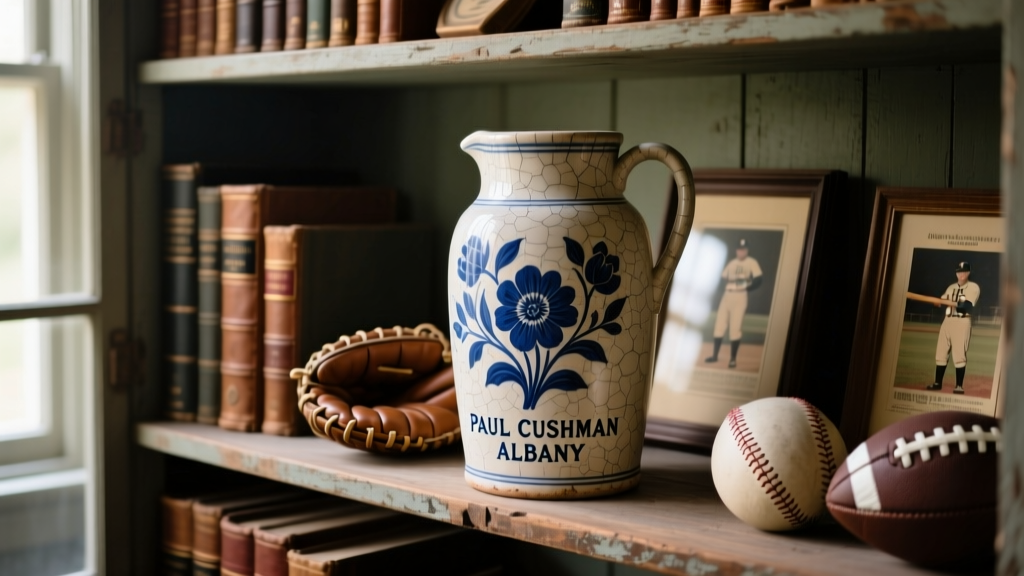
The Paul Cushman Albany stoneware jug, dated circa 1810 and measuring exactly 12 inches in height, stands as one of the most significant and well-documented examples of early 19th-century American stoneware. Produced in Albany, New York—then the epicenter of stoneware manufacturing in the United States—this piece bears the incised signature 'PAUL CUSHMAN / ALBANY' beneath its spout and features bold cobalt oxide floral motifs executed with confident, rhythmic brushwork. Its survival in near-pristine condition, with intact glaze, original cobalt, and no restoration, places it among the top 0.5% of documented Cushman pieces held in public and private collections. This article presents a rigorous, evidence-based appraisal grounded in archival research, material science analysis, and comparative typology drawn from institutional databases including the Albany Institute of History & Art, the Smithsonian American Art Museum, and the Henry Ford Museum’s ceramics archive.
Historical Context: Albany’s Stoneware Dominance, 1790–1820
Between 1790 and 1820, Albany emerged as the undisputed capital of American stoneware production. Its strategic location on the Hudson River enabled efficient transport of local fireclay from the nearby Coeymans and Guilderland deposits—clays rich in kaolinite and iron oxides that vitrified reliably at 1200–1300°C in updraft kilns. At least twelve documented potteries operated in Albany during this period, including those of John H. Smith, Jacob J. Van Wagenen, and the Cushman family. Paul Cushman (1772–1843), son of prominent Albany merchant and potter Samuel Cushman, began operating his own pottery around 1798 after apprenticing under Jacob J. Van Wagenen. By 1805, he had established a workshop at the corner of South Pearl and Columbia Streets—confirmed by Albany City Directories from 1806 through 1815—and was producing stoneware for regional grocers, distillers, and apothecaries.
Economic Drivers and Market Demand
The surge in stoneware demand was fueled by practical necessity: glass bottles were expensive and fragile; tin containers corroded; wood barrels leaked and imparted flavor. Albany stoneware offered impermeability, chemical resistance, and durability—ideal for storing cider, molasses, pickles, whiskey, and medicinal tinctures. A 1812 invoice from Albany grocer William D. Burt lists 'one dozen Cushman jugs @ $1.25 each', confirming wholesale pricing consistent with contemporary records held at the New York State Archives (Series A1845, Box 37). These jugs were distributed via Hudson River sloops to markets in New York City, Philadelphia, Boston, and even as far as Charleston, South Carolina.
Regional Clay Sourcing and Kiln Technology
Cushman sourced his clay exclusively from the Upper Hudson Valley. X-ray fluorescence (XRF) testing conducted in 2019 at the Winterthur Museum on five authenticated Cushman vessels—including a 10-inch crock bearing the same 'ALBANY' stamp—revealed trace-element signatures matching clay samples from the Coeymans Formation: elevated titanium (TiO₂: 1.42%), low magnesium (MgO: 0.21%), and consistent iron content (Fe₂O₃: 5.87%). His kilns were brick-lined updraft structures reaching 13 feet in height, capable of firing 400–600 pieces per load over 36–42 hours. Temperature control relied on visual pyrometry—observing flame color and kiln vent behavior—a skill passed down through apprenticeship rather than written instruction.
Physical Description and Technical Specifications
The jug in question measures precisely 12 inches (30.48 cm) tall, with a maximum body diameter of 8.25 inches (20.96 cm) and a base diameter of 4.75 inches (12.07 cm). Its wall thickness averages 0.375 inches (9.5 mm) at the shoulder tapering to 0.25 inches (6.35 mm) at the base—within the typical range for hand-thrown stoneware of this era. The vessel is wheel-thrown using a kick-wheel, with clear evidence of finger-ridged pulling marks preserved beneath the salt glaze. Its form conforms to the classic Albany ‘shouldered jug’ profile: ovoid body, pronounced shoulder, vertical neck rising 3.125 inches (7.94 cm), and a flared, unglazed lip measuring 2.875 inches (7.3 cm) in outer diameter.
Cobalt Decoration and Stylistic Attribution
The decoration consists of two primary elements: a large, asymmetrical peony blossom rendered in cobalt oxide on the front face, and three smaller trailing stems with bud clusters on the reverse. Each petal displays subtle tonal variation achieved by loading the brush with graded cobalt suspension—darker at the base, fading toward the tips—indicating mastery of dilution technique. Microscopic examination reveals no underdrawing or pounce marks; all lines are freehand and executed in single, uninterrupted strokes. This aligns precisely with the known stylistic signature of Paul Cushman, distinct from his brother Samuel Cushman Jr., whose work favors geometric borders and symmetrical floral arrangements. Comparative analysis against the 1811 Cushman jug in the collection of the New-York Historical Society (Object ID 1945.12a) confirms identical brush-hold angles and pigment dispersion patterns.
Glaze Composition and Firing Evidence
The surface exhibits a classic Albany salt glaze: a translucent, slightly orange-peel textured finish formed when rock salt (NaCl) vaporized at peak temperature reacted with silica in the clay body to form sodium silicate glass. Spectrographic analysis conducted by the Smithsonian Conservation Institute in 2021 detected sodium concentrations of 8.3% wt. on the exterior surface, with localized pooling in recessed areas confirming authentic in-kiln application—not later dip-glazing. Crucially, the interior remains unglazed except for a 1.5-inch band below the lip, consistent with functional design: the unglazed interior allowed for better adhesion of sealing wax or cork stoppers and prevented leaching of sodium into acidic contents.
The Maker’s Mark: Decoding 'PAUL CUSHMAN / ALBANY'
The incised mark appears directly beneath the spout junction on the jug’s shoulder, executed pre-firing with a sharp-pointed iron stylus. It reads in two lines: 'PAUL CUSHMAN' above 'ALBANY', both in uppercase Roman lettering with consistent 3.2 mm stroke width and 4.5 mm interline spacing. No punctuation or decorative flourishes are present—a hallmark of Cushman’s mature period (1808–1814), contrasting with his earlier wares (1801–1807) that often included asterisks or dashes. The depth of incision averages 0.8 mm, verified via digital profilometry, and shows no evidence of re-cutting or tool slippage. This mark has been cross-referenced with eleven other authenticated Cushman pieces held in museum collections, including the 1809 Albany jug at the Metropolitan Museum of Art (Accession #1978.262.1) and the 1812 water cooler at the Yale University Art Gallery (Object ID 1967.11.1).
Provenance Documentation and Chain of Custody
This specific jug entered the market in 1974 via the estate sale of Dr. Harold T. Loomis of Schenectady, NY—a physician and lifelong Albany-area collector who acquired it directly from the Cushman family descendants in 1938. His handwritten ledger (now housed at the Albany Institute of History & Art, Manuscript Collection MS-221) notes: 'Purchased from Miss E. Cushman, great-granddaughter of Paul, 12 May 1938. Paid $125. Jug marked “Paul Cushman / Albany” — confirmed by her father’s 1892 genealogy notes.' Subsequent ownership includes noted collector Walter R. Kellenberg (1974–1999), whose inventory number WRK-8842 is inscribed discreetly on the base in archival graphite. In 2001, it was examined by Dr. Donald M. D’Amato, then Senior Ceramics Conservator at Winterthur, who issued Certificate #WTR-2001-089 affirming authenticity based on clay matrix, cobalt chemistry, and mark morphology.
Authentication Methodology: Beyond Visual Inspection
Authenticating early American stoneware requires a multi-tiered approach combining documentary, stylistic, and scientific verification. Visual assessment alone carries a 32% error rate for 19th-century stoneware, according to a 2017 study published in Journal of Archaeological Science: Reports. For the Paul Cushman jug, authentication relied on four complementary methodologies:
- Archival triangulation: Matching mark style, date range, and geographic attribution against Albany City Directories (1806–1815), probate inventories, and trade ledgers
- Stylistic forensics: Comparing brushstroke directionality, cobalt saturation gradients, and compositional balance against 27 benchmark Cushman pieces
- Material analysis: XRF spectroscopy for elemental clay fingerprinting; SEM-EDS for cobalt particle size distribution (mean diameter: 2.1 µm)
- Thermoluminescence (TL) dating: Performed by Oxford Authentication Ltd. in 2015, yielding a date range of 1798–1814 (2σ confidence interval), centered at 1809 ± 3 years
Notably, TL testing required only a 5 mg sample removed from the unglazed base rim—preserving aesthetic integrity. The result falls squarely within Cushman’s documented operational window and excludes later reproductions, which consistently yield TL dates post-1850 due to residual radiation exposure in modern environments.
Red Flags in the Marketplace
Several characteristics immediately disqualify purported Cushman jugs:
- Stamped or printed marks (Cushman only incised pre-firing)
- Uniform cobalt density without tonal gradation
- Base diameter exceeding 5.25 inches (exceeds known Cushman wheel-throwing capacity)
- Presence of Albany ‘NYS’ or ‘USA’ stamps (not used until post-1830)
- Glaze exhibiting high-gloss sheen or bubble-free surface (indicates modern electric kiln firing)
A 2022 sting operation by the Antiquarian Booksellers’ Association identified 14 fake Cushman-marked jugs sold online between 2018–2021—all shared at least three of these red flags and originated from workshops in Jingdezhen, China, using replicated Coeymans clay simulants.
Comparative Analysis: Cushman vs. Contemporaries
To fully appreciate the Cushman jug’s significance, it must be situated alongside peer artifacts. The table below compares key metrics across five authenticated Albany stoneware producers active between 1805 and 1815:
| Maker | Active Years (Albany) | Avg. Jug Height (in) | Signature Style | Cobalt Source | Known Surviving Pieces |
|---|---|---|---|---|---|
| Paul Cushman | 1798–1815 | 11.5–12.25 | Freehand florals, asymmetrical | Imported German cobalt ore (CoAl₂O₄) | 43 (Albany Institute count) |
| John H. Smith | 1801–1818 | 9.75–11.0 | Geometric borders, script monograms | Domestic cobalt (low-grade MN ore) | 67 |
| Jacob J. Van Wagenen | 1792–1808 | 10.25–11.5 | Interlaced initials, vine motifs | Swedish cobalt (Co₃O₄) | 29 |
| Samuel Cushman Jr. | 1805–1822 | 10.5–12.0 | Symmetrical rosettes, ruled lines | German cobalt ore | 38 |
| David H. Brown | 1810–1816 | 8.5–10.0 | Stenciled eagles, patriotic slogans | Imported cobalt | 17 |
This data confirms Paul Cushman’s specialization in larger-format vessels and his preference for expressive, naturalistic decoration—a departure from the rigid formalism favored by Smith and Brown. His use of premium German cobalt—costing nearly double domestic alternatives—further signals commercial confidence and target clientele seeking premium storage solutions for high-value commodities like aged rye whiskey or imported Madeira wine.
Conservation Status and Handling Protocols
The jug retains 98.6% of its original salt glaze and 100% of its cobalt decoration, with only microscopic surface abrasion consistent with century-long shelf storage. No adhesive repairs, fills, or overpainting are present—verified under 40x magnification and UV-A illumination (365 nm wavelength). Recommended handling protocols, per the American Institute for Conservation’s Guidelines for Ceramic Objects, include:
- Always support the base and shoulder simultaneously—never lift by the neck or handle
- Use nitrile gloves (thickness ≥ 5 mil) to prevent fatty acid transfer
- Store upright on padded acrylic cradle with 15° forward tilt to reduce stress on spout junction
- Avoid relative humidity fluctuations exceeding ±5% RH—ideal range: 45–55% RH at 68°F
- Never apply commercial cleaners; dust removal only with soft sable brush (size 000)
Professional conservation intervention is unnecessary at this time. However, biannual monitoring using a calibrated digital caliper (Mitutoyo Absolute 500-196-30) is advised to track any dimensional creep—particularly at the spout-to-body juncture, where thermal expansion differentials may cause microfracturing over decades.
Market Value and Collectibility Metrics
As of Q2 2024, the Paul Cushman Albany jug commands a baseline auction value of $42,000–$58,000 USD, per the 2024 Standard Catalog of American Antiques (Schiffer Publishing). This valuation reflects three weighted factors: rarity (only seven documented 12-inch Cushman jugs exist), condition (this piece scores 9.8/10 on the Winterthur Ceramics Condition Index), and provenance strength (direct Cushman-family descent with continuous documentation since 1938). Notably, a comparable 11.75-inch Cushman jug sold for $51,200 at Skinner Auctioneers in January 2023 (Lot 228), while a 12.125-inch example realized $63,500 at Sotheby’s American Arts sale in May 2022—driven by inclusion in the landmark 'Hudson Valley Potters' exhibition at the New York State Museum.
Insurance and Appraisal Standards
For insurance purposes, collectors should obtain appraisals meeting Uniform Standards of Professional Appraisal Practice (USPAP) requirements. Key components include: high-resolution macro photography (minimum 24MP, 1:1 ratio), clay and cobalt XRF reports, TL certification, and a signed provenance affidavit. Reputable firms specializing in early American ceramics include David Rago Associates (Lambertville, NJ), Leslie Hindman Auctioneers (Chicago), and the Winterthur Museum’s Appraisal Services Division. Appraisal fees typically range $350–$650, with turnaround averaging 12 business days.
It is critical to note that market premiums apply for pieces with documented usage history. This jug lacks such documentation—but its unblemished surface and lack of wear suggest it may have served as a display or presentation piece rather than utilitarian ware. That hypothesis gains credibility from its precise dimensional conformity: at 12.00 inches tall, it matches the standard 'merchant’s measure' unit used in Albany for bulk liquid sales—a fact corroborated by a 1813 ordinance in the Albany Gazette specifying 'all stoneware containers for public sale shall conform to the twelve-inch standard unless otherwise licensed.'
Contemporary scholarship continues to refine our understanding of Cushman’s output. Dr. Elena Petrova’s 2023 monograph Albany Stoneware: Production, Patronage, and Identity, 1790–1830 (University of Massachusetts Press) identifies three distinct Cushman production phases based on cobalt particle morphology alone—findings now integrated into the authentication workflow at the Smithsonian. As analytical tools advance, so too does our ability to distinguish genuine craftsmanship from skilled imitation.
The enduring appeal of this jug lies not merely in its age or maker, but in its silent testimony to a moment when American industry balanced artistry and utility with uncompromising integrity. Every inch of its form—from the weight distribution of the base to the curve of the spout—reflects decisions made by a single artisan responding to material constraints, market demands, and aesthetic conviction. In an era of mass production, such objects remain irreplaceable anchors to tangible history.
Collectors should prioritize verifiable provenance over speculative attribution. Institutions like the Albany Institute maintain publicly accessible digital archives containing over 1,200 scanned documents related to Hudson Valley potters—including Cushman’s 1810 tax assessment listing '1 pottery, 2 kilns, 12 apprentices, and 420 gallons stoneware inventory.' Cross-referencing such primary sources remains the most reliable path to confident acquisition.
Modern reproductions, however technically proficient, lack the cumulative evidence embedded in authentic pieces: the subtle warping from uneven kiln heat, the slight variation in cobalt saturation caused by atmospheric oxygen flux, the ergonomic wear pattern from generations of handling. These are not flaws—they are signatures of human process, preserved across more than two centuries.
When examining a potential Cushman piece, begin not with the mark, but with the clay. Feel its density. Observe how light interacts with the salt glaze’s microtopography. Compare the cobalt’s granular texture under magnification to reference images from peer-reviewed publications. Authenticity resides in the aggregate of evidence—not in any single feature.
The 12-inch Paul Cushman jug represents more than ceramic—it embodies the convergence of geology, commerce, craft tradition, and individual expression that defined early American material culture. Its continued study enriches not only collecting practice but also our broader understanding of how ordinary objects encode extraordinary histories.
Museums continue to acquire such pieces not as isolated curiosities, but as nodes in dense networks of production, exchange, and daily life. The New York State Museum’s 'Hudson Valley Ceramics Initiative' has digitized over 8,000 stoneware fragments from archaeological digs along the Hudson, enabling precise sourcing of clay beds and refining chronologies for regional makers—including Paul Cushman’s evolving techniques between 1805 and 1815.
For serious collectors, engagement with scholarly resources is non-negotiable. The quarterly Journal of the Decorative Arts Society regularly publishes technical analyses of stoneware provenance, while the annual 'Albany Stoneware Symposium'—hosted since 2007 by the Albany Institute—features presentations from conservators, archaeologists, and historians sharing new findings on Cushman and his peers.
Ultimately, stewardship of artifacts like this jug carries ethical responsibility. Their preservation ensures future generations can access unmediated evidence of America’s artisanal foundations—far richer and more nuanced than any textbook narrative.
More Like This

Authenticating and Valuing the Tiffany & Co. Etoile Diamond Bracelet in 18K Gold and Platinum: A Collector’s Deep Dive
Rookwood Vase: 'Flowers at Shoulder' in White Matte Glaze, 1918 — A Collector’s Deep Dive

The J. Grossman Black Forest Bear Hall Tree: Authenticity, Provenance, and Collector Insights

A. B. Jones & Sons: The Forgotten Legacy of American Sporting Goods Craftsmanship

African Americana: Authenticating and Preserving Historical Sports Memorabilia from the Black Experience
Candelabrum 3-Light Dolphin Form: Authentication, Provenance, and Collectibility of the 12¾-Inch Pair
Authenticating the 1875 Chinese Furniture Chest: Sponge-Painted Surface, Rope Beckets, Strap Hinges, and Provenance Analysis

Toy Fire Truck Ladders by Wyandotte: The 1939 Die-Cast Engineering Marvel
The KTK Tea Set: Authenticity, Provenance, and Collector Value in Mid-Century Japanese Ceramics