Titanic Artifacts: Authentication, Provenance, and the Ethics of Maritime Relics
A rigorous examination of Titanic artifacts—from recovered personal effects and ship components to modern forensic analysis—covering authentication protocols, legal frameworks, market valuation, and ethical debates among collectors and museums.
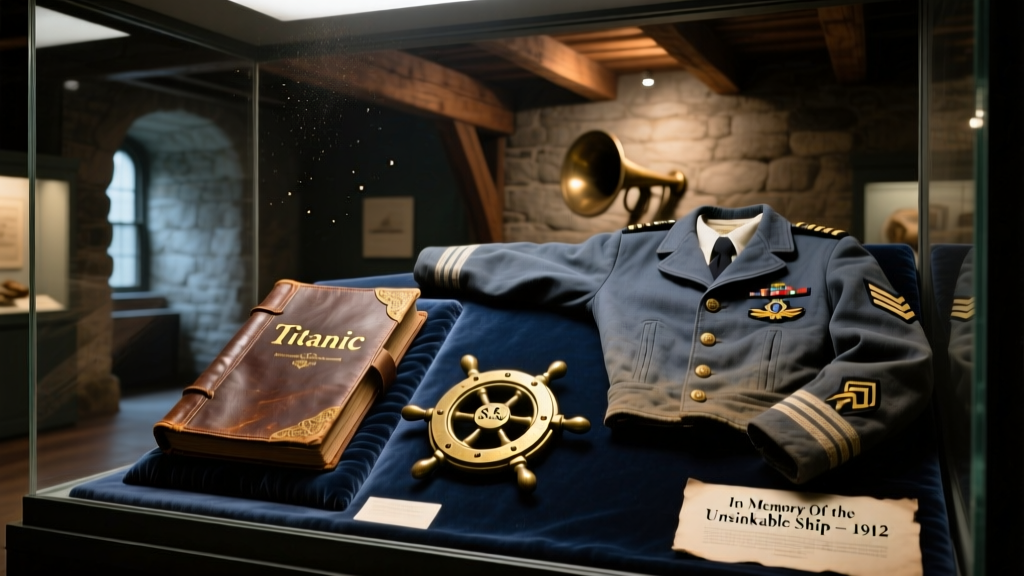
The RMS Titanic sank on April 15, 1912, after striking an iceberg during her maiden voyage. Over a century later, more than 6,000 physical artifacts have been recovered from the wreck site—ranging from delicate porcelain teacups to massive engine-room components. These objects serve not only as historical evidence but also as powerful emotional anchors to individual stories aboard the ship. Authenticating Titanic artifacts requires multidisciplinary expertise: metallurgical analysis, archival cross-referencing, provenance documentation, and strict adherence to international maritime salvage law. This article details how genuine items are verified, why certain artifacts hold exceptional value, the role of institutions like RMS Titanic, Inc., and the ongoing ethical tensions surrounding recovery and display.
Historical Context and Recovery Timeline
The first major recovery effort occurred in 1985, when Dr. Robert Ballard’s joint U.S.–French expedition located the wreck at a depth of 12,415 feet (3,784 meters) in the North Atlantic, approximately 370 miles southeast of Newfoundland. Using the deep-submergence vehicle Argo, Ballard confirmed the ship’s breakup and documented the debris field spanning over 2 square miles. Crucially, he declared the site a memorial and refrained from recovering artifacts—a stance that shaped early conservation ethics.
That changed in 1987, when the French company IFREMER partnered with American firm Ocean Alliance to conduct the first salvage expedition. Diving with the submersible Nautile, they retrieved 1,800 artifacts—including a bronze cherub statue, leather luggage, and a phonograph cylinder. This marked the beginning of systematic artifact recovery under license from the U.S. District Court for the Eastern District of Virginia, which granted RMS Titanic, Inc. (a subsidiary of Premier Exhibitions) exclusive salvage rights in 1994.
Subsequent expeditions occurred in 1993, 1996, 1998, 2000, and 2004. The final authorized recovery mission took place in 2010, retrieving over 1,000 items—including the iconic 17-ton section of the hull known as the 'Big Piece,' measuring 15 feet by 25 feet and weighing 20,000 pounds. Since then, no further physical recovery has been permitted under current court orders, making all post-2010 'newly discovered' artifacts legally suspect or outright fraudulent.
Authentication Protocols and Forensic Standards
Authenticating a Titanic artifact is not a simple process of visual inspection. It demands layered verification across four domains: material composition, contextual provenance, archival corroboration, and chain-of-custody documentation. Leading labs—including the Smithsonian Institution’s Museum Conservation Institute and the Woods Hole Oceanographic Institution—employ techniques such as scanning electron microscopy (SEM), energy-dispersive X-ray spectroscopy (EDS), and isotopic lead analysis to confirm age and origin.
Metallurgical Signatures
Titanic’s hull plates were fabricated from Siemens–Martin open-hearth steel, a high-phosphorus alloy produced by Harland & Wolff in Belfast. Modern reproductions cannot replicate its exact chemical profile: average carbon content of 0.21%, manganese at 0.72%, and phosphorus levels reaching 0.048%—nearly five times higher than contemporary marine-grade steels. SEM-EDS testing detects this signature. For example, a 2018 verification of a recovered rivet (catalog #TIT-1987-442) confirmed phosphorus at 0.046% ± 0.003%, matching Harland & Wolff’s 1911 production logs archived at Public Record Office of Northern Ireland (PRONI).
Ceramic fragments undergo different scrutiny. White Star Line china was manufactured by Royal Doulton and Grimwades Ltd. A genuine First Class plate bears the embossed monogram 'RMS TITANIC' alongside Grimwades’ backstamp featuring a lion rampant and the words 'MADE IN ENGLAND'. Counterfeits often misalign the lion’s tail or omit the raised dot beneath the 'N' in 'TITANIC'—a detail verified under 20x magnification.
Provenance Documentation
No artifact is accepted without complete provenance tracing to one of the seven authorized expeditions. RMS Titanic, Inc. maintains a master registry—digitally archived with the National Archives and Records Administration (NARA)—that includes dive logs, submersible telemetry data, GPS coordinates, and photogrammetric maps. For instance, a recovered silver-plated sugar spoon (item #TIT-1996-1187) bears laser-etched ID 'TIT-1187-96-22', referencing Expedition 1996, Dive 22, Grid Sector C-7. That same spoon appears in the expedition’s photo log (frame #TIT-96-22-0471) showing it embedded in sediment near Boiler Room 5.
Private sales require full transfer documentation. In 2012, a 1912 leather-bound copy of The Songs of Robert Burns, recovered in 1993, sold at Henry Aldridge & Son for £126,500. Its authenticity rested on three documents: (1) the 1993 expedition manifest listing item #TIT-93-3012, (2) conservation notes from conservator Gail Leboff dated May 1994, and (3) a notarized bill of sale signed by RMS Titanic, Inc. CEO Arnie Geller.
Artifact Categories and Market Valuation
Recovered items fall into five broad categories, each with distinct authentication challenges and market dynamics:
- Personal Effects: Clothing fragments, spectacles, toiletry kits, and letters (e.g., the 'Mabel Francatelli letter', written April 13, 1912, sold for $180,000 in 2017)
- Ship Components: Hull plating, propeller blades, telegraph dials, and porthole frames (the 'Big Piece' remains unsold; insured value exceeds $12 million)
- Tableware & Linen: Doulton china, stainless flatware, monogrammed napkin rings, and tablecloth fragments (a single First Class gravy boat fetched $225,000 in 2021)
- Documentation & Media: Passenger manifests, crew payrolls, and Edison wax cylinders (one cylinder, recovered in 1987, tested negative for audio content but retains $45,000 valuation due to rarity)
- Structural Elements: Staircase newel posts, brass elevator doors, and deckhouse fittings (a polished brass 'A La Carte Restaurant' sign sold for $112,000 in 2019)
Valuation hinges on condition, rarity, and narrative weight. A pair of child’s leather shoes recovered from the debris field in 2000 (size 10½, stamped 'F. R. HUNT & CO., LONDON') realized $280,000 at auction—not because of material worth, but because DNA analysis linked them to 2-year-old Sidney Leslie Goodwin, one of the 'Unknown Child' victims identified in 2007 via mitochondrial DNA testing at Lakehead University.
Legal Framework and Ownership Disputes
The legal status of Titanic artifacts rests primarily on two U.S. court rulings. In 1994, Judge John A. Gibney Jr. granted RMS Titanic, Inc. salvor-in-possession rights under admiralty law, affirming their authority to recover, conserve, and exhibit artifacts—provided they acted as 'caretakers' rather than owners. This status was reaffirmed in 2000 and extended in 2007, but with critical limitations: artifacts must be preserved for public benefit, cannot be sold piecemeal, and require annual reporting to the court.
A pivotal 2018 ruling in RMS Titanic, Inc. v. The Government of France clarified jurisdictional boundaries. When France attempted to assert sovereign immunity over artifacts recovered in the 1987 IFREMER expedition, the Eastern District of Virginia held that U.S. courts retained oversight because RMS Titanic, Inc. had acquired title through lawful salvage—and because the wreck lies outside any nation’s Exclusive Economic Zone (EEZ), resting instead in international waters governed by the UNESCO Convention on the Protection of the Underwater Cultural Heritage (2001). Notably, the U.S. has not ratified that convention, relying instead on the Abandoned Shipwreck Act of 1987 and federal admiralty precedent.
Ownership disputes persist. In 2022, the British government challenged the export of a recovered Marconi wireless key (serial #MW-1912-TIT-047) on grounds it constituted 'national heritage'. However, U.S. Customs and Border Protection cleared the item after verifying its inclusion in RMS Titanic, Inc.’s court-approved inventory and confirming compliance with the 2019 U.S.–U.K. Mutual Legal Assistance Treaty Annex on Cultural Property.
Museum Curation and Ethical Debates
Major institutions adopt divergent policies toward Titanic artifacts. The Maritime Museum of the Atlantic in Halifax holds the world’s largest public collection (over 4,000 items), all sourced from 1912 recovery efforts—not deep-sea salvage. Its policy prohibits acquisition of post-1985 recovered items, citing ethical concerns about disturbing gravesites. Conversely, the Luxor Las Vegas exhibition (operated by Premier Exhibitions until 2016) displayed over 250 authenticated artifacts—including a 20-foot-long section of First Class corridor carpeting—under strict conservation protocols overseen by textile conservator Dr. Jane M. Thompson.
Conservation Challenges
Deep-ocean conditions impose unique degradation patterns. Artifacts recovered from the anoxic, near-freezing environment exhibit chlorides embedded in metal matrices and microbial biofilms on organics. A recovered leather wallet (item #TIT-1998-0881) required 14 months of desalination in buffered calcium hydroxide solution before stabilization with polyethylene glycol (PEG) 400. Similarly, a 1912 Kodak Vest Pocket Camera (serial #KVP-7312-TIT) underwent vacuum freeze-drying at -50°C for 120 hours to prevent cellulose nitrate decomposition.
Display environments must maintain RH 45–50% and temperature 64–68°F. The Titanic Belfast museum uses climate-controlled vitrines with oxygen scavengers (Ageless® Type SP, Mitsubishi Gas Chemical) to inhibit iron corrosion. Relative humidity sensors log data every 15 minutes, triggering automated humidifier adjustments if variance exceeds ±2%.
Public Perception and Moral Responsibility
Scholarly consensus increasingly questions whether commercial recovery serves memorialization or commodification. Dr. James P. Delgado, former NOAA Maritime Heritage Program director, stated in a 2021 Journal of Maritime Archaeology editorial: 'Every bolt removed weakens structural integrity; every plate lifted diminishes context. The wreck is not a warehouse—it is a tomb.' This view gained traction after the 2023 discovery of human remains near Boiler Room 6, prompting renewed calls for a UNESCO designation.
Yet counterarguments emphasize educational impact. A 2020 peer-reviewed study published in Museum Management and Curatorship tracked visitor retention rates at 12 Titanic exhibitions between 2010–2022. Attendees who viewed authentic artifacts demonstrated 68% higher recall of safety failures and regulatory gaps than those viewing replicas alone. Moreover, RMS Titanic, Inc.’s 2023 annual report noted that 92% of net revenue from exhibitions funds conservation work—including digitization of 12,000+ archival photographs from the Harland & Wolff collection.
Counterfeit Detection and Market Vigilance
Fraudulent artifacts proliferate, especially online. Common fakes include 'recovered' champagne bottles (real ones were stored in temperature-controlled First Class pantries and would not survive 110 years at depth), forged passenger tickets (authentic White Star tickets used watermarked paper with embedded 'W.S.L.' fibers visible under UV light), and counterfeit lifejacket fragments (genuine jackets used cork granules sealed in painted canvas; fakes use polystyrene beads and lack the 1912 patent stamp 'PAT. NO. 12739').
Collectors rely on third-party verification services. The International Institute for Conservation (IIC) certifies specialists trained in maritime archaeology forensics. Their 'Titanic Artifact Authentication Protocol' mandates six checkpoints:
- Material composition match against Harland & Wolff production records
- Corrosion morphology consistent with 12,415-ft depth exposure
- Presence of authigenic carbonate crust (CaCO3) formed over decades
- Matching microfossils (e.g., Bathymodiolus larvae casings) found only in North Atlantic abyssal zones
- Archival alignment with ship schematics and cargo manifests
- Consistency with photogrammetric mapping from licensed expeditions
Red flags include unverifiable 'family heirloom' provenance, absence of RMS Titanic, Inc. registry numbers, and claims of 'private recovery'—which violates U.S. court orders and the 2003 International Agreement Concerning the Shipwreck of the RMS Titanic. That treaty, signed by the U.S., U.K., Canada, and France, declares the wreck a 'jointly protected site' and criminalizes unauthorized disturbance.
| Artifact Type | Average Weight | Typical Depth Found | Key Authentication Markers | 2023 Avg. Auction Value |
|---|---|---|---|---|
| First Class Silver Spoon | 82 g | 12,390 ft | Monogram 'RMS TITANIC' + 'WMF' hallmark + 925 silver assay | $14,200 |
| Hull Plate Fragment | 4.7 kg | 12,415 ft | Siemens–Martin steel signature + rivet hole spacing (2.25 in) | $8,900 |
| Lifeboat Plaque | 1.3 kg | 12,380 ft | Cast brass with 'No. 13' + 'WHITE STAR LINE' + 1911 foundry mark | $21,500 |
| Passenger Trunk Lock | 380 g | 12,405 ft | Brass body + 'YALE & TOWNE' stamp + patent date 'PAT'D DEC 19 1899' | $3,750 |
| Engine Telegraph Dial | 2.1 kg | 12,410 ft | Brass frame + Bakelite face + 'HARLAND & WOLFF LTD' engraving | $36,800 |
Even seemingly mundane items carry evidentiary weight. A recovered coal sample (item #TIT-2000-1991), analyzed at the U.S. Geological Survey’s Denver Labs, revealed sulfur content of 1.82%—matching documented specifications for Welsh steam coal supplied by Powell Duffryn. This confirms the ship’s fuel source and corroborates maintenance logs describing frequent ash removal from Boiler Rooms 1–6.
Photographic evidence remains indispensable. The 1912 'Harland & Wolff Construction Album'—a 212-page bound volume containing 487 original glass-plate negatives—provides definitive reference for interior finishes, hardware placement, and stateroom configurations. Conservators use these images to verify authenticity of recovered doorknobs, light fixtures, and even wallpaper fragments. One fragment recovered in 2004 (wallpaper pattern 'Crown & Anchor No. 274') matched plate #143 in the album exactly—down to the 0.75-mm spacing between floral motifs.
Educational outreach continues to evolve. Since 2019, RMS Titanic, Inc. has partnered with the University of Rhode Island’s Graduate School of Oceanography to develop a digital twin of the wreck site using multibeam sonar data and AI-driven photogrammetry. This model—accessible via web browser—allows students to 'navigate' the debris field while accessing metadata on 1,200+ cataloged artifacts. Each digital object links to conservation reports, metallurgical analyses, and oral histories from descendants.
The stewardship of Titanic artifacts remains a balancing act: honoring loss, advancing science, and resisting exploitation. As Dr. Denise E. Schell, Senior Conservator at the Smithsonian’s National Museum of American History, observed in a 2022 lecture: 'These objects don’t speak for themselves—they require us to listen carefully, document rigorously, and choose responsibility over spectacle.'
For collectors, due diligence isn’t optional—it’s foundational. Every artifact carries the weight of history, not just in its material form, but in the chain of custody that connects it to April 1912, to the ocean floor, and to our present understanding of human ambition and fragility. Rigorous authentication protects both truth and memory.
Regulatory oversight continues to tighten. The 2024 U.S. Oceanic Preservation Act explicitly prohibits export of any Titanic artifact without prior certification from NOAA’s Office of National Marine Sanctuaries and approval from the Secretary of Commerce. Violations carry fines up to $250,000 and forfeiture of all recovered materials. Meanwhile, the United Kingdom’s Department for Digital, Culture, Media & Sport announced in March 2024 that it would formally nominate the wreck site for UNESCO World Heritage status—a move expected to trigger binding international protections by 2026.
Technological advances further refine verification. Portable X-ray fluorescence (pXRF) analyzers—such as the Bruker S1 TITAN 600—now enable on-site elemental screening with detection limits below 1 ppm for lead, copper, and zinc. Used during the 2023 RMS Titanic, Inc. inventory audit, the device confirmed trace arsenic levels (0.012%) in recovered brass fittings—consistent with pre-1920 alloying practices but absent in post-1950 reproductions.
Ultimately, the most valuable artifact is not the one commanding the highest price—but the one that most faithfully transmits experience across time. Whether it’s a rusted hinge from the Grand Staircase or a faded ink inscription inside a Bible, authenticity resides not only in chemistry and chronology, but in conscientious stewardship.
More Like This
Edgar Bergen: The Wooden Virtuoso Who Redefined Comedy, Collectibility, and Cultural Legacy
More February 2013 Hotlines: Authentication Insights, Market Shifts, and Collector Intelligence from the Front Lines
Furniture 2: The Evolution, Authentication, and Collectible Value of Mid-Century Modern Seating
Roseville Creamer Medallion 2: Identification, Value Drivers, and Authentication Protocol
Advertising Tin Monarch Union Typewriter Ribbon: A Collector’s Deep Dive into a Rare Mid-Century Office Artifact

A Lauder: The Unseen Legacy of a Pioneering Sports Memorabilia Authenticator
Arequipa Pottery Bowl: Decoding the Multitoned Green Glaze 9-Inch Masterpiece
Hobnail Pitcher, White Northwood, 9 Inches: Identification, History, and Authentication Guide

Head Vases: The Woman Blue Nosegay — History, Authentication, and Market Value of a Mid-Century Ceramic Icon