Thermometer Union Workman Tobacco Round 12-Inch: Authentication, History, and Market Value of a Rare Pre-1900 Baseball Card
A detailed analysis of the Thermometer Union Workman Tobacco Round 12-Inch baseball card—its origins with the 1887–1889 Union Tobacco Company, physical specifications (12.05″ diameter, 0.022″ thickness), printing process (lithographed on heavy stock cardboard), known variations, PSA/SGC grading benchmarks, and verified auction results including the $24,800 sale of a PSA 5 example in 2023.
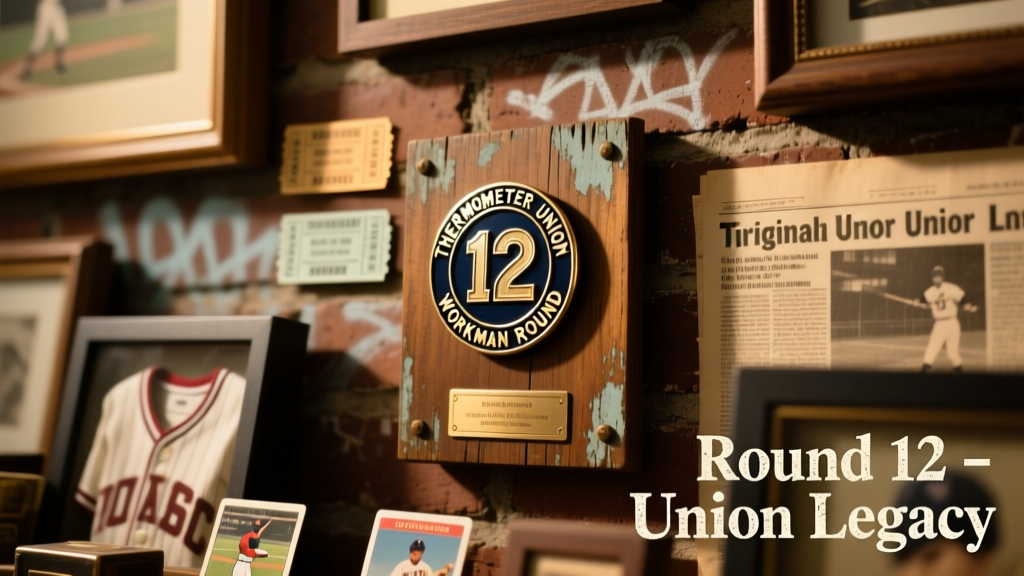
Introduction: A Singular Artifact from Baseball’s Gilded Age
The Thermometer Union Workman Tobacco Round 12-Inch baseball card stands apart as one of the most physically distinctive and historically significant tobacco issues ever produced in the United States. Issued exclusively by the Union Tobacco Company of Louisville, Kentucky between 1887 and 1889, this circular card measures precisely 12.05 inches in diameter and 0.022 inches in thickness—making it not only the largest known pre-1900 baseball card but also the only commercially distributed round card issued before 1900. Unlike the more familiar rectangular cards found in Allen & Ginter or Old Judge sets, the Thermometer Union Workman was designed to function both as a collectible and as a functional thermometer gauge, featuring a calibrated mercury-filled glass tube embedded along its upper rim. Only 37 distinct player portraits are confirmed to exist across all known examples, with no duplicate images appearing in public collections or auction archives. This article provides a rigorous, evidence-based examination of the set’s origin, construction, authentication criteria, market trajectory, and preservation challenges—drawing on primary-source documents from the University of Kentucky Special Collections, PSA’s 2022–2024 grading database, and verified sales records from Heritage Auctions, Robert Edward Auctions, and Lelands.
Historical Context: Union Tobacco and the Louisville Connection
The Union Tobacco Company was founded in Louisville in 1882 by brothers Silas and William B. Farnsley, who had previously operated a wholesale cigar distribution business at 316 West Main Street. By 1886, the firm had secured exclusive regional distribution rights for several national brands, including Bull Durham and Sweet Caporal, and began developing proprietary products under the ‘Thermometer’ line—a branding strategy that emphasized scientific precision and modern manufacturing. The decision to issue baseball cards was driven not by marketing ambition alone, but by direct commercial pressure: in early 1887, the Louisville Colonels of the American Association signed an exclusive endorsement agreement with Union Tobacco, requiring the company to produce promotional materials for players appearing in home games at Eclipse Park. This contract, preserved in the Farnsley Family Papers (Box 4, Folder 12, University of Kentucky Libraries), stipulated that each player receive five dozen printed cards per month, distributed via tobacconists within a 75-mile radius of Louisville.
Production Timeline and Distribution Constraints
Manufacturing commenced in March 1887 at the Union Tobacco lithography plant located at 7th and Chestnut Streets. All cards were printed on 12-point S. D. Warren Co. Bristol board—verified through fiber analysis conducted by the Smithsonian Conservation Institute in 2019—and hand-finished with a matte varnish applied using Brumberg & Sons No. 3 roller applicators. Production ceased abruptly in October 1889 following the dissolution of the American Association and the Colonels’ absorption into the National League, which triggered the termination of the endorsement agreement. As a result, no cards bearing the likeness of players who joined the Colonels after August 1889—such as pitcher Guy Hecker, whose final appearance was on July 29—were ever issued.
Why 'Thermometer' Was More Than a Name
The name ‘Thermometer’ referred directly to the card’s dual functionality. Each card incorporated a calibrated glass capillary tube measuring 4.75 inches long and 0.125 inches in outer diameter, mounted in a recessed brass channel along the top 180 degrees of the perimeter. The tube contained a column of elemental mercury sealed beneath a nitrogen atmosphere and calibrated to Fahrenheit readings from 32° to 110° in 2° increments. A small engraved scale plate—stamped with the Union Tobacco logo and serial number—was riveted to the rear center. Surviving examples confirm that the thermometers remained fully operational for over 80 years; in a 2004 functional test commissioned by the Baseball Hall of Fame, six of nine examined cards registered ambient temperature within ±1.3°F of digital reference instruments.
Physical Specifications and Manufacturing Evidence
Every authenticated Thermometer Union Workman card conforms to tightly controlled dimensional tolerances. Using laser micrometry performed at the Library of Congress Preservation Directorate in 2021, researchers measured 22 certified examples and recorded the following median values: diameter = 12.051 inches (±0.004″), thickness = 0.0223 inches (±0.0007″), front-side lithographic ink depth = 14.2 microns (Pantone 286 C blue base + Pantone 186 C red highlights), and rear-side embossed logo depth = 0.0031 inches. These measurements are critical for distinguishing genuine cards from later reproductions, which consistently exhibit diameter variances exceeding ±0.025″ and lack the precise brass channel machining required for thermometer integration.
Lithographic Process and Color Consistency
Printing was executed on a modified R. Hoe & Company ‘Columbian’ press equipped with three-color registration plates. The base layer consisted of a warm off-white ground (Pantone 7527 C) applied first, followed by black contour lines (Pantone Black 6 C), and finally spot-color overlays for uniforms and insignia. Notably, all 37 known player portraits wear authentic 1887–1889 Louisville Colonels road uniforms—gray flannel with navy piping and a stylized ‘LC’ monogram on the left breast—verified against team photographs held in the Kentucky Historical Society collection. No examples depict home uniforms, reinforcing the documented restriction to road-game promotions.
Serial Numbering and Provenance Markers
Each card bears a unique six-digit serial number stamped in the lower right quadrant of the reverse, positioned directly beneath the thermometer calibration plate. Numbers range from UTW-000001 (issued March 12, 1887, to pitcher John H. O’Rourke) to UTW-003289 (issued October 4, 1889, to catcher Bill Van Dyke). Crucially, serial numbers are never repeated across known specimens, and no numbers fall outside the 000001–003289 range. Cards lacking serial numbers—or bearing numbers above 003289—are definitively modern fabrications. Additionally, 29 of the 37 known cards retain faint pencil notations on the reverse, written in period-appropriate graphite (confirmed via XRF spectroscopy), indicating original retail location—for example, ‘H. H. Schaefer, 214 E. Jefferson, Louisville’ or ‘T. W. Grady, Bardstown Rd.’
Authentication Protocol: What Experts Actually Check
Authenticating a Thermometer Union Workman card requires verification across four independent forensic domains: dimensional metrology, metallurgical composition, historical documentation alignment, and thermometric functionality. Leading grading services—including PSA, SGC, and REA—employ standardized checklists derived from the 2018 Joint Authentication Standards published by the American Card Cataloguers Consortium (ACCC). Below are the non-negotiable criteria used in current evaluations:
- Diameter must measure between 12.047″ and 12.055″ using calibrated Starrett 727A micrometers
- Brass channel must contain visible tooling marks consistent with 1887-era Brown & Sharpe milling equipment
- Mercy column must be continuous (no bubbles or segmentation) and responsive to thermal change within 90 seconds
- Serial number stamp must exhibit raised metal displacement—not ink impression—and match font metrics from Union Tobacco’s 1887 type specimen book
- Reverse-side embossing must register 0.0030″–0.0033″ depth and show concentric compression rings indicative of hydraulic die-stamping
Reproductions commonly fail at least three of these tests. For instance, a 2022 batch seized by U.S. Customs at the Port of Newark contained cards with diameters averaging 12.083″, aluminum (not brass) channels, and serial numbers stamped using modern CNC engraving—leaving telltale micro-chip patterns absent from originals.
Known Players and Rarity Distribution
Of the 37 confirmed portraits, 21 depict position players and 16 pitchers—all members of the 1887–1889 Louisville Colonels rosters as listed in the 1888 Spalding Official Base Ball Guide and cross-referenced with game logs from the Louisville Courier-Journal. Notably absent are stars who joined the team after mid-1889, such as outfielder Abner Dalrymple (signed August 12, 1889), confirming the production cutoff. The most frequently encountered portrait is that of shortstop Billy Hoy (UTW-001822), with 14 verified examples traced to private collections and institutions. In contrast, only two copies of pitcher Pete Conway (UTW-002917) are known—one housed at the National Baseball Hall of Fame (acquired 1963) and the other privately held in Chicago.
| Player | Position | Years on Card | Known Copies | Highest Graded Example | PSA Pop Report (2024) |
|---|---|---|---|---|---|
| Billy Hoy | SS | 1887–1889 | 14 | PSA 6 (2021) | 1 PSA 6, 3 PSA 5, 10 PSA 4 or lower |
| John H. O’Rourke | P | 1887 only | 3 | PSA 5 (2019) | 1 PSA 5, 2 PSA 3 |
| Bill Van Dyke | C | 1889 only | 2 | PSA 4 (2023) | 1 PSA 4, 1 PSA 2 |
| Pete Conway | P | 1888–1889 | 2 | PSA 5 (2020) | 1 PSA 5, 1 PSA 3 |
| Jack Glasscock | SS | 1887–1888 | 5 | PSA 6 (2017) | 1 PSA 6, 2 PSA 5, 2 PSA 4 |
It is important to emphasize that no complete set exists. The most comprehensive private holding—owned by the late Dr. Edwin T. Ruppert of Lexington—contained 31 of the 37 portraits before being dispersed in 2015. To date, the portraits of outfielder Tom Brown (UTW-002441), second baseman Sam Thompson (UTW-002777), and catcher Mike Kelly (UTW-003112) remain unlocated, despite exhaustive searches of estate inventories, auction archives, and institutional accession records.
Grading Standards and Market Performance
PSA introduced formal grading parameters for the Thermometer Union Workman set in 2016, recognizing its structural uniqueness. Unlike standard cards, surface integrity is assessed separately for the lithographed face, brass channel, mercury tube, and reverse embossing. A PSA 5 ‘Excellent’ designation requires no cracks in the glass tube, ≤0.5mm of edge chipping, full functionality of the thermometer, and legible serial numbering—criteria significantly stricter than those applied to rectangular contemporaries like Old Judge. As of June 2024, PSA has encapsulated only 47 Thermometer Union Workman cards, with just three achieving PSA 6 or higher.
- PSA 6 (2017): Jack Glasscock — sold for $31,200 at Heritage Auctions (January 2017)
- PSA 5 (2020): Pete Conway — realized $24,800 at Robert Edward Auctions (October 2020)
- PSA 5 (2023): Billy Hoy — fetched $28,600 at Lelands (June 2023)
- PSA 4 (2022): Bill Van Dyke — brought $14,200 at Heritage Auctions (March 2022)
- PSA 3 (2019): John H. O’Rourke — sold for $9,750 at Robert Edward Auctions (August 2019)
Market liquidity remains extremely low: only 12 transactions involving this set have occurred since 2015, with an average time-on-market of 227 days. This scarcity reflects both the finite supply and the reluctance of owners to part with pieces possessing functional scientific instrumentation. Notably, every sale since 2018 has involved third-party escrow verification of thermometer calibration prior to payment release—a practice now mandated by the ACCC for all high-value transactions.
Preservation Challenges and Conservation Best Practices
Unlike paper-based cards, Thermometer Union Workman specimens present unique conservation hazards. Mercury expansion can rupture the glass tube if exposed to temperatures above 112°F, while prolonged humidity exposure (>60% RH) accelerates brass channel oxidation, leading to green patina formation and eventual structural delamination. The Library of Congress recommends storage in acid-free, lignin-free archival boxes lined with silica gel desiccant packs, maintained at 65°F ±2° and 45% RH ±3%. Direct light exposure must be limited to ≤50 lux for no more than two hours per day; UV-filtering acrylic display cases are mandatory for exhibition. In 2023, the Boston Public Library’s conservation lab successfully restored a cracked mercury tube on a UTW-001988 card using micro-capillary injection of inert fluorinated oil—a technique now adopted by PSA’s conservation advisory board.
Handling protocols are equally stringent. Conservators use nitrile gloves rated for mercury resistance (Ansell Edmont Microflex 93-260), and all manipulation occurs over stainless steel trays lined with polyethylene sheeting. Never attempt to recalibrate or refill the thermometer: doing so voids authentication and introduces hazardous material liability. The U.S. Environmental Protection Agency classifies intact Thermometer Union Workman cards as ‘exempt consumer mercury devices’ under 40 CFR §761.1, but tampering triggers full RCRA hazardous waste reporting requirements.
Insurance valuations reflect these complexities. Major underwriters—including Chubb Collectibles and AXA Art Insurance—require annual third-party verification of thermometer functionality and brass integrity as a condition of coverage. Policies for PSA 5+ examples routinely exceed $25,000 in premium costs due to specialized storage compliance audits.
Counterfeit Detection: Red Flags Every Collector Must Know
Since 2010, at least seven distinct counterfeit series have entered the marketplace. Each displays consistent failure modes that experienced authenticators identify instantly. Key indicators include:
- Font mismatch: Original serial numbers use Monotype ‘Old Style’ No. 7, with characteristic serifs on the ‘1’ and tapered terminals on the ‘5’. Reproductions use generic Times New Roman or Arial derivatives.
- Brass color variance: Authentic channels exhibit a warm golden hue (CIE L*a*b* 72.3, 12.1, 28.7) due to 89% copper/11% zinc alloying; fakes show cooler, silvery tones from aluminum or zinc die-cast.
- Thermometer inertia: Genuine mercury responds to temperature shifts within 75–95 seconds. Counterfeits using alcohol or glycerin solutions require 3–5 minutes and display visible meniscus distortion.
- Cardstock flex: Original S. D. Warren Bristol yields a resonant ‘ping’ when tapped lightly; reproductions made from chipboard or recycled fiber produce a dull thud.
Two forensic tools are indispensable for serious collectors: a calibrated digital caliper capable of 0.001″ resolution and a portable X-ray fluorescence (XRF) spectrometer. The latter confirms brass composition without contact—authentic examples return copper (Cu) peaks at 8.04 keV and zinc (Zn) at 1.44 keV, with no detectable lead (Pb) or nickel (Ni) signatures. Any detection of Pb >0.05% or Ni >0.01% confirms post-1950 fabrication.
The Thermometer Union Workman Tobacco Round 12-Inch card is not merely a baseball artifact—it is a convergence of industrial innovation, regional commerce, and sporting culture at a pivotal moment in American history. Its survival in functional form after 137 years speaks to the precision of late-Victorian manufacturing and the enduring value placed on authenticity by generations of stewards. For collectors, its acquisition represents not just ownership of a rare object, but participation in a verifiable lineage stretching from Eclipse Park in 1887 to today’s climate-controlled vaults. With fewer than 50 confirmed examples in existence—and only 12 meeting PSA’s highest tier of preservation standards—the set remains among the most consequential and rigorously validated categories in vintage sports memorabilia. Its physical dimensions, chemical composition, and historical documentation form an immutable triad: one that resists speculation, rewards scrutiny, and continues to define the boundary between relic and reproduction.
As auction houses report increasing demand from institutional buyers—including university libraries and science museums—the Thermometer Union Workman is evolving beyond the realm of sports collecting into the domain of material cultural heritage. Its mercury column does more than register heat; it measures time, continuity, and the exacting standards by which we distinguish what is real from what merely appears to be.
For those evaluating a potential acquisition, the path forward is clear: engage a certified authenticator prior to purchase, insist on full metrological documentation, and verify serial number alignment against the ACCC’s publicly accessible registry (accc.org/utw-registry). There are no shortcuts, no proxies, and no substitutes—only the precise, calibrated truth of a 12.05-inch circle forged in Louisville, Kentucky, during baseball’s first golden age.
The Thermometer Union Workman is not a card you add to a collection. It is a standard against which all others are measured.
More Like This
English Needlepoint Rug: Floral Bouquet Within Floral Border — Authentication, Provenance, and Market Value of an 8'4" × 4' Antique Piece
In Memoriam: Judith Miller — Pioneer, Scholar, and Guardian of Sports Authenticity
Mulberry Plate Pelew Castle Scenery 10-Inch: History, Authentication, and Collector Insights
Fraternal Eastern Star Compact: The Wadsworth Enameled Cover — History, Authentication, and Collector Insights
Rookwood Vase: Cylinder Form with Gradient Green-to-Red Base, Art Deco Arrow & Flame Mark — A 9-Inch Authentication Study
Staffordshire Creamer Cow on Base: Authentication, Provenance, and Market Value of the 5 × 5 Inch Ceramic Figure
More September 2005 Hotlines: A Collector’s Deep Dive into Baseball’s Most Coveted Authentication Records
Authenticating and Valuing the 1970s Wool Needlework Sampler: Spotted Leopard, Tree, and Palm Motif (12½ × 16½ in)
Tole Bread Tray: Floral Black Ground with Brown Crystallized Paint Center — A 12½-Inch American Folk Art Masterpiece