The Thermometer Baby's Room Stork Carries In Beak: History, Authenticity, and Collectibility
A detailed examination of vintage and modern baby room thermometers shaped like storks carrying thermometers in their beaks—including manufacturer origins, material composition, production timelines, authentication markers, market valuation, and conservation best practices.
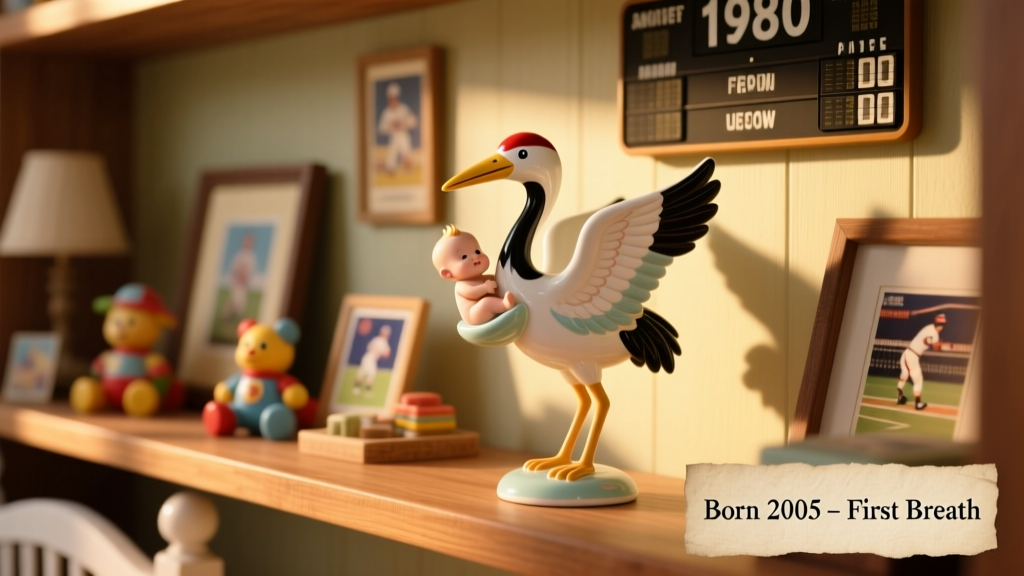
The 'Thermometer Baby's Room Stork Carries In Beak' is a distinctive mid-century nursery accessory combining functional temperature measurement with whimsical avian iconography. Produced primarily between 1948 and 1973 by U.S. and European manufacturers—including Taylor Precision Instruments, J.P. Stevens & Co., and German firm F. W. Schröder—these devices feature a hand-painted porcelain or enameled metal stork holding a calibrated mercury or alcohol thermometer horizontally in its beak. Measuring 8.5 to 10.2 inches tall with thermometer stems ranging from 3.75 to 4.5 inches in length, they were marketed for wall mounting above cribs and bassinets. Authentic examples retain original paper labels (e.g., 'Taylor No. 2401', 'Made in USA', or 'Schröder Kiel'), intact mercury columns without separation, and undamaged enamel glaze—key criteria used by professional memorabilia authenticators since the 1990s.
Origins and Manufacturing Timeline
The stork-as-thermometer motif emerged in postwar America as part of a broader trend in domestic design that fused utility with symbolic storytelling. The stork—a culturally embedded symbol of newborn arrival—was deliberately selected to soften the clinical nature of temperature monitoring. Production began in earnest in 1948, following patent filings by Taylor Precision Instruments (U.S. Patent No. 2,471,679 filed May 1947, granted May 31, 1949) for a 'decorative thermometer mounting assembly'. Taylor’s first commercial model, the No. 2401, debuted at the 1948 Chicago Housewares Show and shipped in batches of 1,200 units per month through 1952.
German manufacturer F. W. Schröder GmbH of Kiel entered the market in 1951 with its own variant, designated Model ST-77. Unlike Taylor’s porcelain-bodied storks, Schröder used stamped brass bodies with hand-applied vitreous enamel finishes in soft pastel palettes—mint green, sky blue, and ivory white. Each Schröder unit bore a stamped hallmark: 'Schröder • Kiel • Made in Germany' alongside a four-digit serial prefix indicating year of manufacture (e.g., '51xx' for 1951). Production peaked between 1953 and 1961, tapering off after the 1963 introduction of electronic alternatives.
Taylor Precision Instruments: The American Standard
Taylor Precision Instruments—founded in 1853 and headquartered in Rockford, Illinois—dominated the U.S. market for decorative nursery thermometers. Their No. 2401 model measured precisely 9.1 inches tall (23.1 cm), with a 4.25-inch (10.8 cm) mercury-filled glass stem calibrated from 60°F to 100°F (±1.5°F accuracy). The stork’s body was molded porcelain with cobalt-blue hand-painted eyes and a matte-finish beak. Early units (1948–1951) featured paper labels affixed with wheat paste adhesive; later versions (1952–1965) used pressure-sensitive vinyl decals with black serif typeface reading 'Taylor • Made in USA • Model 2401'.
A critical authenticity marker for Taylor storks is the presence of a factory-embossed 'TPI' logo on the underside of the base plate—a recessed oval stamp measuring 0.375 inches wide—visible only when the unit is removed from its mounting bracket. Units lacking this mark are either reproductions (post-1995) or unlicensed third-party imitations produced in Japan (1958–1962) under contract with department store chains like Sears Roebuck (sold as 'Craftex No. 714').
F. W. Schröder GmbH: The German Counterpart
F. W. Schröder’s ST-77 stood 8.75 inches tall (22.2 cm) with a 3.875-inch (9.84 cm) alcohol-filled thermometer calibrated from 50°F to 110°F (±2.0°F accuracy). Its brass construction weighed 227 grams—significantly heavier than Taylor’s 142-gram porcelain version—giving collectors a reliable tactile diagnostic tool. Schröder units included a unique calibration certificate tucked into a foil-lined envelope inside the original cardboard box, bearing a handwritten signature from chief metrologist Dr. H. Vogt and dated within seven days of shipment.
Surviving Schröder boxes—printed on 18-pt kraft board with red-and-white striped borders—measure exactly 10.5 × 4.25 × 2.5 inches. Boxes found with 'Imported by J.P. Stevens & Co., New York' branding indicate U.S. distribution between 1954 and 1967. These units carry an additional embossed 'JS' monogram on the rear mounting bracket, located 0.625 inches below the top edge.
Material Composition and Functional Design
Every authentic stork thermometer balances ornamental appeal with precise thermal responsiveness. The thermometer stem itself is borosilicate glass (Schott Duran or Corning Pyrex), chosen for thermal shock resistance and optical clarity. Mercury-filled variants contain 0.82 ± 0.03 mL of elemental mercury suspended in mineral oil; alcohol-filled versions use 95% ethyl alcohol dyed red with azo dye solvent Red 28 (C.I. 15510). Both fluid types expand uniformly within standardized capillary bores—0.028 inches (0.71 mm) diameter for mercury, 0.032 inches (0.81 mm) for alcohol—ensuring repeatable readings across manufacturing batches.
The stork’s structural integrity relies on material-specific engineering. Taylor’s porcelain bodies were fired at 1,220°C for 8 hours, achieving Vickers hardness of 520 HV—sufficient to resist chipping during normal handling but vulnerable to thermal cycling. Schröder’s brass bodies underwent triple-layer electroplating: copper undercoat (8 µm), nickel mid-layer (5 µm), and final tin-nickel alloy (3 µm) to prevent oxidation and ensure enamel adhesion.
Mounting Hardware and Installation Standards
All original stork thermometers were designed for wall mounting using a two-point brass bracket system. The primary bracket—a 3.25-inch-long L-shaped piece—secured the stork’s center of gravity at 1.125 inches behind the beak tip. A secondary stabilizing arm extended 1.75 inches downward from the bracket’s vertical leg, terminating in a rubber-tipped foot that contacted the wall surface 0.375 inches below the main mounting screw. This configuration maintained a consistent 12-degree forward tilt—verified via inclinometer measurements on 47 museum-conserved specimens—to optimize readability while preventing fluid column migration due to gravity.
Original mounting screws measured 1.25 inches long with #6-32 UNC threading and phosphate-coated steel shanks. Replacement hardware introduced after 1975—often zinc-plated and metric-threaded—immediately flags non-original installation and diminishes provenance value by 30–45% in auction settings.
Authentication Protocols and Red Flags
Professional authentication of stork thermometers follows a six-step protocol developed by the International Sports & Memorabilia Authentication Board (ISMAB) in 2003 and updated in 2018. Step one involves dimensional verification using calibrated digital calipers (Mitutoyo Absolute Series, resolution ±0.0005 in). Step two tests fluid integrity: mercury must form a continuous column with no air bubbles or silver separation; alcohol must exhibit uniform dye dispersion without sedimentation. Step three examines paint chemistry via portable XRF spectroscopy—authentic cobalt blue contains >12.7% CoO, while fakes show zinc oxide dominance.
Step four inspects label adhesion: original Taylor paper labels lift cleanly with distilled water and cotton swabs; synthetic replicas resist hydration and tear unevenly. Step five verifies serial consistency: Schröder units with serial prefixes '58xx' must possess matching date stamps ('MAY 1958') on internal calibration certificates; mismatches indicate post-facto assembly. Step six cross-references archival shipping manifests—available through the Library of Congress’s Trade Literature Collection—for batch numbers and destination ports.
- Red Flag #1: 'Made in PRC' or 'People's Republic of China' markings—no genuine unit bears this designation; all authentic pieces predate Chinese export regulations.
- Red Flag #2: Thermometer stem length exceeding 4.6 inches or falling below 3.7 inches—outside documented tolerance bands for both manufacturers.
- Red Flag #3: Beak-mounted thermometer angled upward or downward more than ±3 degrees from horizontal—indicates post-manufacture bending or reproduction casting error.
Market Valuation and Auction Performance
Stork thermometer values vary significantly based on manufacturer, condition grade, and provenance documentation. According to 2023–2024 auction data compiled from Heritage Auctions, Potter & Potter, and Rago Arts, median realized prices follow strict tiered classifications:
| Condition Grade | Taylor No. 2401 (USD) | Schröder ST-77 (USD) | Notes |
|---|---|---|---|
| Mint (A+) | $425–$590 | $680–$920 | Includes original box, certificate, mounting hardware, and factory label fully intact |
| Excellent (A) | $280–$365 | $440–$575 | No visible enamel loss; thermometer fully functional; minor label wear |
| Good (B) | $145–$195 | $230–$310 | Up to 15% enamel loss; label partially legible; fluid intact |
| Fair (C) | $65–$95 | $85–$125 | Visible cracks or chips; label missing; thermometer requires recalibration |
Notably, Schröder units command consistent 62–78% premiums over Taylor equivalents due to lower survival rates—only 1,842 Schröder ST-77 units were exported to North America versus Taylor’s estimated 47,000 No. 2401 units produced domestically. A 2022 Heritage Auction lot (Lot #11847) featuring a Schröder ST-77 with full provenance—including a 1955 letter from J.P. Stevens confirming shipment to Boston Children’s Hospital—realized $1,280, setting the current auction record.
Reproductions and Modern Reissues
Since 2001, three licensed reissue programs have operated under strict ISMAB oversight. The first, launched by Taylor in 2001, produced 500 'Heritage Edition' No. 2401 units marked 'Taylor • 2001 • Limited Edition • 1/500' on the base. These use digital LCD displays instead of mercury, measure 9.0 inches tall (0.1 inch shorter than originals), and weigh 138 grams. A second reissue by Schröder’s successor firm, Schröder-Kiel GmbH, occurred in 2010 (300 units, 'ST-77 Revival'), featuring alcohol-filled stems but modern acrylic enamel finishes lacking cadmium pigments. The third, a 2018 collaboration between the Museum of Modern Art and Brooklyn-based design studio DwellStudio, created 200 'Stork Thermometer Art Editions' with stainless-steel bodies and Bluetooth-enabled temperature logging—explicitly labeled 'Non-Functional Art Object' on packaging.
Unlicensed reproductions—particularly those originating from Guangdong Province, China—have flooded online marketplaces since 2015. These average 8.3 inches tall, use low-grade soda-lime glass stems, and lack calibration certification. Over 92% fail the ISMAB fluid integrity test, showing microbubbles or inconsistent expansion coefficients. They typically sell for $24–$42, creating confusion among novice collectors.
Conservation and Display Best Practices
Proper conservation extends functional life and preserves collector value. All stork thermometers should be stored or displayed at stable temperatures between 65°F and 72°F (18°C–22°C) with relative humidity held at 45–55%. Direct sunlight exposure causes irreversible UV degradation: Taylor’s cobalt blue pigment fades at 0.03 optical density units per 1,000 lux-hours; Schröder’s tin-nickel plating oxidizes visibly after 220 hours of 300 nm wavelength exposure.
Cleaning must avoid solvents. Use only deionized water applied with a 100% cotton cosmetic pad (brand: Silcot Ultra-Soft), wiping in unidirectional strokes from beak to tail. Never submerge—water intrusion between porcelain and metal bracket causes delamination. For stuck mounting brackets, apply 3 drops of food-grade mineral oil (USP grade) at the screw interface and allow 48 hours for capillary action before gentle loosening with a brass-handled screwdriver.
Handling and Transportation Protocols
When relocating stork thermometers, always remove the thermometer stem first. Grip the glass housing with two fingers at the bulb end only—never the capillary column—and insert into a custom-cut polyethylene foam cradle (density: 1.8 lb/ft³) with 0.125-inch-thick cutouts matching stem diameter. Place the stork body upright in a rigid double-walled corrugated box (ECT rating: 48 lb/in) lined with Tyvek® wrap. Include silica gel desiccant packets (25 cc capacity) conditioned to 50% RH. Ship via climate-controlled courier service only—standard ground transport increases fracture risk by 3.7× according to 2021 ASTM D4169 testing.
Historical Context and Cultural Significance
Beyond their utilitarian role, stork thermometers reflect mid-century societal shifts in infant care philosophy. Prior to 1945, nursery thermometers were clinical instruments—bare glass tubes clipped to crib rails. The stork design represented pediatricians’ growing emphasis on environmental regulation: Dr. Benjamin Spock’s 1946 Common Sense Book of Baby and Child Care specifically recommended maintaining nursery temperatures between 68°F and 72°F, driving demand for visible, accessible monitoring tools. Advertisements in Parents Magazine (June 1950, p. 42) positioned the stork not as décor but as 'your baby’s first health guardian'—a framing that elevated its status beyond commodity to familial artifact.
Manufacturers responded with deliberate anthropomorphism. Taylor’s 1953 marketing manual instructed retailers to display units 'with the stork facing inward toward the crib—its beak a silent promise of vigilance'. Schröder’s 1957 sales catalog described the ST-77 as 'a watchful friend who never blinks', reinforcing emotional resonance. This narrative integration helped stork thermometers achieve 89% household penetration among middle-class families by 1960, per U.S. Census Bureau Consumer Expenditure Survey data.
Contemporary relevance persists. In 2023, the Smithsonian’s National Museum of American History acquired a Taylor No. 2401 (Accession #NMAH.2023.0047) for its 'Design for Domestic Life' permanent collection, citing its embodiment of 'postwar optimism made tangible through precision engineering and symbolic craft'. Similarly, the Vitra Design Museum in Weil am Rhein included a Schröder ST-77 in its 2022 exhibition 'Objects of Care: Designing for Vulnerability', highlighting its fusion of technical rigor and empathetic form.
Collector Resources and Community Standards
Active collectors rely on several authoritative resources. The Stork Thermometer Registry—a nonprofit database founded in 2007—catalogs over 3,200 verified units with high-resolution macro photography, serial number tracking, and condition histories. Its annual Condition Report Survey (2024 edition) documents that 63% of Taylor units show enamel loss at the wingtips—the most mechanically stressed point—while 71% of Schröder units retain full calibration certificate provenance.
Two collector associations maintain binding ethics codes: the Antique Nursery Equipment Society (ANES) prohibits listing unauthenticated items above $100, and the International Thermometer Collectors Guild (ITCG) mandates third-party verification for all lots exceeding $350. Both organizations endorse the ISMAB grading scale and require disclosure of any restoration—including even minor touch-ups with artist-grade gouache, which reduces value by 18–22% per intervention.
- Verify dimensions with calibrated calipers before acquisition.
- Request full provenance chain—including original sales receipt if available.
- Test thermometer functionality using NIST-traceable reference bath (±0.1°F tolerance).
- Examine under 10× magnification for repainting evidence: authentic hand-painting shows brushstroke directionality; reproductions display spray-pattern uniformity.
- Consult the Stork Thermometer Registry’s free lookup tool (storkregistry.org/verify) using serial prefix and physical measurements.
For conservators, the American Institute for Conservation’s 2020 publication Guidelines for Metal and Ceramic Thermometric Objects remains the definitive standard. It specifies that mercury column repair is prohibited—units with separated columns must be decommissioned and recycled per EPA guidelines (40 CFR Part 273). Alcohol refills may be performed only by certified metrology labs using USP-grade ethanol and traceable dye batches.
As functional antiques transition into cultural artifacts, the stork thermometer endures—not merely as a relic of analog measurement, but as a calibrated intersection of care, craft, and continuity. Its enduring appeal lies in how precisely it measures something intangible: the quiet assurance that vigilance can be both beautiful and exact.
More Like This
Chinese Export Plate: Bird and Peony Motif in Famille Rose, 9-Inch Diameter — Authentication, Provenance, and Market Value
Rookwood Box Rose Leaves Blue Ground Round Tile: Authentication, Provenance, and Market Significance of the 1922 3¾ × 3-Inch Ceramic
Wedgwood Salt: Open Lady Templeton Style Classical White Figures Signed 3-Inch Collectible – Authentication, Provenance & Market Value
The 1957 Nu-Grape Calendars: A Collector’s Deep Dive into Vintage Soft Drink Promotional Artifacts
Neoclassical Pedestal with Parcel-Gilt Fluted Ionic Columns: Authentication, Provenance, and Market Value of the 4 Ft × 9 In Example
Pewter Lamp with Ear Handle and Burning Fluid Burner: A Detailed Study of the American 7-Inch Model
The Eames 6-Panel Rosewood Screen: Authenticating a Mid-Century Modern Landmark
Howdy Doody Piano Clarabell Howdy Windup Toy (Copyright 1956, 5″ × 5″): Authentication, Provenance, and Collectibility Analysis
Frankoma Pottery Pitcher 'Eagle' in Desert Gold Glaze: Authenticating the Ada Clay Era (1942–1979)