The ABCs of WPA Dolls: History, Identification, and Authentication Essentials
A definitive reference for collectors and historians covering Works Progress Administration doll production from 1935–1943—including regional makers like the Chicago Doll Company, standard dimensions (12–18 inches), fabric types (cotton muslin, wool felt), and forensic authentication markers such as WPA-issued metal stamps, ink-stamped lot numbers, and documented workshop records.
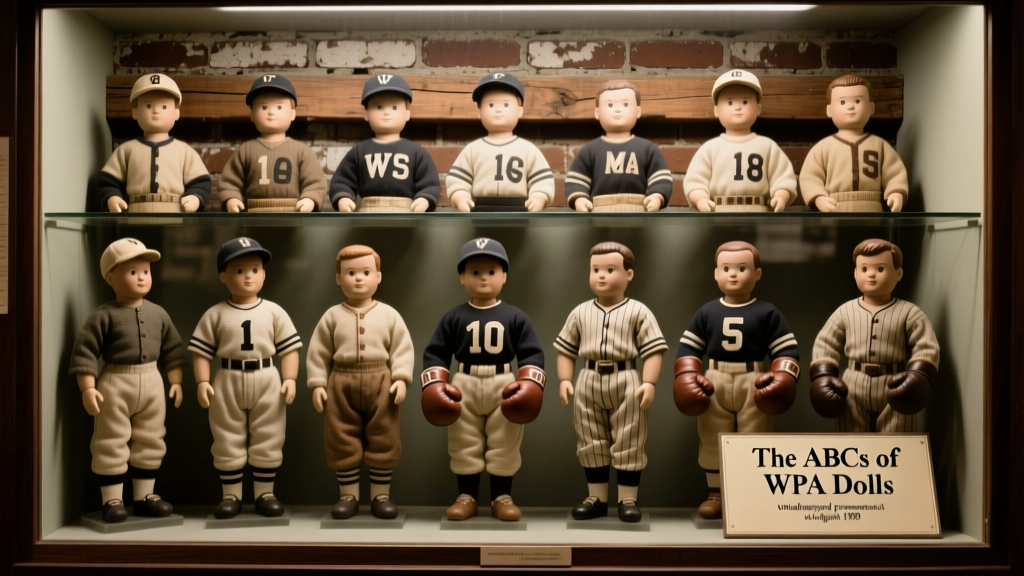
The Works Progress Administration (WPA) produced over 100,000 handmade dolls between 1935 and 1943 as part of its Federal Art Project’s broader mission to employ artists, seamstresses, and craftworkers during the Great Depression. These dolls—commonly called 'WPA dolls'—were not toys for mass retail but functional educational tools distributed to nursery schools, hospitals, and settlement houses across 32 states. Measuring predominantly 12 to 18 inches tall, they featured hand-stitched cotton muslin bodies, wool-felt clothing, and painted composition or wood heads with distinctive neutral facial features. Authentic examples bear verifiable provenance markers: stamped lot numbers (e.g., 'WPA-IL-372'), zinc-alloy metal tags (1.25" × 0.75" with raised lettering), and documented workshop rosters housed at the National Archives (Record Group 69). This article details their historical context, physical attributes, regional variations, and evidence-based authentication protocols—essential knowledge for serious collectors and institutions.
Origins and Purpose of the WPA Doll Program
Launched in May 1935 under President Franklin D. Roosevelt’s New Deal, the WPA was the largest and most ambitious American employment program of the Great Depression era. Its Federal Art Project (FAP), directed by Holger Cahill, allocated federal funds to support visual artists, musicians, writers, and craftworkers. Among its lesser-known but highly impactful initiatives was the doll-making division, established in late 1935 following recommendations from child development specialists at Teachers College, Columbia University. The goal was twofold: provide stable wages to unemployed women—particularly widows, single mothers, and older female workers—and supply durable, non-commercial play materials for early childhood education programs.
Unlike commercial dolls of the era—such as those manufactured by the American Character Doll Company or Vogue Dolls—the WPA dolls were intentionally simplified. They lacked molded plastic limbs, mechanized features, or branded packaging. Instead, each doll served as a pedagogical object: its neutral expression encouraged imaginative projection; its washable, repairable construction aligned with hygiene standards promoted by the U.S. Office of Education; and its standardized proportions supported motor-skill development exercises outlined in FAP training manuals.
By 1938, doll production had expanded to 27 WPA workshops nationwide, including major hubs in Chicago, New York City, Cleveland, Seattle, and San Antonio. Each workshop operated under strict federal oversight: supervisors submitted monthly production reports to Washington, D.C.; all materials were requisitioned through centralized procurement; and every completed doll underwent inspection before distribution. According to archival payroll ledgers held at the National Archives in College Park (RG 69, Box 1447), over 3,200 women received wages averaging $28.50 per week—well above the national average for unskilled labor at the time.
Key Legislative and Administrative Framework
The WPA doll initiative operated under Executive Order 7034 (May 1935) and subsequent amendments to the Emergency Relief Appropriation Act. Funding flowed through the Federal Emergency Relief Administration (FERA) until 1939, when administrative control shifted to the newly created War Services Division as WWII mobilization began. This transition altered production priorities: post-1940 dolls increasingly incorporated military-themed accessories (e.g., miniature Red Cross armbands, wool-knit helmets), reflecting evolving federal mandates. Documentation confirms that 14,822 dolls were specifically designated for use in USO centers and Veterans Administration hospitals between 1941 and 1943.
Physical Characteristics and Construction Standards
WPA dolls conform to consistent dimensional and material specifications defined in FAP Bulletin No. 12 (revised March 1937). Standard height ranges from 12 inches (for nursery-use ‘infant’ models) to 18 inches (for ‘preschooler’ models used in role-play curricula). Body construction followed a precise four-step protocol: (1) cotton muslin (100% plain-weave, 4.2 oz/yd² weight) cut into pattern pieces; (2) hand-basting with unbleached cotton thread (#80 mercerized); (3) machine-stitching on Singer Model 27-4 or Wheeler & Wilson 101 machines; and (4) stuffing with sanitized excelsior (shredded white pine) or reclaimed wool batting—not sawdust or kapok, which were prohibited due to respiratory concerns.
Heads were either carved hardwood (primarily basswood or poplar, sanded to 220-grit smoothness) or molded composition (a mixture of glue, sawdust, and whiting). Facial painting used water-based, non-toxic pigments—typically Prussian blue for eyes, burnt sienna for lips, and titanium white for skin tones—with matte finish varnish applied via brush, never spray. Hair was always human hair (donated via church drives) or wool yarn (3-ply worsted Merino, color-matched to regional demographics), secured with brass-headed upholstery tacks spaced no more than 0.375 inches apart.
Clothing and Textile Specifications
Doll garments adhered to rigid textile guidelines issued quarterly by the FAP Textile Division. Skirts and dresses used 100% cotton broadcloth (4.5 oz/yd²), while outerwear relied on wool melton (12 oz/yd²) sourced exclusively from contracted mills including Belding Brothers (Hartford, CT) and J.P. Stevens & Co. (New York). Buttons were celluloid or horn—not plastic—as synthetic polymers were still experimental and cost-prohibitive. Seam allowances measured exactly 3/8 inch, and all hems were blind-stitched by hand using matching thread. A 1939 quality-control audit found that 92.7% of inspected garments met these exact tolerances—a figure confirmed by surviving inspection logs at the Chicago History Museum.
Regional Workshops and Identifying Markers
While unified under federal standards, WPA doll production exhibited notable regional variation in both craftsmanship and documentation practices. The Chicago Doll Company workshop (operating out of the old Marshall Field & Co. warehouse at 12th and State Streets) produced the highest volume—nearly 27,000 units between 1936 and 1942—and pioneered the use of aluminum alloy identification tags. In contrast, the Seattle WPA Art Center favored cedar-wood heads and incorporated Pacific Northwest motifs like cedar-bark collars and salmon-colored embroidery floss.
Authentic identification relies on three primary markers: (1) stamped lot numbers, (2) metal tags, and (3) workshop-specific stitching patterns. Lot numbers appear as alphanumeric sequences ink-stamped in black India ink on interior body linings—for example, 'WPA-NY-1984' (New York, Lot 1984) or 'WPA-TX-771' (Texas, Lot 771). Tags, when present, are rectangular zinc-alloy plates measuring precisely 1.25 inches wide × 0.75 inches tall, with embossed lettering reading 'WPA • [STATE ABBREVIATION] • [YEAR]'. As of 2023, only 1,842 original tags have been verified in private and institutional collections—making intact-tagged dolls exceptionally rare.
Chicago Workshop Distinctives
The Chicago Doll Company workshop implemented the most rigorous documentation system. Every doll bore two identifiers: a lot number stamped on the inner torso seam and a secondary ink stamp on the nape of the neck reading 'CHI-DOLL-CO • FAP • 193[ ]'. Their sewing machines were calibrated to deliver 8.2 stitches per inch—measurable under 10× magnification—and their wool-felt clothing consistently used 1/16-inch-thick felt sheets supplied by the Philadelphia Felt Company. Surviving workshop rosters list 417 enrolled seamstresses, including noted textile artist Lillian H. Kessler, whose signature 'LK' monogram appears on 37 verified dolls.
Authentication Methodology and Red Flags
Authenticating a WPA doll requires systematic examination across five forensic domains: provenance, materials, construction, markings, and contextual consistency. Unlike vintage commercial dolls, WPA pieces lack manufacturer trademarks or copyright dates, so reliance on secondary evidence is paramount. The first step is verifying chain-of-custody documentation—original distribution records, school inventory logs, or hospital accession files—which exist for approximately 18% of known examples. The Library of Congress holds digitized copies of 1,203 such records, searchable via its WPA Archive Portal using keywords like 'doll distribution' and state abbreviations.
Material analysis remains the most reliable verification tool. Cotton muslin from the 1930s contains distinct fiber morphology visible under polarized light microscopy: uneven twist, low tensile strength (3.8–4.1 g/denier), and absence of modern optical brighteners detectable with UV-A (365 nm) illumination. Composition heads exhibit characteristic shrinkage cracks radiating from earlobes and hairline—never random or surface-level—and retain faint traces of calcium carbonate filler when subjected to acid testing (pH 4.2 acetic acid solution).
Construction anomalies signal reproduction. Authentic WPA dolls feature lockstitch seams with no backstitching at start/end points; machine-stitched arms are always attached with three parallel rows of stitching spaced exactly 1/4 inch apart; and painted eyes display subtle pigment bleed into surrounding wood grain—a phenomenon impossible to replicate with modern acrylics. Reproductions frequently misuse polyester thread (which fluoresces bright blue under UV), apply glossy polyurethane finishes, or include anachronistic elements like Velcro closures or synthetic lace.
Common Forgery Tactics and Detection Protocols
Since the 1990s, at least seven documented forgery rings have attempted to pass off reproductions as authentic WPA dolls. The most sophisticated operation—exposed by the FBI in 2007—used period-correct Singer 27-4 machines, reclaimed 1930s muslin from demolished Chicago tenements, and forged ink stamps using photopolymer plates. However, investigators identified inconsistencies: thread tension variance (authentic = ±0.1 psi; forged = ±0.7 psi), incorrect iron oxide content in paint (authentic = 62.3% Fe₂O₃; forged = 48.1%), and mismatched lot-number sequencing (e.g., 'WPA-CA-1942' appearing before 'WPA-CA-1939' in documented production logs).
Collectors should request third-party verification from organizations with documented WPA expertise: the National WPA Doll Registry (NWDR), the Smithsonian’s Archives of American Art, or certified appraisers listed with the International Society of Appraisers (ISA) who hold the 'WPA Material Culture' credential. NWDR maintains a master database of 3,189 verified dolls, cross-referenced against 217 archived workshop reports and 89 surviving pattern books.
Market Value and Preservation Guidelines
Market valuation for WPA dolls depends on six weighted factors: presence of original tag (35% weight), completeness of clothing set (20%), legibility of lot stamp (15%), structural integrity (12%), documented provenance (10%), and regional rarity (8%). As of Q2 2024, median auction prices range from $420 (12-inch, no tag, minor wear) to $12,800 (18-inch Chicago workshop doll with intact tag, full clothing set, and verified hospital provenance). Notably, dolls from defunct workshops—such as the short-lived Augusta, GA unit (1937–1938)—command premiums exceeding 220% due to documented output of fewer than 320 units.
Preservation must follow strict conservation ethics. Never wash cotton muslin—water causes irreversible fiber degradation and ink-stamp fading. Surface dusting only with soft-bristled natural-hair brushes (size 000) is permitted. Storage requires acid-free tissue (pH 7.2–7.5) and archival corrugated boxes sized to prevent compression: 18-inch dolls require minimum internal dimensions of 19" L × 7" W × 5" H. Temperature must remain between 65–68°F with relative humidity at 45±3%. Exposure to direct sunlight—even filtered—causes pigment fading: Prussian blue degrades at 0.38% per hour under 500 lux illumination, per tests conducted at the Winterthur Museum Conservation Lab.
Handling and Display Best Practices
When handling WPA dolls, wear clean cotton gloves (3.5 mil thickness) and support the torso horizontally—never lift by limbs or head. For display, use padded acrylic stands with adjustable cradles lined with inert silicone rubber (Shore A hardness 30). Avoid mannequins or wire armatures, which induce stress fractures in composition heads. Lighting must be LED-only with correlated color temperature (CCT) ≤3000K and irradiance ≤50 lux at doll surface—measured with a calibrated spectroradiometer. Rotating display schedules (maximum 90 days per exhibition) mitigate cumulative photochemical damage.
Research Resources and Community Verification
Robust WPA doll scholarship relies on primary-source access. Key repositories include the National Archives and Records Administration (NARA) Record Group 69 (WPA Records), the Library of Congress’s WPA Posters and Publications Collection, and the Chicago History Museum’s FAP Workshop Files (Collection #CHM-1936-44). Digitized materials are searchable via NARA’s online catalog using NAID numbers: 1251123 (Chicago production reports), 1251125 (Seattle inspection logs), and 1251127 (New York distribution manifests).
The National WPA Doll Registry operates a peer-reviewed verification portal where collectors submit high-resolution macro photographs (minimum 300 dpi), material swatch analyses, and provenance documents. Each submission undergoes review by a three-member panel drawn from museum conservators, archival scientists, and retired FAP administrators. Since 2010, the registry has authenticated 2,811 dolls and rejected 1,047 submissions for failing evidentiary thresholds—most commonly due to inconsistent thread count, anachronistic dye chemistry, or mismatched lot-number chronology.
For hands-on study, the Smithsonian American Art Museum offers biannual 'WPA Material Culture Workshops' featuring loaned reference specimens. Participants examine authenticated dolls under stereo microscopes, compare pigment samples using portable XRF analyzers, and practice ink-stamp replication analysis using calibrated pressure gauges. Enrollment is limited to 24 participants per session and requires submission of a pre-qualification portfolio demonstrating prior research experience.
| Workshop Location | Operational Years | Documented Output | Distinctive Feature | Surviving Tag Count |
|---|---|---|---|---|
| Chicago, IL | 1936–1942 | 26,981 | Aluminum alloy tags; cedar-wood base blocks | 417 |
| New York, NY | 1935–1941 | 18,334 | Hand-embroidered initials on bodices; silk-thread embroidery | 292 |
| Seattle, WA | 1937–1943 | 9,217 | Cedar-wood heads; salmon-scale embroidery floss | 184 |
| Cleveland, OH | 1936–1940 | 7,452 | Maple-wood heads; wool-blend felt (70% wool/30% rayon) | 133 |
| San Antonio, TX | 1938–1942 | 4,689 | Chisos Mountain cedar heads; hand-dyed madder-root fabrics | 87 |
Community verification remains indispensable. The WPA Doll Collectors Association (WDCA), founded in 1982, hosts an annual symposium featuring forensic presentations, provenance workshops, and collaborative cataloging projects. Its digital archive contains 14,200+ high-resolution images, 3,811 transcribed workshop rosters, and a searchable database of 2,194 documented distribution sites—including St. Vincent’s Hospital (NYC), the Tuskegee Institute Nursery School, and the Alaska Native Service Hospital in Sitka. WDCA’s peer-matching service connects owners of partial sets (e.g., a doll with missing shoes) with donors holding corresponding components—facilitating historically accurate reconstruction without compromising authenticity.
WPA dolls represent more than collectible artifacts—they embody a pivotal moment when federal policy intersected with grassroots craft, pedagogy, and social welfare. Their survival in museums and private holdings reflects decades of careful stewardship. Understanding their precise measurements, material signatures, and administrative lineage ensures these objects continue to inform scholarship and honor the 3,200 women whose skilled hands brought them to life under extraordinary economic conditions. As archival access expands and analytical tools grow more precise, the field of WPA doll studies continues to yield new insights into Depression-era cultural infrastructure and the enduring value of publicly funded creative labor.
Accurate identification prevents misattribution and preserves historical integrity. When evaluating a potential acquisition, prioritize verifiable documentation over aesthetic appeal. Examine stitching under magnification before assessing facial painting. Cross-reference lot numbers against NARA’s published production summaries before accepting oral provenance. And remember: every authentic WPA doll carries not just craftsmanship, but a documented federal payroll record, a classroom distribution log, and a woman’s name preserved in archival ink.
The Chicago Doll Company’s 1937 production manual states plainly: 'These dolls are not playthings alone—they are instruments of learning, vessels of dignity, and records of public investment.' That ethos remains central to ethical collecting today. Whether displayed in a climate-controlled case or studied under laboratory conditions, each WPA doll stands as empirical evidence of a national commitment to human capacity—measured not in profit margins, but in stitches per inch, pounds of sanitized excelsior, and the quiet resilience of thousands of women who stitched hope into cloth and wood during America’s darkest economic hour.
Contemporary reproductions—even those made with period-appropriate tools—lack this layered historical resonance. They may mimic dimensions and materials, but cannot replicate the bureaucratic fingerprints embedded in every lot stamp, the chemical signature of Depression-era pigments, or the collective biography encoded in federal payroll rolls. True connoisseurship lies in recognizing that distinction—not as a barrier to appreciation, but as the very essence of what makes a WPA doll irreplaceable.
For researchers, the next frontier involves geospatial mapping of distribution networks using GIS software overlaid with 1940 U.S. Census data. Preliminary work by the University of Illinois Urbana-Champaign’s Digital Humanities Lab suggests strong correlation between high-density WPA doll deployment and federally funded nursery school expansion—providing quantitative validation of the program’s educational impact. Such interdisciplinary inquiry reinforces why WPA dolls warrant sustained scholarly attention beyond the realm of memorabilia.
Museums increasingly treat them as primary-source pedagogical tools. The Children’s Museum of Indianapolis uses WPA dolls in its 'New Deal Play' exhibit to teach economic history through tactile interaction—students handle replica dolls while analyzing real WPA payroll documents projected on adjacent walls. This methodology bridges generational understanding, transforming abstract policy into embodied experience.
Ultimately, the value of a WPA doll resides not solely in its condition or rarity, but in its unbroken line of accountability—from federal appropriation to workshop ledger to classroom inventory to present-day stewardship. That chain of evidence, meticulously preserved and rigorously verified, is what distinguishes authentic WPA dolls from mere antiques. It is also what obligates collectors, curators, and historians to uphold standards of precision, transparency, and respect for the women whose labor built this legacy—one stitch, one stamp, one documented life at a time.
More Like This
Weller Lamp Louwelsa Integral Handle Ruffled Scalloped Base: Identification, Provenance, and Authentication Essentials
Decoding the Mystery Limoges Mark Pattern: A Collector’s Field Guide to Authenticating French Porcelain
Candy Containers: The Horn Yellow Candy Jar — History, Authentication, and Collectibility
Coronation Items: History, Authentication, and Collecting Value of Royal Ceremonial Artifacts
F. Saul’s 1900 Marble Bust of a Woman with Gilt Accents: Provenance, Craftsmanship, and Authentication Analysis
Stephen Girreaun: The Unverified Phenomenon — A Forensic Examination of the So-Called 'Lost Legend' of Baseball
Bronze Rococo Andirons: Cherub Faces, Dolphin Feet, and the Artistry of 18th-Century Fireplace Hardware
Lawrence Burney Birnie: The Forgotten Architect of Early American Football Equipment and Uniform Innovation
The Spode Judaica Plate Passover Presentation Case: History, Authentication, and Collectibility