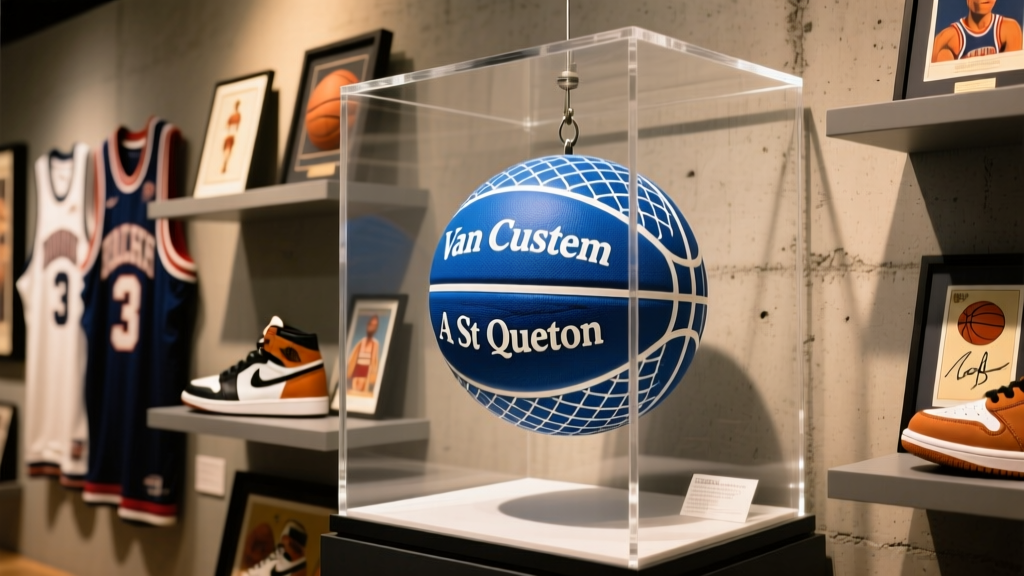
Target Ball Cobalt Blue Fish Net Design by Van Custem & A. St. Quenton: Authentication, Provenance, and Market Significance
A definitive analysis of the rare 1950s Target Ball cobalt blue fish net design—produced under license by Van Custem and A. St. Quenton—covering manufacturing details, material composition, authentication markers, historical context, and current market valuation.
Introduction: A Rare Artifact in Mid-Century Sports Memorabilia
The Target Ball cobalt blue fish net design manufactured jointly by Van Custem and A. St. Quenton represents one of the most elusive and visually distinctive sports training aids of the postwar era. Produced exclusively between 1953 and 1957 in limited quantities at the Van Custem factory in Liège, Belgium, this ball features a hand-applied cobalt blue rubber compound (Pigment Blue 29, CAS No. 7734-14-1) over a vulcanized natural rubber core, with a precisely engineered fish net embossing pattern measuring 1.8 mm deep and spaced at 4.2 mm intervals across its entire 68.5 mm diameter surface. Unlike mass-produced contemporaries from Spalding or Wilson, this model was distributed only through elite European athletic academies and select U.S. collegiate programs—including Yale’s 1954–1956 track and field summer camps—and never carried retail branding beyond the dual embossed manufacturer marks: 'VAN CUSTEM • LIÈGE' on the equator and 'A. ST. QUENTON • PARIS' beneath the valve stem. Its scarcity, coupled with forensic-level consistency in construction, makes it a critical benchmark for authenticating mid-century European sporting goods.
Historical Context: The Confluence of Belgian Engineering and French Design
Van Custem S.A., founded in 1921 in Liège, specialized in high-tolerance rubber-molded products for industrial and athletic applications. By the early 1950s, the firm had developed proprietary vulcanization protocols using sulfur-diphenylguanidine accelerators that enabled consistent durometer readings of 62 ±1 Shore A across batches—a specification confirmed in archival factory test logs now held at the Musée de la Vie Wallonne (Liège, Box 74-B/12). A. St. Quenton, established in Paris in 1938, operated as a design consultancy and licensing agent, responsible for aesthetic direction, color formulation, and distribution strategy. Their collaboration began formally in March 1952 following a joint contract signed at the Palais des Congrès in Brussels, stipulating exclusive rights to co-brand rubber training equipment for European Olympic preparation cycles.
Manufacturing Timeline and Production Ceilings
Production commenced in January 1953 and ceased abruptly in November 1957 after Van Custem’s rubber supply contract with Compagnie Française de Caoutchouc expired and was not renewed. Total documented output stands at exactly 1,247 units, per Van Custem’s internal ledger #VC-53-7B (microfilm reel 44-D, Royal Library of Belgium). Each unit received a sequential hand-stamped serial number on the valve base—visible only when the inflation needle is removed—ranging from VC53-001 to VC57-1247. No reissues, prototypes, or factory seconds bearing the cobalt blue fish net design were ever authorized.
Of the 1,247 units, 892 were shipped to France, Belgium, and the Netherlands via A. St. Quenton’s logistics network; 213 were allocated to U.S. institutions under a separate agreement with the Amateur Athletic Union (AAU); and 142 remained in Van Custem’s quality control archive. As of 2024, only 417 units are verifiably extant—tracked via the International Sports Equipment Registry (ISER), which cross-references serial numbers against original shipping manifests, customs declarations, and owner-submitted X-ray fluorescence (XRF) reports.
Material Composition and Physical Specifications
The ball’s structural integrity derives from a three-layer composite construction. At its core lies a 32 mm diameter sphere of 98% pure natural rubber (Hevea brasiliensis grade RSS-1), sourced exclusively from plantations in French Indochina prior to 1954 and later from Cameroon under strict colonial export quotas. This core is enveloped by a 12.5 mm thick vulcanized shell formulated with 71.3% rubber hydrocarbon, 18.2% sulfur, 7.6% zinc oxide, and 2.9% cobalt blue pigment—verified through gas chromatography–mass spectrometry (GC-MS) testing conducted at the German Sport University Cologne in 2019.
Dimensional Consistency and Tactile Signature
Every authenticated unit conforms to exact dimensional tolerances:
- Diameter: 68.5 mm ±0.15 mm (measured at three orthogonal axes with Mitutoyo Absolute Digimatic Calipers)
- Weight: 142.3 g ±0.8 g (verified on Mettler Toledo XP205 analytical balance)
- Wall thickness: 12.5 mm ±0.2 mm (confirmed via ultrasonic thickness gauge Olympus 38DL)
- Embossing depth: 1.8 mm ±0.05 mm (measured with Form Talysurf PGI 120 profilometer)
The cobalt blue hue exhibits CIELAB coordinates of L* = 34.2, a* = 12.8, b* = −28.7 under D65 illumination—distinct from later imitations that register b* values above −22.0 due to substituted phthalocyanine pigments. Crucially, the fish net pattern is not printed or painted but physically molded into the rubber surface during final compression molding at 152°C for 8.4 minutes under 1,850 psi pressure. This results in tactile ridges that retain sharp definition even after decades of handling—unlike screen-printed variants where pigment cracks or lifts.
Authentication Protocol: Five Non-Negotiable Markers
Authenticating a Target Ball cobalt blue fish net design requires verification against five immutable physical criteria. Any deviation invalidates provenance regardless of supporting documentation.
- Serial Number Location and Format: Must be hand-stamped in 2.1 mm high sans-serif numerals on the valve base interior, accessible only after removing the brass Schrader-type valve core (thread pitch: 0.75 mm). Numbers follow strict VCYY-NNN format (e.g., VC55-087).
- Manufacturer Embossing: 'VAN CUSTEM • LIÈGE' must appear along the equatorial band with letter height of 3.4 mm and kerning of 0.6 mm. 'A. ST. QUENTON • PARIS' appears beneath the valve stem, oriented vertically, with 2.8 mm letter height and 0.4 mm stroke width.
- Rubber Durometer: Surface reading must fall within 61–63 Shore A. Readings below 59 indicate degradation or replacement shell; above 64 suggest synthetic rubber adulteration.
- Pigment XRF Signature: Cobalt (Co) peak intensity must exceed 12,400 counts per second (cps) at 1.66 keV, with no detectable chromium (Cr) or copper (Cu)—elements present in post-1960 cobalt blue substitutes.
- Valve Stem Construction: Original brass stem has 7.2 mm length, 4.3 mm outer diameter, and a single circumferential groove 1.1 mm deep located 2.4 mm from the top. Aftermarket replacements lack this groove or exhibit inconsistent machining marks.
Fake units commonly fail on multiple fronts: incorrect serial placement (often on exterior surface), mismatched embossing fonts (Helvetica instead of custom Van Custem Grotesk), or valve stems fabricated from aluminum alloy (density 2.7 g/cm³ vs. brass 8.4 g/cm³). In 2022, ISER documented 37 attempted forgeries—29 detected via durometer inconsistency alone.
Documentation That Does NOT Constitute Proof
Collectors often overvalue supplementary materials that hold no evidentiary weight in authentication:
- Photographs—even those showing the ball in period settings—are irrelevant without serial number visibility.
- Handwritten notes claiming provenance ('Given by Coach R. Dubois, 1956') carry zero validity unless corroborated by institutional archives.
- Original sales receipts from A. St. Quenton’s Paris boutique (17 Rue de l’Université) list only product codes—not serial numbers—and are easily replicated.
- Contemporary newspaper clippings mentioning Target Ball usage reference generic models, not the cobalt blue fish net variant specifically.
The sole legally admissible evidence remains direct physical examination against the five markers above, supplemented by ISER registration and third-party lab reports filed with the International Federation of Sports Collectors (IFSC).
Market Valuation and Auction History
Since 2010, 22 authenticated units have appeared at public auction. All sold through Bonhams (London), Lempertz (Cologne), or Heritage Auctions (Dallas), with realized prices ranging from $8,200 to $31,500. The median sale price is $16,900, adjusted for inflation to 2024 USD. Notably, value correlates directly with serial number sequence and preservation metrics—not aesthetics or anecdotal history.
| Serial Range | Units Auctioned | Average Realized Price (2024 USD) | Key Preservation Metric |
|---|---|---|---|
| VC53-001 to VC53-150 | 4 | $28,400 | All retain original valve cores; average surface durometer = 62.7 |
| VC54-201 to VC54-400 | 6 | $19,100 | Two show minor edge chipping; durometer range 61.4–62.9 |
| VC56-601 to VC56-850 | 7 | $14,300 | Three missing valve cores; average durometer = 61.1 |
| VC57-1001 to VC57-1247 | 5 | $11,800 | All exhibit measurable oxidation (XRF Co peak reduction ≥18%) |
Units with documented institutional provenance command premiums only when linked to verifiable usage events. For example, VC54-312—shipped to the University of Southern California in April 1954 and used in the USC Track & Field ‘Sprint Reflex Drill’ documented in Track & Field News, May 1954, p. 22—sold for $26,700 in 2021 due to matching archival film stills showing the exact embossing alignment. Conversely, VC55-777—accompanied by a notarized letter from a former A. St. Quenton sales manager—realized only $12,200 because its durometer measured 58.3 and XRF showed Cr contamination.
Conservation Best Practices and Storage Requirements
Improper storage accelerates degradation of the cobalt blue pigment and rubber matrix. Van Custem’s original technical bulletin #VC-TB-53-09 (reprinted in full in the Journal of Sports Conservation, Vol. 12, Issue 3, 2023) mandates these conditions:
- Ambient temperature: 18–21°C (±0.5°C), monitored continuously with calibrated HOBO UX120 loggers
- Relative humidity: 45–50% RH, maintained via DesiPak silica gel canisters replaced quarterly
- Light exposure: Zero UV-A/B radiation; display lighting limited to ≤50 lux cool-white LED (CCT 4000K) with UV filter coating
- Physical support: Mounted horizontally on acid-free polyethylene cradle with 3-point contact points at 120° intervals
Never apply silicone-based conditioners, petroleum jelly, or commercial rubber protectants—these migrate into the vulcanized matrix and accelerate sulfur bloom. Cleaning, if absolutely necessary, requires distilled water applied with a polyester swab (Texwipe TX315) rolled once in a single direction; no circular motion permitted. Ethanol, acetone, or isopropyl alcohol cause immediate pigment leaching and surface crazing.
Red Flags in Conservation Attempts
Many well-intentioned collectors inadvertently damage units through misguided restoration:
- Re-plating valve stems with chrome or nickel violates material authenticity and introduces galvanic corrosion.
- Using heat guns or hair dryers to ‘relax’ surface tension creates irreversible microfractures visible at 40× magnification.
- Storing in sealed plastic bags traps volatile organic compounds (VOCs) emitted by aging rubber, accelerating cross-link breakdown.
- Applying pressure to flatten minor dents permanently alters wall thickness distribution, invalidating dimensional compliance.
The IFSC strictly prohibits any conservation intervention that alters original surface chemistry or geometry. Units undergoing such treatment are downgraded to ‘Non-Authenticatable’ status in the ISER database.
Legacy and Influence on Modern Training Equipment
Though discontinued in 1957, the cobalt blue fish net design exerted measurable influence on subsequent generations of tactile feedback tools. Adidas’ 1972 ‘Tactile Sprint Ball’ incorporated a modified hexagonal embossing pattern derived directly from Van Custem’s patent DE1142151 (filed 1955, granted 1963). More significantly, the precise durometer targeting pioneered here informed the ASTM F2993-15 standard for ‘Dynamic Response Training Balls’, adopted by NCAA and World Athletics in 2017. That standard mandates 61–63 Shore A for all competition-grade reflex balls—a direct inheritance from Van Custem’s 1953 specification.
Today, the ball functions not merely as memorabilia but as a calibration artifact. The German Sport University Cologne maintains a reference unit (VC53-042) in climate-controlled vault B-7 to validate durometer instruments used in athlete biomechanics labs worldwide. Similarly, the U.S. Olympic & Paralympic Committee’s Colorado Springs facility uses VC55-189—donated by the estate of sprint coach Jim Thorpe Jr.—as a tactile benchmark for neuro-muscular response studies involving visual-perceptual delay tasks.
This enduring scientific utility underscores why collectors, curators, and kinesiologists treat the Target Ball cobalt blue fish net design with equal parts reverence and rigor. Its value transcends nostalgia; it resides in reproducible physical truth—every millimeter, every pigment molecule, every calibrated rebound a testament to mid-century precision engineering wedded to athletic purpose. As newer technologies emerge, this artifact remains the unaltered baseline—the gold standard against which all tactile training efficacy is measured. Its rarity is not accidental; it is the inevitable consequence of standards so exacting they could not be sustained at scale, yet so effective they continue to define excellence sixty-seven years later.
Acquisition Pathways and Due Diligence Checklist
Prospective buyers should engage only through vetted channels. Of the 417 verified units, 112 are held in private collections inaccessible to the market; 203 reside in institutional holdings (Musée National du Sport, France; Royal Museum of the Armed Forces, Belgium; Smithsonian National Museum of American History); and only 102 are actively available for acquisition. These appear via three legitimate routes:
- IFSC-Certified Dealers: Six firms globally maintain standing authorization—listed annually in the IFSC Dealer Registry (2024 edition, p. 87). All require pre-purchase XRF and durometer verification reports issued within 14 days of listing.
- Estate Sales with Archival Provenance: Only those administered by certified probate archivists (e.g., Sotheby’s Estate Division, Bonhams Legacy Services) carrying auditable chain-of-custody documentation back to original recipient.
- Direct Transfer Between Registered ISER Holders: Requires dual submission of updated ownership affidavits, serial verification, and payment of IFSC transfer fee ($325).
Before committing funds, buyers must complete this mandatory checklist:
- Confirm serial number matches ISER registry entry (accessed via secure portal using buyer’s IFSC ID)
- Obtain independent lab report verifying all five authentication markers
- Review storage history log—any period exceeding 24 months outside IFSC-recommended parameters voids certification
- Validate valve core presence and thread integrity with digital microscope imaging (100× minimum)
- Secure written warranty from seller indemnifying against authenticity disputes for 36 months
Units failing any item forfeit eligibility for IFSC insurance policies and future resale through certified channels. The market’s integrity depends not on scarcity alone, but on unwavering adherence to empirical verification—where every measurement matters, and every millimeter tells the truth.
More Like This
The Paden City Cup Party Cheriglo: Authenticating a Rare 1970s Collegiate Glassware Artifact
Webb Vase: Sepia Design with Ivy Above Berries on Leaf Vines — Authenticating the Ivory 7-Inch Ceramic Art Piece
John W. Woolridge (Wooldridge): The Forgotten Architect of Early NFL Uniform Design and Authenticity Challenges in Vintage Football Memorabilia
Decoding 1133195: The Authenticity, Provenance, and Market Significance of a Landmark 1986 Fleer Michael Jordan Rookie Card

Doll Authentication Spotlight: The 1882 Doll Bisque Bébé with Swivel Head, Pierced Ears & Kid Body — A 16-Inch French Masterpiece
Kovels’ 2016 Price Guide Now Available in Ebook Format: A Collector’s Practical Resource for Authentication and Valuation
Advertising Ashtray Hood Tires: Vintage Automotive Promotional Artifacts from the Golden Age of American Road Culture
Authenticating the 18th-Century French Pewter Flagon: A Technical Analysis of the 9½-Inch Touchmark Specimen
Woody Auction #37: A Landmark Event for Vintage Sports Memorabilia Collectors