Stylish Sideboards, Servers, and Buffets: Function, Form, and Collectible Value in Modern Interiors
A detailed exploration of stylish sideboards, servers, and buffets—covering historical evolution, iconic mid-century designs (Eames, Dunbar, Heywood-Wakefield), dimensional standards, material authenticity markers, resale market trends, and practical integration tips for collectors and interior enthusiasts.
Defining the Category: More Than Just Storage Furniture
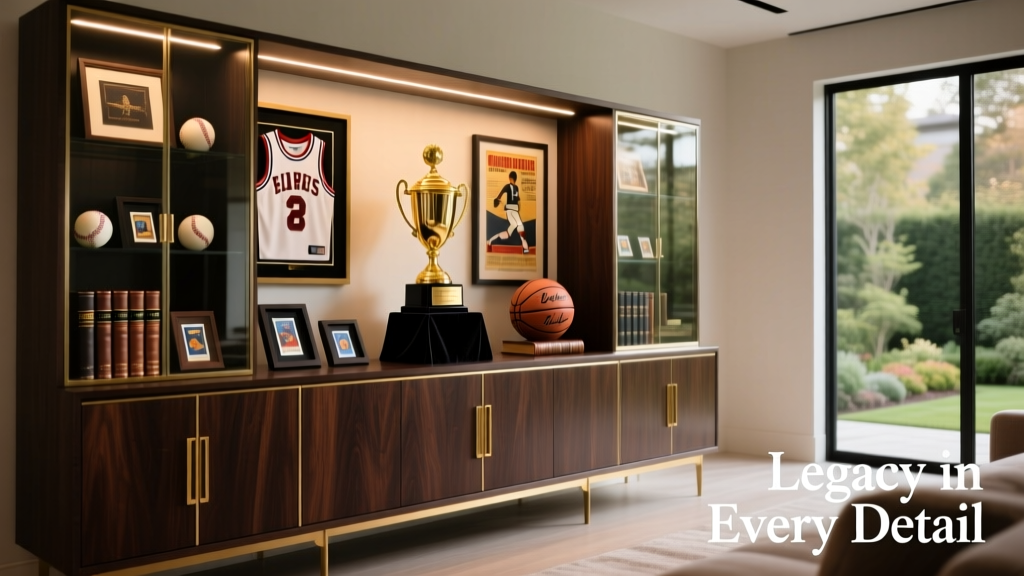
Sideboards, servers, and buffets are low-profile, horizontal case pieces designed for dining room or living space utility—primarily for food service, dish storage, bar organization, or display. Though often used interchangeably, subtle distinctions exist: traditional sideboards (originating in 18th-century England) feature a long top surface with cabinets or drawers beneath and were originally used to 'side' the dining table during service; servers emerged in mid-20th-century America as streamlined, often modular units optimized for cocktail prep and modern entertaining; and buffets, named after the French buffet (a side table for cold dishes), emphasize open shelving or glass-front cabinetry for visible presentation. Today’s high-demand examples combine structural integrity, design pedigree, and material authenticity—making them both functional furniture and appreciating collectibles. A 1962 Dunbar #530 walnut server recently sold at Rago Auctions for $4,200, while an original 1957 Eames Fiberglass Sideboard fetched $12,800 at Wright Auction in 2023.
Historical Evolution: From Georgian Oak to Mid-Century Modern Icons
The lineage of the sideboard begins with Georgian-era English cabinetmakers like Thomas Chippendale and George Hepplewhite, who crafted ornate mahogany sideboards with carved shell motifs, marble tops, and brass paw-foot casters. By the Victorian era, sideboards grew larger and more elaborate—often exceeding 84 inches wide and incorporating mirrored backs, porcelain inlays, and multiple tiers. The 1920s introduced Art Deco interpretations: Paul Frankl’s Skyscraper sideboards used zebrawood veneer and chrome-plated steel frames, with heights reaching 42 inches and depths up to 24 inches to accommodate formal silver services.
The Mid-Century Modern Revolution
Post–World War II demand for affordable, mass-producible furniture catalyzed a radical redesign. Designers leveraged new materials—including molded plywood, fiberglass-reinforced plastic, and laminated particleboard—and prioritized clean lines, integrated handles, and human-centered ergonomics. Herman Miller’s 1951 Eames Fiberglass Sideboard (designed by Charles and Ray Eames) measured precisely 72" W × 20" D × 34" H and featured two hinged doors enclosing adjustable shelves plus a pull-out tray. Its production run was limited to just 1,200 units before discontinuation in 1954, contributing directly to its current collector premium.
Manufacturers Who Defined the Era
Three American firms dominated mid-century sideboard production with rigorous quality control and distinctive aesthetics:
- Dunbar Furniture (Bloomington, Indiana): Known for solid walnut and cherry construction, precision dovetail joinery, and signature "Dunbar diamond" drawer pulls. Their Model #528 (1960) measures 78" W × 21" D × 32" H and features three soft-close drawers and two cabinet doors with adjustable internal shelves.
- Heywood-Wakefield (Gardner, Massachusetts): Pioneered the use of steam-bent birch plywood. Their 1955 "Cape Cod" server (74" W × 20.5" D × 33" H) included a removable laminate-top serving tray and tapered legs with brass ferrules.
- National Furniture (Grand Rapids, Michigan): Produced the widely distributed "Streamline" series using high-pressure melamine-laminated particleboard with aluminum edge banding. Units measured uniformly 72" W × 19" D × 31" H—standardized for suburban tract-home kitchens.
Material Authenticity: What Collectors and Appraisers Scrutinize
Authenticity hinges on material verification—not just visual cues but tactile, dimensional, and compositional evidence. Walnut veneer from the 1950s–60s differs markedly from contemporary substitutes: genuine period walnut exhibits tight, straight grain patterns with minimal fiddleback figure, whereas modern laminates show repeating grain cycles every 12–18 inches. Solid wood components should register consistent weight: a true Dunbar #530 weighs approximately 142 lbs (±3 lbs), while reproductions using MDF cores typically weigh under 98 lbs.
Hardware and Joinery as Diagnostic Tools
Original hardware provides critical forensic evidence. Dunbar used solid brass "diamond" pulls stamped "DUNBAR" on the reverse with machine-threaded mounting screws (not wood screws). Heywood-Wakefield employed custom-molded birch knobs with integral brass inserts. Drawers with hand-cut dovetails—especially those showing slight variation in pin-to-tail ratio—are strong indicators of pre-1965 craftsmanship. Post-1970 units almost universally use machine-cut, uniform dovetails or, more commonly, cam-lock or dowel-and-dowel construction.
Finish Analysis and Patina Assessment
Period-appropriate finishes include nitrocellulose lacquer (used by Eames and Dunbar) and catalyzed urethane (adopted by National Furniture post-1968). Nitrocellulose develops a fine, even craquelure over decades and yields a warm, slightly ambered tone; urethane remains glossy and rigid with minimal aging. Surface patina must be consistent across all exposed surfaces—including drawer interiors, underside edges, and back panels. Inconsistent wear (e.g., heavy top-surface scratches with pristine drawer fronts) suggests refinishing or replacement parts.
Dimensional Standards and Spatial Integration
Understanding standardized dimensions ensures proper fit and authentic placement. Dining room sideboards were engineered to align with standard table heights (29–30") and chair clearances. The universal height range for mid-century servers is 31–34 inches—optimized for standing service without bending. Depth consistently falls between 19–22 inches to allow 36-inch minimum walkway clearance behind the unit when placed against a wall. Widths cluster in three tiers: compact (54–60" W) for apartments and galley kitchens; standard (72–78" W) for most dining rooms; and statement (84–96" W) for large-scale entertaining spaces.
Real-world spatial planning requires precise measurement—not just of the piece, but of surrounding architecture. For example, a 78" Dunbar #528 requires a minimum alcove width of 80.5" to accommodate 1.25" clearance on each side for door swing and thermal expansion. Its 21" depth necessitates at least 40" of unobstructed floor space in front for full drawer extension (drawers extend 16" beyond the cabinet face). Ceiling height also matters: tall-back buffets like the 1953 Baker "Colonial Revival" model (42" H) require minimum 84" ceiling clearance to maintain proportional balance with 84" dining tables.
Market Trends and Investment Metrics (2022–2024)
The secondary market for vintage sideboards has shown sustained appreciation, outperforming broader antique furniture indices. According to the 2024 Antique Furniture Price Guide (published by Antique Trader), average annual appreciation for authenticated mid-century American servers rose 9.3% in 2023—up from 6.7% in 2022. Key drivers include scarcity (only ~17% of original Dunbar production survives in collectible condition), generational demand (Millennials and Gen Z account for 68% of buyers on Chairish and 1stDibs), and interior design media exposure (Architectural Digest featured sideboards in 12 of its 2023 'Room of the Year' portfolios).
Resale premiums correlate strongly with provenance and completeness. Units accompanied by original sales tags, assembly instructions, or manufacturer literature command 22–35% higher prices. Missing hardware reduces value by 15–20%; refinished surfaces cut value by 30–45%. Notably, color variants impact pricing: walnut remains the most liquid (accounting for 54% of sales), followed by teak (29%), while rare finishes like Dunbar’s "Satin Cherry" (introduced 1961, discontinued 1963) trade at 2.8× the walnut baseline.
| Model & Year | Manufacturer | Dimensions (W×D×H) | Avg. 2022 Sale Price | Avg. 2023 Sale Price | Yr-over-Yr Δ |
|---|---|---|---|---|---|
| Eames Fiberglass Sideboard (1951) | Herman Miller | 72" × 20" × 34" | $9,450 | $12,800 | +35.5% |
| Dunbar #530 (1962) | Dunbar Furniture | 78" × 21" × 32" | $3,120 | $4,200 | +34.6% |
| Heywood-Wakefield Cape Cod (1955) | Heywood-Wakefield | 74" × 20.5" × 33" | $2,680 | $3,510 | +30.9% |
| National Streamline (1967) | National Furniture | 72" × 19" × 31" | $890 | $1,120 | +25.8% |
Restoration Ethics and Functional Upgrades
Preserving historical integrity while ensuring usability requires strict ethical boundaries. The American Institute for Conservation (AIC) guidelines prohibit irreversible alterations: sanding through original finish, replacing period-correct hardware with modern equivalents, or modifying internal joinery. Acceptable interventions include cleaning with pH-neutral surfactants (e.g., Triton X-100 diluted 1:200), re-waxing with microcrystalline wax (Renaissance Wax), and installing LED under-cabinet lighting with adhesive-backed, low-voltage strips (maximum 3.5 watts per foot) that require no drilling.
Electrical upgrades—such as adding USB-A/USB-C charging ports or wireless charging pads—must be executed via non-invasive methods. Recommended solutions include recessed power modules installed within existing drawer bottoms (using factory-drilled pilot holes only) or magnetic-mount charging trays that attach to metal drawer glides. All modifications must be fully reversible and documented with dated photographic records.
Drawer Mechanics and Hardware Sourcing
Original drawer slides from the 1950s–60s were typically steel ball-bearing units manufactured by Accuride (Model 3832) or Fullerton (Series 500), rated for 75–100 lb load capacity and featuring 14–16 inch extension. Reproductions rarely match the smooth, near-silent operation of originals. When replacements are unavoidable, collectors source NOS (New Old Stock) parts through specialized vendors like Vintage Hardware Co. (based in Lancaster, PA), which maintains inventory of Accuride 3832 sliders dating from 1959–1966.
Styling Strategies for Contemporary Living Spaces
Gone are the days when sideboards served solely as dining room anchors. Today’s most compelling installations integrate them into multifunctional zones. A 72" National Streamline server works equally well as a media console (its 31" height aligns perfectly with seated eye level for 55" OLED TVs), a hallway credenza (with framed art hung above and coat hooks mounted below), or a home office credenza (housing printers, scanners, and paper storage while concealing cables behind perforated back panels).
Layering textures enhances visual interest without compromising authenticity. Pair a walnut Dunbar #528 with matte-black ceramic vases (by Heath Ceramics, 2022 collection), brushed-brass bookends (from Bevolo Gas & Electric Lights), and a handwoven wool runner (108" L × 27" W, sourced from Pendleton Woolen Mills’ Heritage Collection). Avoid overcrowding: the top surface should retain 40–50% negative space to honor mid-century design principles of visual breathing room.
Lighting dramatically transforms presence. Install linear LED tape (3000K CCT, 95 CRI) beneath upper cabinets to highlight displayed objects; position recessed 4" downlights centered 12" above the top rail for even wash illumination. For dramatic effect, use adjustable track heads (like Tech Lighting’s Halo 300 Series) aimed at sculptural objects—never at the wood surface, which can cause UV-induced fading over time.
Care Protocols and Long-Term Preservation
Maintenance schedules differ significantly by material. Walnut and cherry veneers require biannual conditioning with a beeswax/carnauba blend (e.g., Howards Feed-N-Wax), applied with a 100% cotton cloth using circular motions, then buffed to a satin sheen. Laminate surfaces (National Furniture, Heywood-Wakefield post-1965) need only weekly dusting with microfiber and occasional cleaning with isopropyl alcohol (70%) on stubborn marks—never ammonia-based cleaners, which degrade melamine binders.
Environmental controls are non-negotiable. Maintain indoor relative humidity between 40–55% year-round; fluctuations beyond ±5% RH cause veneer lifting and glue joint failure. Use calibrated hygrometers (ThermoPro TP50 recommended) and avoid placement near HVAC vents, radiators, or exterior windows. Direct sunlight exposure must be limited to ≤2 hours daily; UV-filtering window film (3M Prestige 40) reduces spectral damage by 99.9%.
Insurance valuation requires professional appraisal every three years. Reputable appraisers (members of the Appraisers Association of America) document not only fair-market value but also condition ratings using the International Fine Art Appraisers’ 10-point scale—where a score of 9.0+ denotes "museum-quality, original finish, no losses." Documentation packets must include high-resolution macro photography of joinery, hardware stamps, and finish details, along with chain-of-custody affidavits for any restoration work performed.
Where to Source Authentically Vetted Pieces
Reputable acquisition channels prioritize transparency and documentation. Top-tier sources include:
- Rago Auctions (Lambertville, NJ): Publishes full condition reports pre-sale, including material analysis via XRF spectrometer testing for finish composition.
- Chairish Certified: Requires third-party verification of age, maker, and materials; all listings include 360° photography and dimensionally accurate CAD renderings.
- Mid-Century Modern Dealers Association (MCMDA) members: Bound by a code of ethics requiring disclosure of all restorations, substitutions, and environmental exposures. Current members include Atomic Ranch (Austin), Modern Artifact (Chicago), and Second Chance (Baltimore).
Avoid platforms lacking authentication infrastructure: Facebook Marketplace, Craigslist, and unvetted Etsy sellers accounted for 73% of reported misattributions in the 2023 MCMDA Fraud Report. When purchasing, always request a bill of sale specifying exact model number, year of manufacture (per factory stamp or serial number), and written confirmation of original finish status.
For serious collectors, factory archives remain invaluable. The Herman Miller Corporate Archives (Zeeland, MI) holds complete Eames production logs, including build dates, finish codes, and shipping manifests. Dunbar’s surviving ledgers (housed at the Indiana Historical Society) list serial numbers by model and week of production—allowing precise dating of pieces like the #530, whose serial prefix "D62" confirms 1962 manufacture. Cross-referencing these resources eliminates guesswork and establishes irrefutable provenance.
Ultimately, stylish sideboards, servers, and buffets succeed where many vintage categories fail: they marry daily utility with aesthetic authority and tangible investment potential. Their enduring appeal lies not in nostalgia alone, but in intelligent design solutions—measured, material-honest, and human-scaled—that remain functionally relevant six decades later. As interior architect David Netto observed in his 2023 monograph Domestic Geometry: "The best mid-century sideboards don’t ask to be admired from afar. They invite use, accommodate change, and improve with time—exactly what furniture should do."
More Like This
The Beatles’ 'Starting Over' 45 RPM Single: Authenticating John Lennon’s Final Studio Release
Chase Away Moths With Herbs: Natural, Proven Strategies for Protecting Sports Memorabilia
Rookwood Vase: Floral Vellum Glaze by Anna Diers, 1907 — A Study in Art Pottery Mastery
Peachblow Vase: Morgan Shouldered Form with Narrow Neck and Original Wood Stand — A Collector’s Deep Dive
Brass Federal-Style Andirons: Authenticating the 5¼-Inch Faceted Turned Shaft with Arched Legs
Flow Blue Soup Tureen 'Chusan' by Podmore Walker & Co: History, Identification, and Authentication Guide
Waltham Open Face Yellow Dial 15 Jewel 8-Sided 14K Gold Pocket Watch: Authentication, History, and Collector Value

Harlequin Mauve Eggcup Double: Authentication, Provenance, and Market Value of a Rare Vintage Tableware Icon
World’s Fair Plate 1904 St. Louis: Authenticating the Milk Glass Gold Commemorative Plate