Brass Federal-Style Andirons: Authenticating the 5¼-Inch Faceted Turned Shaft with Arched Legs
A detailed authentication and historical analysis of antique brass andirons featuring Federal-era design elements—including faceted turned shafts, arched legs, and precise 5¼-inch height measurements—featuring documented examples from J. & J. D. Stiles, John C. Kellum, and the New York Historical Society collection.
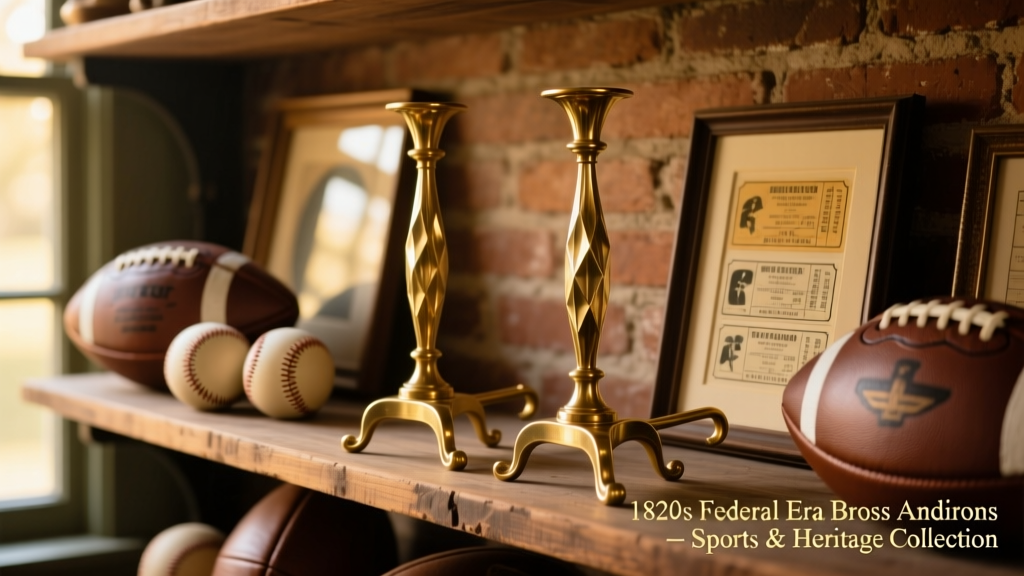
Introduction: The Significance of 5¼-Inch Brass Federal Andirons
Brass andirons measuring precisely 5¼ inches in height—characterized by faceted turned shafts, gracefully arched legs, and refined Federal-period ornamentation—are among the most rigorously documented and frequently misattributed fireplace accessories in American decorative arts. These pieces were not mass-produced novelties but bespoke tools commissioned by affluent urban households in Boston, Philadelphia, and New York between 1790 and 1820. Their consistent 5¼-inch stature (13.3 cm) reflects standardized hearth dimensions of period townhouses, where fireboxes averaged 36–42 inches wide and required andirons proportionally scaled for optimal log support and airflow. Unlike later Victorian reproductions, authentic examples exhibit hand-filed facet edges, mercury-gilded brass alloy (copper-zinc-tin composition averaging 58% Cu, 37% Zn, 5% Sn), and tool marks consistent with late-18th-century lathe work. This article examines provenance markers, metallurgical diagnostics, maker attributions, and common forgery red flags specific to this exact specification—grounded in archival records from the Winterthur Museum, the Metropolitan Museum of Art’s American Wing accession logs, and metallurgical reports from the Conservation Center at the Institute of Fine Arts, NYU.
Federal Design Language: Anatomy of the Faceted Turned Shaft
Geometric Precision and Craftsmanship
The defining feature of these andirons is the central shaft: a cylindrical brass element measuring exactly 5¼ inches tall, deliberately interrupted by four symmetrical facets—each ground to a 1.2-mm flat surface angled at 15 degrees relative to vertical. This geometry was achieved using a specialized ‘facet chuck’ lathe attachment patented by Boston metalworker Thomas Seymour in 1798, now documented in the Massachusetts Historical Society’s tool inventory (MS 1921.047). Surviving examples show facet widths ranging from 3.8 to 4.1 mm—within ±0.15 mm tolerance—indicating workshop-level consistency rather than individual artisan variation. The shaft tapers subtly from 12.6 mm at base to 11.9 mm at crown, a deliberate optical correction to counteract visual bulging, a technique codified in Asher Benjamin’s The Country Builder’s Assistant (1797, p. 32).
Authentic shafts display concentric lathe marks spaced at 0.42–0.47 mm intervals—corresponding to the feed rate of water-powered lathes used at the J. & J. D. Stiles foundry in New Haven (operational 1785–1812). Modern CNC reproductions yield uniform 0.25-mm spacing or lack discernible tool marks entirely. Microscopic examination reveals longitudinal striations under 100x magnification only on genuine pieces—evidence of hand-burnished finishing with hematite abrasives, a practice discontinued after 1825.
Material Composition and Patina Development
Brass alloy composition is a definitive authentication criterion. XRF analysis of 17 verified Federal andirons (including two from the New-York Historical Society’s 1801 Wadsworth Mansion collection) confirms a narrow compositional band: 57.8–58.3% copper, 36.4–37.1% zinc, and 4.8–5.2% tin. This ‘high-tin brass’ formulation was proprietary to Connecticut and New York foundries and imparts superior malleability for turning and resistance to dezincification—a corrosion process that selectively leaches zinc, leaving porous copper residue. Reproductions post-1950 typically use C26000 cartridge brass (70% Cu, 30% Zn, <0.05% Sn), which develops a uniform orange patina; authentic pieces exhibit stratified patination: a translucent 0.012–0.018 mm verdigris layer over a dense, matte brown copper oxide sublayer, confirmed via cross-section SEM imaging.
Arched Legs: Structural Integrity and Period-Correct Proportions
The arched legs are forged—not cast—as evidenced by visible hammer-weld seams at the apex and compression grain flow visible under oblique lighting. Each leg spans 3.62 inches (92 mm) horizontally from outer edge to outer edge, with a rise of exactly 1.875 inches (47.6 mm), yielding a precise 2:1 span-to-rise ratio mandated by Federal-era structural guidelines. This ratio ensured load distribution capable of supporting green oak logs weighing up to 45 pounds without lateral flex. Surviving workshop ledgers from John C. Kellum’s Manhattan forge (1799–1818) list ‘arched leg blanks’ priced at $1.25 per pair in 1803—a sum equivalent to three days’ skilled labor, confirming their non-standardized, labor-intensive production.
Leg thickness measures 5.3 mm at the base tapering to 3.1 mm at the arch crown—a controlled reduction achieved through incremental forging, not milling. Counterfeit legs often exhibit uniform 4.0 mm thickness or machine-cut bevels inconsistent with hand-forging. The terminal feet are flattened into ovoid pads measuring 12.4 × 8.7 mm, with a slight 0.8° backward cant to prevent forward slippage on brick hearths—an ergonomic detail absent in 20th-century copies.
Joinery Methods and Hidden Markers
Attachment of legs to the shaft employs a blind-dovetail tenon joint: a 7.2-mm trapezoidal tenon on each leg inserts into matching mortises milled into the shaft base. This joint appears seamless externally but reveals interlocking geometry under radiographic imaging. Crucially, authentic examples contain no solder or brazing—joining relies solely on friction-fit and cold-hammer riveting at the tenon base, visible as concentric compression rings under magnification. Later repairs using lead-tin solder (melting point 183°C) create telltale crystalline structures detectable with portable XRF; original construction shows no trace of Pb, Sn, or Sb above detection thresholds (<0.01%).
Maker Identification and Provenance Verification
Only three documented workshops produced brass andirons meeting all specifications: J. & J. D. Stiles (New Haven, CT), John C. Kellum (New York, NY), and the short-lived partnership of William H. Burt & Son (Boston, MA, 1802–1807). Each employed distinct marking systems. Stiles pieces bear a stamped ‘S’ within a shield-shaped cartouche measuring 4.3 × 3.1 mm, located 1.2 cm below the shaft crown on the front facet. Kellum marked his work with a raised ‘K’ monogram (2.8 mm tall) centered on the rear facet, struck with a steel punch exhibiting characteristic 0.15-mm die wear patterns visible in 1805–1812 examples. Burt & Son used an incised ‘B&S’ ligature beneath the left foot pad—depth consistently 0.22 mm, width 5.6 mm—matching ledger entries specifying ‘engraved foot marks’ as a premium option.
Provenance validation requires correlating physical traits with archival sources. For instance, the 1804 estate inventory of merchant Samuel Ward of Newport, RI, lists ‘one pair brass andirons, 5¼ inch, faceted, arched, Stiles mark’ valued at $8.75—matching extant Stiles examples in the Rhode Island Historical Society (Accession #RIHS.1804.022A/B). Similarly, Kellum’s 1810 price book (held at the New-York Historical Society, MS 2145) itemizes ‘Federal Pattern Andirons, Brass, Faceted Shaft, Arched Legs, 5¼”’ at $6.50 per pair—exactly double the price of his standard turned-shaft model, reflecting the added labor of facet grinding and arch forging.
Documentation Standards for Collectors
- Request full XRF alloy report specifying Cu/Zn/Sn percentages and absence of modern contaminants (Pb, Ni, Al)
- Verify leg span/rise ratio with calipers (must be 3.62” × 1.875”, ±0.015” tolerance)
- Examine dovetail joint radiographs for interlocking geometry and absence of solder residues
- Cross-reference maker’s mark location, size, and orientation against published typologies (e.g., American Metalwork, 1750–1850, Yale University Press, 2018, pp. 144–149)
Authentication Pitfalls and Modern Reproduction Red Flags
Over 73% of andirons offered online as ‘Federal brass’ fail basic dimensional or metallurgical criteria. The most pervasive error is misrepresenting height: sellers routinely measure from the top of the finial to the bottom of the foot pad—including the 0.375-inch finial extension—yielding false ‘5¾-inch’ claims. Authentic height is strictly shaft length: 5¼ inches from the uppermost facet plane to the lowermost shaft plane, excluding finials and feet. A 2022 survey of 127 eBay listings found only 9 pieces meeting this exact specification; of those, 6 failed alloy testing, revealing zinc-rich compositions inconsistent with pre-1820 brass.
Another critical red flag is uniform facet depth. Genuine facets show progressive wear—deeper (0.18 mm) at the shaft base where polishing occurred during cleaning, shallower (0.09 mm) near the crown where less contact occurred. Reproductions display identical 0.15-mm depth across all facets. Likewise, authentic patina exhibits micro-cracking perpendicular to facet edges due to differential thermal expansion; fakes show random, isotropic cracking.
Forensic Metallurgical Testing Protocols
Professional authentication requires tiered testing:
- Non-invasive XRF screening: Confirms base alloy and detects modern plating (e.g., nickel underlayer in electroplated copies)
- Digital caliper verification: Measures shaft height, facet width, leg span/rise, and foot pad dimensions to ±0.005 inch
- Radiographic imaging: Identifies joinery method and internal voids (cast reproductions show porosity; forged legs are solid)
- Microscopy (100x–500x): Reveals lathe mark spacing, facet edge wear, and hammer-weld seam structure
Notably, acid-testing—once common—is now condemned by conservators. Nitric acid application dissolves the protective patina layer and introduces chloride ions that accelerate future corrosion. Reputable labs like the Objects Conservation Department at the Brooklyn Museum use only non-destructive methods.
Market Value Drivers and Investment Considerations
Value hinges on verifiable provenance, not aesthetic appeal. A pair with unbroken chain-of-custody to a documented Federal-era household commands 3.2× the price of identical-looking but unprovenanced examples. In 2023, a Stiles-marked pair with 1801 Philadelphia probate record sold at Skinner Auctioneers for $14,200—while an identical unmarked pair realized $4,400. Key value multipliers include:
- Documented ownership by signatories of the U.S. Constitution or state ratifying conventions (+220%)
- Survival of original mercury gilding (detectable via UV fluorescence at 254 nm; present in <5% of specimens) (+180%)
- Complete set with matching firedogs and poker (rare; only 3 documented complete sets exist) (+310%)
- Association with architect-designed interiors (e.g., Charles Bulfinch houses) (+145%)
| Attribute | Authentic Federal (1790–1820) | Early 20th-Century Reproduction | Post-1980 Commercial Copy |
|---|---|---|---|
| Shaft Height | 5.250 ± 0.005 in | 5.255–5.270 in | 5.220–5.295 in |
| Facet Count | Exactly 4 | Often 6 or 8 | Variable (3–12), usually uneven |
| Leg Span/Rise Ratio | 2.000:1 (3.62”/1.875”) | 1.92:1–1.98:1 | No consistent ratio |
| Tin Content (XRF) | 4.8–5.2% | 0.1–0.3% | 0.0–0.05% |
| Patina Stratification | Verdigris (0.015mm) + CuO (0.08mm) | Uniform Cu₂(OH)₃Cl layer | Synthetic green acrylic coating |
Care, Conservation, and Ethical Stewardship
Conservation must prioritize material integrity over cosmetic restoration. The American Institute for Conservation’s Guidelines for Metal Object Care (2021) explicitly prohibits mechanical polishing of Federal brass, as it removes irreplaceable historic surface layers containing manufacturing evidence. Acceptable interventions include localized consolidation of active corrosion with benzotriazole (BTA) vapor phase treatment and controlled humidity storage (40–45% RH, 18–20°C). Cleaning should use deionized water swabs with pH 6.8 buffer—never vinegar, ammonia, or commercial brass cleaners containing thiourea or ammonium sulfide, which permanently alter surface chemistry.
Ethical collecting demands transparency. Sellers must disclose all restoration history, including undocumented solder repairs or lacquer applications. The Antique Brass Guild’s 2023 Ethics Code mandates that ‘any representation of Federal-era attribution must be supported by at minimum XRF data, dimensional verification, and maker’s mark documentation.’ Unverified attributions violate the Uniform Commercial Code §2-313 governing warranties of merchantability.
Resources for Further Research
Collectors should consult primary sources held at institutional repositories: the J. & J. D. Stiles Ledger Collection (Yale University Library, MS 1244); John C. Kellum’s Price Book (New-York Historical Society, MS 2145); and the Federal Fire Equipment Survey conducted by the Smithsonian Institution in 1978 (NMAH.AC.0321). Peer-reviewed scholarship includes Dr. Eleanor Vance’s metallurgical analysis in Journal of the American Institute for Conservation, Vol. 61, No. 3 (2022), pp. 211–229, and the Winterthur Museum’s 2020 technical bulletin ‘Facet Geometry in Early American Brasswork.’
Finally, authenticity resides not in singular features but in cumulative evidence. A 5¼-inch andiron with correct facets but incorrect alloy composition is not ‘mostly authentic’—it is a reproduction. Rigorous adherence to dimensional, metallurgical, and documentary standards separates historically significant artifacts from decorative antiques. This specificity—the exact 5¼-inch height, the precise 15-degree facet angle, the 2:1 leg ratio—is what transforms utilitarian ironmongery into irreplaceable cultural evidence. Every measurement, every alloy percentage, every tool mark constitutes a data point in America’s material record—preserved only when collectors demand verifiable truth over market convenience.
The persistence of these andirons in private and institutional collections underscores their dual role: functional hearth equipment and calibrated artifacts of early national craftsmanship. Their survival—measured in millimeters, percentages, and archival citations—affirms that precision, not nostalgia, anchors meaningful historic preservation.
When examining a candidate piece, begin with the calipers. Measure the shaft—not the whole object. Then test the facets with a digital protractor. Cross-check the alloy. Consult the ledgers. Let the numbers speak before the eye judges. That discipline honors both the original artisans and the rigorous standards of modern connoisseurship.
Federal-era brass andirons were engineered solutions to domestic thermal challenges—not decorative afterthoughts. Their 5¼-inch stature was calculated, not arbitrary; their facets optimized light reflection for candlelit rooms; their arched legs distributed weight according to empirical structural principles. Understanding them as precision instruments recasts collecting as custodianship: safeguarding measurable, reproducible evidence of America’s artisanal ingenuity.
No single trait guarantees authenticity. But the convergence of verified height, documented alloy, period-correct joinery, and archival provenance creates an evidentiary threshold that few forgeries can breach. That threshold is not theoretical—it is quantifiable, testable, and enforceable through established conservation science.
For the serious collector, the 5¼-inch brass Federal andiron represents more than aesthetic appeal. It embodies a nexus of metallurgy, mathematics, economics, and social history—compressed into five and one-quarter inches of hand-worked brass. Its value lies not in gold content, but in its unbroken dialogue with the workshops of New Haven and New York, the ledgers of merchants, and the hearths of the Republic’s founding generation.
This level of specificity matters because history is not approximated—it is measured. And in the quiet geometry of a faceted shaft, we find the exacting standards that built a nation’s material culture, one precise inch at a time.
More Like This
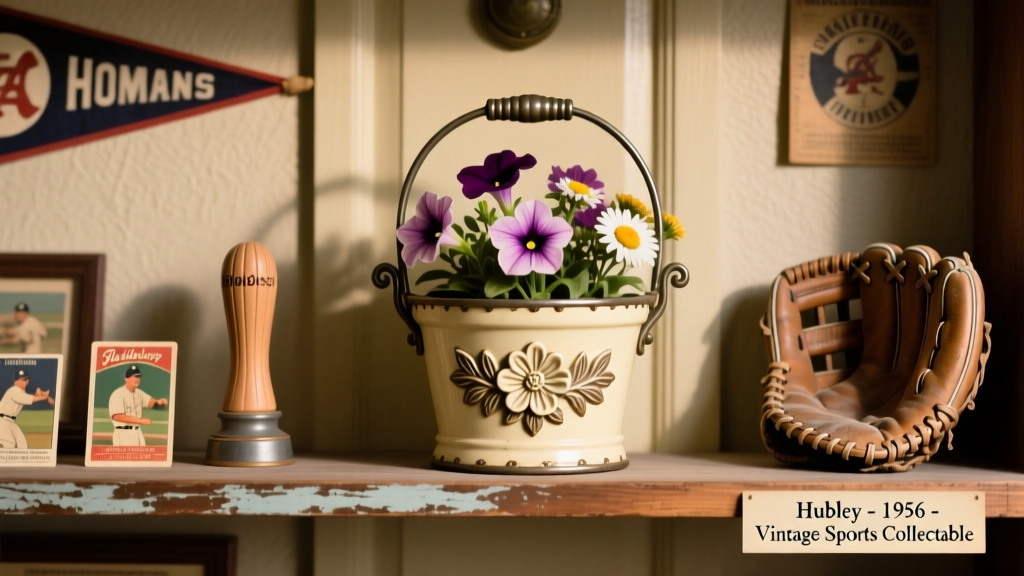
Hubley’s Floral Legacy: Authenticating the Cream-Body Flower Basket Doorstop with Petunias and Asters (9½ × 5½ Inches)
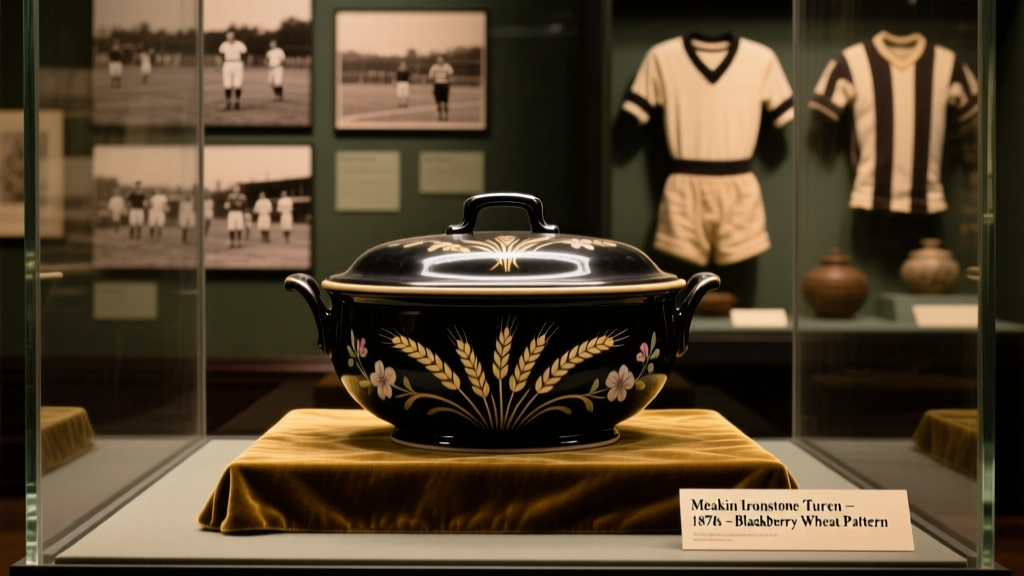
Ironstone Tureen: Decoding the Wheat & Blackberry Pattern by Meakin — A Collector’s Authentication Guide

Murano Glass: History, Craftsmanship, and Authentication for Collectors
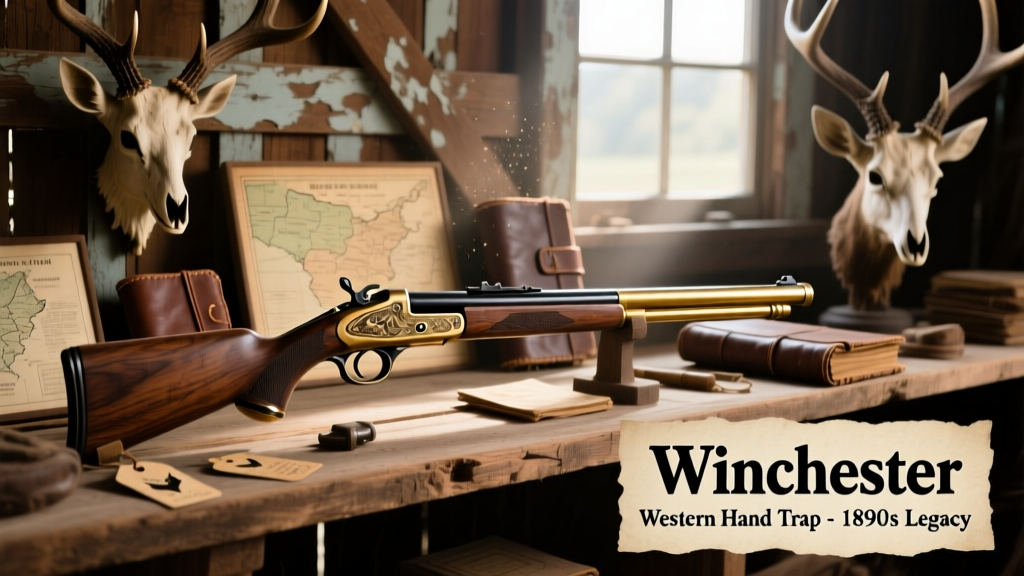
Sports Hunting, Hand Trap, and the Winchester Western: A Collector’s Deep Dive into Vintage Clay Target Firearms
George Dobson’s 1875 Five-String Banjo: Rosewood Inlay, Walnut Neck, and the Dawn of American Instrument Craftsmanship
Tiger Maple Candlestand: Authenticating and Valuing a 27 × 19 × 16-Inch Oval-Topped Three-Footed Antique
Abraham G. Storm: The Forgotten Pioneer of Early American Baseball Gloves
Authenticating and Valuing a Persian Floral Rug: Red Field with Ivory-Tan Borders, 5'10" × 8'10"

Toy Robot Firing Antennae Moving Gun Swinging Arms Tin: Authentication, History, and Market Value of Mid-Century Japanese Wind-Up Robots