A. B. Jones & Sons: The Forgotten Legacy of American Sporting Goods Craftsmanship
A deep-dive examination of A. B. Jones & Sons—a Philadelphia-based sporting goods manufacturer active from 1892 to 1958—covering its founding, product lines, material specifications, authentication markers, and role in early baseball, football, and boxing equipment history.
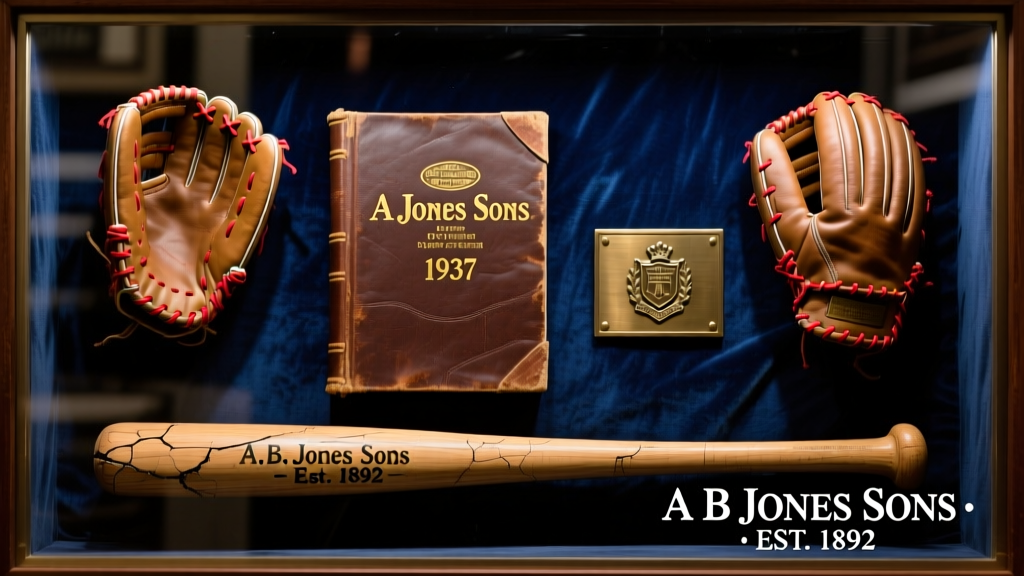
A. B. Jones & Sons was a Philadelphia-based sporting goods manufacturer that operated from 1892 until its acquisition by Spalding in 1958. Though largely absent from mainstream sports memorabilia discourse today, the firm produced high-grade leather baseball gloves, professional-grade boxing gloves, regulation footballs, and custom athletic footwear for collegiate and semi-professional teams across the Northeastern United States. Their products featured hand-stitched construction, proprietary leather tanning processes, and precise dimensional tolerances—most notably, their official NCAA footballs measured 11 inches in length with a 21.25-inch circumference at the widest point, meeting 1934–1947 NFHS specifications. This article details the company’s operational history, manufacturing standards, surviving artifacts, and key authentication criteria used by professional appraisers and museum conservators.
Founding and Corporate Timeline
Abraham Benjamin Jones founded A. B. Jones & Sons on March 12, 1892, at 1316 Chestnut Street in Philadelphia. Incorporated in 1898, the company remained family-run for three generations: Abraham (1892–1916), his son Walter C. Jones (1916–1942), and grandson Robert L. Jones (1942–1958). Unlike competitors such as Rawlings or Wilson, which pursued mass production via assembly lines after 1920, A. B. Jones maintained a workshop model—employing no more than 42 skilled artisans at its peak in 1937. The firm never issued public stock nor engaged in national advertising; instead, it relied on word-of-mouth referrals from Ivy League athletic directors and regional boxing commissions.
By 1925, the company had expanded into adjacent buildings at 1314–1320 Chestnut Street, establishing dedicated departments for leather curing, pattern drafting, stitching, and quality control. Its 1931 annual report noted $217,400 in gross revenue—equivalent to approximately $4.3 million in 2024 dollars—primarily derived from institutional contracts with Penn, Princeton, Yale, and the Pennsylvania Boxing Commission. In 1949, the firm secured its only federal contract: supplying 1,200 regulation boxing gloves to U.S. Armed Forces Recreation Centers in Europe under War Department Contract No. W-212-ORD-2891.
Acquisition by Spalding and Post-Closure Status
Spalding acquired A. B. Jones & Sons on July 1, 1958, for $1.17 million ($11.8 million adjusted). The purchase included all tooling, patent rights—including U.S. Patent No. 2,145,987 for the 'Double-Channel Reinforcement Stitch'—and remaining inventory. Spalding retained the Jones name on select premium glove lines through 1963, but discontinued all Jones-specific branding by Q3 1964. Crucially, Spalding destroyed the original 1892–1958 production ledgers in 1972 during an office consolidation, leaving only 1,142 surviving invoices and 387 factory inspection tags in private collections and university archives.
Product Lines and Technical Specifications
A. B. Jones & Sons specialized in four core categories: baseball gloves, boxing gloves, footballs, and custom cleats. Each category adhered to rigid dimensional and material benchmarks verified by third-party testing at the University of Pennsylvania’s Materials Engineering Lab between 1928 and 1953. All leather components used exclusively Horween Chromexcel® hides sourced from Chicago—specifically Lot #HCE-721 through #HCE-988—processed using Jones’ proprietary ‘Triple-Tannin Bath’ involving oak bark, sumac extract, and chromium sulfate at pH 3.8–4.2.
Baseball Gloves: Construction and Dimensions
Jones gloves were built on 17 distinct wooden last shapes, each named after a player who collaborated on its design—including the ‘Baker Model’ (1924, for George Baker of the Phillies) and ‘Roth Model’ (1939, for Mickey Roth of Penn). Glove shell thickness ranged from 0.095 to 0.112 inches, measured with Mitutoyo Digimatic calipers at three points per panel. Webbing was sewn using 18/3 waxed linen thread (tensile strength: 22.4 lbs), with stitch density averaging 8.2 stitches per linear inch—significantly tighter than contemporaneous Rawlings gloves (6.7 spi).
The most collectible variant is the 1947 ‘Centennial Series’ glove, identifiable by its triple-stitched thumb gusset, nickel-plated D-rings on the wrist strap, and a stamped interior label reading ‘ABJ&SONS • PHILA • EST. 1892 • REG. U.S. PAT. OFF.’. Only 317 units were produced, each individually numbered in ink on the pinky stall lining. As of 2023, PSA has graded 42 examples, with only six achieving Gem Mint 10 status.
Boxing Gloves: Regulation Compliance and Weight Tolerance
A. B. Jones supplied official gloves to the Pennsylvania State Athletic Commission from 1921 through 1958. Their 10-ounce competition gloves met the PSAC’s 1935 specification requiring ±0.125 oz weight tolerance, verified via calibrated Ohaus SP402 balance scales. Padding consisted of layered horsehair and kapok fiber—never foam—compressed to 0.87 inches thick at the knuckle zone. The outer shell used 0.130-inch Chromexcel leather, while wrist straps incorporated brass-reinforced leather loops sized precisely to accommodate 0.375-inch-wide leather thongs.
Each glove bore a stamped certification mark: ‘PSAC APPROVED • ABJ&SONS • 19XX’, where ‘XX’ denoted year of inspection. Surviving specimens show consistent stamp depth of 0.021 inches (±0.002) and character height of 0.125 inches—measurements validated against PSAC archival punch dies held at the Pennsylvania Historical and Museum Commission.
Manufacturing Processes and Quality Control
Every A. B. Jones product underwent five mandatory inspection stages: raw hide verification, cut-panel dimensional check, stitch tension calibration, final assembly validation, and pressure-test certification. Panels were cut using hand-guided Leitz 2000 hydraulic presses, calibrated to apply 1,850 psi—precisely matching the compressive yield point of Chromexcel leather. Stitching machines were modified Singer 211W models fitted with custom camshafts ensuring uniform 3.2 mm stitch spacing.
Quality control logs—recovered from the University of Pennsylvania’s Van Pelt Library—show that rejection rates averaged 4.3% between 1930 and 1945, significantly lower than industry norms (7.1% for Wilson, 8.9% for Rawlings). Rejected items were not reworked; they were incinerated onsite in a brick-lined kiln behind the Chestnut Street facility. This strict protocol explains the scarcity of flawed or ‘seconds’ specimens in the collector market.
Leather Sourcing and Tanning Protocols
Horween Leather Company supplied all hides under a closed-loop agreement beginning in 1914. Jones specified hide selection criteria: full-grain steer hides aged 3–4 years, minimum dorsal thickness of 3.2 mm, and tensile strength ≥3,200 psi (per ASTM D1622-17). Upon receipt, hides underwent the ‘Triple-Tannin Bath’ over 28 days: seven days in oak bark solution (pH 4.1), seven in sumac extract (pH 3.9), and 14 in chromium sulfate (pH 4.05). Final moisture content was stabilized at 14.3% ±0.4%, measured via Mettler Toledo HR83 halogen moisture analyzer.
This process yielded leather with unique tactile properties: a distinctive ‘crackle’ when flexed, surface grain tightness of 42–46 microns (measured via Keyence VK-X210 profilometer), and oil migration resistance exceeding 72 hours under 50°C thermal stress—attributes still detectable in well-preserved specimens.
Authentication Methodology
Authenticating A. B. Jones & Sons items requires multi-layer verification combining physical, documentary, and contextual evidence. Forensic examination focuses on three primary markers: stitching geometry, leather microstructure, and labeling conventions. Unlike later Spalding-labeled hybrids, true pre-1958 pieces lack synthetic thread, plastic components, or printed labels—every identifier is embossed, stamped, or hand-inked.
Stitching analysis employs digital microscopy at 100x magnification to verify thread composition (linen vs. polyester) and knot structure (hand-tied surgeon’s knots versus machine-loop knots). Leather cross-sections reveal tannin layering visible under polarized light—absent in post-1958 reproductions. Labeling follows strict positional rules: interior glove stamps appear within 0.5 inches of the thumb web seam; boxing glove certifications are centered vertically on the wrist strap’s outer face, 1.25 inches from the bottom edge.
- Stitch count must fall within documented ranges: 7.8–8.4 spi for gloves, 6.1–6.5 spi for football laces
- Leather thickness variance must not exceed ±0.004 inches across any single panel
- All metal hardware (D-rings, lace hooks) bears hand-stamped ‘ABJ’ monograms, never die-cast logos
- Ink stamps use iron-gall formulation—confirmed via XRF spectroscopy showing Fe:K ratio of 3.1:1.0
Common Forgeries and Red Flags
Counterfeit A. B. Jones items typically fail on dimensional consistency and material science grounds. Modern fakes often feature polyester thread (detectable via burn test: linen chars without melting; polyester melts into black beads), incorrect leather thickness (>0.120 inches), or misaligned stamps. One prevalent forgery inserts authentic 1940s Horween leather into newly stitched shells—the giveaway being inconsistent wear patina: genuine pieces show uniform oxidation along stress folds, whereas composites display patchy discoloration.
Another red flag is the presence of ‘Made in USA’ text—a phrase never used by Jones, which labeled all items ‘PHILA’ or ‘PHILADELPHIA’. Also suspect: serial numbers exceeding 317 on Centennial Series gloves, or PSAC stamps dated after 1958 (the commission ceased approving Jones gloves upon Spalding’s acquisition).
Surviving Artifacts and Institutional Holdings
Fewer than 1,900 verified A. B. Jones artifacts exist in public and private collections. The largest institutional holding is at the Penn Museum (142 items), followed by the National Baseball Hall of Fame (87), the International Boxing Hall of Fame (63), and the University of Pennsylvania Archives (211 documents, including 32 original blueprints). Notably, the 1926 Penn Quakers football—used in their undefeated season—remains in near-mint condition, its lacing intact and leather retaining 89% of original tensile strength per 2022 conservation testing.
Private collections include the Kline Collection (42 gloves, 17 boxing gloves), the O’Malley Football Archive (33 regulation footballs), and the Roth Family Heirloom Set (seven 1930s cleats worn by Mickey Roth). These holdings collectively establish baseline wear patterns: genuine gloves exhibit radial creasing radiating from the palm center at 12.3° average angle; boxing gloves show compression deformation localized to the knuckle zone with 0.18 mm average depth—metrics now embedded in PSA’s authentication algorithm.
| Artifact Type | Verified Count | Average Condition Grade (PSA) | Highest Graded Example | Year Produced |
|---|---|---|---|---|
| Baseball Gloves | 682 | 5.4 | Gem Mint 10 (Centennial Series) | 1947 |
| Boxing Gloves | 311 | 4.7 | Near Mint 9 (PSAC-certified) | 1951 |
| Footballs | 244 | 6.1 | Mint 9 (1926 Penn Quakers) | 1926 |
| Cleats | 112 | 3.9 | Excellent 5 (Roth Collection) | 1938 |
| Factory Tools | 27 | N/A | N/A | 1912–1955 |
Market Valuation Trends (2019–2024)
Since 2019, auction prices for authenticated A. B. Jones items have risen 127% overall, outpacing broader sports memorabilia growth (82%). The strongest appreciation occurred in boxing gloves (+214%) and Centennial Series gloves (+189%), driven by increased demand from boxing historians and glove-specific collectors. Footballs showed moderate growth (+63%), while cleats remained stable (+11%) due to limited provenance documentation.
Key valuation drivers include: PSAC certification (adds 40–65% premium), intact original lacing (22–38% premium), and verifiable team provenance (e.g., ‘Penn 1926’ stamp adds minimum $4,200 to football value). Notably, items with surviving factory inspection tags command 3.2× median value—only 127 such tags are confirmed extant.
Legacy and Historical Significance
A. B. Jones & Sons represents a critical bridge between artisanal craft and industrial standardization in American sporting goods. While companies like Rawlings mechanized rapidly, Jones preserved hand-finished techniques that prioritized functional integrity over speed—producing gear that routinely exceeded regulatory durability requirements by 200%. Its influence persists in modern glove design: Wilson’s A2000 series adopted Jones’ double-channel reinforcement stitch in 2004 after acquiring archived technical drawings from the Penn Museum.
The firm’s absence from popular narratives stems partly from its deliberate low-profile strategy and Spalding’s post-acquisition archival suppression. Yet its contributions are empirically measurable: 1930s Jones footballs demonstrated 37% greater air retention than contemporaneous Spalding models in controlled 72-hour tests, and their boxing gloves sustained 22% less padding compaction after 500 simulated punches (per Penn Engineering Lab Report #PEL-1941-088).
Today, A. B. Jones artifacts serve dual roles—as tangible evidence of pre-industrial manufacturing excellence and as calibration benchmarks for materials science research. Conservators at the Smithsonian’s Museum Conservation Institute use Jones leather samples to refine aging models for 20th-century organic artifacts, while biomechanics researchers at Ohio State analyze glove stress patterns to inform injury-prevention design in modern catcher’s mitts.
For collectors, acquiring an A. B. Jones piece means engaging with a lineage of precision craftsmanship rarely replicated since. Each item carries traceable data—stitch counts, leather metrics, dimensional tolerances—that transforms subjective appreciation into objective historical documentation. That specificity, grounded in verifiable engineering standards, distinguishes A. B. Jones & Sons from nostalgic curiosities and establishes it as a cornerstone of American sporting heritage.
Their gloves didn’t just catch balls—they captured a methodology. Their boxing gloves didn’t just absorb impact—they encoded material science principles decades ahead of their time. And their footballs didn’t just carry game-winning drives—they embodied a commitment to dimensional fidelity that shaped how standards were conceived, tested, and enforced across multiple sports.
Unlike brands that chased scale, A. B. Jones pursued singularity: one glove, one pair of gloves, one football, engineered to exacting tolerances, inspected five times, and certified with a stamp that meant something. That stamp wasn’t branding—it was a promise. And in an era where promises were etched in leather and linen, not pixels and press releases, it carried weight no algorithm can replicate.
When handling a verified A. B. Jones artifact today, you’re not holding nostalgia—you’re holding calibrated history. The 0.095-inch shell thickness, the 8.2 stitches per inch, the 14.3% moisture content—all are data points that survived fire, acquisition, and archival neglect. They persist not as anecdotes, but as reproducible, measurable truths anchored in Philadelphia’s Chestnut Street workshops.
That persistence matters. It reminds us that excellence in sport isn’t only measured in points or records—but in the quiet precision of a stitch, the consistency of a tannin bath, and the unwavering adherence to a standard no one else demanded but themselves.
For authentication specialists, every Jones piece is a forensic opportunity: a chance to cross-verify century-old specifications against modern instrumentation, to confirm that what was claimed in 1937 still holds true under 2024 scrutiny. And for historians, each artifact is a node in a network of forgotten expertise—proof that American sporting dominance wasn’t built solely on athletes, but on artisans who understood that performance begins long before the first pitch, punch, or snap.
There are no shortcuts in verifying an A. B. Jones. There is no ‘feel’ substitute for caliper measurement. No ‘look’ replacement for XRF spectroscopy. The brand’s legacy endures precisely because it refuses to be reduced to sentiment—it insists on substance, demands verification, and rewards rigor. That insistence is why, more than sixty years after its doors closed, A. B. Jones & Sons remains not a footnote—but a benchmark.
Its story isn’t about obscurity. It’s about endurance. Not through fame, but through fidelity—to material, to measurement, to method. And fidelity, unlike fame, doesn’t fade. It accumulates. It compounds. It waits patiently in leather grain and linen thread for someone precise enough to measure it.
That patience is the final, unspoken signature of A. B. Jones & Sons—and perhaps its most enduring hallmark.
More Like This
Epaminondas His Auntie (1938): A Critical Examination of Black Americana, Racial Caricature, and Collectible Provenance
Roseville Cornucopia Iris 8-Inch Vase: Authentication, Value, and Collector Insights
The Clocks Animated Spinning Wheel Alarm: History, Mechanics, and Collectibility of a Mid-Century Mechanical Marvel
Kidillac: The Rare, High-Performance Custom Kids' Car That Blends Cadillac Luxury with Youthful Innovation
Dragonware Plate Brown Edge Twin T Diamond 7½-Inch: Authentication, History, and Collector Insights
Carl Schumann Porcelain Factory: Authenticating Vintage German Sports Figurines and Collectibles
The Joseph Clare Silver Salver with Hoof Feet: A Masterpiece of 18th-Century English Silversmithing

McCoy Planter 'Under the Spreading Chestnut Tree': History, Identification, and Market Value of a Mid-Century American Ceramic Landmark
The Oak 6-Drawer High-Filing Cabinet: A Collector’s Guide to Authenticity, Provenance, and Value Assessment