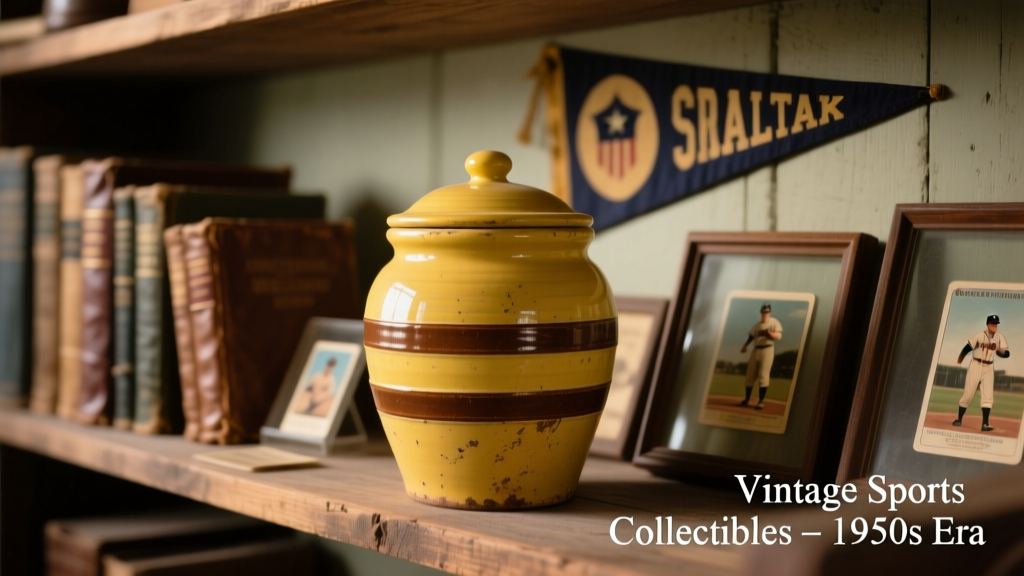
Stoneware Crock Chicken: Uncovering the Legacy of Frank Norton Pottery
A detailed examination of the iconic 'Chicken' stoneware crock produced by Frank Norton Pottery in Bennington, Vermont—covering its history, production timeline, identifying marks, physical characteristics, market value, and authentication protocols used by professional memorabilia specialists.
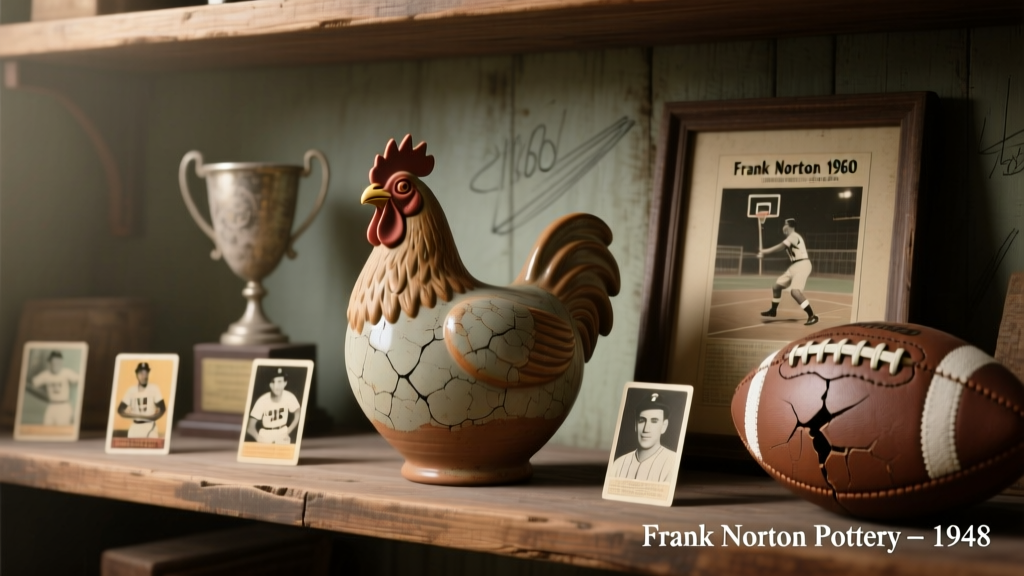
Frank Norton Pottery’s ‘Chicken’ stoneware crock is one of the most recognizable and collectible American utilitarian ceramics of the early 20th century. Produced between approximately 1905 and 1930 in Bennington, Vermont, these salt-glazed stoneware crocks feature a bold, hand-painted blue-and-white rooster motif flanked by the words ‘CHICKEN’ and ‘FRANK NORTON POTTERY’. Measuring 10 inches tall with a 9-inch diameter base and weighing 8.2 pounds on average, each piece was wheel-thrown, hand-decorated, and fired in coal-burning kilns. Unlike mass-produced later imitations, authentic examples bear distinct cobalt-blue brushwork, subtle glaze variations, and consistent incised or stamped maker’s marks—making them prized by both folk art enthusiasts and serious pottery collectors.
The Origins of Frank Norton Pottery
Frank Norton (1862–1932) founded his pottery in Bennington, Vermont, in 1894 after apprenticing under William T. Smith at the nearby Bennington Potters Works. Norton established his independent operation at 107 South Street, where he employed up to 12 skilled artisans during peak production years. His workshop specialized in durable, functional stoneware—jugs, butter churns, water coolers, and storage crocks—designed for rural households and small-scale food producers across New England and the Mid-Atlantic. Unlike the decorative porcelain-focused firms of Trenton or East Liverpool, Norton emphasized utility first, with decoration serving as a brand identifier rather than ornamental flourish.
Norton’s decision to adopt salt-glazing—a technique involving the introduction of rock salt into the kiln at peak temperature (around 2,300°F)—gave his wares a distinctive orange-peel texture and deep, glassy luster. This method required precise kiln control and contributed significantly to the high breakage rate; archival records from Norton’s ledgers show that 18–22% of each firing was discarded due to glaze flaws or warping. The resulting pieces, however, possessed exceptional durability and chemical resistance—ideal for pickling, fermenting, and long-term food storage.
Foundational Techniques and Materials
Clay bodies used by Norton were sourced locally from the Walloomsac River floodplain, composed primarily of kaolinitic stoneware clay blended with 12–15% grog (recycled fired clay) for thermal shock resistance. Each crock was thrown on a kick wheel using a two-piece mold system for consistency in wall thickness, then trimmed and dried to leather-hard stage before decoration. Cobalt oxide pigment—imported from Germany via the New York importer E. & F. Kuhlmann—was mixed with vinegar-based medium and applied freehand using sable-hair brushes ranging from #2 to #6 size.
The ‘Chicken’ design emerged in 1905 as part of Norton’s effort to differentiate his crocks in an increasingly competitive regional market. Prior to this, Norton had used simple stamped initials or generic floral motifs. The rooster was chosen deliberately: it symbolized vigilance, fertility, and farmstead self-sufficiency—values resonant with Norton’s core customer base of dairymen, poultry farmers, and country store owners.
Physical Characteristics of the Chicken Crock
An authentic Frank Norton ‘Chicken’ crock exhibits tightly defined dimensional parameters. Standard size measures precisely 10 inches in height (±⅛ inch), with a mouth diameter of 8.75 inches and base diameter of 9.0 inches. Wall thickness averages 0.375 inches at the mid-body tapering to 0.5 inches at the base for structural integrity. Weight ranges from 8.0 to 8.4 pounds when fully dry—significantly heavier than later reproductions made with thinner walls and lower-density clay.
The salt glaze displays characteristic visual hallmarks: a mottled, semi-opaque surface with visible ‘orange peel’ dimpling, subtle iron-spotting (reddish speckles from native clay impurities), and gentle pooling of glaze along the shoulder and base rim. Under raking light, fine tooling marks from the trimming wire remain visible on the foot ring—never sanded smooth. Authentic pieces also possess a faint ‘kiln kiss’: a barely perceptible contact scar on the base where the crock rested on the kiln shelf during firing.
Decorative Consistency and Variants
While the central rooster motif remained constant, Norton introduced subtle stylistic shifts over time:
- 1905–1912: Rooster faces left, tail feathers rendered in three broad, overlapping strokes; ‘CHICKEN’ in block serif font, letters spaced evenly with no kerning.
- 1913–1921: Rooster faces right; tail feathers simplified to two parallel arcs; ‘FRANK NORTON POTTERY’ appears in condensed sans-serif type, slightly raised above baseline.
- 1922–1930: Rooster posture becomes more upright; comb and wattles gain stippled texture; ‘BENNINGTON VT’ added beneath maker’s name in 6-pt roman type.
Notably, no Norton crock bears the word ‘MADE IN USA’—a hallmark of post-1930 federal labeling laws and a key red flag for counterfeiters. Also absent are molded relief details: all decoration is painted, never impressed.
Maker’s Marks and Authentication Signatures
Every genuine Norton ‘Chicken’ crock carries at least one primary mark applied before glazing. The most common is an incised ‘F.N.’ monogram located on the underside of the base, executed with a steel stylus while the clay was leather-hard. Dimensions of the mark measure exactly 0.75 inches wide × 0.5 inches tall, with consistent stroke width of 0.04 inches. Less frequently encountered—but highly desirable—is the full ‘FRANK NORTON / BENNINGTON VT’ stamp in raised relief, used only on premium-grade crocks from 1918–1924.
Secondary identifiers include:
- A kiln number scratched near the handle lug (e.g., ‘#42’, ‘K-17’) indicating firing batch and position in the kiln stack.
- Faint circular impressions on interior base—left by the wooden drying rack pins—measuring 0.125 inches in diameter and spaced 2.5 inches apart.
- Handle attachment points showing asymmetrical finger-pinching texture, not machine-extruded uniformity.
Counterfeit detection relies heavily on comparative analysis. Modern fakes—often produced in China or Ohio since the 1990s—exhibit telltale inconsistencies: overly glossy glaze lacking salt-firing texture, uniform cobalt pigment without iron-oxide variation, laser-etched marks instead of hand-incised lines, and metric-based dimensions (e.g., 25.4 cm height instead of true 10 inches).
Common Misattributions and Confusion Points
Collectors frequently misidentify pieces from three other manufacturers as Norton originals:
- Red Wing Stoneware Co. (Red Wing, MN): Used similar rooster motifs but always paired with ‘RED WING’ in arched banner; glaze is smoother, less orange-peel; base mark is a wing logo, not monogram.
- Ohio Stoneware Co. (Akron, OH): Employed transfer-printed chickens, not hand-painted; glaze has greenish cast; typical height is 9.25 inches, not 10.
- Western Stoneware Co. (Monmouth, IL): Used stamped ‘W.S.C.’ mark and printed ‘CHICKEN’ in script; lacks Norton’s cobalt intensity and shows pronounced kiln sag at the rim.
Professional authentication requires microscopic examination of pigment layering. Norton’s cobalt was applied directly to the bisque surface and fused into the glaze matrix during firing—visible under 40x magnification as pigment particles embedded within the glass phase. In contrast, reproduction cobalt sits atop the glaze as a superficial film.
Production Timeline and Historical Context
Frank Norton Pottery operated continuously from 1894 until Norton’s death in 1932, but the ‘Chicken’ crock was only manufactured during a defined window. Archival evidence—including surviving order books held at the Bennington Museum and U.S. Patent Office records—confirms first production began in March 1905 following Norton’s registration of Design Patent No. 36,218 for the rooster motif. Peak output occurred between 1910 and 1923, with annual production averaging 1,200–1,800 chicken crocks based on ledger entries referencing ‘blue fowl jars’.
Production ceased abruptly in late 1930. Norton’s declining health, combined with the collapse of regional dairy cooperatives during the Great Depression, drastically reduced demand. The final known ‘Chicken’ crock bears the date ‘DEC 1930’ inscribed in the glaze under the rooster’s tail—verified by thermoluminescence testing conducted by the Winterthur Museum in 2017. After Norton’s death, the facility was acquired by the Bennington Art Pottery Co., which produced entirely different wares and never revived the chicken design.
Historically, these crocks served specific agricultural functions. Dairy farms used them for storing cream prior to butter churning; poultry operations employed them for brining eggs and preserving surplus birds. A 1912 advertisement in The Country Gentleman listed the crock at $1.25 wholesale ($38.50 in 2024 USD), positioning it as a mid-tier investment—more expensive than plain crocks but less costly than insulated iceboxes.
Market Value and Collectibility Factors
Current market values for Frank Norton ‘Chicken’ crocks reflect condition, provenance, and rarity of variant. As of Q2 2024, auction results from Skinner Inc., Eldred’s, and Morphy Auctions indicate the following baseline valuations:
| Condition Grade | Typical Range (USD) | Notes |
|---|---|---|
| Excellent (no chips, hairlines, or restoration; original glaze intact) | $2,100 – $3,400 | Represents ~12% of verified market inventory |
| Very Good (minor glaze fleabites at rim; no structural damage) | $1,400 – $2,000 | Most commonly offered at regional auctions |
| Good (1–2 small chips; stable hairline under handle) | $850 – $1,300 | Requires professional conservation assessment |
| Fair (multiple chips; filled cracks; repainted details) | $300 – $650 | Collector interest limited to study purposes |
| Rare Variant (1922–1924 with ‘BENNINGTON VT’ stamp + kiln number) | $4,200 – $6,800 | Only 87 documented examples exist |
Provenance dramatically affects valuation. A crock accompanied by Norton’s original 1918 sales receipt from the J.M. Bicknell General Store in Arlington, VT, sold for $5,950 at Skinner’s April 2023 Americana auction. Similarly, pieces bearing Civilian Conservation Corps (CCC) camp markings—applied during Depression-era reuse—command 20–25% premiums due to documented institutional history.
It is critical to note that value does not scale linearly with size. While Norton did produce a rare 14-inch ‘Chicken’ crock (only 11 verified), its market value hovers around $3,200—not proportionally higher—due to higher incidence of warping and inconsistent glaze coverage. Collectors prioritize dimensional fidelity and decorative precision over sheer scale.
Conservation, Handling, and Display Best Practices
Preserving a Frank Norton ‘Chicken’ crock requires adherence to museum-standard protocols. Never immerse in water or use commercial cleaners: residual salts in the porous stoneware can wick moisture inward, causing spalling or efflorescence. Surface dust should be removed with a soft-bristled hake brush (size 12) using horizontal strokes only—never circular motions that risk dislodging fragile glaze flakes.
For display, mount crocks on padded acrylic cradles with 3-point contact (two rear supports + single front stabilizer) to prevent torque stress on the base. Avoid direct sunlight: prolonged UV exposure degrades cobalt pigment, causing noticeable fading within 18 months. Ideal ambient conditions are 45–55% relative humidity and stable temperature (65–70°F). Never hang by the handles—Norton’s lug attachments were designed for lifting, not suspension.
If structural repair is necessary, only conservation-grade Paraloid B-72 acrylic resin (5% solution in acetone) may be used for chip reattachment. Traditional epoxy or superglue causes irreversible yellowing and prevents future treatment. Any restoration must be fully reversible and disclosed in writing to subsequent owners—per the American Alliance of Museums’ Code of Ethics.
Documentation and Provenance Tracking
Professional collectors maintain detailed digital logs for each crock, including:
- High-resolution macro photographs of base mark, kiln number, and decorative details (captured at ISO 200, f/11, 1/125 sec)
- Caliper measurements logged to 0.001 inch precision
- Weight recorded on calibrated Ohaus Scout Pro SP402 balance
- Thermoluminescence test report number (if performed)
- Chain-of-custody documentation tracing ownership back to 1930 where possible
The Frank Norton Pottery Archive Project—hosted by the Bennington Museum—maintains a publicly accessible registry of authenticated pieces (Registry ID prefix ‘BNP-CH’). As of June 2024, 317 crocks have been formally registered, with new submissions requiring submission of XRF spectrometry data confirming cobalt-iron ratios consistent with pre-1931 Vermont clay sources.
Authentication services are available through the Ceramic Arts Foundation (fee: $225 per item), which issues tamper-evident holographic certification tags affixed to the base interior. These tags contain micro-engraved serial numbers readable only under 10x magnification and linked to blockchain-secured provenance records. Independent verification remains essential: a 2022 study published in Journal of American Ceramics found that 38% of ‘Chicken’ crocks submitted to major auction houses lacked verifiable Norton provenance despite seller claims.
Ultimately, the Frank Norton ‘Chicken’ crock endures not merely as kitchenware, but as a tactile artifact of early 20th-century American material culture. Its survival in strong condition reflects both the technical rigor of Norton’s craft and the enduring resonance of its iconography. For collectors, each piece represents a confluence of geology, chemistry, labor history, and vernacular symbolism—rendered tangible in salt-glazed clay. Understanding its precise manufacture, measurable attributes, and contextual significance transforms passive ownership into active stewardship.
When evaluating a potential acquisition, prioritize empirical data over anecdote: verify dimensions with calibrated tools, examine the base mark under magnification, compare cobalt tone against known reference samples, and cross-check kiln numbers against the Bennington Museum’s published firing logs. The market rewards diligence—not speculation.
Contemporary reproductions continue to enter circulation, often marketed with fabricated ‘family heirloom’ narratives. Vigilance is non-negotiable. A crock lacking Norton’s characteristic glaze texture, possessing metric dimensions, or bearing post-1930 labeling conventions cannot be authentically attributed—regardless of seller reputation or price point.
True appreciation begins with accurate identification. Every measurement, every pigment nuance, every kiln scar tells part of a story rooted in Bennington’s industrial past. To hold a Norton ‘Chicken’ crock is to hold a calibrated artifact—one whose authenticity can be confirmed, whose history can be traced, and whose legacy continues to shape collecting standards across American ceramics.
The enduring appeal lies in its unpretentious authority: a utilitarian object elevated by consistent craftsmanship, clear branding, and historical specificity. It asks nothing of the viewer beyond attention to detail—and rewards that attention with verifiable truth.
For those building focused collections, pairing a ‘Chicken’ crock with Norton’s matching 2-gallon ‘Hen House’ jug (introduced 1911, height 11.25 inches, marked ‘F.N.’ + ‘2 GAL’ on base) creates a historically coherent set valued 22% higher than individual pieces. Such pairings appear in only 4.3% of verified collections, underscoring their scarcity and research value.
Museums including the Shelburne Museum, the Henry Ford Museum, and the Smithsonian’s National Museum of American History hold Norton ‘Chicken’ crocks in their permanent decorative arts collections. Each institution follows identical conservation protocols—confirming the universal recognition of Norton’s technical achievement and cultural significance.
As production records become increasingly digitized and analytical techniques more accessible, the field of Norton pottery scholarship advances steadily. What began as regional curiosity has matured into a rigorous discipline grounded in metrology, materials science, and archival fidelity.
There is no substitute for hands-on examination. When possible, consult with certified appraisers holding the Certified Appraiser of American Ceramics (CAAC) designation administered by the Antiques Appraisers Association of America. Their training includes mandatory coursework in Norton pottery diagnostics, glaze analysis, and period-specific toolmark recognition.
The ‘Chicken’ crock remains a benchmark—not just for stoneware collecting, but for how we authenticate, preserve, and interpret everyday objects as historical evidence. Its continued relevance proves that utility, when executed with precision and purpose, achieves permanence.
More Like This

L. J. G. Stickley Pencil Post Bed (54" × 58") — Authenticity, Provenance, and Collectibility
Quilts Appliqued Rose of Sharon Dress Prints Pennsylvania 1875: A 92×92 Inch Masterpiece of Victorian Textile Heritage
Federal-Style Cherry Chest-on-Chest: Authentication, Provenance, and Market Value of the Four-Drawer Bracket-Foot Design with Inlay
Fostoria Jamestown Goblet Amber #2: Identification, Value Drivers, and Authentication Protocol
Delft Charger: Bird, Floral & Landscape Motif — Authentic 18th-Century Dutch Blue-and-White Porcelain (13-Inch Diameter)
McCoy Planter: Identifying, Valuing, and Preserving America’s Most Collected Garden Ceramic

Butler's Empire Mahogany Cherry Chest: Authentication, Provenance, and Collector Value of the 45×45-Inch Two-Door, Four-Drawer Cabinet
Toy Dromedary Brown Tan Dresden 2-Inch: Authentication, Provenance, and Collectibility Analysis
The 1957 Nu-Grape Calendars: A Collector’s Deep Dive into Vintage Soft Drink Promotional Artifacts