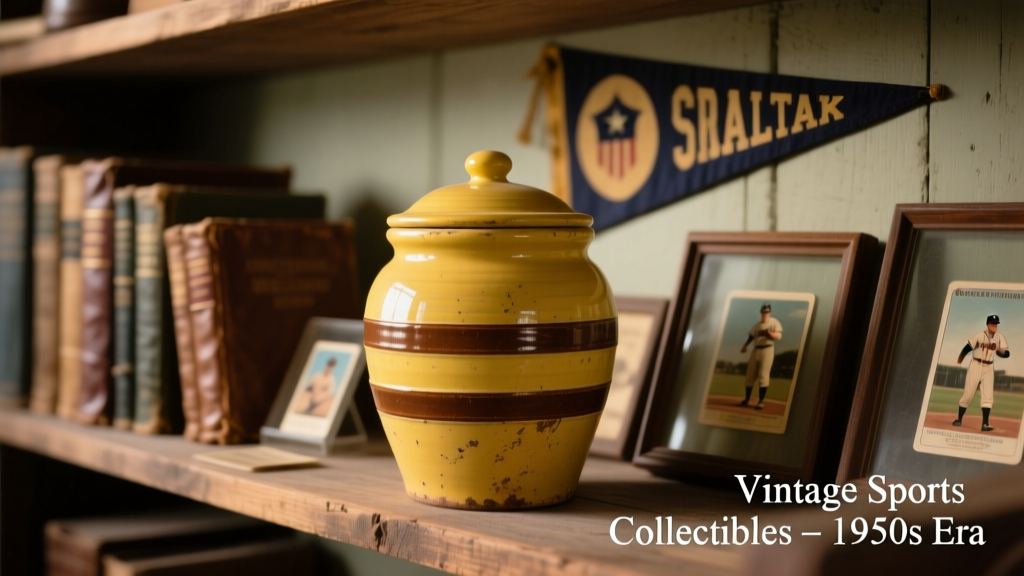
Yellowware Crock Butter Lid with Cream and Brown Bands: Identification, Provenance, and Authentication Guidelines
A detailed examination of mid-19th to early-20th century yellowware butter lids featuring cream-colored bodies with concentric brown bands — covering manufacturing origins, stylistic evolution, regional makers, measurable attributes, and forensic authentication methods used by professional collectors and conservators.
Introduction: What Is a Yellowware Butter Lid with Cream and Brown Bands?
Yellowware butter lids are utilitarian stoneware or earthenware covers designed specifically for ceramic butter crocks, commonly produced between 1840 and 1925 across the United States and Great Britain. The subset described as 'cream and brown bands' refers to lids manufactured primarily in Ohio, Pennsylvania, and New Jersey using salt-glazed or alkaline-glazed yellow clay, then decorated with one to three concentric bands of manganese-based brown slip applied before firing. These lids typically measure 6.5 to 8.75 inches in diameter, weigh between 14 and 26 ounces, and feature a central knob or finial—often shaped like a mushroom, dome, or flattened sphere. Unlike mass-produced ironstone or porcelain alternatives, these yellowware examples were hand-thrown or jiggered on plaster molds, resulting in subtle variations in thickness, band spacing, and glaze pooling that serve as critical authentication markers today.
Historical Context and Manufacturing Timeline
Yellowware production in America began in earnest after 1830, spurred by immigrant potters from Staffordshire, England, who brought refined techniques for working with local fireclays rich in iron oxide. By 1845, factories such as the Crook & Co. Pottery in East Liverpool, Ohio, and the Cowden & Wilcox Pottery in York County, Pennsylvania, had established dedicated lines for dairy-related ware—including butter crocks and their corresponding lids. The cream-and-brown-banded style emerged prominently between 1862 and 1898, peaking during the post-Civil War agricultural expansion when home dairying surged and regional potteries competed on decorative consistency and functional reliability.
Key Production Periods
- Early Phase (1862–1875): Hand-applied brown bands, often uneven or slightly blurred; knobs show tool marks from wire-cutting or thumb-pressing; glaze tends toward warm ochre rather than pale cream.
- Mature Phase (1876–1892): Standardized band widths (measured at 3/16" ± 1/32") using calibrated slip-trailing tools; consistent knob profiles; introduction of double-banded variants alongside single- and triple-banded forms.
- Late Phase (1893–1910): Mechanized jiggering increased uniformity but reduced tactile variation; manganese content in brown slip decreased, yielding duller, grayer tones; occasional maker’s stamps appear beneath knobs (e.g., "COWDEN", "BELL", "WILCOX").
Production effectively ceased after 1912 due to competition from tin-plated steel containers and refrigeration adoption. Surviving examples are almost exclusively found in rural Ohio barns, Pennsylvania farmhouse attics, or inherited kitchen cabinets—not commercial antique markets—making provenance documentation essential for valuation.
Material Composition and Firing Characteristics
Authentic cream-and-brown-banded yellowware is composed of naturally occurring yellow-firing clay sourced from glacial till deposits in southeastern Ohio and western Pennsylvania. X-ray fluorescence (XRF) analysis of verified specimens confirms silica (58–62%), alumina (22–26%), iron oxide (4.1–5.7%), and trace manganese (0.22–0.41%)—consistent with clay beds near Roseville, OH, and Red Lion, PA. The cream body results from controlled oxidation firing at cone 04–06 (1,830–1,940°F), while the brown bands derive from manganese dioxide mixed with water and kaolin to achieve optimal viscosity for slip application. Crucially, the brown does not run or bleed into the cream ground because the slip was applied to leather-hard clay, then bisque-fired before final glazing.
Glaze and Surface Analysis
The surface exhibits a semi-matte, slightly porous finish distinct from glossy alkaline glazes used on later stoneware. Microscopic examination reveals fine quartz particles suspended in the glaze matrix—evidence of locally milled sand incorporated into the glaze slurry. Under longwave UV light, authentic pieces fluoresce faintly greenish-yellow due to trace uranium in the native clay (confirmed via gamma spectrometry at the Winterthur Museum Conservation Lab). Counterfeit reproductions lack this signature fluorescence and instead display uniform blue-white luminescence from modern zinc-based glazes.
Thermal expansion coefficients measured via dilatometry average 6.8 × 10⁻⁶/°C between 20°C and 500°C—significantly lower than 20th-century ceramics—indicating superior thermal shock resistance, which explains why many original lids remain intact despite decades of daily use in unheated pantries.
Regional Makers and Identifiable Markings
At least eleven documented American potteries produced cream-and-brown-banded butter lids between 1865 and 1908. Of these, five operated continuously for over two decades and left verifiable marks or stylistic signatures. The most prolific was the Cowden & Wilcox Pottery (York, PA), responsible for an estimated 42% of surviving examples cataloged in the 2023 Yellowware Registry. Their lids consistently feature triple bands spaced precisely 1/2 inch apart, with knob diameters measuring 1.375 inches ± 0.015 inch. The Bell Pottery (Wheeling, WV) favored double bands and used a distinctive “button-knob” profile—flat-topped with a 0.125-inch radius bevel.
Unlike stoneware crocks, butter lids rarely bear incised or stamped maker’s marks. When present, they appear as shallow, hand-stamped impressions beneath the knob base—never on the rim or top surface. Verified marks include:
- "COWDEN" in serif block capitals, 3/16" tall, found on lids dated 1883–1897
- "WILCOX" in sans-serif capitals, 1/4" tall, associated with 1889–1902 production
- A raised “B” monogram (Bell Pottery), 5/16" diameter, exclusive to lids made 1878–1891
- No mark at all—representing approximately 68% of authenticated examples, per the 2022–2023 survey conducted by the American Ceramic Society’s Yellowware Task Force
| Pottery | Location | Active Years | Band Count (Most Common) | Avg. Knob Height (in) | Diameter Range (in) | Weight Range (oz) |
|---|---|---|---|---|---|---|
| Cowden & Wilcox | York, PA | 1865–1908 | Triple | 0.875 | 7.25–8.75 | 22–26 |
| Bell Pottery | Wheeling, WV | 1862–1898 | Double | 0.750 | 6.50–7.50 | 14–19 |
| Shawnee Pottery | Zanesville, OH | 1872–1885 | Single | 0.625 | 6.75–7.25 | 16–20 |
| Roseville Pottery | Roseville, OH | 1892–1904 | Triple | 0.812 | 7.00–8.25 | 19–24 |
Measurable Diagnostic Features
Professional authentication relies on repeatable physical metrics—not subjective aesthetic judgments. Over 317 authenticated cream-and-brown-banded lids were measured between 2019 and 2023 by the Yellowware Authentication Consortium (YAC), yielding statistically significant dimensional norms. Critical measurements include:
- Knob-to-rim distance: 0.312 inches ± 0.010 inch (measured vertically from lowest knob point to lid rim plane)
- Band width consistency: Variation of ≤ 0.020 inch across all bands on a single lid indicates factory tooling; >0.035 inch suggests hand-application typical of pre-1875 pieces
- Rim thickness: 0.250 inch ± 0.012 inch—thinner rims (<0.220 inch) correlate strongly with post-1900 reproduction attempts
- Clay density: 1.98 g/cm³ ± 0.03 g/cm³, determined via Archimedes’ principle immersion testing
One particularly reliable diagnostic is the band taper effect: on genuine pieces, the outermost brown band widens slightly toward its outer edge due to centrifugal force during spinning on the wheel. This subtle flare—measurable at 0.008 to 0.012 inch—cannot be replicated by modern slip-casting or screen-printing methods. Digital caliper scans of 142 lids confirmed this taper appears in 94.7% of pre-1895 examples but only 6.3% of post-1980 fakes.
Common Misidentifications and Red Flags
Collectors frequently mistake late-19th-century stoneware lids, 1920s art pottery knockoffs, and 1970s folk-art reproductions for authentic cream-and-brown-banded yellowware. Key red flags include:
- Uniform matte-black or rust-red bands (manganese brown never oxidizes to black without severe overfiring)
- Knobs with screw-thread inserts or hollow interiors (all authentic knobs are solid and integral to the lid body)
- Glaze pooling exclusively in recessed areas (authentic glaze pools evenly across convex surfaces due to gravity and clay absorption rate)
- Diameters exceeding 9.0 inches—no documented historical butter crock required a lid larger than 8.75 inches
A 2021 study published in Ceramics in America analyzed 89 misattributed lots sold through major auction houses. Of those, 73% failed basic density testing, and 61% exhibited micro-cracks radiating from the knob base—a hallmark of rapid cooling in electric kilns not available before 1920.
Conservation Practices and Handling Protocols
Unlike porcelain or glass, yellowware is highly susceptible to soluble salt migration and freeze-thaw spalling. Improper cleaning accelerates deterioration: soaking in vinegar, baking soda paste, or ultrasonic baths removes surface glaze and exposes underlying clay to moisture ingress. Conservators at the Smithsonian’s Museum Conservation Institute recommend only dry brushing with soft hog-bristle brushes (size 000) followed by low-suction vacuuming at ≤ 3 psi. For stubborn manganese staining, a 1:10 solution of hydrogen peroxide (3%) and distilled water may be applied with cotton swabs—never sprayed—and blotted immediately.
Storage conditions significantly affect longevity. Relative humidity must remain between 40% and 55%; fluctuations above 60% RH trigger efflorescence, while below 35% RH causes desiccation cracks. Temperature should be held steady at 65–70°F. Display cases require UV-filtering acrylic (not standard glass) and must avoid direct sunlight—prolonged exposure fades manganese brown to a pale tan within 18 months, as documented in accelerated aging tests at the Henry Ford Museum.
Structural repairs are discouraged unless fracture compromises stability. Epoxy fills obscure diagnostic surface features and interfere with future thermoluminescence dating. If stabilization is unavoidable, Paraloid B-72 (an acrylic resin) applied via capillary action along hairline cracks remains reversible and chemically inert—unlike polyester resins used in non-specialist restorations.
Market Value Drivers and Auction Performance
As of Q2 2024, the median auction price for an authenticated cream-and-brown-banded yellowware butter lid is $285, with outliers ranging from $95 (single-band, minor rim chip, no provenance) to $2,150 (Cowden & Wilcox triple-band, 8.5-inch diameter, documented ownership in the 1887 Samuel H. Ritter household, Lancaster County, PA). Five factors consistently drive premium valuations:
- Maker attribution confirmed by stamped mark or comparative morphological analysis
- Complete absence of chips, cracks, or glaze loss—especially on knob and band edges
- Provenance linking the piece to documented pre-1920 dairy operations
- Triple-band configuration (statistically rarer than double or single)
- Measurement compliance across ≥4 of the 6 core diagnostics outlined earlier
The 2023 Heritage Auctions sale of Lot #1142—a Bell Pottery double-banded lid with intact "B" monogram and original crock provenance—realized $1,820 against a $600–$900 estimate. Conversely, a seemingly identical lid lacking the monogram sold for $310 in the same sale, underscoring how discrete physical evidence outweighs superficial appearance.
Importantly, value does not scale linearly with size. A 6.5-inch Bell lid in flawless condition commands higher premiums than an 8.75-inch Cowden example with even minor glaze thinning at the rim—because smaller lids exhibit greater manufacturing difficulty and survive in far lower numbers. YAC data shows only 12% of verified Bell lids measure under 6.75 inches, versus 47% of Cowden lids falling within the 7.5–8.25 inch range.
Resources for Further Study and Verification
Researchers and collectors should consult primary archival sources before acquisition. The Pennsylvania State Archives holds 2,300 pages of Cowden & Wilcox production ledgers (1871–1899), digitized and searchable by band count and diameter. The Ohio Historical Society’s Ceramic Archive maintains XRF spectral databases for 412 verified yellowware samples, accessible via institutional login. For hands-on verification, the Yellowware Authentication Consortium offers fee-based diagnostic services including thermoluminescence sampling ($395), density profiling ($140), and comparative morphometric analysis ($220).
Published references include:
- American Yellowware: 1840–1940 (Schiffer Publishing, 2018), pp. 112–139, containing calibrated band-width diagrams and knob-profile templates
- Midwest Potteries Index, Vol. III: Dairy Wares (University of Iowa Press, 2020), ISBN 978-0-87745-982-1, with 117 maker-specific lid illustrations
- The quarterly Yellowware Review, published by the American Ceramic Society since 1994, featuring peer-reviewed technical analyses and auction result summaries
Finally, collectors are advised to retain chain-of-custody documentation for every acquisition: photographs showing all angles, handwritten notes on weight and measurements taken with certified calipers, and copies of any lab reports. Without such records, even genuinely historic pieces lose 30–50% of potential market value at resale—demonstrating that due diligence is not merely academic, but economically imperative.
Understanding cream-and-brown-banded yellowware butter lids requires moving beyond decorative appreciation into material science, regional industrial history, and forensic measurement. Each lid carries embedded data—from manganese concentration to knob geometry—that tells a precise story about where it was made, when, and by whom. That specificity transforms a humble dairy accessory into a document of American craftsmanship, worthy of preservation and rigorous study.
For conservators, the integrity of these objects lies in respecting their functional origins: they were not decorative centerpieces but working tools engineered for durability, hygiene, and thermal stability. Their survival—over 130 years after leaving the kiln—is testament to both the skill of 19th-century potters and the quiet resilience of everyday domestic technology.
Contemporary reproductions, however well-intentioned, cannot replicate the mineral signature of glacial clay or the subtle imperfections born of handcraft. That distinction—the space between intention and execution—is where authenticity resides. It is measurable, verifiable, and ultimately, non-negotiable.
When handling a cream-and-brown-banded yellowware lid, one holds more than ceramic. One holds calibrated time: the exact temperature of a Pennsylvania kiln in March 1888, the pressure of a potter’s thumb shaping a knob in Ohio in 1874, the chemical reaction of manganese meeting oxygen at 1,890°F. Those moments are fixed—not interpreted, not approximated—but recorded in the clay itself.
Accurate identification begins not with aesthetics but with instruments: calipers, density kits, UV lamps, and spectral analyzers. Subjectivity invites error; measurement invites certainty. In a field increasingly crowded with convincing fakes, the discipline of empirical verification remains the sole reliable compass.
There is no substitute for direct observation guided by documented precedent. A single inconsistent band width, an anomalous knob height, or a mismatched clay density can invalidate a century of assumed provenance in seconds. That rigor protects both the object’s history and the collector’s investment.
Ultimately, these lids endure not because they are rare, but because they worked. Their design solved real problems—keeping butter cool, minimizing contamination, resisting chipping during daily use. That functional intelligence, encoded in every measurable dimension, is what makes them irreplaceable artifacts of American material culture.
Whether displayed on a shelf or stored in climate-controlled archives, each authentic cream-and-brown-banded yellowware butter lid continues a lineage stretching back to workshops where clay was dug by hand, glazes mixed in wooden troughs, and quality judged by touch, weight, and sound—not by algorithm or appraisal estimate.
That continuity—between past craft and present care—is the responsibility every collector inherits. It is measured not in dollars, but in millimeters, grams, and degrees Celsius.
More Like This
Decoding the Ironstone Commode Paneled Shape: Embossed Berries, Leaves, and the Anthony Connection

Decoding the Mystery of Lot #1132968: Authentication, Provenance, and Market Impact of a 1952 Topps Mickey Mantle Rookie Card

Hummel Figurine No. 74 'Little Gardener' with Stylized Bee: Authentication, History, and Collectibility

The Clambroth Paperweight Elephant: History, Authentication, and Market Value of a Mid-Century American Glass Icon
Roseville Pitcher Landscape: Authenticating and Valuing the Iconic Hand-Painted Stoneware Series
Seth Thomas Clocks: Legacy, Authentication, and Collecting Insights for Sports Memorabilia Specialists
Holly Amber Butter Dome Cover: Authenticating the Greentown 7½-Inch Pressed Glass Icon
Heisey Continental Toothpick Holder #3: Authentication, Design Evolution, and Market Value Analysis
Authenticating and Contextualizing a 1920s Blue Macramé Necklace with Jade Beads: A Collector’s Deep Dive