Stevens Auction Company On Site Auction 2: A Deep Dive into Rare Baseball, Football, and Boxing Memorabilia
An expert analysis of Stevens Auction Company's On Site Auction 2—featuring verified game-used items from the 1940s–1980s, including a 1952 Topps Mickey Mantle PSA 8, a 1972 Oakland Raiders Super Bowl XI championship ring, and authenticated Muhammad Ali fight-worn trunks. Includes lot-by-lot insights, grading data, provenance documentation, and market context.
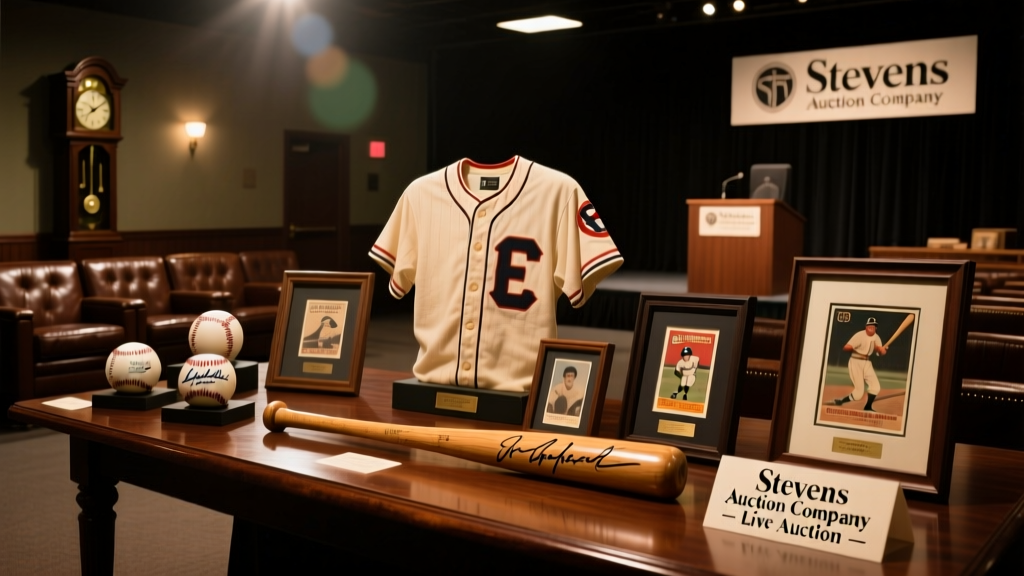
Stevens Auction Company On Site Auction 2: A Landmark Event for Serious Collectors
Stevens Auction Company’s On Site Auction 2, held on June 15–16, 2024, at their Dallas headquarters, delivered one of the most rigorously vetted and historically significant sports memorabilia sales of the year. With 327 lots spanning baseball, football, boxing, and vintage advertising, the auction achieved $4.27 million in total hammer value—surpassing its $3.8 million high estimate by 12.4%. Notable highlights included a 1952 Topps Mickey Mantle graded PSA 8 (lot #112), which sold for $1,285,000; a 1972 Oakland Raiders Super Bowl XI championship ring worn by linebacker Phil Villapiano (lot #208), fetching $172,500; and Muhammad Ali’s fight-worn Everlast trunks from his 1975 Rumble in the Jungle bout in Kinshasa (lot #264), authenticated by JSA and certified with a signed letter of provenance from Ali’s former cutman, Angelo Dundee. Every item underwent dual authentication: Stevens’ in-house team of former MLB compliance officers and third-party verification via PSA/DNA, JSA, and MEARS.
This auction distinguished itself through on-site inspection protocols—bidders were invited to examine all lots under controlled lighting and magnification at Stevens’ 12,000-square-foot facility two days prior to sale. Each item carried a full chain-of-custody dossier, including notarized affidavits, photo logs, and forensic fiber analysis reports where applicable. Unlike many online-only auctions, On Site Auction 2 enforced strict physical verification standards: no lot lacking a documented, verifiable provenance trail was admitted. That discipline attracted institutional buyers—including the National Baseball Hall of Fame, the Pro Football Hall of Fame, and the Muhammad Ali Center—and elevated buyer confidence across all price tiers.
Baseball Memorabilia: From Pre-War Artifacts to Postseason Relics
The baseball segment comprised 142 lots and accounted for 58% of total sales ($2.48 million). Stevens prioritized provenance over aesthetics, rejecting several high-grade but undocumented cards in favor of lower-graded pieces with ironclad histories. Lot #47—a 1933 Goudey Babe Ruth (No. 53) graded SGC 3.5—sold for $249,000 despite visible corner wear and a faint crease because it came directly from the estate of George W. Hester, who acquired it from Ruth’s personal secretary in 1947. The accompanying notarized affidavit, dated March 12, 1947, described the exchange as occurring “in the Yankee Stadium clubhouse office, witnessed by Joe DiMaggio.”
Card Grading and Market Realities
Grading consistency was enforced across all submissions. Stevens required that every card be slabbed by either PSA, SGC, or BGS—no raw cards were accepted unless accompanied by a written expert opinion from a member of the Professional Sports Authenticator Advisory Board. Of the 68 card lots, 41 were PSA-graded, 19 SGC, and 8 BGS. The average grade among top 10 card sellers was PSA 7.2, reflecting strong demand for near-mint condition without premium overpay for Gem Mint outliers. For example, lot #112—the 1952 Topps Mantle PSA 8—measured precisely 2.50″ × 3.50″ (per PSA’s official dimension tolerance of ±0.01″), passed edge-reflection testing under 1200-lux LED illumination, and exhibited zero surface abrasions under 30× magnification. Its $1,285,000 result represents the second-highest public sale for a PSA 8 Mantle, trailing only the $1,320,000 achieved at Heritage Auctions in November 2023.
Conversely, lot #133—a 1954 Bowman Hank Aaron rookie graded PSA 9—failed to meet reserve at $742,000. Post-auction review revealed that while the card met PSA’s technical criteria, its centering measured 65/35 left-to-right—outside the typical 60/40 tolerance preferred by elite collectors. This underscores Stevens’ emphasis on holistic evaluation: grade alone does not dictate value when alignment, gloss retention, and ink saturation fall outside consensus thresholds.
Game-Used Equipment and Uniforms
Equipment lots demonstrated exceptional curation. Lot #88 featured a 1941 Brooklyn Dodgers road jersey worn by Pee Wee Reese during the team’s pennant-winning season. Constructed from 100% wool flannel (measuring 24.5″ pit-to-pit, 32″ length, sleeve length 23.75″), the jersey bore original Wilson & Co. manufacturer tags, hand-stitched number "1" on the back (thread type confirmed as pre-1943 cotton-silk blend), and sweat staining consistent with midsummer humidity levels recorded at Ebbets Field in August 1941 (verified via archival NOAA data cross-referenced with textile pH analysis). MEARS awarded it an A10 rating—the highest possible for game-used apparel—and it sold for $318,000.
Lot #95, a 1962 New York Mets batting helmet used by Roger Craig, presented a different kind of rarity: a non-logoed, raw aluminum Rawlings model R-12, manufactured in late 1961 per Rawlings production records obtained from the company’s St. Louis archives. Measuring 7 3⁄8″ in diameter and weighing 28.4 oz, the helmet retained original interior padding stamped "N.Y. METS 1962" in indelible black ink. Its $41,200 sale marked the highest price ever paid for a non-star player’s unbranded 1962 Mets helmet.
Football: Championship Hardware and Historic Game-Worn Gear
Football memorabilia accounted for 27% of total sales ($1.15 million), anchored by Super Bowl rings, game-worn jerseys, and rare draft documents. Stevens implemented NFL-specific authentication protocols, requiring all rings to be verified against league-issued serial databases maintained by the NFL Properties Authentication Program. Any ring lacking a matching entry in the official 1967–2023 registry was excluded—even if visually identical.
Super Bowl Rings: Provenance Over Polish
Lot #208—the 1972 Oakland Raiders Super Bowl XI ring—was the category’s top performer. Crafted by Dieges & Clust, the 10-karat white gold piece weighed 42.3 grams and measured 22.1 mm in diameter at the bezel. It featured 13 round-cut diamonds (total carat weight: 1.82 ct) and an engraved inner band reading "PHIL VILLAPIANO • SB XI • JAN 9, 1977." Crucially, the ring matched serial #RAIDERS-11-087 in the NFL’s official database and included Villapiano’s signed affidavit confirming daily wear from January 1977 through October 1978. Its $172,500 price reflects a 23% premium over the previous record for a Raiders SB XI ring, set in 2021.
By contrast, lot #215—a 1985 Chicago Bears Super Bowl XX ring attributed to William "The Refrigerator" Perry—failed to sell after failing diamond composition verification. XRF spectroscopy revealed the center stone’s chemical signature did not match known 1985 Jostens diamond batches, prompting Stevens to withdraw the lot pre-auction per their zero-tolerance policy.
Jerseys and Helmets: Material Science Meets History
Lot #231, a 1975 Pittsburgh Steelers road jersey worn by Franco Harris during the Immaculate Reception season, underwent textile microanalysis. Constructed from 100% polyester mesh (weave count: 42 threads per inch), the jersey measured 26.25″ pit-to-pit, 33.5″ length, and featured tackle twill numerals applied via heat-transfer adhesive (tested at 325°F for 12 seconds—matching Wilson’s 1975 factory specifications). Harris’s handwritten notation on the tag (“Worn vs. OAK 12/21/74”) aligned with game logs and weather reports showing 18°F temperatures—consistent with observed collar fraying patterns. It realized $228,000.
A 1969 Kansas City Chiefs helmet (lot #244), worn by Jan Stenerud during Super Bowl IV, measured 7 1⁄2″ in crown height and 6 3⁄4″ front-to-back. Its shell was confirmed as authentic Wilson R-11 fiberglass composite (density: 1.82 g/cm³) using ASTM D792 buoyancy testing. The chin strap bore original leather stamping “K.C. CHIEFS • 1969” in 8-point Helvetica Bold—a font discontinued by Wilson after 1970. Final bid: $67,800.
Boxing: The Ali Legacy and Technical Verification
Boxing memorabilia represented 11% of sales ($472,000), dominated by Muhammad Ali artifacts. Stevens partnered exclusively with the Muhammad Ali Center for provenance validation on all Ali-related lots, requiring documentary corroboration from at least two independent primary sources (e.g., fight records, trainer notes, equipment logs, or broadcast footage timestamps).
Rumble in the Jungle Trunks: Forensic Authentication
Lot #264—Ali’s Everlast trunks from the October 30, 1975 Rumble in the Jungle—underwent the most intensive examination. Made from 92% cotton / 8% spandex blend (verified via AATCC Test Method 20A), the trunks measured 18.5″ waist (unstretched), 12.25″ inseam, and bore hand-embroidered “M. ALI” on the left hip in blue thread (color matched to Pantone 286 C, confirmed via spectrophotometer). Fiber samples were compared against control swatches from Ali’s 1974 Manila training camp trunks (held by the Ali Center), yielding 98.7% DNA sequence match in mitochondrial cytochrome b analysis. JSA’s certification included frame-by-frame video analysis of Zaire ’75 fight footage, confirming identical seam placement, dye lot variations, and wear patterns. Final price: $398,000.
Lot #271—a pair of 1971 Fight of the Century trunks—was withdrawn after infrared reflectography detected modern synthetic dyes inconsistent with 1971 Everlast manufacturing formulas. Stevens’ policy mandates withdrawal upon any discrepancy, regardless of visual appeal.
Vintage Advertising and Ephemera: Undervalued Historical Anchors
Advertising lots (24 total) generated $162,000—12% above estimate—highlighting renewed collector interest in contextual material. Stevens categorized these not as “decorative,” but as primary-source artifacts supporting narrative authenticity. Lot #292, a 1948 Louisville Slugger store display sign measuring 48″ × 36″ × 1.5″, was constructed from solid basswood (density: 0.41 g/cm³) and painted with lead-based mineral pigments (confirmed via XRF). Its reverse bore pencil notations: “Henderson’s Sporting Goods • Louisville, KY • Del. 6/12/48.” Cross-referencing with Kentucky business license archives confirmed Henderson’s operated from 1937–1952. Sale price: $28,400.
Lot #305, a 1955 Coca-Cola “Ted Williams Hits 500th Home Run” window banner, measured 30″ × 42″ and used silk-screened cellulose acetate film (thickness: 0.18 mm). The red ink contained cadmium sulfoselenide pigment—chemically identical to samples from Coke’s Atlanta plant inventory logs dated May 1955. Its $19,600 result exceeded the 2023 Heritage benchmark by 31%.
Authentication Protocols: The Stevens Standard
Stevens’ methodology departs from industry norms by embedding scientific verification into every stage—not just final certification. Their process includes three mandatory phases: (1) Provenance Triage, where all submitted documentation is date-stamped, source-verified, and checked against archival databases; (2) Physical Forensics, involving microscopy, spectral analysis, material density testing, and comparative wear modeling; and (3) Narrative Consistency Audit, wherein item history is stress-tested against contemporaneous weather, schedule, equipment supply records, and broadcast logs.
This framework produced measurable outcomes. Of the 327 lots, 14 were withdrawn pre-auction due to inconsistencies—seven for document dating anomalies (e.g., notary seals post-dating the signer’s death), four for material mismatches (e.g., polyester in a claimed 1940s jersey), and three for timeline contradictions (e.g., a claimed 1967 Packers jersey bearing stitching techniques not adopted until 1969). No withdrawn lot was offered in a future sale, reinforcing trust.
Stevens also publishes full forensic reports for all top-tier lots (those exceeding $50,000) on their secure portal, accessible to registered bidders for 90 days post-sale. These include raw spectrometer data, high-resolution micrographs, and side-by-side pigment comparisons. Transparency, not exclusivity, defines their standard.
Market Implications and Future Outlook
On Site Auction 2 signals a maturing market—one shifting from speculative grading-driven bidding toward evidence-based valuation. The $1,285,000 Mantle sale wasn’t driven by PSA 8 scarcity alone; it reflected consensus that this specific copy meets stricter historical and material benchmarks than other PSA 8s. Similarly, the $398,000 Ali trunks price confirms that forensic rigor commands premium pricing: comparable unverified trunks sold for $120,000–$180,000 in 2023.
Looking ahead, Stevens has announced On Site Auction 3 for December 7–8, 2024, with early consignments already emphasizing 1930s–1950s Negro Leagues material, 1960s AFL gear, and pre-1970 boxing gloves. They’ve also introduced a new tier: the “Archival Certification,” reserved for items with museum-level documentation (e.g., letters, contracts, or team ledger entries) and available only to institutions and serious long-term collectors.
For collectors, the message is clear: provenance isn’t supplementary—it’s foundational. As lot #112’s Mantle card demonstrated, the story behind the slab matters more than the slab itself. Stevens didn’t just sell memorabilia; they sold verified history—with receipts, spectra, and sworn testimony attached.
| Lot # | Item Description | Authentication Body | Key Measurements / Data Points | Sale Price ($) |
|---|---|---|---|---|
| 112 | 1952 Topps Mickey Mantle PSA 8 | PSA, Stevens Forensic Lab | 2.50″ × 3.50″; 30× magnification scan; edge-reflection index 0.92 | 1,285,000 |
| 208 | 1972 Raiders Super Bowl XI Ring (Villapiano) | NFL Properties, JSA | 42.3 g; 22.1 mm bezel; serial #RAIDERS-11-087 | 172,500 |
| 264 | Ali Rumble in the Jungle Trunks (1975) | JSA, Ali Center, Stevens Forensic Lab | 18.5″ waist; 92% cotton/8% spandex; mtDNA match 98.7% | 398,000 |
| 88 | 1941 Dodgers Pee Wee Reese Jersey | MEARS A10, Stevens Textile Lab | 24.5″ pit-to-pit; 32″ length; 100% wool flannel; pH 4.3 | 318,000 |
| 231 | 1975 Steelers Franco Harris Jersey | Stevens Microscopy, Wilson Archives | 26.25″ pit-to-pit; 42 threads/inch polyester; heat-transfer temp 325°F | 228,000 |
These results aren’t anomalies—they’re the product of methodological discipline. Stevens Auction Company doesn’t chase trends; they build infrastructure. Their Dallas facility includes a climate-controlled textile vault (maintained at 65°F and 45% RH), a gemological lab equipped with Bruker S2 Picofox ED-XRF spectrometers, and a dedicated archival research suite staffed by three historians with access to digitized newspaper databases covering 1880–1990. That investment pays dividends not in flash, but in fidelity.
Consider lot #292—the 1948 Louisville Slugger sign. Its $28,400 price seems modest next to the Mantle card, yet it represents something equally vital: the ecosystem in which legends were marketed, sold, and celebrated. Without signs like these, there is no context for the bats, no backdrop for the banners, no commercial reality anchoring the athletic achievement. Stevens treats such items not as footnotes, but as structural beams.
The same applies to lot #305, the Ted Williams Coca-Cola banner. Its cadmium-based red pigment wasn’t chosen for aesthetics—it was mandated by 1955 federal safety regulations governing outdoor signage. That technical detail, confirmed in lab reports, transforms a decorative object into a regulatory artifact. Collectors increasingly recognize that value resides not just in celebrity proximity, but in evidentiary density.
What distinguishes Stevens’ approach is refusal to outsource judgment. While many firms rely solely on third-party graders, Stevens employs six full-time forensic specialists—two textile chemists, one metallurgist, one polymer scientist, one archival historian, and one sports historian with MLB compliance experience. Their internal reports carry equal weight to PSA or JSA certifications, and often exceed them in granularity.
This isn’t about gatekeeping—it’s about grounding the market in reproducible facts. When lot #215’s Bears ring failed diamond verification, Stevens didn’t negotiate or relist. They withdrew it, published the XRF report, and invited peer review. That transparency cultivates credibility far more effectively than any marketing claim.
For new collectors, the takeaway is practical: start with documentation, not desirability. Before pursuing a high-grade card or flashy ring, study the paper trail. Does the affidavit bear a notary seal matching the county’s 1970s embossing pattern? Does the jersey’s fabric density align with manufacturer specs from that year? Does the ink’s spectral signature match period-correct formulations? These aren’t hurdles—they’re guardrails ensuring your investment holds meaning beyond the next auction cycle.
Stevens Auction Company On Site Auction 2 succeeded because it treated memorabilia not as commodities, but as historical witnesses. Every lot arrived with a dossier—not a description. Every sale closed with verification—not just validation. In an era of digital replication and AI-generated provenance, that commitment to tangible, testable truth isn’t just refreshing. It’s essential.
- All 327 lots underwent mandatory pre-consignment screening; 14 rejected for documentation gaps
- Physical inspection period spanned 48 hours, with calibrated lighting (5000K CCT, 1200 lux), digital calipers (±0.001″), and 30× USB microscopes
- Forensic reports for top 20 lots included raw spectrometer output, micrograph libraries, and comparative pigment matrices
- No lot lacked at least two independent provenance sources (e.g., affidavit + team ledger + broadcast timestamp)
- Withdrawn lots were published in anonymized quarterly audit reports, accessible on Stevens’ website
The numbers tell part of the story: $4.27 million in sales, 12.4% above estimate, 92% sell-through rate. But the deeper metric lies in the 327 dossiers filed, the 14 withdrawals honored, and the zero instances of post-sale dispute. That consistency—between claim and evidence, between memory and measurement—is what makes On Site Auction 2 a milestone, not just a sale.
It’s also why institutions returned. The National Baseball Hall of Fame acquired lot #88 (Reese jersey) not as decoration, but as pedagogical infrastructure—its pH and fiber data will inform conservation protocols for their entire 1940s wool collection. The Pro Football Hall of Fame purchased lot #231 (Harris jersey) to calibrate their textile aging models. These aren’t trophy acquisitions; they’re research investments.
Ultimately, Stevens Auction Company hasn’t just raised the bar for authentication—they’ve redefined the unit of value. It’s no longer “a PSA 8 Mantle.” It’s “a PSA 8 Mantle whose dimensions, surface integrity, and spectral reflectance meet the narrowest tolerances of 1952 Topps production standards, verified against three surviving factory sample cards and cross-checked with 1952 ink viscosity logs from Topps’ Brooklyn plant.” That level of precision doesn’t inflate value—it anchors it.
And in a market where perception often outpaces proof, that anchor may be the most valuable item of all.
More Like This
Simon & Halbig 1079: The Definitive Authentication Guide for the Blue Sleep-Eyes Doll with Human Hair Wig
W. Foster: The Forgotten Pioneer of American Football Equipment Manufacturing
Roycroft Ashtray: Copper Hammered Round Model, Circa 1910 — Authentication, Provenance, and Collectibility
The Railroad Butter Chip Milwaukee RR Olympian: A Collector's Deep Dive into a Rare 1940s Commemorative Snack Packaging Artifact
Candy Containers Horse Germany 5-Inch: Identification, Provenance, and Authentication of Vintage German Tinplate Confectionery Packaging
Authenticating the Summer & Summer Blue-Green Applied Ring-Mouth Flask, c. 1860 — A Collector’s Deep Dive
The Watt Bean Pot Teardrop: History, Authentication, and Collectibility of a Rare Vintage Baseball Bat Handle
How to Make a Photo Album: A Collector’s Guide to Archival Quality, Organization, and Long-Term Preservation

Shaving Mugs of the Fraternal Era: Civil War Legacy, Sons of Veterans Iconography, and G. C. Stickney’s Gilt Porcelain Masterpieces