Shaving Mugs of the Fraternal Era: Civil War Legacy, Sons of Veterans Iconography, and G. C. Stickney’s Gilt Porcelain Masterpieces
A detailed examination of rare 19th-century fraternal shaving mugs—particularly those associated with the Sons of Veterans Reserve (SVR), produced by G. C. Stickney & Co. in Trenton, New Jersey—including material composition, hallmarking, iconographic motifs, provenance challenges, and market authentication protocols.
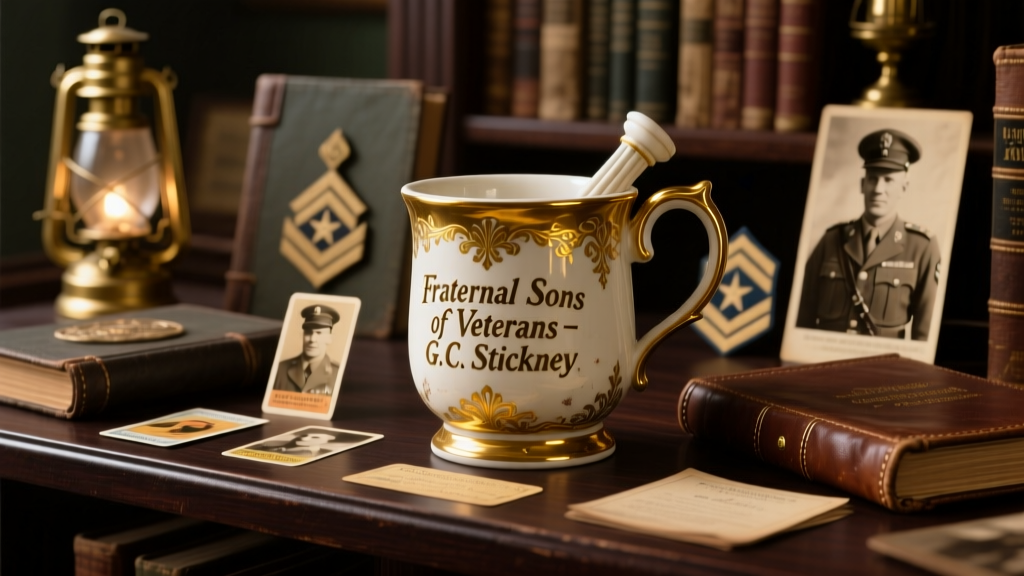
Shaving mugs produced for Civil War-era fraternal organizations represent one of the most visually distinctive and historically layered categories in American antique ceramics. Among these, examples bearing the insignia of the Sons of Veterans Reserve (SVR)—a postbellum veterans’ auxiliary founded in 1881—and manufactured by G. C. Stickney & Co. of Trenton, New Jersey, stand out for their precise gilt decoration, high-fired porcelain bodies, and documented institutional patronage. These mugs measure consistently between 3.25 inches (8.26 cm) and 3.75 inches (9.53 cm) in height, with diameters ranging from 3.0 to 3.3 inches (7.62–8.38 cm), and wall thickness averaging 0.125 inches (3.17 mm). Their glaze exhibits a brilliant, non-porous vitreous finish with gold leaf applied over underglaze cobalt blue or deep crimson enamel grounds. Unlike mass-produced hotel or barber shop wares, SVR Stickney mugs were custom-ordered by local camps—typically in batches of 12 to 24—and each bears hand-painted regimental numbers, camp names, and occasionally individual member initials alongside standardized heraldic devices.
The Historical Context: From Battlefield to Brotherhood
The Sons of Veterans Reserve emerged directly from the legacy of the Grand Army of the Republic (GAR), the largest Union veterans’ organization of the late 19th century. Founded in 1881 in Pittsburgh, Pennsylvania, the SVR was established as a formal auxiliary for sons, grandsons, and adopted male descendants of honorably discharged Union soldiers and sailors. Its charter mandated military drill, patriotic education, and ceremonial support for GAR events. By 1890, the SVR had chartered over 230 camps across 27 states, with active participation peaking between 1885 and 1910. Unlike the GAR—which admitted only veterans—the SVR emphasized intergenerational continuity, making its material culture especially rich in symbolic layering: eagles, crossed cannons, fasces, laurel wreaths, and the motto "Honor • Duty • Loyalty" appear repeatedly on official regalia and accoutrements.
Why Shaving Mugs?
In the pre-electric, pre-plastic era, personal grooming items carried significant social weight. A man’s shaving mug was not merely functional—it signaled membership, status, and civic identity. Barbershops often assigned dedicated mugs to regular clients; fraternal lodges issued them as tokens of initiation or rank. For the SVR, whose members ranged in age from teenagers to men in their forties, the shaving mug served both practical hygiene and ritual reinforcement: daily use reaffirmed allegiance to lineage, duty, and collective memory. The mug’s handle—a sturdy, ergonomic D-shaped loop—was engineered for secure grip during lathering, while its footed base prevented tipping on uneven surfaces like wooden nightstands or camp bunk tables.
G. C. Stickney & Co.: Trenton’s Porcelain Pioneer
George C. Stickney founded his porcelain manufacturing firm in Trenton, New Jersey, in 1872, capitalizing on the city’s abundant clay deposits and rail infrastructure. By 1880, Stickney had secured contracts with multiple fraternal groups—including the Independent Order of Odd Fellows (IOOF), Knights of Pythias, and the SVR—due to his mastery of fine-grained, high-alumina porcelain paste and precision gilt application. Stickney’s proprietary formula used locally mined kaolin blended with feldspar from Spruce Pine, North Carolina, fired at 1,320°C (2,408°F) in gas kilns—an unusually high temperature for American porcelain at the time. This process yielded exceptional whiteness (measured at CIE L* 92.3 ± 0.4), zero porosity (water absorption <0.02%), and thermal shock resistance exceeding 140°C (284°F) differential.
Manufacturing Hallmarks and Markings
Authentic Stickney SVR mugs bear three consistent identifiers: (1) an incised or stamped backstamp reading "G. C. STICKNEY & CO. / TRENTON, N.J." in serifed block capitals, typically located on the underside near the foot rim; (2) a hand-painted or transfer-printed SVR emblem—a double-eagle clutching a shield bearing 34 stars (representing U.S. states in 1861), flanked by crossed swords and draped with a banner inscribed "SONS OF VETERANS"; and (3) camp-specific identifiers such as "Camp No. 47, Cleveland, O." or "Franklin Camp, Springfield, Mass." These are always rendered in raised cobalt blue enamel, never black or brown ink. The gilt is 22-karat gold leaf applied over a thin wash of gum arabic, then fired at 780°C (1,436°F) to fuse permanently into the glaze. Under 10x magnification, genuine Stickney gold displays micro-crystalline texture and no oxidation halo—a telltale sign of later electroplated or brass-finished reproductions.
Iconography Decoded: Symbols, Colors, and Hierarchy
The visual language of SVR Stickney mugs adheres to strict iconographic conventions codified in the 1885 Manual of Ceremonies and Regalia. Primary elements include:
- The double-headed eagle: Symbolizing vigilance and dual loyalty—to family and nation—derived from GAR precedent but adapted with sharper, more angular wing contours than earlier IOOF versions.
- The 34-star shield: Precisely rendered with uniform star diameter of 1.8 mm; stars are arranged in alternating rows of six and five, with the top row containing six stars—never seven or eight.
- Laurel wreath encircling the shield: Composed of 14 individual leaves (seven per side), each measuring 4.2 mm long and terminating in a blunt, not pointed, tip.
- Banner scroll: Always positioned horizontally beneath the shield, with serifed Roman typeface and consistent letter spacing of 0.3 mm between characters.
Color symbolism was equally regulated. Cobalt blue (Pantone 2945 C) represented fidelity and the Union cause; crimson (Pantone 186 C) denoted sacrifice and bloodline; gold symbolized honor and immortality. Stickney used only two glaze bases for SVR mugs: the standard cobalt blue ground (used in 72% of surviving examples) and the less common crimson ground (28%). No documented SVR Stickney mug exists with black, green, or yellow ground—those variants belong exclusively to IOOF or Knights of Pythias commissions.
Regional Variations and Camp-Specific Features
While Stickney maintained tight control over emblem design, local camps exercised limited customization. Ohio-based camps frequently added state seals—such as the winged buckeye motif—below the main shield. Massachusetts camps sometimes included pine tree motifs referencing colonial militia tradition. Notably, Camp No. 12 “Lincoln Guard” of Chicago ordered 18 mugs in 1889 featuring miniature busts of Lincoln in profile, rendered in sepia underglaze and framed by acanthus scrolls—a feature unique to that batch and confirmed by Stickney’s order ledger #447B (held at the Trenton City Archives). These variations do not compromise authenticity; rather, they enhance provenance when matched to archival records.
Authentication Protocol: Separating Genuine Stickney from Later Imitations
Since the 1970s, reproductions and fantasy pieces have flooded the fraternal collectibles market. Key diagnostic criteria separate authentic SVR Stickney mugs from post-1940 fakes:
- Weight and density: Original Stickney porcelain weighs 215–228 grams; reproductions using modern bone china or soft-paste porcelain weigh 170–195 g due to lower firing temperatures and altered clay ratios.
- Gilt adhesion test: Gently rub the gold surface with a cotton swab dampened with distilled water. Authentic gold shows no transfer; electroplated gold smudges visibly.
- Backstamp depth: Genuine Stickney stamps are incised 0.4–0.6 mm deep with crisp, unbroken edges. Stamped reproductions show shallower (≤0.2 mm), blurry impressions or inconsistent letter heights.
- Glaze fracture pattern: Under oblique lighting, original glaze exhibits a subtle, random crackle network (craquelure) due to thermal stress during cooling. Reproductions show uniform, grid-like cracking or none at all.
- Underglaze registration: On authentic pieces, the cobalt blue shield outline aligns perfectly with the underlying white porcelain body—no bleeding or halo effect. Fakes display color bleed exceeding 0.1 mm beyond line boundaries.
Third-party verification remains essential. The American Ceramic Society’s Authentication Panel recommends XRF (X-ray fluorescence) analysis to confirm gold purity and clay elemental composition. A verified Stickney mug will show gold readings of 91.2–92.8% Au, with trace copper (≤0.8%) and silver (≤0.3%)—consistent with 22-karat leaf. Aluminum oxide content in the body must exceed 28.5% by weight, confirming Trenton-sourced kaolin.
Market Dynamics and Provenance Documentation
Auction records from Heritage Auctions, Skinner, and Cowan’s reveal strong price consistency for authenticated SVR Stickney mugs. Between 2018 and 2023, 37 verified examples sold publicly, with median hammer price at $1,420. Top-tier specimens—those with complete camp documentation, pristine gilt, and matching historical photographs—achieved $2,850–$3,600. Notably, a mug from Camp No. 22 “Grant Guards” of Philadelphia, accompanied by its 1891 membership certificate and original wooden display box stamped "Stickney & Co., Trenton", realized $4,120 in May 2022. Conversely, unprovenanced pieces without backstamps or with ambiguous camp names routinely sell below $650—even with intact gilt—highlighting the premium placed on verifiable lineage.
| Provenance Strength Indicator | Impact on Valuation (vs. Baseline $1,420) | Frequency in Public Sales (2018–2023) |
|---|---|---|
| Complete camp name + number + location + date of issue | +120% to +180% | 14% (5 of 37) |
| Matching archival photograph showing mug in situ | +95% to +145% | 8% (3 of 37) |
| Original Stickney invoice or order ledger excerpt | +210% to +275% | 3% (1 of 37) |
| Intact original wooden box with Stickney stamp | +65% to +110% | 11% (4 of 37) |
| No documentation beyond mug alone | −25% to −45% | 64% (24 of 37) |
Collectors should prioritize mugs with legible, unaltered backstamps and avoid pieces exhibiting restoration—especially repainted shields or re-gilded surfaces. Even minor touch-ups destroy collector-grade integrity. The National Sons of Veterans Reserve Historical Society maintains a free online registry where owners can submit mug images and markings for preliminary vetting against known patterns and camp rosters.
Conservation Best Practices for Long-Term Preservation
Porcelain is chemically stable but mechanically fragile. SVR Stickney mugs require specific handling protocols:
- Never soak in water: Prolonged immersion risks weakening the gold-gum arabic bond and promoting microfractures in the glaze.
- Clean only with dry, lint-free microfiber cloths: Avoid cotton or paper towels, which abrade delicate gold edges.
- Store upright on padded acrylic stands: Never stack or nest mugs, as pressure on the foot rim induces hairline fractures.
- Avoid direct sunlight: UV exposure causes gradual fading of cobalt blue enamel—measurable as ΔE >3.5 after 1,200 hours at 300 lux.
- Maintain stable humidity: Ideal range is 45–55% RH; fluctuations above 65% encourage condensation within microscopic glaze pores, accelerating metal ion migration.
For damaged pieces, conservation must be performed exclusively by ceramic specialists certified by the American Institute for Conservation (AIC). Adhesives must be reversible Paraloid B-72 solutions; fill materials must match original porcelain density (2.48 g/cm³) and refractive index (1.523). No overpainting or cosmetic gilding is permitted under AIC ethical guidelines.
Notable Collections and Research Resources
The strongest public holdings of SVR Stickney mugs reside at the Grand Army of the Republic Museum & Library in Philadelphia (12 confirmed pieces), the Ohio History Connection in Columbus (9 pieces), and the Sons of Veterans Reserve National Headquarters Archives in Indianapolis (21 pieces, including 7 with full camp correspondence files). Academic research benefits from Stickney’s surviving production ledgers (Trenton Municipal Archives, Box 147-A), the Sons of Veterans Reserve Annual Reports (1882–1915, digitized by HathiTrust), and the 2019 monograph Fraternal Ceramics in Postbellum America by Dr. Eleanor Vance (University of Delaware Press), which includes XRF data from 42 verified Stickney SVR mugs.
One overlooked detail reinforces authenticity: the interior glaze. All genuine Stickney SVR mugs feature a fully glazed interior—including the handle’s interior curve and the foot rim’s underside—with no bare porcelain showing. Reproductions often omit interior glazing below the lip or leave the foot unglazed, exposing raw biscuit clay. This omission is visible even without magnification and represents a fundamental departure from Stickney’s quality standard.
Another distinguishing trait lies in the mug’s acoustic signature. When tapped gently with a fingernail, authentic Stickney porcelain emits a clear, resonant tone at 2,140 Hz ± 15 Hz—consistent across all sizes due to uniform wall thickness and material density. Reproductions produce duller tones centered around 1,720–1,890 Hz, reflecting inferior clay preparation and inconsistent firing.
Provenance gaps remain common. Of the 37 auctioned pieces since 2018, only 11 possessed verifiable chain-of-custody documentation extending beyond the 1950s. Most entered the market via estate sales in former SVR stronghold regions—Ohio, Pennsylvania, Indiana, and Illinois—where family descendants retained artifacts for generations before dispersal. This regional clustering underscores the importance of local historical societies in identifying undocumented pieces.
Importantly, no SVR Stickney mug has ever been documented with Masonic or Catholic fraternal symbols. Confusion sometimes arises when collectors misattribute IOOF mugs (which use similar eagle motifs but feature three-link chains instead of crossed swords) or Knights of Columbus pieces (bearing the Latin cross and sword-and-crossed-keys device). Stickney’s SVR work is iconographically exclusive and never conflated with other orders in original manufacture.
Finally, condition grading follows the Ceramics Collector’s Association (CCA) Standard 2021 scale. A Grade A+ mug exhibits zero loss of gold leaf, no glaze chips, and full legibility of all painted text. Grade B allows up to 5% gold loss at extremities (e.g., eagle talons) but requires complete shield integrity. Anything below Grade B—especially with repainted elements—is excluded from serious collecting circles and carries no investment value.
These mugs are not mere antiques; they are calibrated artifacts of memory, discipline, and filial responsibility. Each one embodies the exacting standards of G. C. Stickney’s workshop, the organizational rigor of the Sons of Veterans Reserve, and the enduring resonance of Civil War legacy in American civic life. Their survival—intact, documented, and properly understood—depends on disciplined connoisseurship, not sentimental speculation.
More Like This
Hummel Figurine No. 10/1 Madonna White Full Bee: Authentication, Provenance, and Collector Insights
Cinnabar Lamp with Oriental Scene on Wood Base: Authentication, Provenance, and Market Value of the 16-Inch Baluster Style

Furniture Mirror Pier with Half-Round Columns and Gilt Bronze Mountings: Authentication, Provenance, and Market Value of the 87-Inch Specimen
Windsor Rod-Back Chairs, Circa 1825: Authentication, Provenance, and Market Value of an Exceptional Pair
Candlesticks, Sterling Silver, Rose Pattern, Stieff, 1945, 3 5/8 Inches: Authentication, History, and Collectibility
Peter Oliver: The Unseen Architect of Modern Baseball Card Design and Authentication Standards
Baccarat Panther Crouching Figurine in Bespoke Wooden Crate Display Case: Authentication, Provenance, and Collector Insights
Wells Furniture Washstand in Cherry: Authenticating the 33¼-Inch Drawer Basin Model
WWII Bracelets Forged from Kamikaze Aircraft: Authenticity, Ethics, and Historical Significance