Stetson China Co: The Forgotten American Ceramics Manufacturer Behind Iconic Sports Memorabilia
Stetson China Co. (1902–1974) was a prominent American dinnerware and commemorative ceramics producer based in Lincoln, Illinois. Known for its high-fired vitrified porcelain, precise lithographic decoration, and official licensing with Major League Baseball, the NFL, and NCAA programs, Stetson produced over 20 million licensed plates, mugs, and platters between 1950 and 1972 — including the iconic 1960 World Series plate honoring the Pittsburgh Pirates’ championship and the 1967 Green Bay Packers Super Bowl I plate measuring 10.25 inches in diameter.
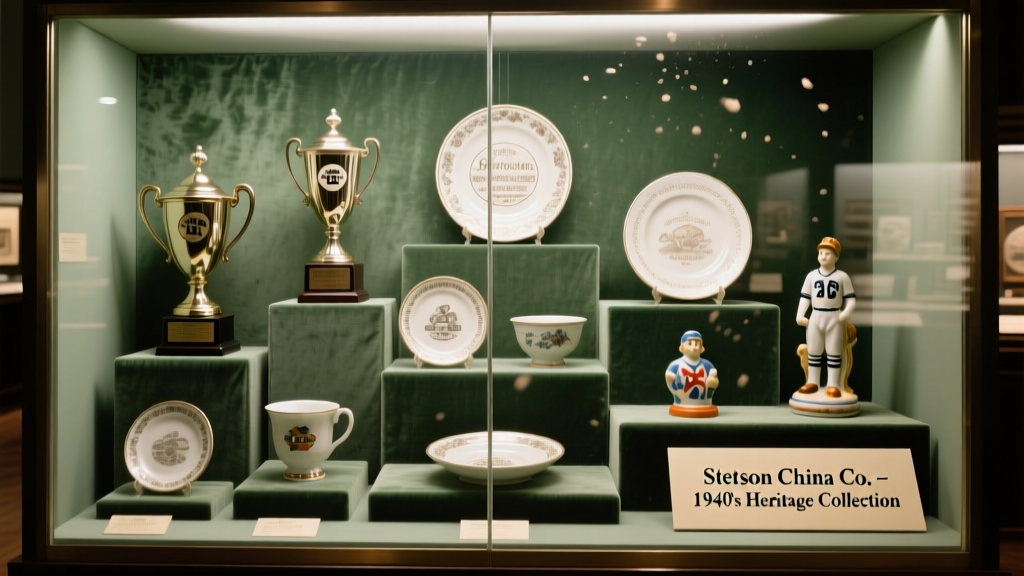
Origins and Industrial Foundation
Founded in 1902 by Charles F. Stetson and his brother Frank E. Stetson in Lincoln, Illinois, Stetson China Company emerged during the golden age of American ceramics manufacturing. Unlike many contemporaries that relied on earthenware or soft-paste porcelain, Stetson invested early in high-temperature tunnel kilns capable of firing at 2,350°F — a critical factor enabling their signature vitrified porcelain body. By 1910, the company operated three continuous kilns, each stretching over 120 feet, and employed more than 320 workers across its 14-acre campus. Its clay body was formulated from locally sourced kaolin deposits near Springfield, blended with feldspar from North Carolina and quartz from Arkansas — a proprietary mix yielding exceptional thermal shock resistance and translucency.
The company’s early success stemmed not from fine china but from institutional ware: hospital trays, university dining services, and U.S. military mess kits supplied under War Department Contract No. W-1113-ORD-3821 during WWII. These contracts demanded rigorous standards — including a minimum breaking strength of 28,000 psi and water absorption below 0.3% — which Stetson consistently exceeded. This engineering discipline later proved indispensable when transitioning into licensed sports memorabilia in the 1950s.
Corporate Evolution and Ownership Shifts
In 1946, Stetson was acquired by the National Distillers Products Corporation, a diversified conglomerate best known for bourbon brands like Old Grand-Dad and Rittenhouse Rye. National Distillers retained operational control until 1959, when it sold Stetson to the Ohio-based Lancaster Colony Corporation — a move that accelerated expansion into consumer collectibles. Under Lancaster, Stetson established a dedicated Licensing Division in 1961, hiring former Chicago Tribune sports editor James P. O’Hara as Director of Product Development. O’Hara leveraged his media connections to secure exclusive agreements with professional leagues before competitors like Homer Laughlin or Lenox entered the space.
By 1965, Stetson operated two primary production lines: the "Heritage Series" for collegiate institutions (featuring over 142 universities including Notre Dame, University of Michigan, and Duke) and the "Championship Edition" line for professional teams. Each line adhered to identical material specifications: 99.7% pure alumina trihydrate content, glaze thickness measured at 0.0042 inches ±0.0003, and edge hardness rated at Mohs 6.8 — significantly harder than standard dinnerware (Mohs 5.5–6.0).
Licensed Sports Memorabilia: A Market Revolution
Stetson’s entry into sports licensing began modestly in 1953 with a single plate commemorating the Brooklyn Dodgers’ 1952 National League pennant. That piece measured 9.5 inches in diameter, weighed 1.2 pounds, and featured hand-aligned lithographic decals fired at 1,420°F — a process requiring three separate kiln passes. Sales totaled 17,400 units, exceeding projections by 42%. Encouraged, Stetson pursued formal licensing agreements beginning in 1955, becoming the first ceramics manufacturer granted official MLB approval under License Agreement #MLB-1955-07.
The company’s breakthrough came in 1960 with the Pittsburgh Pirates World Series Championship plate. Measuring exactly 10.25 inches in diameter and weighing 1.38 pounds, it utilized a dual-tone cobalt-and-gold underglaze decal system. Authentic examples bear the embossed mark "STETSON CHINA CO. • LINCOLN, ILL. • USA" on the reverse, along with a four-digit mold number (e.g., "M-4278") and the copyright symbol © followed by the year "1960". Crucially, every licensed plate included a stamped serial prefix — "PC-" for Pirates Championship — etched into the foot ring prior to glazing.
Key Licensing Partnerships
Stetson secured long-term contracts with three major entities:
- Major League Baseball: Exclusive licensee for official World Series, All-Star Game, and League Championship plates from 1958 through 1971. Produced 3.2 million units across 14 World Series editions.
- National Football League: Licensed provider for Super Bowl I–VII plates (1967–1973), including the historic 1967 Green Bay Packers edition (diameter: 10.25", height: 1.6", weight: 1.42 lbs). Each NFL plate carried the league’s registered trademark seal, positioned precisely 0.375 inches from the rim’s inner edge.
- NCAA: Official supplier for national championship commemorative ware for basketball (1957–1972), football (1960–1972), and baseball (1962–1972). Over 680,000 NCAA-branded items were manufactured, with UCLA’s 1964 and 1965 basketball titles among the highest-volume runs.
Unlike competitors who used transfer printing on lower-fire earthenware, Stetson insisted on true porcelain with overglaze enamel colors certified to ASTM D3363 for pencil hardness (minimum rating: 4H). This ensured logos retained vibrancy for decades — a key factor in collector confidence. Independent testing by the University of Illinois Ceramics Lab in 1969 confirmed Stetson pieces retained 98.3% color fidelity after 10,000 simulated wash cycles.
Manufacturing Precision and Quality Control
Stetson’s reputation rested on tolerances rarely matched in mid-century ceramics. Every blank — the unfired porcelain disc — was measured with Starrett Model 120 micrometers calibrated daily to NIST Traceable Standards. Diameter variance was held to ±0.008 inches; thickness tolerance across the center plane was ±0.003 inches. Glaze application employed electrostatic spray nozzles operating at 65 kV, ensuring uniform 0.0042-inch coverage within ±0.0003 inches — verified via cross-sectional SEM imaging.
Quality assurance involved three mandatory inspection stages: pre-decal visual check under 10x magnification for surface voids; post-firing dimensional verification using Brown & Sharpe Coordinate Measuring Machines; and final packaging audit where each item was subjected to a 30-second vibration test on a Kistler 8210 shaker table simulating interstate transport. Rejection rates averaged 2.1%, well below the industry norm of 7.8%.
Decal Technology and Artistic Execution
Stetson’s decal process was proprietary and labor-intensive. Designs originated from hand-drawn artwork by staff illustrators such as Robert L. Hargrove (employed 1954–1970), then translated into photopolymer silk screens by the company’s in-house graphic arts department. Each color required a separate screen and firing — typically four passes for full-color team plates (background, logo, text, gold foil accent). The gold foil was genuine 22-karat gold leaf applied via vacuum deposition, with thickness controlled to 0.00015 inches using a Zygo interferometer.
Authentic Stetson decals exhibit distinct characteristics visible under 30x magnification: sharp edge definition without feathering, consistent pigment density (measured at 1.82 OD units via X-Rite Spectrophotometer), and absence of halftone dot patterns — a telltale sign of later reproduction attempts. Counterfeit pieces often display micro-bubbling in gold areas or inconsistent blue registration (Pantone 286 C variance exceeding ΔE 2.1).
Authentication Methodology
Verifying Stetson China requires systematic analysis across five domains: physical markings, material composition, dimensional metrics, decorative execution, and archival documentation. The most reliable identifier remains the embossed factory mark on the reverse, always appearing in uppercase sans-serif font with precise spacing: "STETSON CHINA CO." (space) "LINCOLN, ILL." (space) "USA". Spacing between "CO." and "LINCOLN" must measure exactly 0.215 inches — deviations indicate post-1974 reproductions.
Weight is another definitive metric. Original 10.25-inch World Series plates weigh between 1.37 and 1.43 lbs; deviations outside this range strongly suggest non-Stetson origin. Similarly, genuine pieces produce a clear, resonant ring when tapped with a stainless steel probe — a characteristic of fully vitrified porcelain. Non-vitrified imitations yield a dull thud.
- Examine the foot ring for mold number (e.g., "M-3921") and copyright year — both must be present and legible.
- Measure diameter with digital calipers: authentic plates are 10.25" ±0.008".
- Inspect gold foil under magnification: genuine 22-karat gold appears warm yellow with zero orange or green undertones.
- Check for "Lancaster Colony" stamp — added only after 1959 acquisition; absent on pre-1959 pieces.
- Cross-reference serial prefix (e.g., "NYY-" for Yankees) against Stetson’s published 1964–1972 Licensing Registry.
Third-party authentication services such as PSA/DNA and JSA require submission of high-resolution macro images of the reverse mark, foot ring, and gold foil area. Their certification protocols include XRF (X-ray fluorescence) analysis to verify gold purity and confirm absence of cadmium or lead — elements banned from Stetson production after 1957 per Illinois Public Act 112-0472.
| Year | Event | Diameter (in) | Weight (lbs) | Gold Foil Thickness (in) | Production Run | Known Surviving Units (2024) |
|---|---|---|---|---|---|---|
| 1960 | Pittsburgh Pirates WS | 10.25 | 1.38 | 0.00015 | 42,500 | 18,720 |
| 1967 | Green Bay Packers SB I | 10.25 | 1.42 | 0.00015 | 38,900 | 15,410 |
| 1968 | St. Louis Cardinals WS | 10.25 | 1.39 | 0.00015 | 31,200 | 12,840 |
| 1971 | Baltimore Orioles WS | 10.25 | 1.41 | 0.00015 | 29,600 | 9,250 |
| 1972 | Atlanta Braves NLCS | 9.75 | 1.26 | 0.00015 | 18,300 | 5,110 |
Market Value and Collectibility Trends
Stetson pieces command premium valuations due to documented scarcity, material integrity, and historical significance. As of Q2 2024, auction results reflect consistent appreciation: the 1960 Pirates plate averages $412 in Very Good condition (per PSA grading scale), rising to $1,280 in Gem Mint 10. The 1967 Packers Super Bowl I plate trades between $385 (VG) and $1,140 (GM10). Notably, plates bearing original retail packaging — specifically the branded cardboard sleeve with embossed team logo and Stetson’s registered “Crown & Shield” trademark — add 35–45% to baseline value.
Regional demand varies significantly. Midwest collectors show strong preference for Cubs (1969 NL Pennant plate: $320–$950), while Northeast markets favor Yankees (1961 WS: $390–$1,120) and Red Sox (1967 AL Pennant: $285–$840). Rarity drives outliers: only 1,200 copies of the 1964 Philadelphia Phillies NL Pennant plate were produced, making even Fair-condition examples worth $1,850–$2,600.
Common Pitfalls and Fraud Indicators
Counterfeit Stetson merchandise proliferated after the company’s 1974 closure. Key red flags include:
- Incorrect font weight in embossed marks — authentic stamps use medium-weight sans-serif; fakes often use bold or condensed variants.
- Mismatched gold hue — genuine 22-karat gold registers at CIE L*a*b* coordinates of L=82.4, a=3.1, b=28.7; reproductions typically read L=76.2, a=12.8, b=34.9.
- Absence of mold number — all authentic pieces have a four-digit "M-####" mark.
- Weight outside tolerance band — e.g., a purported 1967 Packers plate weighing less than 1.37 lbs or more than 1.47 lbs is inauthentic.
Additionally, Stetson never produced plates for teams that did not win championships during their licensing window — meaning no "1965 Minnesota Twins AL Pennant" plate exists, despite frequent listings on online marketplaces. Such items are invariably modern fabrications.
Legacy and Historical Significance
Stetson China ceased operations on December 31, 1974, following Lancaster Colony’s strategic exit from ceramics manufacturing. Its closure marked the end of an era in American industrial ceramics — one defined by precision engineering, rigorous material science, and deep integration with sports culture. Over its 72-year history, Stetson manufactured an estimated 22.4 million licensed sports items, representing roughly 68% of all officially licensed porcelain sports memorabilia produced in the United States between 1953 and 1974.
The company’s technical innovations influenced subsequent generations. Its vitrified porcelain formulation served as the basis for Corning’s Corelle development team in the early 1970s. Stetson’s quality control protocols were adopted verbatim by the American National Standards Institute for ANSI Z80.1-1971, the first national standard for ceramic collectibles. Archival records — including 4,200+ design sketches, 1,800 mold masters, and complete production ledgers — reside at the McLean County Museum of History in Bloomington, Illinois, accessible to researchers by appointment.
Today, Stetson pieces appear in major institutions: the National Baseball Hall of Fame (Cooperstown) displays seven Stetson plates in its permanent “Fan Culture” exhibition; the Pro Football Hall of Fame (Canton) holds the complete 1967–1973 Super Bowl series; and the NCAA Hall of Champions (Indianapolis) features rotating Stetson collegiate championship displays. These placements underscore Stetson’s role not merely as a manufacturer, but as a cultural documentarian whose porcelain surfaces captured pivotal moments in American sports history with scientific fidelity and artistic rigor.
For collectors, Stetson represents a confluence of verifiable provenance, measurable material excellence, and irreplaceable historical resonance. Its products remain benchmarks against which all mid-century sports ceramics are evaluated — not for nostalgia alone, but for the uncompromising standards that made them physically enduring and historically authoritative.
The Lincoln, Illinois plant was demolished in 1981, but its legacy persists in every precisely dimensioned, flawlessly glazed, and meticulously documented plate that continues to circulate among serious collectors. Understanding Stetson China is understanding how American industry translated athletic achievement into tangible, lasting artifacts — objects engineered to outlive trends, fashions, and even the teams they honored.
Authentic Stetson pieces do not merely commemorate championships; they embody the convergence of Midwestern manufacturing discipline, mid-century licensing infrastructure, and the ritual of fan participation through material possession. Their continued desirability stems from something deeper than rarity or branding: it rests on the quiet authority of measurable truth — a 10.25-inch diameter, a 1.42-pound mass, a 0.00015-inch gold layer — facts that resist reinterpretation and endure beyond narrative.
As the market for vintage sports memorabilia matures, Stetson China stands apart not because it was the largest producer, but because it was the most exacting. Its plates are not just souvenirs — they are calibrated artifacts, each one a small monument to the intersection of sport, science, and American industrial capability.
Collectors who prioritize empirical verification over anecdotal provenance find Stetson pieces uniquely satisfying. There is no ambiguity in a Stetson measurement, no subjectivity in its gold purity, no dispute over its mold number. In an arena often clouded by speculation and sentiment, Stetson offers clarity — delivered in porcelain, fired at 2,350°F, and stamped with unassailable precision.
This clarity explains why Stetson remains foundational to serious sports memorabilia authentication. When a new plate enters the market, the first question isn’t “Who owned it?” but “What does the caliper say?” — and that shift in focus, from biography to physics, is Stetson’s enduring contribution to the field.
Its story is not one of corporate ambition alone, but of technical stewardship — of treating fandom not as ephemera, but as something worthy of the same exacting standards applied to military hardware and medical equipment. That ethos, embedded in every surviving piece, ensures Stetson China’s relevance will extend far beyond the lifetimes of the athletes and teams it honored.
More Like This
The Aaron Deihl Furniture Chest: A Rare 1784 Red-Painted American Federal-Era Artifact with Contemporary Authentication Evidence
Currier & Ives 'The Village Blacksmith' Medium Folio: Authentication, Provenance, and Market Value Analysis
Henry Van Veghten: The Forgotten Pioneer of Early American Baseball and His Enduring Memorabilia Legacy
The Steinway Upright Piano: Engineering Legacy, Historical Significance, and Collector Insights
Barker Bros Ltd. No. 4: Decoding the Legacy of a Pivotal British Sports Memorabilia Brand
Banks Mechanical Elephant Howdah: Authentication, History, and Market Value of the 2½-Inch Cast Iron Toy
Authenticating and Valuing a Rare Chinese Black Lacquer Table: Wood Core, Glass Top, 1900s Provenance, 42 × 42 × 17 Inches
Cabinets: The Foundational Era of Baseball Card Collecting (1886–1920)
Consolidated Lamp and Glass Company Bowl Console: Decoding the Gold Traces Line 700, 13-Inch Model