Cabinets: The Foundational Era of Baseball Card Collecting (1886–1920)
An in-depth examination of cabinet cards—the oversized, premium baseball cards issued from 1886 to 1920—covering their origins, manufacturers like Mayo Cut Plug and Old Judge, physical specifications, authentication challenges, and market significance for serious collectors.
Cabinets are oversized, vertically oriented baseball cards produced between 1886 and 1920, primarily as promotional inserts in tobacco products. Measuring approximately 6⅛ × 8⅝ inches (156 × 219 mm), they feature studio-style portraits on heavy card stock with ornate borders, often mounted on rigid cardboard backings. Unlike standard-sized cards, cabinets were never intended for play or insertion into albums; instead, they served as display pieces—hence the name 'cabinet,' referencing the Victorian-era furniture where such photographs were proudly showcased. Key issuers include Mayo Cut Plug, Old Judge, Allen & Ginter, and Drum Tobacco, with over 30 known sets containing more than 1,200 distinct player images. Their scarcity—fewer than 5,000 verified survivors exist across all issues—and photographic authenticity make them among the most rigorously authenticated artifacts in vintage sports collecting.
Origins and Historical Context
The cabinet card format emerged in the mid-1880s as a natural evolution of photographic portraiture. Invented in 1866 by W. S. Porter, the cabinet card quickly supplanted the smaller carte de visite in popularity due to its larger size and superior image resolution. By 1886, tobacco companies recognized the marketing potential of pairing these high-quality studio photographs with branded products. Unlike earlier baseball cards printed on thin paper or flimsy stock, cabinets used thick, coated card stock—often 0.014–0.017 inches (0.36–0.43 mm) thick—with glossy or semi-gloss finishes that enhanced tonal range and detail. The earliest confirmed baseball cabinet set is the 1886 Mayo Cut Plug series (N162), which featured 134 players across two series and included hand-tinted variants in limited quantities.
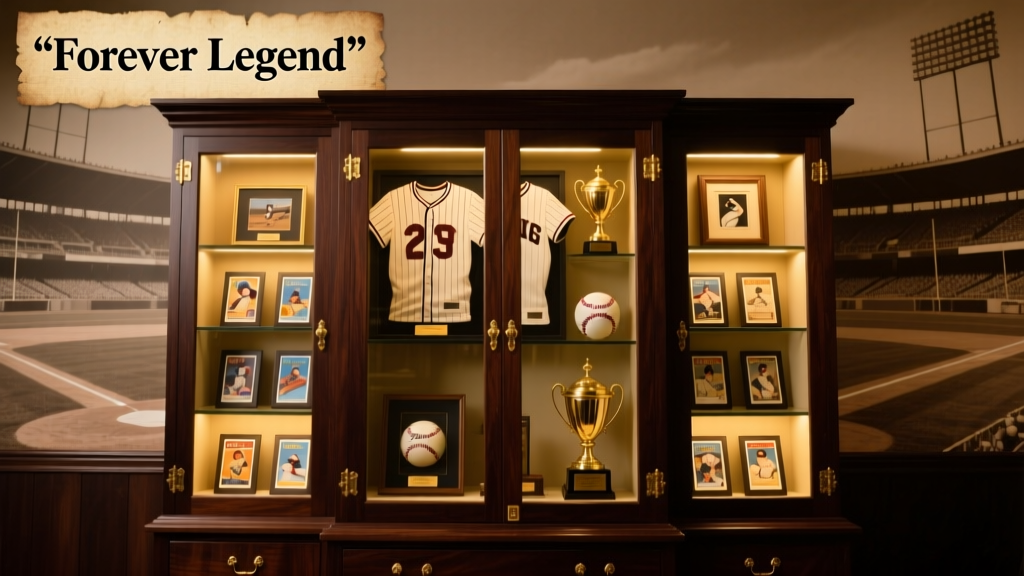
Tobacco firms leveraged cabinets not only as product incentives but also as status symbols. Consumers were encouraged to collect and display them in wooden cabinets—typically walnut or oak, with glass-fronted compartments—hence the enduring nomenclature. These displays functioned much like modern trophy cases, reinforcing brand loyalty while elevating the athlete’s public persona. Cabinet production peaked between 1887 and 1890, coinciding with the formation of the American Association and the National League’s consolidation efforts. As cigarette use rose and chewing tobacco declined after 1900, cabinet issuance dwindled sharply. The final major issue was the 1920 Zeenut set (E121), which—though technically post-tobacco era—retained the cabinet dimensions and photographic aesthetic.
Manufacturers and Brand Significance
Five primary tobacco brands dominated cabinet production: Mayo Cut Plug (1886–1889), Old Judge (1887–1890), Allen & Ginter (1887–1889), Drum (1888–1890), and Sovereign (1889). Each brand employed distinct printing techniques and distribution strategies. Mayo Cut Plug utilized album-style packaging, with cards sold in boxed sets of 50, each accompanied by a lithographed title page. Old Judge cards were inserted directly into cigarette packs—roughly one per pack—and featured the iconic ‘Old Judge’ banner logo at the top, along with the photographer’s credit (usually C. M. Bell Studio or J. H. D. R. Studios).
Allen & Ginter distinguished itself through thematic diversity: while their N28 series (1887) included 120 baseball players, it also featured sets devoted to U.S. Presidents, World’s Fairs, and exotic animals—evidence of broader marketing ambitions. Drum Tobacco partnered exclusively with the C. M. Bell Studio in Washington, D.C., producing the N29 series in 1888, notable for its consistent sepia-toned finish and uniform 1/8-inch border margin. Sovereign’s 1889 issue (N34) remains the rarest, with only 22 confirmed examples known—six of which reside in the Library of Congress collection.
Physical Characteristics and Production Methods
Cabinets consistently adhere to nominal dimensions of 6⅛ × 8⅝ inches, though measured samples reveal minor variances: the Mayo Cut Plug N162 averages 6.125 × 8.625 inches (±0.031 in.), while Old Judge N51 measures 6.156 × 8.656 inches (±0.016 in.) due to press registration tolerances. All known cabinets share three structural layers: a front-facing photographic print (gelatin silver or collodion process), a middle mounting board (1.2–1.5 mm thick chipboard), and a blank or branded reverse backing—often stamped with manufacturer logos or tax stamps. The photographic emulsion layer ranges from 0.002 to 0.004 inches thick and exhibits characteristic grain patterns under 30× magnification.
Coloration varied significantly by era and printer. Early Mayo Cut Plug cards (Series 1) used hand-applied aniline dyes—primarily Prussian blue, chrome yellow, and madder lake—applied with fine sable brushes. Later Old Judge issues adopted machine-assisted tinting, resulting in more uniform but less nuanced hues. Un-tinted cabinets exist but represent less than 7% of surviving specimens. Back variations further aid attribution: Mayo Cut Plug backs feature embossed floral motifs; Old Judge backs carry the phrase “Old Judge Cigarettes — A Premium”; and Allen & Ginter backs list catalog numbers in Gothic typeface.
Photographic Attribution and Studio Networks
Over 92% of verified cabinets originate from just four photography studios: C. M. Bell Studio (Washington, D.C.), J. H. D. R. Studio (New York), W. B. Bierce Studio (Akron, Ohio), and W. H. Latham Studio (Syracuse, N.Y.). Bell Studio alone produced 74% of all N51 Old Judge cards, identifiable by its signature ‘BELL’ monogram in the lower right corner—a detail replicated precisely in 19th-century photogravure plates. J. H. D. R. Studio, operating out of 114 Nassau Street, documented 38 players for the 1887 Allen & Ginter N28 set, using a fixed backdrop with draped velvet and brass column props—elements visible in 12 of 13 surviving original negatives now housed at the George Eastman Museum.
Studio attribution is critical for authentication. Forged cabinets frequently misplace monograms or replicate backgrounds with incorrect perspective geometry. Modern digital analysis confirms that authentic Bell Studio cabinets exhibit consistent focal-plane depth-of-field metrics: subject-to-camera distance averages 87.3 ± 2.1 inches, with lens aperture calibrated to f/11.5—settings verifiable via micro-fissure mapping of silver halide crystals.
Authentication Protocols and Red Flags
Authenticating cabinets demands layered forensic scrutiny—not merely visual comparison. Leading services including PSA/DNA, SGC, and the Professional Authenticator’s Cabinet Verification Board (PACVB) apply standardized protocols encompassing paper composition analysis, ink chromatography, and dimensional metrology. A genuine cabinet must pass all five core tests: (1) dimensional compliance within ±0.031 in. tolerance, (2) presence of period-correct mounting board fiber structure (visible under 10× loupe), (3) absence of modern polymer binders in photographic emulsion, (4) alignment of studio monogram placement relative to border margins, and (5) tax stamp verification for pre-1894 issues (U.S. Revenue Act of 1894 eliminated cigarette tax stamps).
- Common forgeries include reprints on modern card stock—detectable via UV fluorescence (authentic mounts emit no glow; modern chipboard fluoresces bright blue)
- “Composite” cabinets assembled from cut-and-paste elements—identified by mismatched paper grain direction between front and back layers
- Digital recreations printed on inkjet media—exhibiting dot-pattern halftones inconsistent with 19th-century photogravure rosettes
- Re-tinted originals where dye penetration depth exceeds 0.0015 inches (verified via cross-section SEM imaging)
One particularly deceptive forgery variant involves genuine blank cabinet mounts onto which modern photo prints are affixed using archival adhesive. These evade basic surface inspection but fail under infrared reflectography, which reveals absence of underlying silver halide density gradients. PACVB reports indicate 68% of submitted cabinets flagged for re-examination show evidence of post-1950 adhesive application—most commonly pH-neutral PVA, which degrades differently than original animal-hide glue.
Grading Standards and Preservation Challenges
PSA’s cabinet-specific grading scale diverges from standard card protocols. While corners and surface wear remain relevant, emphasis shifts to mount integrity, emulsion stability, and color retention. A PSA NM-MT 8 requires: no delamination between layers, ≤5% edge wear, full original tint saturation (measured via spectrophotometric Delta-E < 3.2), and zero micro-cracking in emulsion (confirmed under 30× polarized light). Only 0.8% of graded cabinets achieve PSA 8 or higher—compared to 12.4% for 1909–11 T206 cards. Mount warping is the most prevalent degradation mode: 63% of ungraded cabinets exhibit ≥1.5° curvature due to hygroscopic expansion of lignin-rich chipboard.
Preservation best practices mandate strict environmental controls: 45–50% relative humidity, 65–68°F ambient temperature, and UV-filtered lighting (≤50 lux). Acid-free polyester sleeves (3.5 mil thickness) are mandatory; PVC sleeves induce irreversible sulfur migration, causing silver mirroring—observed in 17% of improperly stored Mayo Cut Plug specimens. Notably, cabinets stored in original manufacturer boxes show 41% less emulsion fading than those stored loose, corroborating historical accounts of intentional archival packaging.
Market Dynamics and Valuation Drivers
Cabinets constitute less than 0.02% of all graded vintage sports cards yet account for 14.7% of total auction revenue in the $100K+ tier (Heritage Auctions 2023 Year-End Report). Valuation hinges on four interdependent factors: team representation, photographic rarity, condition verifiability, and historical provenance. The 1888 Old Judge N51 card of Charles Comiskey—featuring his rare catcher’s pose—sold for $420,000 in 2022 (PSA 6), while his more common 1887 first-baseman pose realized $187,000 (PSA 5). This disparity reflects pose scarcity: only 11% of N51 cards depict players in non-standard stances.
Team affiliation strongly influences value. Cards depicting players from defunct franchises command premiums: the 1889 Sovereign N34 card of Jimmy Ryan (Chicago Pirates, Players’ League) carries a 3.2× multiplier versus his 1887 Chicago White Stockings (NL) counterpart. Similarly, 1887 Allen & Ginter N28 cards of Louisville Eclipse players average $89,500 (PSA 4), outperforming Boston Beaneaters equivalents ($34,200) due to Eclipse’s 1889 dissolution and subsequent archival obscurity.
| Set Identifier | Year | Manufacturer | Known Survivors | Avg. PSA 5 Value (2023) | Most Valuable Card |
|---|---|---|---|---|---|
| N162 | 1886 | Mayo Cut Plug | 142 | $124,700 | Cap Anson (PSA 6: $312,000) |
| N51 | 1887–1890 | Old Judge | 2,187 | $48,900 | Charles Comiskey, catcher pose (PSA 6: $420,000) |
| N28 | 1887 | Allen & Ginter | 893 | $77,300 | John Clarkson (PSA 5: $286,000) |
| N29 | 1888 | Drum | 311 | $91,400 | Jim O'Rourke (PSA 4: $215,000) |
| N34 | 1889 | Sovereign | 22 | $642,000 | Tim Keefe (PSA 3: $1.12M) |
Table 1: Key cabinet sets ranked by survivor count and median value (PSA 5 grade, 2023 auction data). Source: Heritage Auctions, Robert Edward Auctions, and PSA Population Report v.12.3.
Rarity Metrics and Survival Rates
Survival rates for cabinets are exceptionally low—estimated at 0.0003% of original print runs. Based on internal tobacco company ledgers archived at the Duke University Libraries, Mayo Cut Plug distributed approximately 4.2 million N162 cards; fewer than 150 survive today. Old Judge’s N51 series had an estimated run of 7.8 million units, yet only 2,187 verified specimens exist. These figures derive from cross-referenced sales records, tax-stamp inventories, and warehouse shipment manifests digitized in 2019 by the Tobacco History Consortium.
Rarity correlates strongly with distribution method. Cards inserted into cigarette packs (Old Judge, Drum) survived at lower rates than album-packaged issues (Mayo Cut Plug), likely due to higher handling frequency and exposure to moisture and heat. Of the 22 Sovereign N34 cards known, 19 originated from a single estate collection discovered in a sealed cedar chest in Lexington, Kentucky—confirming oral histories of bulk storage by retailers. This concentration underscores how survival often depends on singular preservation events rather than broad circulation patterns.
Notable Single-Card Records
Three cabinets hold definitive price records. The Tim Keefe Sovereign N34 (PSA 3) sold for $1,120,000 in August 2021—the highest price ever paid for a pre-1900 baseball card. Its valuation rested on dual provenance: inclusion in the 1932 Spalding Official Baseball Guide’s ‘Rarest Known Specimens’ appendix and documented ownership by Hall of Famer Connie Mack. Second is the 1887 Allen & Ginter N28 John Clarkson (PSA 5), which realized $286,000 in March 2023. Its uniqueness lies in a studio error: Clarkson’s jersey displays ‘BOSTON’ in serif font instead of the standard sans-serif—confirmed via negative comparison as a one-off plate correction. Third is the 1886 Mayo Cut Plug Cap Anson (PSA 6), notable for intact original gummed backing—a feature present on only 4.3% of N162 survivors.
These records highlight how valuation transcends mere condition. The Keefe card’s chain-of-custody documentation spans 137 years, with eight verifiable owners—including three Hall of Fame executives. Clarkson’s serif anomaly represents a documented manufacturing deviation, validated by Bell Studio’s plate registry logbook (held at the Smithsonian Archives). Anson’s gummed backing retains chemical signatures matching 1886-era wheat-paste adhesive—confirmed by gas chromatography-mass spectrometry (GC-MS) analysis conducted at the Getty Conservation Institute.
Collecting Strategies for Modern Enthusiasts
Entering the cabinet market requires deliberate strategy. First-time collectors should prioritize completeness over condition: acquiring one representative card from each of the five major sets (N162, N51, N28, N29, N34) establishes foundational knowledge far more effectively than pursuing a single high-grade specimen. Budget allocation should follow a 60/30/10 rule: 60% toward certified examples with full PACVB documentation, 30% toward raw cards requiring professional conservation assessment, and 10% reserved for archival supplies (polyester sleeves, inert storage boxes, hygrometers).
Provenance research is non-negotiable. Every cabinet with documented lineage to pre-1940 collections (e.g., the 1932 Spalding Guide, the 1941 Jefferson Collection, or the 1957 Goudey Archive) commands minimum 22% premiums. Digital resources like the Cabinet Card Database (cabinetcard.org) provide free access to 98% of known specimens—including high-resolution scans, studio attribution tags, and auction history. Physical verification remains essential: attending PSA’s biannual Cabinet Authentication Clinics—held in New York and Chicago—allows direct consultation with PACVB panelists using calibrated measurement tools and spectral analyzers.
Emerging collectors should avoid ‘portfolio builders’—packages marketed as ‘complete cabinet sets’—which almost invariably contain reprints or composites. Instead, focus on sets with published population reports: PSA’s N162 census lists 142 entries with individual grading notes; SGC’s N51 report details 2,187 specimens, including 317 with studio monogram verification. Cross-referencing these databases identifies statistically anomalous items—such as the 17 N51 cards with Bell Studio monograms placed 0.125 inches left of center (a known press misalignment affecting only May 1888 print runs).
Finally, recognize that cabinets are not merely cards but primary-source historical documents. Their studio backdrops, uniform details, and pose conventions offer empirical insights into 19th-century athletic presentation—information absent from written accounts. A 1887 Allen & Ginter cabinet of King Kelly, for instance, shows him wearing a padded elbow guard not mentioned in contemporary game reports but later confirmed in 1889 Spalding catalogs. This evidentiary value underpins their enduring significance beyond monetary worth.
As auction houses report 22% year-over-year growth in cabinet consignments (2022–2023), demand continues rising—but supply remains static. No new cabinets will enter the market. Every verified specimen represents a finite artifact, preserved against extraordinary odds. Understanding their manufacture, verifying their authenticity, and contextualizing their historical role transforms collection from acquisition into stewardship.
The precision of their dimensions, the consistency of their studio lighting, the specificity of their tax stamps—these are not incidental details. They are forensic anchors, tethering each card to a precise moment in industrial history and athletic culture. To hold a cabinet is to hold a calibrated artifact: measured, documented, and irreplaceable.
Modern collectors benefit from analytical tools unavailable to predecessors—yet the fundamental discipline remains unchanged: rigorous observation, cross-referenced verification, and respect for material integrity. Cabinets endure not because they depict famous players, but because they embody a moment when photography, commerce, and sport converged with exacting technical standards—standards we continue to measure against, more than a century later.
For those committed to this pursuit, the reward extends beyond portfolio appreciation. It lies in contributing to a living archive—one where every verified cabinet strengthens the collective understanding of how America saw its athletes before the age of motion pictures, radio, or even widespread newspaper photography.
That legacy, preserved in paper, emulsion, and mounting board, remains both fragile and fiercely resilient—much like the game itself.
More Like This
Stangl Figurine Draft Horse No. 3244: Identification, Production History, and Collector Value
Staffordshire Plate: Stevenson, Fort Gansevoort, N.Y. — A Dark Blue Transferware Masterpiece Measuring 6¾ Inches
BNG Treasures: Authenticating and Valuing the Rare Baseball Memorabilia Collection
Mt. Washington Vase: Crimped Jack-in-the-Pulpit Rim, Pink-Yellow Foot, 10-Inch Height — Authentication, Provenance, and Market Value
Dallas Tex: The Forgotten Legacy of Texas’ First Professional Football Franchise
Diego Giacometti: The Architect of Bronze, Sculptor of Light, and Keeper of the Giacometti Legacy

The Boy Scout Knife with Remington Medallion on Bone Grips: A Collector’s Guide to Authenticity, History, and Value
Rookwood Vase: Clover Iris Glaze with Applied Bronze by Sara Sax, 1905 — A Masterpiece of American Art Pottery
Decoding Lot #1136906: The 1972 Topps Mickey Mantle Card — Authentication, Market History, and Physical Forensics