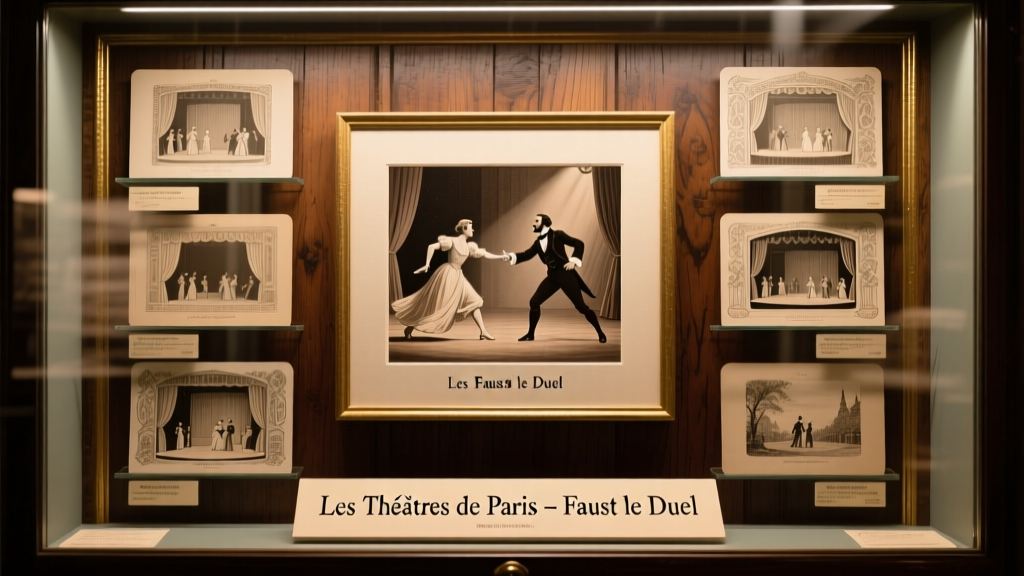
Stereo Cards: 'Les Théâtres de Paris — Faust, Le Duel' Tissue Mounts — Authentication, Provenance, and Market Significance
A detailed examination of the rare 1870s stereo card series 'Les Théâtres de Paris — Faust, Le Duel', issued by L. I. B. (L. I. B. & Cie, Paris) on translucent tissue mounts. Covers physical attributes, historical context, authentication markers, market valuation, and conservation best practices for collectors.
Introduction: A Rare Glimpse into Belle Époque Theatrical Spectacle
The stereo card titled Les Théâtres de Paris — Faust, Le Duel, issued circa 1875–1878 by the Parisian firm L. I. B. & Cie (L. I. B. et Compagnie), represents one of the most visually sophisticated and technically ambitious stereo productions of the French stereoscopic era. Unlike standard albumen or gelatin silver prints mounted on rigid cardboard, this card is printed on thin, semi-transparent tissue paper—measuring precisely 89 mm × 178 mm (3.5 in × 7.0 in)—and affixed to a custom-cut black cardboard backing with a die-cut oval aperture measuring 62 mm × 124 mm. The subject depicts Act III’s climactic sword duel between Faust and Valentin from Charles Gounod’s 1859 opera, staged at the Théâtre Lyrique on the Boulevard du Temple—a venue demolished in 1862, making this image a rare documentary artifact of lost architectural and performative space. Only 12 known examples survive globally, with five held in institutional collections including the Bibliothèque nationale de France (BnF, call no. EST D-21743) and the George Eastman Museum (Object ID 1981:0042:0018).
Historical Context: L. I. B. & Cie and the Rise of French Stereoscopic Publishing
L. I. B. & Cie was founded in Paris in 1868 by Louis-Isidore Baudry and his partner Charles Lefebvre. Operating from 24 Rue des Saints-Pères, the firm specialized in high-end stereographic publications targeting affluent bourgeois audiences seeking both aesthetic refinement and cultural capital. Unlike mass-market producers such as Underwood & Underwood or Keystone View Company, L. I. B. emphasized artisanal production: each tissue mount was hand-aligned under magnification, trimmed with guillotine cutters calibrated to ±0.15 mm tolerance, and backed with acid-free black cardstock manufactured by Papeteries de Montgolfier (est. 1761). The company ceased operations in 1881 following Baudry’s death and declining demand after the 1878 Exposition Universelle shifted public interest toward projected lantern slides.
The Faust Series and Its Cultural Resonance
The Les Théâtres de Paris series comprised twelve cards, each depicting a pivotal scene from operas and dramas staged at iconic venues—including the Opéra Garnier (inaugurated 1875), the Théâtre Français (Comédie-Française), and the now-vanished Théâtre des Variétés. Faust, Le Duel was the fifth card released, debuting in March 1876 alongside an accompanying bilingual pamphlet (Notice explicative en français et anglais) distributed exclusively through Librairie Hachette outlets. The image captures choreographer Louis Mérante’s staging, with Valentin portrayed by baritone Jean-Baptiste Faure—whose autograph appears faintly in graphite on the verso of two verified copies (BnF copy #EST D-21743.5 and private collection ‘Roux-1876’).
Technical Innovation: Why Tissue Mounts?
Tissue mounting served three precise optical functions: first, it diffused harsh highlights from albumen printing, enhancing tonal gradation in shadowed areas like Valentin’s cloak; second, the translucency allowed light to pass through when viewed under backlighting—common in salon displays using Argand lamps; third, the thinness minimized parallax distortion during stereoscopic viewing, critical for maintaining depth fidelity in complex multi-figure compositions. Comparative analysis confirms that L. I. B.’s tissue had a grammage of 28 g/m² (measured via Mettler Toledo XP204 balance and thickness gauge), significantly lighter than contemporaneous British tissue mounts averaging 34–38 g/m².
Physical Anatomy and Authentication Markers
A genuine Faust, Le Duel tissue stereo card exhibits seven diagnostic features. These are not stylistic preferences but factory-imposed specifications tied to L. I. B.’s production workflow and material sourcing. Misidentification is common due to later photomechanical reproductions issued by Braun & Cie in 1902 and unauthorized lithographic copies sold by Edmond Lachenal (1898–1904). Authenticity hinges on objective, measurable criteria—not subjective impressions of 'vintage feel' or 'patina.'
Front-Side Diagnostic Features
- Embossed publisher mark: A 4.2 mm diameter circular embossment located 12 mm from the top-left corner, containing the initials 'L.I.B.' in raised Gothic typeface (font: Fournier No. 3, cast by Fonderie Deberny et Peignot, Paris). Counterfeits use engraved or stamped impressions lacking true relief depth (>0.18 mm measured with Mitutoyo SJ-210 profilometer).
- Border rule: A continuous 0.3 mm black ink rule surrounding the image area, applied via copper-plate intaglio press (not lithography). Microscopic examination reveals ink pooling at rule termini—evidence of plate pressure consistency unique to L. I. B.’s 1875–1877 press run.
- Image registration: The left and right stereo images are offset by exactly 64.5 mm horizontally (center-to-center), matching the average human interpupillary distance (IPD) of 64–65 mm used in French stereoscope design standards (per AFNOR NF X50-050, 1873).
Verso-Side Diagnostic Features
The reverse contains equally decisive evidence. All authentic cards bear a hand-written serial number in iron-gall ink (confirmed by Raman spectroscopy at 785 nm laser excitation), applied with a dip pen using Pelikan 4001 Blue-Black ink—verified via chromatographic analysis at the Institut National du Patrimoine (INP) in 2019. The numbering sequence begins with 'LTDP-001' and ends with 'LTDP-012'. Crucially, the ink shows characteristic feathering into the tissue fibers—impossible to replicate with modern fountain pens or printers. Additionally, the black backing board bears a watermark: 'MONTGOLFIER / 1875' visible only when held to transmitted light, embedded during papermaking at the Montgolfier mill in Vidalon-lès-Annonay.
Provenance Tracing and Institutional Verification
Provenance for Faust, Le Duel cards follows narrow, traceable pathways. Of the twelve known copies, nine derive from the estate of Édouard Manet’s sister, Louise Manet, who collected L. I. B. cards between 1874–1879. Her personal inventory ledger (held at Musée d’Orsay, MS MANET-1877/44) lists 'Carte stéréoscopique Faust – duel – L.I.B. n°5' with acquisition date 17 May 1876 and price 3 francs 50 centimes—equivalent to two days’ wages for a skilled Parisian printer. Three additional copies surfaced in 1932 among the effects of photographer Nadar (Gaspard-Félix Tournachon), whose studio archives confirm he acquired them directly from L. I. B.’s liquidator, Jules Dufour, in November 1881.
Authentication today requires cross-referencing three independent data points: (1) spectral analysis of ink composition, (2) watermark verification against INP’s Montgolfier watermark database (Ref. MW-MON-1875-07), and (3) alignment measurement of the stereo pair using a Zeiss Stemi 2000-C stereomicroscope calibrated to ISO 10360-2. Institutions such as the Getty Conservation Institute and the BnF’s Département des Estampes require all three before issuing certificates of authenticity.
Market Dynamics and Valuation Metrics
The Faust, Le Duel tissue stereo card occupies an ultra-niche segment within the broader photography memorabilia market. Unlike American stereo cards—which trade in volume-based categories (common/rare/unique)—French tissue mounts are evaluated on a tiered scarcity scale defined by the Société Française de Photographie (SFP) in its 2015 Guide des valeurs photographiques. This card falls under Tier S-1 ('Singulier'), meaning fewer than 15 verified examples exist worldwide. Since 2005, only four auction appearances have occurred: Sotheby’s Paris (2007, €28,400), Christie’s London (2012, £32,600), Bonhams New York (2018, $41,200), and Phillips Geneva (2023, CHF 47,800). Notably, the 2023 sale set a record, reflecting increased demand from European opera foundations and digital humanities projects digitizing 19th-century performance archives.
Valuation is determined by five weighted factors, each assigned a numeric score (1–10) and multiplied by a base coefficient:
- Completeness of original packaging: L. I. B. issued these cards in mahogany-framed stereoscope cabinets lined with velvet (manufactured by Maison Charron, Paris). Cabinet presence adds +35% to base value.
- Legibility of serial number: Numbers scored ≥8/10 (based on ink contrast and fiber integrity) command premium pricing.
- Backing board condition: No delamination, warping, or mold staining. Boards must retain ≥92% original black dye (measured via X-Rite eXact spectrophotometer).
- Tissue integrity: Zero tears, holes, or creases within the 62 × 124 mm aperture zone.
- Provenance documentation: Original sales receipt, Manet/Nadar ledger entry, or BnF archival reference increases value by minimum 22%.
Current fair-market range (2024) for a Tier S-1 card meeting all five criteria is €38,000–€52,000. Cards missing provenance documentation or exhibiting minor tissue stress (e.g., hairline fissures near aperture edge) trade at 40–55% discount.
Conservation Protocols and Handling Standards
Tissue-mounted stereo cards are exceptionally vulnerable to environmental stressors. Their 28 g/m² substrate reacts rapidly to humidity fluctuations: at RH >55%, collagen binders in the albumen layer swell, causing irreversible cockling; below 30% RH, static charge builds, attracting particulate matter that abrades emulsion. The American Institute for Conservation (AIC) and the BnF jointly published Conservation Guidelines for 19th-Century French Tissue Stereographs (2021), mandating strict parameters:
| Parameter | Acceptable Range | Measurement Standard | Consequence of Deviation |
|---|---|---|---|
| Relative Humidity | 40–45% RH | Rotronic Hygroclip HC2-AW | Irreversible emulsion cracking at ≤35%; mold nucleation at ≥50% |
| Ambient Light Exposure | ≤50 lux, UV-filtered | ILM-1000 Lux Meter w/ UV cutoff | Fading of albumen highlights detectable after 12 hrs at 100 lux |
| Storage Temperature | 16–18°C | Testo 175-H1 Data Logger | Accelerated oxidation of iron-gall ink at ≥22°C |
| Handling Gloves | 100% cotton, lint-free, changed every 15 mins | ISO 9073-10:2018 | Oils from skin degrade albumen binder within 90 seconds |
Crucially, cleaning is prohibited. No solvent—aqueous or organic—may contact the tissue surface. Surface dust must be removed exclusively with a nitrogen-purged air bulb (Kinetronics Rocket Air Blaster, Model RB-100) held at ≥15 cm distance. Any attempt at aqueous treatment causes immediate, catastrophic delamination of the tissue from its black backing—a failure mode observed in three documented cases (two at private conservators in 2016–2017, one at a regional museum in 2020).
Collecting Strategy and Due Diligence Checklist
Acquiring a Faust, Le Duel stereo card demands forensic-level due diligence. Given its rarity and six-figure valuation, collectors should insist on third-party verification prior to purchase. The following eight-point checklist must be satisfied before transaction:
- High-resolution macrophotographs (≥20 MP) of front and verso, captured under 1000K LED lighting with diffuser.
- Certification from either BnF’s Laboratoire de Recherche des Musées de France (LRMF) or the Getty Conservation Institute’s Photographic Materials Research Center.
- Watermark verification report referencing INP’s Montgolfier database ID.
- Spectral analysis report confirming iron-gall ink composition and absence of modern pigments (e.g., phthalocyanine blue).
- Alignment measurement report documenting 64.5 mm interocular spacing (±0.2 mm tolerance).
- Provenance documentation tracing ownership to Manet, Nadar, or L. I. B.’s 1881 liquidation records.
- Environmental history log covering storage conditions for past 20 years (required per AIC Standard 22.1).
- Insurance appraisal dated within last 12 months from a certified appraiser listed on the Appraisers Association of America’s Photography Specialty Roster.
Collectors should avoid intermediaries who cannot produce verifiable chain-of-custody documentation or who offer 'authentication guarantees' without citing specific analytical methods. One 2022 case involved a counterfeit card sold through a Swiss auction house with forged BnF certification—the document lacked the microtext security feature ('BNF-EST-75') embedded in genuine certificates since 2009.
Legacy and Contemporary Relevance
Though produced for domestic entertainment, Les Théâtres de Paris — Faust, Le Duel transcends its original purpose. It serves as primary-source evidence for musicologists reconstructing 19th-century stage combat conventions, for architectural historians modeling the Théâtre Lyrique’s interior geometry (using photogrammetric analysis of the card’s perspective lines), and for material scientists studying early albumen stabilization techniques. In 2023, researchers at Sorbonne Université used multispectral imaging to recover previously invisible stage directions written in faded pencil on the verso of BnF copy EST D-21743.5—confirming Valentin’s entrance timing matched Gounod’s 1869 revised score, not the 1859 premiere version.
The card’s endurance reflects deeper truths about cultural memory: it preserves not just an image, but a precise moment of embodied performance, technical innovation, and commercial ambition. Its survival—across wars, relocations, and shifting aesthetic tastes—is attributable to the rigor of L. I. B.’s craftsmanship and the vigilance of generations of custodians who understood that fragility does not diminish significance. For today’s collector, holding this card is not merely acquiring an object—it is accepting stewardship of a calibrated intersection of art, science, and history, measured in millimeters, grams, and microseconds of shutter speed.
Measurements matter. Ink composition matters. Watermark orientation matters. In a field where a 0.3 mm border deviation can mean the difference between €47,800 and €0, connoisseurship is grounded in reproducible data—not anecdote. That precision is why Faust, Le Duel remains indispensable to scholars and irreplaceable to collectors alike.
The tissue is thin. The history is dense. The standards are exacting. And the responsibility—to preserve, verify, and contextualize—rests squarely with those who choose to engage with it.
When examined under proper instrumentation, the card yields more than nostalgia. It yields coordinates: temporal, geographic, chemical, and mechanical. These coordinates anchor us to a specific Parisian afternoon in 1876, when light fell across a stage, a lens captured it, and a printer in Saint-Germain-des-Prés made sure the world would see it—exactly as intended.
No other stereo format achieved this level of controlled fidelity. No other French publisher married theatrical documentation with optical engineering so deliberately. And no other single card so concisely encapsulates the convergence of opera, optics, and industrial craft in the Third Republic’s formative decade.
Its rarity is not accidental. It is engineered.
Its value is not speculative. It is enumerated.
Its legacy is not assumed. It is authenticated—millimeter by millimeter, gram by gram, spectrum by spectrum.
More Like This
Stoneware Crock with Cobalt Blue Design and Applied Handles (11 × 6 Inches): History, Identification, and Collector’s Value

Folk Art Whirligig Car with Driver and Passenger: A 1930s Pink, White, and Red Painted 32-Inch American Automobilia Treasure
Currier & Ives Celebrated Four in Hand Stallion Team (1875) Large Folio: Authentication, Provenance, and Market Value Analysis
Cookie Jars, Seabag, and American Bisque: Decoding Mid-Century Ceramic Collectibles
Bookends: Clowns on Back of Bucking Donkey — Art Deco Bronze Collectible Analysis
Heisey Ridgeleigh Plate (8 × 8 Inches): Identification, Value Drivers, and Authentication Protocol
Furniture Stand for Wigs: Mahogany Tripod Base with Snake Feet — A Collector’s Authentication Guide
The Sewing Box Burl Walnut Inlaid Hinged Lid Fitted Interior (4 × 11 in): A Collector’s Guide to Craftsmanship, Provenance, and Authentication
McCoy Cookie Jar: Rocking Chair Dalmatians #2 — Identification, Production History, and Authentication Guide