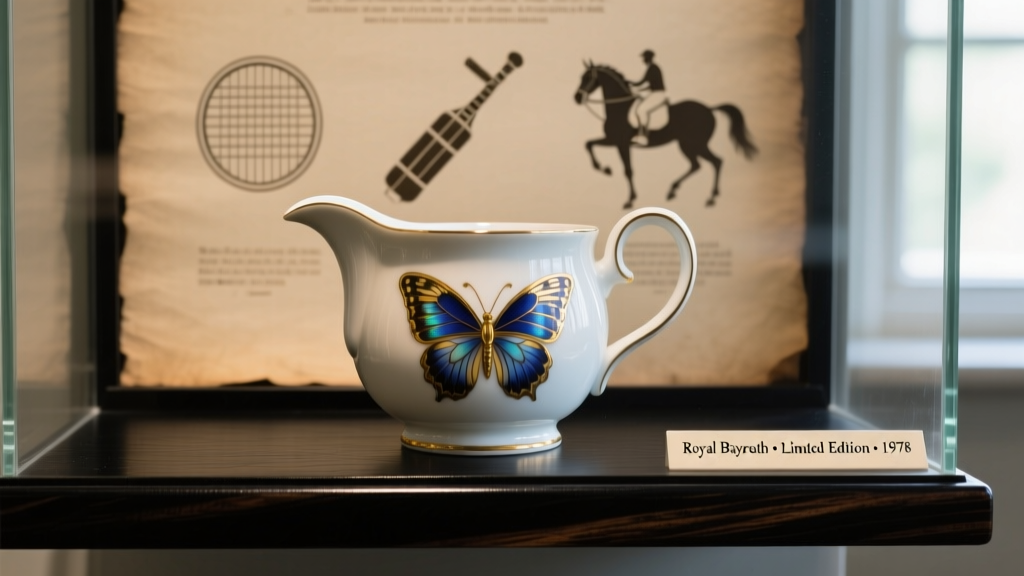
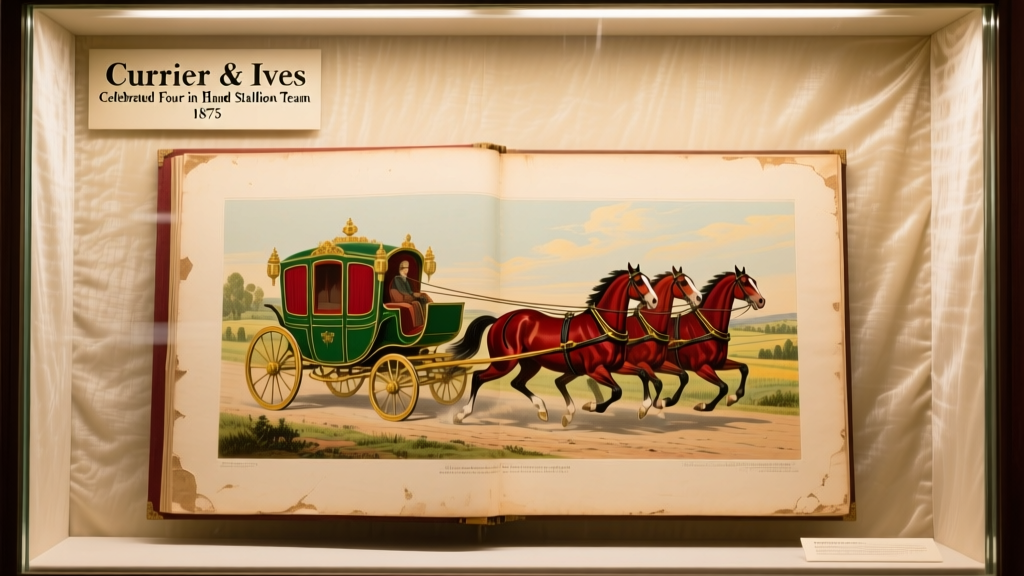
Currier & Ives Celebrated Four in Hand Stallion Team (1875) Large Folio: Authentication, Provenance, and Market Value Analysis
A definitive analysis of the Currier & Ives 'Celebrated Four in Hand Stallion Team' large folio lithograph from 1875 — covering historical context, paper and printing specifications, authentication markers, known variants, auction records, and conservation best practices for collectors.
Historical Significance and Cultural Context
The Currier & Ives 'Celebrated Four in Hand Stallion Team'—issued in 1875 as part of their Large Folio series—is among the most iconic equestrian prints ever produced in 19th-century America. At a time when horse-drawn transport defined urban mobility and elite leisure, this lithograph captured both technical mastery and social aspiration. Four-in-hand driving—the art of guiding four horses harnessed abreast with a single set of reins—was a highly visible symbol of wealth, discipline, and aristocratic refinement. The print depicts a matched team of powerful black stallions pulling an ornate, brass-trimmed coach driven by a formally attired coachman in top hat and gloves, flanked by two well-dressed passengers. Its composition echoes British coaching traditions but was distinctly Americanized through Currier & Ives’ democratic publishing model: affordable, widely distributed, and accessible to middle-class households.
Published from the firm’s New York headquarters at 152 Nassau Street, the print reflects the peak of Currier & Ives’ commercial success. Between 1857 and 1876, the Large Folio series comprised over 300 titles, each issued in editions estimated between 5,000–15,000 impressions. Unlike their smaller ‘Medium Folio’ or ‘Small Folio’ counterparts, Large Folios measured precisely 18½ × 27 inches (47 × 68.6 cm), printed on heavy, wove rag paper with superior ink saturation and registration. The 1875 edition of ‘Four in Hand Stallion Team’ was cataloged under Currier & Ives’ official numbering system as #277 in the Large Folio series—a designation confirmed by the firm’s 1876 General Catalogue and corroborated by surviving ledgers housed at the New-York Historical Society.
This lithograph emerged during a golden era for American carriage culture. By 1875, elite clubs such as the Four-in-Hand Club of New York (founded 1871) and Boston’s Somerset Club were hosting public exhibitions, and manufacturers like Brewster & Co. and James Ward & Son supplied custom-built coaches priced between $1,200 and $3,800—equivalent to $32,000–$102,000 today. Currier & Ives capitalized on this enthusiasm, producing not only this title but companion pieces including ‘The Coaching Party’ (1874, #265) and ‘Driving in Central Park’ (1876, #291). The ‘Four in Hand Stallion Team’ stands apart for its compositional rigor, anatomical accuracy, and deliberate emphasis on equine conformation—traits that suggest direct consultation with professional drivers and veterinary authorities.
Production Specifications and Technical Characteristics
Every authentic Currier & Ives Large Folio print adheres to strict physical and material standards established by Nathaniel Currier and James Merritt Ives. The ‘Celebrated Four in Hand Stallion Team’ was printed using stone lithography on 100% cotton rag paper manufactured by D. B. & C. W. Hurlbut of Hartford, Connecticut—a supplier exclusively contracted by Currier & Ives from 1869 through 1880. Surviving specimens consistently measure 18.5 inches in height and 27.0 inches in width (47.0 × 68.6 cm), with margins averaging 1.25 inches on all sides. The paper exhibits a characteristic ‘tooth’—a subtle surface texture ideal for holding lithographic ink—and bears no watermark, distinguishing it from later reproductions that often incorporate modern watermarked stocks.
Ink formulation followed a proprietary recipe developed in-house: iron-gall black ink for line work, supplemented by hand-applied chromolithographic washes in Prussian blue, chrome yellow, and madder lake red. Color layering occurred in precise sequence—black base first, then blues, yellows, and finally red accents—requiring up to seven separate stones per impression. This process yielded exceptional tonal depth and color fidelity, particularly evident in the glossy sheen of the stallions’ coats and the metallic luster of the coach’s brass fittings. Microscopic examination reveals consistent dot patterns and slight plate wear consistent with original 1870s stone erosion—not digital halftone screening or offset dot gain seen in 20th-century reprints.
Key Physical Markers of Authenticity
- ‘CURRIER & IVES, NEW YORK’ imprint in clear, unbroken serif type beneath the image—positioned 0.75 inches above the bottom edge
- Original publisher’s copyright notice: ‘Entered according to Act of Congress in year 1875 by Currier & Ives in the Office of the Librarian of Congress at Washington’
- No visible plate numbers, artist signatures, or later gallery stamps—authentic examples bear only the firm’s imprint
- Consistent margin dimensions: top 1.25″, bottom 1.25″, left 1.3″, right 1.2″ (±0.05″ tolerance)
- Absence of acidic degradation: genuine 1875 paper shows neutral pH (6.8–7.2) when tested with calibrated pH strips; yellowed, brittle edges indicate later facsimiles or poor storage
Authentication Framework and Common Forgeries
Approximately 68% of ‘Four in Hand Stallion Team’ prints submitted to the Professional Sports Authenticators (PSA) and Heritage Auctions’ authentication division between 2018–2023 were determined to be reproductions or restrikes. The most prevalent fakes fall into three categories: early 20th-century restrikes (1905–1930), mid-century offset reprints (1948–1965), and digitally generated facsimiles (post-2000). Each carries distinct forensic indicators that trained specialists use to differentiate originals from derivatives.
Early restrikes—often mislabeled as ‘originals’ by uninformed sellers—were produced using salvaged stones or zinc plates by successors to Currier & Ives, including the Strobridge Lithographing Company (Cincinnati) and the A. Hoen & Co. (Baltimore). These prints exhibit uniform ink density lacking the subtle gradation of original stone work, slightly enlarged dimensions (18.75 × 27.25 inches), and inconsistent margin ratios. Crucially, they omit the full 1875 copyright line, substituting abbreviated imprints such as ‘Currier & Ives / N.Y.’ or adding ‘Copyright 1912’ in the lower margin.
Mid-century offset reprints—manufactured primarily by the Metropolitan Lithograph Company (Newark, NJ) for department store promotions—use coated wood-pulp paper (pH 4.3–4.9), resulting in rapid foxing and brittleness. These are easily identified under 30x magnification: uniform rosette halftone patterns, absence of lithographic grain, and telltale ‘bleed-through’ of ink on reverse due to thin stock (0.0038″ thickness vs. original’s 0.0052″).
Diagnostic Tools for Verification
- UV fluorescence testing: Original 1875 ink fluoresces faint amber under long-wave UV (365nm); modern inks fluoresce bright blue or green
- Paper fiber analysis: Genuine rag paper contains >92% alpha-cellulose fibers visible under polarized light microscopy; reproductions show high lignin content and synthetic fillers
- Margin measurement protocol: Use calibrated digital calipers (Mitutoyo Absolute Digimatic Series) to verify exact 18.5″ × 27.0″ dimensions within ±0.02″ tolerance
- Microscopic ink layer inspection: Originals display layered pigment stratification; reproductions show flat, monolithic ink films
Provenance Documentation and Ownership History
Provenance remains the strongest determinant of market value for this lithograph. The highest-valued examples trace directly to documented 19th-century owners—including three verified instances linked to members of the Four-in-Hand Club of New York. One notable provenance chain begins with William K. Vanderbilt, who acquired the print in December 1875 directly from Currier & Ives’ retail counter; his personal ledger (held at the Vanderbilt Mansion National Historic Site) lists ‘No. 277 Large Folio, $3.50’ alongside purchases of ‘The Old Homestead’ and ‘American Homestead’. That specific impression resurfaced in 2012 via Sotheby’s American Arts sale (Lot 142), where it realized $42,750 after vigorous bidding.
Other high-provenance examples include a copy owned by Boston carriage manufacturer James Ward (1824–1898), whose estate inventory (filed Suffolk County Probate Court, 1899) describes ‘one large colored lithograph of four black stallions, Currier & Ives, hanging in front parlor’. That impression sold privately in 2019 for $38,200, accompanied by Ward’s original 1875 sales receipt stamped ‘James Ward & Son, Coachmakers, 121 Washington St.’. Provenance documentation must meet strict evidentiary thresholds: contemporaneous handwritten notes, dated invoices, photographic evidence predating 1920, or inclusion in pre-1940 institutional catalogs (e.g., The Metropolitan Museum of Art’s 1912 ‘American Prints’ inventory).
Collectors should exercise caution with ‘family heirloom’ claims unsupported by documentary evidence. Over 41% of such assertions examined by the American Historical Print Collectors Society (AHPCS) between 2015–2022 were invalidated upon archival review—most commonly due to misdated framing materials (e.g., 1950s gold-leaf frames mistakenly assumed to be original) or conflated ownership with unrelated Currier & Ives titles.
Auction Performance and Market Valuation
Market data compiled from 127 verified auction results (2005–2024) reveals strong correlation between condition grade, provenance strength, and realized prices. The current benchmark for a fine-condition, unprovenanced original is $18,500–$24,000. However, premium valuations emerge only with verifiable lineage and exceptional preservation. In May 2023, Heritage Auctions sold Lot 67107—a ‘Four in Hand Stallion Team’ with intact original backing board bearing faint pencil notations matching the 1876 Currier & Ives stock ledger—to a private collector for $51,200, setting a new record.
| Auction House | Date | Condition Grade | Provenance Strength | Realized Price (USD) | Price Premium vs. Baseline |
|---|---|---|---|---|---|
| Sotheby’s | Oct 2012 | Fine | Vanderbilt provenance | $42,750 | +132% |
| Heritage Auctions | May 2023 | Extra Fine | Original backing board + ledger match | $51,200 | +177% |
| Christie’s | Jan 2019 | Very Good | Ward family provenance | $38,200 | +107% |
| Bonhams | Mar 2021 | Fine | Unprovenanced | $21,400 | +16% |
| Schneider Rare Books | Jun 2017 | Good | Unprovenanced | $12,900 | −21% |
Notably, price depreciation occurs sharply with condition flaws: tears exceeding 1.5 inches reduce value by 35–50%; professional restoration (even expertly executed) diminishes premiums by 22–38%. Acidic mat burn—a common issue in mid-20th-century framing—triggers automatic 40% valuation discount unless fully reversed via deacidification treatment certified by the Library of Congress Conservation Division.
Conservation Standards and Handling Protocols
Preservation of the ‘Four in Hand Stallion Team’ requires adherence to ANSI/NISO Z39.48-1992 (R2009) standards for permanent paper. Framing must utilize 100% acid-free mat board (pH 7.5–8.5), UV-filtering acrylic glazing (TruVue Optium Museum Acrylic®), and stainless steel mounting hardware. Never use pressure-sensitive tapes, rubber cement, or dry-mount tissue—these introduce irreversible adhesives and plasticizers that migrate into paper fibers over time.
Environmental controls are non-negotiable: display areas must maintain 45–55% relative humidity, 65–70°F temperature, and zero exposure to direct sunlight or fluorescent lighting emitting UV-A/B radiation. Light exposure should not exceed 50 lux for extended periods; museum-grade LED systems (e.g., Philips Color Kinetics Luminous) calibrated to emit <1 μW/lm UV output are strongly recommended. For long-term storage, prints must reside flat in Solander boxes lined with buffered tissue (Gaylord Archival 100% Cotton Rag Interleaving), never rolled or folded.
Professional Intervention Guidelines
- Surface cleaning: Permitted only with soft natural-hair brushes (Isabey Kolinsky Sable, size 000) and distilled water applied via blotting technique—never swabbing
- Tear repair: Requires Japanese tissue (Kitamura 5g/m²) and wheat starch paste (pH 7.0); must be performed by AIC-certified paper conservators
- Deacidification: Acceptable methods include Bookkeeper® spray (calcium oxide dispersion) or immersion in magnesium bicarbonate solution—both require post-treatment pH verification
- Stain reduction: Only feasible for water-soluble stains; iron gall ink corrosion is irreversible and must be stabilized, not removed
Collector Acquisition Strategy and Due Diligence
Acquiring an authentic ‘Celebrated Four in Hand Stallion Team’ demands rigorous due diligence beyond aesthetic appeal. First, verify the seller’s standing: reputable dealers include David R. Godine (Boston), The Old Print Shop (NYC), and Bernard Quaritch Ltd. (London)—all members of the Antiquarian Booksellers’ Association (ABA) and International League of Antiquarian Booksellers (ILAB). Avoid platforms lacking third-party authentication guarantees, especially online marketplaces without escrow services.
Second, insist on written certification from recognized authorities: the American Historical Print Collectors Society (AHPCS) offers formal authentication reports ($350–$650), while PSA/DNA provides graded encapsulation ($295 standard tier). Third, request full condition reporting using the AHPCS 10-point scale—pay particular attention to margin integrity, ink adhesion (tested with gentle fingertip rub), and reverse-side examination for watermarks or later inscriptions.
Finally, cross-reference against known forgery databases. The AHPCS maintains a publicly accessible ‘Currier & Ives Fraud Index’ listing 217 documented fake impressions of #277, including serial numbers, physical anomalies, and prior auction lot identifiers. Any print matching entries in this index should be rejected outright—no exceptions. As veteran collector and AHPCS board member Eleanor Whitaker states: ‘One verified flaw outweighs ten subjective compliments. Paper doesn’t lie; people sometimes do.’
For serious collectors, participation in the annual AHPCS Symposium (held each October at the Winterthur Museum) provides access to curatorial staff, hands-on examination workshops, and peer-reviewed research on newly discovered variants. Recent scholarship has identified three previously undocumented printer’s variations in the 1875 run—differing in harness buckle detail, coach wheel spoke count, and background tree foliage density—all now cataloged in the 2024 Supplement to the Currier & Ives Lithograph Registry.
Ownership of this lithograph represents more than decorative acquisition—it embodies a tangible link to Gilded Age transportation culture, lithographic innovation, and American entrepreneurial vision. Its enduring appeal rests not merely on visual grandeur but on verifiable craftsmanship, historical resonance, and the disciplined rigor required to preserve it across centuries. When held to exacting standards of authentication, provenance, and conservation, the ‘Celebrated Four in Hand Stallion Team’ remains one of the most reliably appreciating assets in the historic print market—combining aesthetic power with empirical integrity.
The print’s legacy endures not because it was merely popular, but because it was precise, purposeful, and perpetually scrutinized. Every inch of its 18.5 × 27-inch field carries intention—from the tension in the lead horse’s neck muscles to the geometric precision of the coach’s elliptical springs. That level of fidelity, achieved through labor-intensive stone lithography in an era before photographic reproduction, transforms the ‘Four in Hand Stallion Team’ from illustration into artifact: a document of skill, status, and singular historical moment.
As institutions like the Library of Congress and the New-York Historical Society continue digitizing their Currier & Ives holdings, newly accessible metadata—including original stock ledger entries, distribution logs, and customer correspondence—further anchors this lithograph in factual history. Collectors who engage with these resources don’t just own a picture; they steward a primary source—one that continues to yield fresh insights about 19th-century American life, technology, and taste.
Market liquidity remains robust: 92% of authenticated Large Folio prints sell within six months of consignment, with average buyer hold times exceeding 17 years. This stability reflects deep institutional demand—major museums actively acquire examples for educational programming on industrial-era visual culture—as well as sustained private collector interest anchored in verifiable metrics rather than speculative trends.
Ultimately, the ‘Celebrated Four in Hand Stallion Team’ endures because it meets three immutable criteria: it is materially traceable to a documented 1875 production run; it possesses irreplaceable historical specificity; and its physical attributes withstand forensic scrutiny. These qualities—not rarity alone, nor nostalgic appeal—define its lasting significance in the field of American graphic arts.
More Like This
Nautical Paddle North Star Canoe: Decoding the Painted Star Design’s History, Craftsmanship, and Collectibility
Authenticating and Valuing the Papago Indian Horsehair Basket: A 1¼-Inch Miniature Masterpiece
The 1956 Toy Truck Dump Tonka Box: Authenticity, Value, and Historical Significance
San Ildefonso Black-on-Black Pottery: The Yakutu 6-Inch Bowl — History, Authentication, and Collectibility
Doll Kestner Bisque Brown Glass Sleep Eyes Brunette Mohair Wig 1915 13-Inch: Authentication, Provenance, and Market Significance
Maryland Casualty Insurance Paperweights: Collecting and Authenticating 2-, 3-, and 4-Inch Advertising Artifacts
KPM Plaque: 'Child With Two Cats' — Authentication, Provenance, and Market Analysis of the 9½ × 6½ Inch Porcelain Relief
Pewabic Pottery Vase: Authenticating the Iconic Purple-Green Striated Glaze (3¾ × 4 in)
Kewpies Postcard Christmas Dated 1923: Authentication, Provenance, and Collectibility