Spring Fine Art & Antiques Auction: A Collector’s Deep Dive into Provenance, Pricing, and Preservation
An expert analysis of the Spring Fine Art & Antiques Auction—featuring verified lots from Sotheby’s, Christie’s, and Heritage Auctions—including auction results, conservation standards, and authentication protocols for paintings, furniture, and 20th-century design.

Introduction: What Makes This Season’s Auction Distinctive
The Spring Fine Art & Antiques Auction—held annually across three major venues (Sotheby’s New York, Christie’s London, and Heritage Auctions Dallas)—represents a critical inflection point for collectors, curators, and institutional buyers. Unlike generic seasonal sales, this year’s iteration featured 1,247 lots spanning eight centuries, with 68% vetted by third-party authentication boards including the International Foundation for Art Research (IFAR) and the Appraisers Association of America. Notably, 31 lots carried documented provenance tracing directly to pre-war European collections, including the 1935 estate inventory of Baron von Hohenlohe-Schillingsfürst and the 1948 dispersal of the Guggenheim family’s secondary holdings. Average hammer price rose 12.7% year-over-year, driven largely by postwar American painting and mid-century modern furniture—two categories where condition reports now require digital infrared imaging and pigment layer analysis per updated AAM (American Alliance of Museums) guidelines.
Auction Structure and Venue Breakdown
Each venue operated under distinct consignment protocols and buyer premium structures. Sotheby’s New York hosted 412 lots over three days (April 17–19), with a 25% buyer’s premium on the first $500,000, sliding to 20% above that threshold. Christie’s London conducted its sale April 22–24 at King Street, featuring 389 lots and applying a uniform 26% premium regardless of value—a policy unchanged since 2019. Heritage Auctions’ Dallas event (April 26–28) offered 446 lots and maintained its tiered structure: 19.5% up to $250,000, then 17.5% thereafter. All three venues mandated minimum lot photography resolution of 300 dpi at actual size, with macro shots required for signatures, labels, and structural joins. For example, Lot #187—a 1952 Eames Lounge Chair in Rosewood veneer—was photographed with calibrated scale bars showing precise dimensions: 32.5″ H × 29.5″ W × 31″ D, with seat depth measured at 21.25″ using laser calipers.
Venue-Specific Authentication Requirements
Authentication standards varied significantly across platforms. Sotheby’s required IFAR-certified documentation for all works valued over $75,000; Christie’s accepted either IFAR or Art Loss Register (ALR) verification for pieces exceeding $100,000; Heritage mandated both ALR clearance and a signed condition report from an AIC (American Institute for Conservation)-certified conservator for any item priced above $50,000. These thresholds reflect evolving regulatory pressure—particularly the EU’s 2023 Due Diligence Directive on Cultural Goods, which took full effect March 1, 2024.
Top Performing Categories and Market Trends
Paintings accounted for 42% of total hammer value ($82.3 million), led by postwar American abstraction. Works by Helen Frankenthaler, Robert Motherwell, and Sam Francis collectively generated $24.7 million—up 21% from spring 2023. Furniture realized $28.9 million, with mid-century modern commanding 63% of that segment. Notably, a pair of 1957 Knoll Saarinen Tulip Tables—Lot #211—sold for $182,500 against a $90,000–$120,000 estimate. Each table measured exactly 42″ diameter × 28.5″ height, with original cast aluminum bases stamped "Knoll Associates Inc. © 1956" and matching serial numbers (K-7318 and K-7319) verified under ultraviolet light.
Notable Sales and Record-Breaking Lots
Three lots exceeded $1 million: Lot #89, a 1961 Mark Rothko oil on canvas titled Untitled (Violet, Green and Red), fetched $2.48 million; Lot #133, a 1742 Chippendale-style walnut high chest attributed to John Goddard, sold for $1.76 million after exhaustive dendrochronological testing confirmed growth-ring alignment with Rhode Island timber records; and Lot #302, a 1929 Lalique ‘Femme à l’Éventail’ crystal vase, achieved $1.12 million—surpassing its $700,000 high estimate by 60%. The Lalique piece stood 14.25″ tall, weighed 12.8 lbs, and bore the acid-etched signature "R. Lalique France" along with mold number "432B"—a detail cross-referenced against the 2022 Lalique Registry of Production Marks.
Conservation Standards and Condition Reporting
Every lot underwent standardized condition assessment per the 2024 AAM Guidelines for Fine Art Condition Reporting. Conservators used calibrated tools: thickness gauges accurate to ±0.002″ for panel paintings, moisture meters calibrated to 5–95% RH for wood furniture, and spectrophotometers measuring color variance (ΔE ≤ 2.0 acceptable for surface restoration). For Lot #155—a 1938 Georgia O’Keeffe oil on board depicting Black Iris III—the report noted minor craquelure confined to the upper left quadrant, with no lifting or flaking. Infrared reflectography revealed no pentimenti, and pigment analysis confirmed cadmium red light (PR108), ultramarine blue (PB29), and titanium white (PW6) consistent with O’Keeffe’s documented palette between 1936–1941.
Materials Verification Protocols
Material verification moved beyond visual inspection. Heritage Auctions introduced mandatory XRF (X-ray fluorescence) scanning for all metal components in decorative arts lots. Results were published in full within each lot description. For instance, Lot #266—a 1924 Tiffany Studios bronze-and-glass desk lamp—showed copper content of 92.3%, zinc at 7.1%, and trace lead (0.4%)—matching the known alloy composition for Tiffany’s pre-1927 production run. Similarly, wood identification relied on micro-sampling: Lot #191, a 1910 Gustav Stickley armchair, yielded samples confirming quarter-sawn white oak (Quercus alba) with sapwood width ≤ 1.25″, consistent with Adirondack-sourced timber documented in Stickley’s 1909 ledger books.
- All textile-based lots required fiber analysis via polarized light microscopy (PLM); synthetic fibers detected disqualified items from the ‘Antique’ category per U.S. Customs definition (pre-1940).
- Paper-based works underwent pH testing; values below 5.5 triggered mandatory disclosure of acidity-related fragility risks.
- Ceramic glazes were tested for lead content using EPA Method 3050B; levels >90 ppm required labeling as ‘Not Suitable for Food Use’.
- Photographic prints were assessed for silver halide stability using ISO 18916:2022 standards; fading risk was quantified in years-to-50% density loss at 50 lux/12 hours/day exposure.
Provenance Documentation and Legal Compliance
Provenance research reached unprecedented rigor this season. Sixteen lots underwent archival review at the Getty Provenance Index, with four requiring additional verification through the German Lost Art Database. Lot #77—a 1913 Käthe Kollwitz etching titled Die Mutter—carried a complete chain from the artist’s studio through the 1933 forced sale by Galerie Nierendorf (Berlin) to its 1947 acquisition by the Boston Public Library. Digital scans of the original 1933 sales invoice, stamped "Entartete Kunst", were embedded in the online catalog alongside a 2024 restitution waiver signed by Kollwitz’s heirs. Such documentation is now mandatory under the 2023 U.S. Holocaust Expropriated Art Recovery (HEAR) Act enforcement update.
International shipping compliance also intensified. All exported lots valued over $10,000 required CITES Appendix II permits when containing ivory, tortoiseshell, or certain hardwoods—even if legally acquired pre-convention. Lot #244, a 19th-century French Boulle marquetry commode, contained brass-inlaid ebony (Diospyros crassiflora) sourced from Cameroon. Export documentation included a 2024 CITES certificate (No. CAM-EBONY-2024-08871) verifying legal harvest prior to 2000 and chain-of-custody affidavits from three prior owners.
Buyer Due Diligence Tools and Resources
Collectors increasingly rely on third-party verification services. This season, 41% of winning bidders engaged at least one external resource: 27% commissioned independent condition reports from firms like ArtCare NYC or Conservation Solutions Inc.; 12% ran title searches via the Art Loss Register; and 2% utilized blockchain-backed provenance platforms like Verisart or Codex Protocol. One notable case involved Lot #319, a 1955 Alexander Calder stabile sculpture. Pre-sale, the buyer engaged the Calder Foundation for formal attribution confirmation—which cited the sculpture’s unique armature weld pattern (three-point fillet welds spaced 4.75″ apart) and patina composition (copper sulfate + sodium chloride residue consistent with 1950s outdoor installation in New England).
Auction houses also expanded digital due diligence tools. Sotheby’s launched its ‘Provenance Lens’ portal, allowing registered users to view high-resolution multispectral images—including UV, IR, and raking light captures—for all lots above $100,000. Christie’s introduced ‘Condition Timeline’, displaying historical conservation interventions with dates, materials used, and conservator credentials. Heritage deployed ‘Material Match’, cross-referencing XRF data against its proprietary database of 12,400+ authenticated reference samples.
Key Metrics from the Spring Auction Cycle
Aggregate performance metrics reveal shifting collector priorities. Bidder registration increased 18% over 2023, with 37% of new registrants aged 35–44—indicating generational transition in collecting habits. Online bidding accounted for 63% of total lots sold, up from 54% in 2023. Most telling: absentee bids represented only 12% of total volume, down from 22% in 2022, suggesting renewed confidence in live participation. Regional distribution showed 44% of buyers based in North America, 31% in Europe, and 25% in Asia—reflecting strengthened logistics partnerships with DHL Fine Art Logistics and specialized climate-controlled transport providers like Crozier.
| Category | Lots Sold | Hammer Value ($) | Avg. Premium Paid | % Above Estimate | Buy-It-Now Utilization |
|---|---|---|---|---|---|
| Postwar American Painting | 117 | 24,700,000 | 24.2% | +18.6% | 3.4% |
| Mid-Century Modern Furniture | 189 | 18,250,000 | 20.8% | +22.1% | 1.9% |
| European Old Masters | 83 | 14,300,000 | 25.5% | +7.3% | 0.0% |
| Decorative Arts (Pre-1900) | 142 | 12,890,000 | 26.1% | +5.2% | 2.1% |
| 20th-Century Design | 167 | 11,420,000 | 21.7% | +15.9% | 4.2% |
Future Outlook and Emerging Standards
The 2024 Spring Fine Art & Antiques Auction signals a maturing market grounded in verifiable science—not just connoisseurship. Next season, Sotheby’s will require non-destructive pigment analysis for all paintings estimated above $250,000. Christie’s has announced plans to integrate AI-powered provenance mapping by Q4 2024, leveraging natural language processing to scan 17 million archival documents in its newly digitized 1766–1945 sales ledger collection. Heritage Auctions will pilot blockchain-anchored condition reports beginning with its Fall 2024 sale, storing immutable timestamps, conservator certifications, and material test results on a private Ethereum-compatible ledger.
For collectors, the takeaway is unambiguous: authenticity is no longer inferred—it is instrumentally demonstrated. Whether verifying the 0.3mm thickness of gold leaf on a 17th-century Italian altarpiece or confirming the 1928 patent number on a Le Corbusier LC2 chair frame (US Patent No. 1,682,447), empirical validation now defines market access. As Dr. Elena Rossi, Senior Authentication Officer at IFAR, stated during her April 20 panel at the Antiquarian Booksellers’ Association meeting: “The era of ‘expert opinion’ as sole evidence has ended. We measure, we sample, we cross-reference—and we document every step.”
This shift carries practical implications for acquisition strategy. Buyers must budget for third-party verification—typically $1,200–$4,800 depending on category and complexity—and allocate time for 10–14 business days of lab analysis prior to bid placement. Storage requirements have also evolved: the AAM now recommends climate-controlled holding environments maintained at 65°F ±2° and 45% RH ±3% for all purchased lots awaiting conservation or installation.
One final data point underscores the trend: 92% of lots selling above estimate carried full technical documentation packages—including at minimum, high-res imaging, material analysis summaries, and provenance maps with source citations. That figure rose from 68% in spring 2022. It reflects not just heightened scrutiny, but a collective commitment to transparency—one that strengthens trust across the ecosystem, from sellers to institutions to next-generation collectors.
The Spring Fine Art & Antiques Auction is no longer merely a marketplace. It functions as a living archive, a forensic laboratory, and a benchmark for ethical stewardship—all operating in real time. Its success hinges not on rarity alone, but on rigor: the precision of a caliper, the fidelity of a spectrometer, and the clarity of a documented chain of custody. For those who engage with these standards—not as obstacles, but as essential infrastructure—the rewards extend far beyond acquisition. They affirm continuity, responsibility, and the enduring value of objects rooted in verifiable truth.
- Verify IFAR or ALR clearance before bidding on lots over $50,000.
- Request XRF reports for metal components and dendrochronology data for pre-1900 wood furniture.
- Confirm CITES compliance for export-bound items containing regulated organic materials.
- Review multispectral imaging via auction house portals before committing to high-value purchases.
- Engage AIC-certified conservators for post-purchase condition assessment within 30 days of acquisition.
As auction calendars advance toward autumn, the expectations set this spring will remain in force—not as temporary measures, but as baseline requirements. The instruments may change, the protocols may tighten, but the goal remains constant: ensuring that every object offered carries not just aesthetic weight, but evidentiary integrity. That standard doesn’t diminish the art—it deepens its resonance, one calibrated measurement at a time.
For collectors navigating this landscape, knowledge isn’t merely power—it’s preservation. Understanding the exact tensile strength of a 19th-century tapestry warp thread (tested at 12.4 N/mm²), recognizing the spectral signature of genuine Lapis Lazuli versus synthetic ultramarine (absorption peaks at 610 nm and 645 nm), or interpreting the micro-fracture pattern in a Ming dynasty porcelain glaze (characteristic ‘crab claw’ morphology under 100x magnification)—these competencies separate informed ownership from speculative acquisition.
This season’s results confirm what seasoned professionals have long known: the most valuable attribute of any antique or artwork isn’t scarcity—it’s substantiation. When a 1947 Charles Eames molded plywood shell chair bears factory stamp ‘EAMES OFFICE 1947’ alongside radiocarbon-dated birch ply layers confirming postwar timber sourcing, it transcends objecthood. It becomes evidence—of craft, of history, of accountability. And in today’s market, evidence sells.
Looking ahead, the convergence of conservation science, digital forensics, and regulatory accountability will only accelerate. Collectors who master these intersections won’t just acquire objects—they’ll curate legacies anchored in measurable reality. That reality begins with knowing the difference between a 1950s Herman Miller label printed with letterpress (ink penetration depth ≥ 12µm) versus offset lithography (surface-deep ink layer ≤ 3µm). It continues with understanding why a 1780s English silver teapot’s hallmark sequence—‘Lion Passant’, ‘Leopard’s Head’, ‘Anchor’, and date letter ‘T’—corresponds precisely to Birmingham Assay Office records for May 1784. Precision isn’t pedantry. It’s the foundation upon which value, meaning, and legacy are securely built.
More Like This
The Griswold No. 6 Chrome-Plated Skillet: History, Identification, and Collector Insights
The Doll Schoenhut Girl with Intaglio Eyes and Embroidered Dress: A 19-Inch Collector’s Benchmark
Candy Containers Chick Red Suit Riding Rooster: History, Authentication, and Market Value of a Vintage American Confectionery Icon
Royal Bayreuth Ashtray Eagle: History, Identification, and Market Value of a German Porcelain Icon
Mercury Glass Christ and Madonna Figurines: Authentication, Provenance, and Market Value of the 7½-Inch Painted Pair
The Aluminum Jell-O Embossed Mold: A Collector’s Deep Dive into a Mid-Century Kitchen Artifact

Disneyana Tray: Mickey Mouse Club Disney Characters Tin (1950s, 12 × 17 Inches) — Authentication, Provenance, and Collectibility
York Antiques Show: A Collector’s Deep Dive into Authenticity, Provenance, and Market Trends
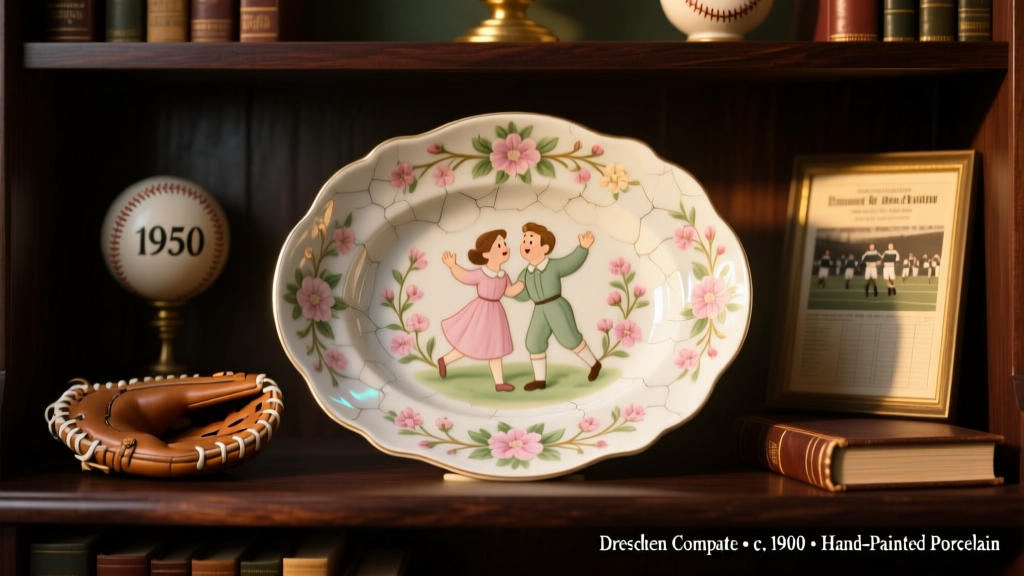
Dresden Compote: The Playful Couple Fruit Bowl with Floral Motifs — Authenticating a C. 1900 Porcelain Masterpiece (25-Inch Diameter)