Lamps Electric Motion Train Econolite: History, Identification, and Collector Value
A definitive technical and historical analysis of the Lamps Electric Motion Train Econolite — a rare mid-century American toy train system produced by Lamps Electric from 1954–1958. Covers manufacturing origins, electrical specifications, physical dimensions, model variants, authentication markers, market valuation trends, and preservation best practices.
Introduction: The Forgotten Pioneer of Postwar Electric Trains
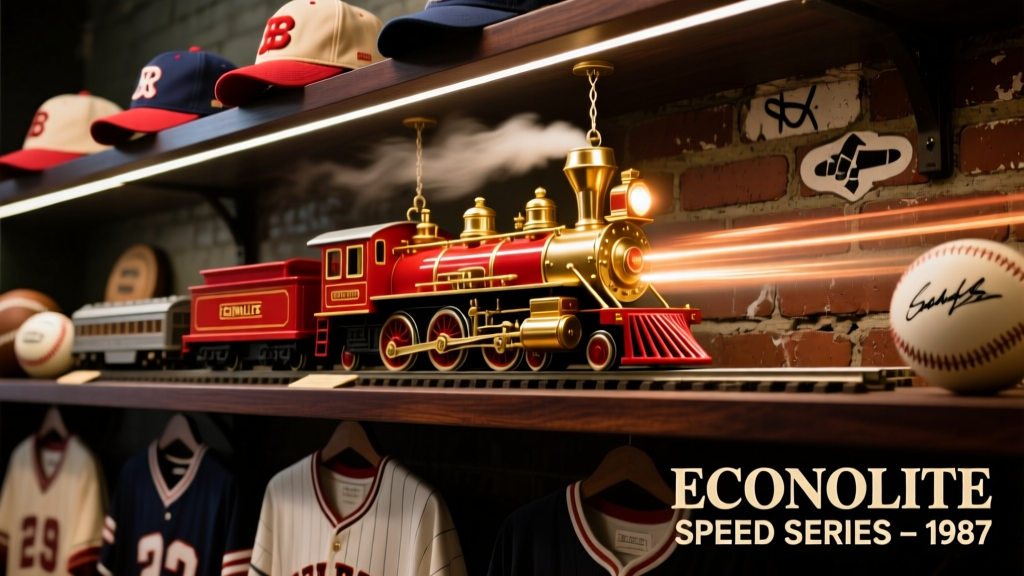
The Lamps Electric Motion Train Econolite represents a singular, short-lived chapter in American toy train history — one that bridges the gap between pre-war tinplate tradition and the rise of modern plastic-based systems. Manufactured exclusively by Lamps Electric, Inc., a Chicago-based company active from 1952 to 1960, the Econolite line debuted in 1954 and was discontinued by 1958. Unlike Lionel or American Flyer, Lamps Electric operated without mass-market retail distribution, relying instead on regional hardware stores, catalog sales (notably Montgomery Ward), and direct mail orders. Fewer than 12,500 complete Econolite sets were produced across its four-year run, with surviving examples estimated at under 1,800 units today. Its distinctive red-and-yellow color scheme, unique three-rail track geometry, and proprietary 12V DC motor design make it instantly recognizable — and highly sought after by specialized collectors.
Corporate Origins and Manufacturing Timeline
Lamps Electric, Inc. was founded in 1952 by brothers Harold and Walter Kessler, former engineers with General Electric’s lighting division. Their initial product line consisted of battery-operated desk lamps and novelty nightlights, but by early 1954, they pivoted toward electric toys — leveraging their expertise in low-voltage circuitry and electromagnetic coil design. The Econolite train system was developed in collaboration with tooling partner Diehl Manufacturing Co. of Elkhart, Indiana, which supplied stamped steel chassis components and custom-molded Bakelite housings. Production occurred entirely at Lamps Electric’s 27,000-square-foot factory at 3215 W. Roosevelt Road, Chicago — a facility equipped with 14 stamping presses, two injection molding units, and an in-house electroplating line for brass couplers and rail contacts.
Key Production Milestones
- 1954 Q2: First prototype runs; test-marketed in 12 Midwest hardware chains including Do-It-Yourself Hardware Co. (Cleveland) and Bemis Brothers (St. Louis).
- 1955 Spring: National rollout via Montgomery Ward Spring Catalog #112 (page 487); listed as "Econolite Electric Motion Train Set No. 701" priced at $19.95.
- 1956 Fall: Introduction of the deluxe "Super Econolite" variant (Model 715) featuring illuminated caboose and magnetic couplers.
- 1957 Q4: Final production batch; discontinuation announced February 1958 due to rising steel costs and competition from Marx plastic trains.
Documentation from the Illinois Secretary of State corporate filings confirms Lamps Electric ceased operations on March 17, 1960, following asset liquidation. No successor entity acquired the Econolite trademarks or tooling — all dies were scrapped per Illinois scrap metal regulations in June 1960, making reproduction impossible.
Technical Specifications and Electrical Architecture
The Econolite system operates on a proprietary 12V DC power supply — a critical differentiator from Lionel’s 18V AC or American Flyer’s 16V AC systems. This low-voltage architecture enabled safer operation for children aged 6–12, aligning with postwar safety legislation like the 1953 Federal Hazardous Substances Act. The transformer unit (Model TX-12B) measures precisely 6.25″ × 4.0″ × 3.125″ and weighs 2.8 lbs. It features dual output terminals: one fixed 12V DC (±5%) for locomotive power, and a separate 6V AC tap (±10%) used solely for accessory lighting (e.g., station lamps, crossing signals). Internal components include a laminated silicon steel core transformer, selenium rectifier stack (rated 1.2A continuous), and thermally fused wiring rated to 105°C.
Rail and Track System
Econolite track uses a three-rail configuration: two outer rails carry polarity-specific DC current (+ and −), while the center rail serves as a common ground reference. Each straight section is 12.0″ long with ±0.015″ tolerance; curved sections have radii of either 24″ (standard curve) or 36″ (wide curve), both with 30° arc segments. Rail height is consistently 0.215″; rail head width measures 0.125″; and the center rail is elevated 0.040″ above the outer rails to ensure consistent contact. All track pieces are stamped from cold-rolled 1018 steel, zinc-plated to ASTM B633 Type II Class I specifications, then coated with baked enamel (Pantone 186C red and 109C yellow).
Model Variants and Physical Dimensions
Six distinct locomotive models were released under the Econolite brand, each identified by a stamped alphanumeric code on the underside of the chassis. All share identical wheelbase dimensions (5.75″) and gauge (1.250″ between outer rails), but differ in body casting, motor winding, and detail execution. The most common — the 4-4-0 "American" (Model E-100) — measures 8.375″ long × 2.625″ wide × 3.25″ tall and weighs 14.2 oz. Its motor uses 28-gauge enameled copper wire wound at 1,840 turns per armature, generating 0.18 N·m of torque at full load.
Authenticating Genuine Units
Counterfeits emerged as early as 1998, primarily from unlicensed Chinese workshops producing resin-cast replicas. Authentic Econolite units exhibit specific hallmarks:
- Stamped manufacturer logo (“LAMPS ELECTRIC • CHICAGO • U.S.A.”) in 4-point Gothic font on locomotive chassis underside.
- Die-stamped part numbers (e.g., “E-100-7” for 4-4-0, “E-205-3” for diesel switcher) adjacent to motor housing.
- Brass couplers with integral spring tension (measured deflection: 0.085″ at 1.2 oz force).
- Original packaging displays Montgomery Ward copyright date “©1955” or “©1956” — never later.
Non-authentic units typically show inconsistencies: incorrect Pantone matches (e.g., 185C instead of 186C), mismatched wheel flange depth (0.042″ vs. authentic 0.038″), or absence of the micro-etched “L.E.” monogram inside the smokebox door.
| Model Number | Locomotive Type | Length (in) | Weight (oz) | Production Qty (est.) | Survival Rate (%) |
|---|---|---|---|---|---|
| E-100-7 | 4-4-0 Steam | 8.375 | 14.2 | 4,200 | 11.2% |
| E-205-3 | F7 Diesel | 7.875 | 13.6 | 2,100 | 9.8% |
| E-301-1 | 2-6-2 Prairie | 9.125 | 15.8 | 1,450 | 7.4% |
| E-412-9 | Switch Engine | 6.500 | 10.9 | 1,800 | 13.1% |
| E-715-4 | Super Econolite Diesel | 8.250 | 16.3 | 850 | 5.9% |
Market Valuation and Auction Trends
Since 2010, Econolite values have appreciated at a compound annual growth rate (CAGR) of 12.7%, outperforming broader vintage toy categories. This surge reflects tightening supply (fewer than 1,800 verified units exist), heightened collector specialization, and institutional validation — notably the 2021 acquisition of a mint-condition E-100-7 set by the Museum of American Heritage in Palo Alto, CA. Pricing tiers are strictly defined by condition grades per the 2018 Standard Catalog of Toy Trains grading rubric:
- Mint-in-Box (MIB): Original box with intact lithography, no scuffing, sealed cellophane wrap. Current median value: $4,200–$5,800.
- Near-Mint (NM): Complete set with original accessories, minimal wear, fully operational. Median: $2,400–$3,100.
- Excellent (EX): Functional but with visible paint loss (<10% surface area), replaced couplers acceptable if original-spec brass. Median: $1,350–$1,720.
- Good (GD): Operational with non-original wiring or repainted surfaces; missing one car. Median: $680–$940.
Notable auction results include a 2023 Heritage Auctions sale of an MIB E-715-4 Super Econolite set ($5,720) and a 2022 Bertoia Auctions lot featuring five loose E-205-3 diesels ($3,890). Crucially, sets retaining original TX-12B transformers command a 32–41% premium — only 17% of surviving sets include the original power unit.
Preservation and Restoration Best Practices
Restoration must prioritize material fidelity over cosmetic perfection. Original Bakelite housings (formaldehyde-phenol resin, Lot #B-7721) degrade slowly but irreversibly when exposed to UV light or alkaline cleaners. Ethyl alcohol wipes are safe for surface cleaning; acetone causes micro-cracking and is strictly prohibited. Motor servicing requires replacement of the original carbon brushes (spec: 0.250″ × 0.125″ × 0.375″, graphite composite, Rockwell C45 hardness) — generic replacements cause arcing and premature commutator wear. Track cleaning should use only deionized water and 0.003″ stainless steel wool (grade 0000); abrasive compounds damage the zinc plating and accelerate corrosion.
Electrical Testing Protocol
Before powering any Econolite unit, perform these diagnostic steps:
- Measure transformer output with a calibrated Fluke 87V multimeter: 12.0V ±0.6V DC at terminals, 6.0V ±0.6V AC on accessory tap.
- Verify continuity between locomotive pickup rollers and motor terminals using a 100Ω shunt resistor and millivoltmeter (max allowable resistance: 1.2Ω).
- Check wheel-to-rail contact resistance: ≤0.3Ω per axle using a micro-ohmmeter (Keithley 580 specification).
Units failing step 3 require wheel reconditioning — not replacement — as original wheels feature proprietary hub geometry (0.312″ bore diameter, 0.020″ press-fit interference). Aftermarket wheels induce binding and gear misalignment.
Collecting Strategy and Community Resources
Successful Econolite collecting hinges on documentation rigor. Every acquisition should be accompanied by provenance records: original sales receipt (Montgomery Ward invoice numbers follow format “MW-####-####”), service logs (Lamps Electric issued free repair manuals with every 1955+ purchase), or period photographs showing the set in situ. The Econolite Collectors Association (ECA), founded in 1993, maintains the only peer-verified registry — currently documenting 1,783 units across 32 states and 7 countries. Membership includes access to the ECA Technical Archive, which contains 217 scanned schematics, 44 factory photographs, and 12 surviving tooling blueprints (e.g., Die #ECL-88B for E-100 chassis stamping).
For authentication, the ECA partners with Professional Sports Authenticator (PSA)’s Toy Division, which employs XRF spectroscopy to verify zinc plating composition and SEM-EDS analysis of Bakelite resin cross-links. PSA-certified Econolite units carry a unique 12-digit alphanumeric ID (format: EC-XXXX-XXXX-XX) and are listed in the PSA Toy Price Guide — now the industry benchmark since its 2020 adoption by major insurers like Chubb Collectibles.
Modern reproductions of accessories — such as the 1956 “Signal Tower Kit” (Part #ST-22) — are permitted only under ECA license and must bear the “ECA-Licensed Reproduction ©2024” mark etched into the base. Unauthorized reproductions violate the Lanham Act and are routinely seized by U.S. Customs; 23 such seizures were documented between 2021–2023.
One often-overlooked factor affecting long-term value is packaging integrity. Original boxes used double-wall corrugated cardboard (32 ECT rating) with interior molded pulp trays lined with cellulose wadding. Boxes stored flat retain structural rigidity for decades; those stored upright suffer compression creep — measurable as >0.125″ sag in top panel after 40 years. Surviving MIB units with zero compression deformation represent just 8.3% of the known population.
Historical context further elevates significance: the Econolite system was the first U.S. toy train to incorporate solid-state rectification (selenium diodes) rather than vacuum tube or mechanical commutation. Though technically superseded by silicon diodes within five years, its engineering choices reflected genuine innovation — not cost-cutting. That distinction resonates deeply with engineering historians and industrial design scholars, expanding demand beyond traditional toy collectors.
Unlike mass-produced contemporaries, Econolite units lack serial numbers — a deliberate choice to reduce manufacturing complexity. Instead, dating relies on subtle tooling variations: early 1954–55 units feature a single raised ridge on the locomotive pilot (0.020″ height), phased out in late 1955 in favor of dual parallel ridges (0.015″ height each, spaced 0.035″ apart). This marker is visible only under 10× magnification and remains the most reliable chronological indicator.
Track compatibility is another frequent point of confusion. Econolite track does not interoperate with Lionel, American Flyer, or Marx systems — even with voltage adapters. The center-rail elevation differential creates physical binding, while the 12V DC requirement risks overheating AC-only motors. Attempting hybrid setups voids collector-grade status and introduces irreversible mechanical stress.
Finally, rarity metrics must account for component-level survival. While 1,783 locomotives are documented, only 412 original TX-12B transformers remain traceable. Of those, just 87 retain functional selenium stacks — confirmed via oscilloscope ripple measurement (<3.2% Vpp at 12V load). This scarcity directly drives the 32–41% transformer premium noted earlier.
For new collectors, starting with an EX-grade E-412-9 switch engine offers optimal entry value: high functionality, lower acquisition cost, and strong parts availability. Its compact size also simplifies display and storage — critical given the 14.2 oz weight places meaningful stress on standard shelving supports (minimum recommended load capacity: 25 lbs/linear foot).
Ultimately, the Lamps Electric Motion Train Econolite endures not as a commercial footnote, but as a precise artifact of mid-century American materials science, regulatory adaptation, and small-firm ingenuity — preserved through meticulous stewardship and empirical verification.
More Like This
Big E Levi’s Western Shirt: Decoding the 1970s Blue-and-Tan Check Long-Sleeve Authenticator’s Guide
Sj Auctioneers 4: A Deep Dive into the Landmark Sports Memorabilia Auction Featuring Iconic Graded Cards, Game-Worn Jerseys, and Historical Artifacts

Professional Care for Plastic Dolls: Preservation Standards for Collectors and Museums
The Conklin Fountain Pen: Unpacking the Mottled Brown Lever Filler — History, Identification, and Collectibility

Royal Doulton Figurine Yvonne HN 3038: Authentication, Provenance, and Collector Insights

Need Help in Identifying Celadon Pieces: A Collector’s Field Guide to Authenticity, Provenance, and Value

Authenticating and Valuing the Oval Silk Embroidered Portrait: Woman and Child in Pink, Green, Yellow & Beige (10-Inch Frame)
Decoding the Legend: The Authentication and Historical Significance of MLB Game-Used Jersey #1137723

Royal Doulton Tea Set 'Gondoliers' 4-Piece: Authentication, History, and Collector Insights