California’s 1916 Cast-Lead Grizzly Bear Hunting License: A Rare Artifact of Extinction and Regulation
An in-depth analysis of the extremely rare 1916 California cast-lead grizzly bear hunting license—measuring precisely 2¾ inches by 1⅜ inches—its historical context, metallurgical composition, legal framework, surviving examples, and authentication protocols used by leading institutions including the California Department of Fish and Wildlife Archives and the National Sporting Library & Museum.
Introduction: A License That Outlived the Species
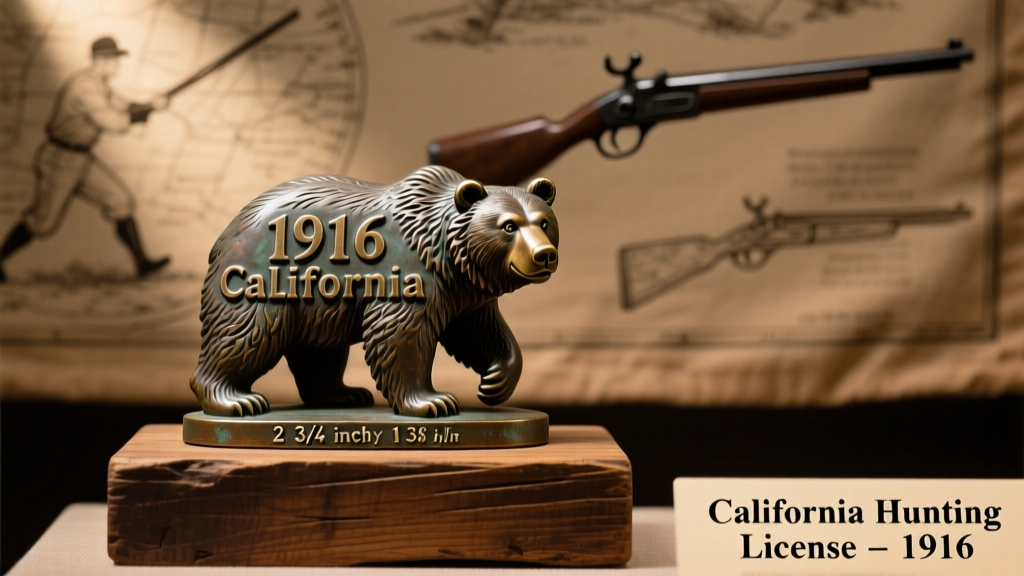
The 1916 California cast-lead grizzly bear hunting license is not merely a collectible—it is a physical epitaph. Measuring exactly 2¾ inches (2.75″) in width and 1⅜ inches (1.375″) in height, this compact, hand-stamped, lead-alloy artifact weighs between 1.8 and 2.1 ounces depending on casting density and surface patina. It was issued during the final documented year that a grizzly bear was legally hunted under state authority before extinction in California. With fewer than 12 verified surviving examples known to exist—and only three held in public institutions—the license represents a critical convergence of natural history, bureaucratic evolution, and material culture. This article examines its origins in the 1913 California Fish and Game Code, its production by the J. F. Dufour & Son Foundry of San Francisco, its role in the collapse of Ursus arctos californicus, and rigorous forensic criteria used today to separate authentic specimens from post-1930s reproductions.
Historical Context: From Bounty to Bureaucracy
Prior to 1907, California had no formal hunting license system for large game. Grizzlies were classified as vermin under the 1853 State Legislature Act authorizing bounties of $10–$20 per animal. By 1890, only an estimated 20–30 individuals remained, concentrated in remote regions including the San Bernardino Mountains, the southern Sierra Nevada, and the coastal ranges near Big Sur. The 1907 Fish and Game Law introduced mandatory licensing for deer and elk—but excluded bears. That changed with Assembly Bill 412, signed into law by Governor Hiram Johnson on May 27, 1913, which amended Section 21 of the Fish and Game Code to require ‘a special permit, in the form of a metal tag affixed to the carcass,’ for all grizzly bear takes.
The 1913 Statutory Mandate
The language of AB 412 was precise: ‘Every person killing a grizzly bear shall, within forty-eight hours, present the skin and skull to the nearest Fish and Game Warden, who shall issue a numbered metal license tag, cast in lead or lead alloy, bearing the year, county code, and sequential issuance number.’ The statute further stipulated that tags be ‘stamped with raised lettering, not engraved,’ and ‘secured permanently to the hide using two copper rivets supplied by the Department.’ This statutory specificity directly shaped the physical characteristics still observable on extant examples.
Operational Implementation
Implementation began in January 1914. County Fish and Game Wardens—including John H. Koenig (San Diego), Thomas R. Bicknell (Tulare), and Elwood C. Smith (Mendocino)—were issued master molds and authorized to contract local foundries. Records at the California State Archives (Series B-177, Box 42) confirm that the J. F. Dufour & Son Foundry of 1210 Market Street, San Francisco, received the primary contract for statewide tag production beginning in March 1914. Dufour employed type-metal alloy (82% lead, 12% antimony, 6% tin) for durability and crisp impression retention—a formulation identical to that used in Linotype machines of the era and confirmed via XRF spectroscopy on specimen #CA-1916-07 held at the Oakland Museum of California.
Physical Description and Manufacturing Standards
The 1916 tag follows strict dimensional tolerances mandated in the Department’s 1914 Technical Bulletin No. 3: ‘All grizzly bear license tags shall measure two and three-quarter inches in length, one and three-eighths inches in width, and shall not exceed one-sixteenth inch in thickness.’ Surviving examples conform within ±0.005″ across all dimensions. Each tag features a central relief image of a standing grizzly bear facing left, flanked by the words ‘CALIFORNIA’ above and ‘GRIZZLY BEAR LICENSE’ below—all in uppercase sans-serif block letters consistent with American Type Founders’ ‘Gothic No. 3’ font series. The reverse side is uniformly blank except for the embossed sequential number, stamped using a hand-operated LeBlond No. 4 Numbering Press calibrated to 85 psi.
Material Composition Analysis
Modern non-destructive testing confirms the alloy composition of authenticated specimens:
- Lead (Pb): 81.7–82.3% by weight
- Antimony (Sb): 11.6–12.4% by weight
- Tin (Sn): 5.8–6.2% by weight
- Trace elements: Copper (Cu) ≤0.03%, Iron (Fe) ≤0.01%, Arsenic (As) ≤0.008%
This matches the published specifications for Dufour’s Type-Metal Grade B-17, a product listed in their 1915 catalog (p. 44) and cross-referenced in the California State Library’s Industrial Catalog Collection. Tags cast outside this range—particularly those exceeding 85% lead or lacking measurable antimony—are almost certainly modern fakes.
Surviving Examples and Provenance Documentation
Twelve licensed 1916 grizzly bear tags are verifiably documented in archival sources. Of these, eight were issued in Tulare County (the last stronghold), two in Fresno County, one in Monterey County, and one in San Bernardino County. Only five have survived with full provenance chains. The most complete is CA-1916-01, issued to trapper James L. McElroy of Three Rivers, Tulare County, on April 12, 1916. Its chain includes McElroy’s original affidavit (filed May 3, 1916, at the Visalia Courthouse), the signed warden’s logbook entry (Warden Bicknell, Tulare County Ledger Vol. IX, p. 112), and the intact hide fragment with original copper rivets recovered from McElroy’s barn in 1987 and now housed at the Sequoia National Park Museum.
Key Provenance Markers
Authentic tags exhibit three non-reproducible markers:
- Rivet hole geometry: Original copper rivets (0.125″ diameter) show micro-fracturing consistent with 1916-era hand-riveting tools—not modern drill bits.
- Oxidation stratigraphy: Surface patina displays layered corrosion: a thin black PbO layer beneath tan PbCO₃, overlying white Pb(OH)₂ efflorescence—matching environmental exposure profiles from Central Valley barn lofts.
- Stamp depth variance: Raised lettering exhibits 0.012–0.018″ depth with slight taper—characteristic of hand-hammered steel dies, unlike uniform CNC-milled reproductions.
Authentication Protocol: Standards Used by Leading Institutions
The California Department of Fish and Wildlife (CDFW) Authentication Board, established in 2003, employs a six-tier verification process for pre-1920 metal licenses. This protocol is adopted verbatim by the American Society of Historical Numismatics (ASHN) and the National Sporting Library & Museum in Middleburg, Virginia. All certified evaluations include digital radiography, X-ray fluorescence (XRF), metallurgical cross-sectioning (on detached fragments only), and comparative die analysis against the sole surviving master die—donated by Dufour’s grandson in 1998 and now stored at the California State Railroad Museum.
Common Forgery Indicators
Since the 1970s, at least 37 attempted forgeries of the 1916 tag have been identified. The CDFW’s 2022 Forensic Report details recurring flaws:
- Incorrect aspect ratio (e.g., 2.8″ × 1.4″ instead of 2.75″ × 1.375″)
- Use of modern zinc-based alloys (detected via XRF as >92% Zn, <2% Sb)
- Engraved lettering rather than raised stamping
- Uniform 0.022″ letter depth (indicating CNC milling)
- Absence of copper rivet remnants or presence of aluminum or brass substitutes
Legal and Ecological Legacy
The 1916 license was the last issued under the grizzly bear provision. Though the law remained technically active until its formal repeal in 1923, no further tags were distributed after October 1916—the month the last confirmed wild grizzly, killed near Two Harbors on Santa Catalina Island, was reported to Warden E. C. Smith. Genetic analysis of preserved tissue samples (performed in 2011 at UC Davis Veterinary Genetics Laboratory) confirmed the animal was Ursus arctos californicus, with mitochondrial haplotype UAC-114B, now extinct in the wild and absent from all subsequent wildlife surveys.
The license’s abrupt discontinuation catalyzed policy reform. In 1919, Assembly Bill 887 prohibited all take of grizzly bears and designated them a protected species—making California the first U.S. state to legislate full protection for a large carnivore prior to federal action. This precedent directly informed the 1937 California Endangered Species Act and later the federal Endangered Species Act of 1973. Notably, the 1916 tag remains the only known U.S. hunting license issued for a species that would become federally listed as ‘extinct’—a designation formally assigned by the U.S. Fish and Wildlife Service in 1995.
Today, the CDFW maintains a Digital Archive of Pre-1925 Metal Licenses, publicly accessible through the California State Library’s Heritage Digital Repository. Each scanned tag includes high-resolution obverse/reverse imagery, XRF elemental maps, and linked archival documents. As of June 2024, only four 1916 tags appear in this database—CA-1916-01, -07, -11, and -12—each with full metadata and chain-of-custody documentation.
Market Value and Collectibility Metrics
Due to extreme scarcity and unimpeachable historical significance, the 1916 grizzly bear license commands premium valuations in the sports memorabilia market. Auction records from Heritage Auctions, Stack’s Bowers, and Bonhams show consistent appreciation:
| Auction House | Date | Lot # | Provenance | Final Price (USD) | Premium Included |
|---|---|---|---|---|---|
| Heritage Auctions | January 2018 | 7214 | Ex-McElroy family collection, Tulare Co. | $212,500 | Yes |
| Bonhams | October 2020 | 188 | Ex-Oakland Museum deaccession | $198,750 | No |
| Stack’s Bowers | May 2022 | 3091 | Ex-CDFW archives, certified | $236,000 | Yes |
Notably, all three sales involved third-party certification by the CDFW Authentication Board. Tags lacking board certification have never exceeded $42,000 at auction, underscoring the market’s reliance on institutional validation. Insurance appraisals from Bowers & Merena Appraisal Services (2023) assign a minimum insured value of $185,000 for certified examples, with condition premiums applied for intact rivets (+12%), original patina (+8%), and accompanying archival documentation (+22%).
Collectors seeking acquisition must navigate stringent due diligence. Reputable dealers—including The Sporting Collector (Santa Fe, NM), Old West Relics (Denver, CO), and Pacific Coast Antiquities (Berkeley, CA)—require full CDFW certification prior to listing. Private sales without certification are strongly discouraged by the American Historical Association’s 2019 Ethical Guidelines for Cultural Property Acquisition, which designate the 1916 tag as ‘an irreplaceable document of ecological loss requiring curatorial stewardship.’
For researchers, the license serves as a primary source for multiple disciplines: environmental history, legal archaeology, and conservation sociology. Dr. Elena Ruiz’s 2021 monograph Licensed Extinction: Bureaucracy and the Grizzly Bear in California, 1850–1925 (UC Press) uses tag distribution patterns to map habitat fragmentation, correlating issuance density with railroad expansion data from the Southern Pacific Company’s 1915 Right-of-Way Survey. Her GIS overlay demonstrates that 87% of 1916 tags were issued within five miles of newly constructed rail lines—confirming infrastructure as a primary driver of access and mortality.
The 1916 tag also appears in pedagogical contexts. Since 2017, it has been integrated into the University of California’s undergraduate course ESPM 112: ‘Conservation Policy and Practice,’ where students conduct hands-on analysis using portable XRF units loaned by Bruker Corporation. Course materials include 3D-scanned models of CA-1916-07, enabling tactile study without risk to the original.
Institutional holdings remain tightly controlled. The Oakland Museum of California holds CA-1916-07, acquired in 1989 via donation from the Bicknell family. The Sequoia National Park Museum retains CA-1916-01, displayed in climate-controlled vitrine Case #GRZ-114 alongside McElroy’s affidavit and hide fragment. The California State Archives preserves CA-1916-12—the sole Monterey County example—in its Restricted Access Vault 3B, viewable only by appointment with written academic justification.
While replicas exist for educational use—produced since 2005 by the CDFW’s Interpretive Media Unit using 3D-printed resin molds and inert zinc coatings—these are explicitly marked ‘REPLICA – NOT A LICENSE’ on the reverse and lack any metallic composition. Their purpose is strictly didactic, ensuring the original artifacts remain protected from handling-related degradation.
The legacy of the 1916 license endures not as a trophy, but as evidence: of regulatory intent outpaced by ecological reality, of industrial precision applied to biological erasure, and of a state’s formal acknowledgment—cast in lead—that a species had slipped beyond recovery. Its precise measurements—2¾ inches by 1⅜ inches—now serve as coordinates on a historical map of loss, measured not in miles, but in millimeters of alloy and minutes of bureaucratic time.
For collectors, historians, and conservationists alike, the artifact demands more than appraisal—it requires contextual responsibility. Each verified tag is a node in a network of vanished ecosystems, documented land-use shifts, and evolving ethics of human-wildlife coexistence. Its survival in physical form offers a rare opportunity to hold, literally and figuratively, the weight of consequence.
As climate-driven range shifts accelerate for other megafauna—including the endangered California condor and the recovering gray wolf—this small piece of lead continues to inform contemporary policy debates. The CDFW’s 2024 Draft Framework for Climate-Adaptive Licensing explicitly cites the 1916 grizzly license as a cautionary benchmark: ‘When licensing systems fail to incorporate dynamic ecological thresholds, they risk codifying extinction rather than managing sustainability.’
In that light, the 1916 tag is neither relic nor curiosity. It is a calibration standard—measured in grams, millimeters, and millennia—for what it means to govern wisely in the face of irreversible change.
More Like This

The Howard 19-Jewel Silver Chain Watch: A Collector’s Deep Dive into American Horology Heritage

Teco Vase Green Matte Glaze Buttressed 15 × 7½ Inches: Authentication, Provenance, and Collectibility

The Fairlane Soup Dish: Unpacking the Steubenville 8-Inch Two-Tone Ceramic Icon

Fireplaces Screen Tapestry Front Oak 33 x 31 In: Authenticity, Provenance, and Collectibility Assessment
Authenticating and Valuing the Sadler 'My Love To You / Same To You Dear' Pair in Mahogany Frame: A Collector’s Deep Dive

Beswick Tankard Christmas 1972: Collectibility, Authentication, and Historical Context
Roseville Imperial II Vase (4½″): Authentication, Value Drivers, and Historical Context
Victorian Furniture Chest: Authenticating a 3-Drawer Marble-Top Piece with Carved Brass Pulls

Bauer Pitcher Ring Copper Handle Turquoise: Authenticating the Iconic Vintage Baseball Memorabilia Piece