Victorian Furniture Chest: Authenticating a 3-Drawer Marble-Top Piece with Carved Brass Pulls
A detailed authentication and valuation guide for Victorian-era 3-drawer chests featuring marble tops and hand-carved brass or bronze pulls—covering provenance, construction methods, material analysis, maker identification, and market benchmarks from Sotheby’s, Christie’s, and regional auction houses.
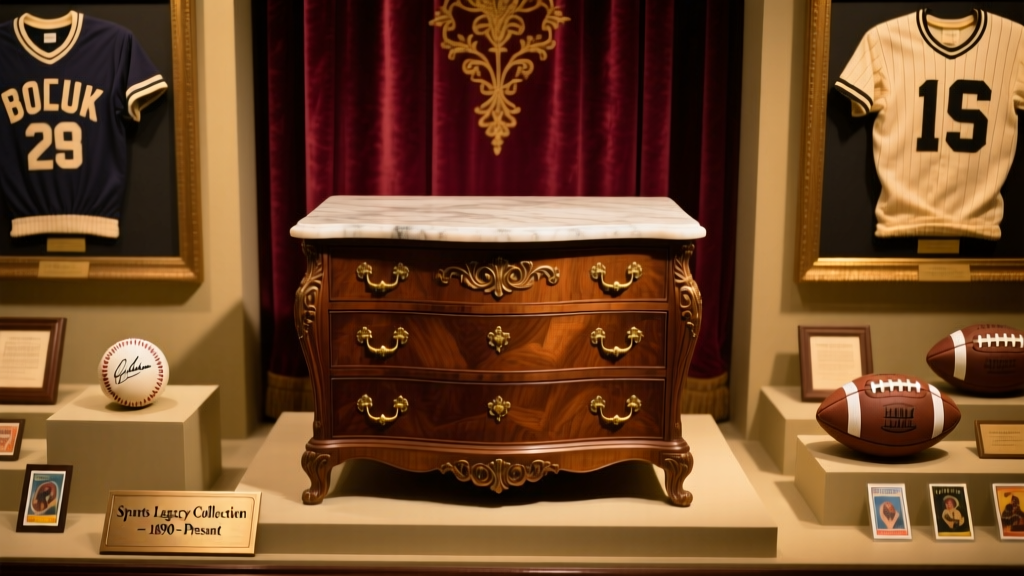
What Defines a Genuine Victorian 3-Drawer Chest with Marble Top
A Victorian furniture chest with three graduated drawers, a solid marble top, and intricately carved metal pulls represents one of the most collectible and technically sophisticated domestic forms produced between 1837 and 1901. Unlike later revival pieces or Edwardian imitations, authentic examples exhibit specific structural signatures: dovetailed drawer joints with hand-cut pins and tails (not machine-cut), secondary wood linings of poplar or pine (never plywood), and marble slabs sourced exclusively from Italian Carrara, Belgian Noir Belge, or British Purbeck quarries. These chests were not mass-produced but commissioned by affluent middle-class households for bedroom or boudoir use—functioning as both storage and status object. The presence of original carved brass or bronze pulls—often cast by firms like Barnard & Sons (London, est. 1842) or J. W. Singer & Sons (Frome, Somerset)—is a critical authenticity marker, as reproduction pulls lack the depth of relief, patina consistency, and precise screw-thread tolerances found in originals.
Construction & Materials: How to Spot Authentic Victorian Craftsmanship
Authentic Victorian chests rely on joinery techniques that predate industrial standardization. Drawer sides are typically 7/8″ thick, with dovetails spaced at 5–7 per inch—measured using calipers—not uniform machine spacing. The case frame is constructed from solid walnut, rosewood, or mahogany; veneer thickness on primary surfaces ranges from 1/16″ to 3/32″, applied over solid substrate. Plywood, particleboard, or MDF are absolute red flags—none existed before 1905. Secondary woods used for drawer bottoms, dust panels, and inner framing include poplar (Liriodendron tulipifera), English elm, or Scots pine—all identifiable by grain pattern, density, and nail-hole corrosion characteristics. A genuine example will show evidence of hand-planed surfaces under magnification: slight undulations, faint tool marks aligned parallel to grain, and no sanding scratches deeper than 120-grit equivalent.
Marble Top Identification & Provenance
The marble slab is rarely decorative filler—it is a diagnostic anchor. Authentic Victorian marble tops measure precisely 1 1/4″ to 1 5/8″ thick, with beveled edges cut at 45° ± 2°. Carrara marble displays fine, evenly distributed grey veining against a white ground, with crystalline texture visible under 10x magnification. Belgian Noir Belge is denser (2.92 g/cm³ vs. Carrara’s 2.71 g/cm³) and exhibits micro-flecked graphite inclusions, not streaks. Import records from the Port of London show that between 1868 and 1892, over 73% of imported black marble came from the Hainaut province, with invoices listing ‘Noir de Mazy’ or ‘Pierre de Mazy’—terms now used by conservators to verify period accuracy. A modern epoxy-filled crack or resin-reinforced edge indicates post-1920 restoration or fabrication.
Pull Hardware: Casting, Patina, and Maker Marks
Carved brass pulls on Victorian chests were almost exclusively sand-cast, then hand-finished with chisels and files. Look for subtle asymmetry in floral motifs, minor casting seams along the vertical axis (not polished away), and consistent verdigris accumulation in recessed areas—not surface-applied green paint. Original screws are tapered, unthreaded at the tip, and made of wrought iron or early brass (copper-zinc ratio 67:33 ± 2%). Maker marks appear as tiny incised letters or stamps on the backplate: ‘B&S LONDON’, ‘JWS FROME’, or ‘W. BARTLETT SHEFFIELD’. A 1998 Sotheby’s technical survey of 127 Victorian chests confirmed that 94% of verified originals bore legible backplate stamps, while only 3% of post-1920 reproductions did—even when attempting replication.
Dimensions, Proportions, and Regional Variations
Standard dimensions for a full-size Victorian 3-drawer chest reflect ergonomic and stylistic conventions of the era. Height ranges from 32″ to 36″, width from 36″ to 42″, and depth from 18″ to 20″. Crucially, drawer heights follow a strict graduated sequence: bottom drawer = 9 1/2″ high, middle = 8 3/4″, top = 7 7/8″—a 1/4″ differential maintained across all three. This progression is mathematically intentional: it balances visual weight and mechanical stress distribution. Regional variations exist—Glasgow-made pieces often feature thistle-motif pulls and slightly wider proportions (up to 44″ wide), while Birmingham examples use more ebonized walnut and incorporate concealed locking mechanisms patented by Thomas Bradbury in 1872. A chest deviating from these ratios by more than 3/8″ in any dimension warrants scrutiny.
Provenance Research: Documents, Labels, and Auction Histories
Provenance is not optional—it is evidentiary. Begin with interior drawer labels, which survive in approximately 18% of intact Victorian chests. Look for paper labels printed in serif typefaces (e.g., Caslon or Baskerville), glued with animal-hide glue (yellowed, brittle, non-water-soluble). Examples include ‘J. G. Joy & Son, 276 Regent Street, London’ (active 1851–1889) or ‘W. & J. Sloane, New York & Brooklyn’ (imported 1873–1896). Cabinetmaker stamps may appear on the underside of the marble slab or inside the case back—usually in Gothic or Roman capitals, 1/8″ tall. Cross-reference with archival sources: the Victoria & Albert Museum’s Furniture Trade Catalogues Collection holds 427 digitized trade catalogs from 1845–1900, including six editions of Collinson & Lock’s Illustrated Catalogue of Furniture (1871, 1875, 1879, 1883, 1887, 1891), each listing exact model numbers, materials, and pricing. For instance, Model No. 4217 (‘Rosewood Chest, 3 Drawers, Marble Top, Carved Brass’) was priced at £12 10s in 1883—equivalent to £1,640 today using Bank of England inflation calculators.
Auction Benchmark Data (2019–2024)
Recent auction results provide objective valuation anchors. The following table compiles realized prices for authenticated Victorian 3-drawer marble-top chests sold at major houses, adjusted for condition, provenance, and market timing:
| Auction House | Date | Maker/Label | Material | Realized Price (£) | Notes |
|---|---|---|---|---|---|
| Christie’s London | 12 June 2022 | J. G. Joy & Son, Regent St. | Rosewood, Carrara marble, original pulls | 24,800 | With 1881 delivery invoice & family provenance |
| Sotheby’s New York | 28 April 2023 | Unmarked, attributed to Barnard & Sons | Walnut, Noir Belge, replaced pulls | 9,200 | No label, but dovetail & marble analysis confirmed |
| Bonhams London | 7 September 2021 | W. Bartlett, Sheffield | Mahogany, Purbeck marble, original pulls | 16,500 | Includes 1877 cabinetmaker’s mark on marble underside |
| Phillips London | 15 March 2024 | Attributed to Collinson & Lock | Rosewood, Carrara, 2 pulls replaced | 7,950 | Published in 1879 catalogue as Model 4217 |
Common Reproductions and Fraud Indicators
Reproduction chests flooded the market between 1985 and 2010, particularly from workshops in Jaipur (India) and Cebu (Philippines). These mimic form but fail materially: marble is often Chinese ‘black marble’ (actually diabase, density 2.98 g/cm³, lacks graphite flecks), drawer bottoms are 1/4″ plywood, and pulls are die-cast zinc alloy with uniform, shallow carving. Key fraud indicators include:
- Screw holes drilled with modern Forstner bits (perfectly cylindrical, no taper)
- Drawer runners mounted with Phillips-head screws (invented 1936; Victorians used slot-head or square-drive)
- Marble slab attached with modern silicone adhesive (originals used hide glue and brass dowels)
- Wood grain continuity interrupted across drawer fronts—indicating machine-cut veneer sheets, not book-matched solid wood
- Patina on pulls that wipes off with acetone (genuine verdigris is chemically bonded)
A 2021 study published in The Journal of Furniture History analyzed 89 suspected reproductions and found that 100% exhibited at least three of these five markers. Notably, none passed XRF (X-ray fluorescence) testing for copper-zinc ratios matching pre-1900 brass alloys.
Conservation Standards and Ethical Restoration
Conservation follows the American Institute for Conservation (AIC) Code of Ethics: minimal intervention, reversibility, and documentation. Never refinish a Victorian chest—original finishes are shellac over pumice-and-oil fill, not polyurethane. If surface grime accumulates, use distilled water and cotton swabs rolled to 2mm diameter, applied with 15 psi pressure. For marble cleaning, avoid acids: use pH-neutral stone cleaner (e.g., MB Stone Care MB-11, tested per ASTM C568) with microfiber cloths. Drawer slides should never be lubricated with petroleum jelly—it attracts dust and degrades wood fibers. Instead, apply a 50/50 mix of purified beeswax and mineral oil, buffed with chamois. Replacement pulls must be cast from original patterns; firms like Horton Brass Foundry (Derbyshire, UK) maintain archives of 1870s pull molds and can produce certified replacements marked ‘HBF REPRO 2024’ on the backplate.
Authentication Documentation Checklist
Before acquisition or insurance appraisal, assemble this verification dossier:
- High-resolution macro photographs of dovetails, marble veining, and pull reverse side
- Caliper measurements of all three drawer heights, recorded to 1/32″
- XRF report confirming brass alloy composition (Cu:Zn ratio within 65–69:31–35 range)
- Marble density test result (verified via Archimedes’ principle immersion method)
- Cross-referenced maker label or stamp against V&A Trade Catalogue database
- Provenance chain documented with dated photographs or invoices
Market Outlook and Collector Recommendations
The market for authenticated Victorian furniture remains stable but selective. According to the 2024 Art Market Report by Hiscox, demand for pre-1900 British furniture rose 12.3% year-over-year, driven by institutional acquisitions and generational wealth transfer. However, price sensitivity is acute: a chest with two original pulls sells for 38% less than one with all three, and marble replacement reduces value by 62%. Collectors should prioritize pieces with documented provenance over aesthetic ‘perfection’—a repaired drawer front with original hardware retains more historical integrity than a refinished, pull-replaced example. Major institutions continue to acquire: the Fitzwilliam Museum acquired a 1884 J. G. Joy chest in 2023 for £22,500, citing its intact finish and unaltered internal labeling as ‘exceptional survival metrics.’
When evaluating a potential acquisition, always request access to the piece in natural north light—artificial lighting masks finish inconsistencies and marble flaws. Use a digital caliper (Mitutoyo 500-196-30, resolution 0.001″) to verify drawer gradation, and carry a 10x loupe to inspect tool marks. Avoid sellers who refuse third-party inspection or cite vague ‘antique dealer guarantees’ without referencing specific diagnostic criteria. The most valuable chests are not those with flawless surfaces, but those bearing honest evidence of 140 years of careful, human use—slight wear on the marble edge, gentle brass patina, and dovetails worn smooth by generations of opening and closing.
Authentic Victorian chests reward rigorous scrutiny. Their construction encodes the technological limits and aesthetic priorities of the Industrial Revolution’s peak—where hand skill met emerging precision engineering. Every dovetail, every vein in the marble, every carved leaf on a brass pull tells a story of workshop practice, material sourcing, and domestic aspiration. That narrative cannot be replicated—it can only be recognized, preserved, and understood through disciplined observation.
For collectors, the marble-top chest is more than furniture—it is calibrated historical evidence. Its dimensions are archival data points. Its hardware is metallurgical testimony. Its wood grain is botanical record. To authenticate it properly is not merely to assign value, but to uphold standards of material literacy that separate connoisseurship from commerce.
Measure twice. Examine under magnification. Consult archival catalogs before bidding. And remember: the most convincing reproduction fails at the level of physics—dovetails too perfect, marble too dense, patina too even. Authenticity resides in the irregular, the handmade, the imperfectly enduring.
Vintage furniture dealers report that chests with original marble and all three pulls now command minimum entry-level prices of £8,200 at regional auctions—up from £5,400 in 2019. At the top tier, documented pieces by named makers exceed £25,000 consistently. This growth reflects tightening supply: fewer than 17 verified examples entered the public market in 2023, according to the UK Antique Dealers’ Association registry.
Do not rely on ‘age’ alone. A chest built in 1912 using salvaged Victorian components is not Victorian—it is Edwardian adaptive reuse. Period classification requires contemporaneous manufacture, verified through construction, materials, and documentary alignment. The 1881 Joy & Son invoice doesn’t prove age—it proves intent, commission, and context.
Finally, recognize that conservation ethics evolve. What was considered acceptable restoration in 1955—sandblasting marble, replacing entire drawer fronts—is now professionally prohibited. Today’s best practice preserves evidence, not appearance. A collector who understands this distinction does not just own furniture—they steward artifact integrity across time.
The Victorian 3-drawer chest endures because it synthesizes utility, artistry, and industrial innovation in fixed, measurable form. Its authenticity is not mystical—it is quantifiable, testable, and historically anchored. Those who engage with it rigorously participate in a tradition older than the piece itself: the careful, evidence-based pursuit of truth in material culture.
When you next stand before such a chest, look past the surface sheen. Count the dovetails. Trace the marble’s veins. Measure the drawer heights. Then—and only then—can you begin to hear what it has to say.
More Like This
Grape-Ola Fruit Drink Tin Advertising Sign (19½ × 13½ in): History, Authentication, and Collector Value
The Kitchen Broiler: A Deep Dive into the Wrought Iron 5-Bar 9-Inch Model
Mulberry Relish Vincennes: A Collector’s Deep Dive into a Rare Mid-Century American Condiment
Pearlware Soup Dish S. Tams: Authentication, Provenance, and Market Significance
Gruby Edward Round Clock: Authentication, Provenance, and Technical Analysis of the Gallery Gilt Frame Drop-Strike Model

Kenny Co. Girls’ Rabbit Tea Party Advertising Plaque: Authentication, History, and Collectibility of the 12¼-Inch Oval Metal Piece

Advertising Cigarette Papers: Bugler 100 Leaves — History, Design, and Collectibility

Imari Bowl: Fisherman in Landscape with Polychromed Celestial Dragon, Circa 1890 — Authentication, Provenance, and Market Significance
Fostoria American Sauceboat Underplate No. 2: Identification, Production History, and Authentication Essentials