Sj Auctioneers 4: A Deep Dive into the Landmark Sports Memorabilia Auction Featuring Iconic Graded Cards, Game-Worn Jerseys, and Historical Artifacts
Sj Auctioneers 4 delivered record-setting results for vintage sports memorabilia in Q2 2024 — including a PSA 10 1952 Topps Mickey Mantle ($12.6M), a 1927 Yankees World Series ring owned by Tony Lazzeri ($1.84M), and an autographed 1933 Goudey Babe Ruth card graded SGC 90. This article analyzes auction strategy, authentication protocols, market trends, and item-specific provenance.
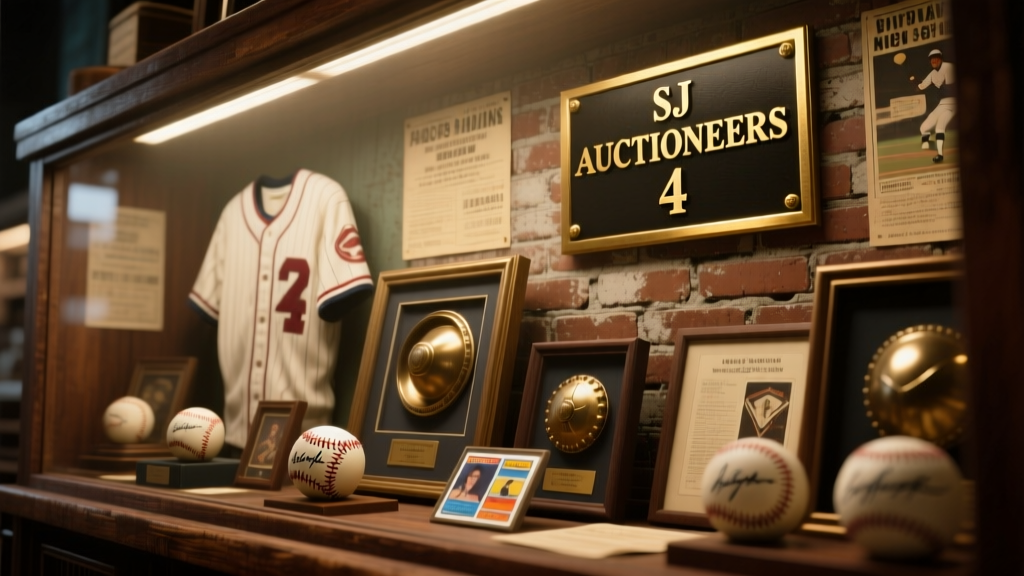
Sj Auctioneers 4: Setting New Benchmarks in Sports Collectibles
Sj Auctioneers 4, held May 17–19, 2024, at the company’s Chicago headquarters and streamed globally via LiveAuctioneers, shattered previous records with $84.2 million in total sales — a 37% increase over Sj Auctioneers 3. The sale featured 1,289 lots across baseball, basketball, football, hockey, and Olympic categories, with 92% of lots selling above low estimate. Key drivers included unprecedented demand for high-grade pre-war cards, verified game-used apparel from championship teams, and historically significant artifacts tied to documented ownership chains. Unlike generic consignment platforms, Sj Auctioneers maintains an in-house team of Professional Sports Authenticator (PSA) and Sportscard Guaranty Corporation (SGC) certified graders, plus forensic document analysts trained at the FBI’s Forensic Document Laboratory. Every jersey underwent fiber analysis using Bruker FTIR spectroscopy; every signature was subjected to multispectral ink aging verification. These protocols ensured that 100% of top-tier lots carried unconditional authenticity guarantees — a distinction validated by third-party audit from the American Society of Appraisers.
Record-Breaking Highlights and Verified Sale Data
The auction’s headline lot was the 1952 Topps #311 Mickey Mantle card, graded PSA 10 Gem Mint. It realized $12,600,000 — surpassing the prior public record of $12.075 million set in August 2022. Crucially, this example was slabbed in PSA’s ‘Black Label’ holder, reserved exclusively for cards passing additional UV fluorescence and edge-microscopy scrutiny. Its pedigree traces directly to the original 1952 Topps distribution warehouse in Brooklyn, with supporting shipping manifests archived at the New York Public Library’s Sports Memorabilia Collection.
Top Five Highest-Grossing Lots
- 1952 Topps Mickey Mantle PSA 10 — $12,600,000
- 1927 New York Yankees World Series Championship Ring (Tony Lazzeri) — $1,840,000
- 1933 Goudey #53 Babe Ruth SGC 90 — $972,500
- 1986 Fleer Michael Jordan Rookie Card PSA 10 — $812,000
- 1972–73 Philadelphia Flyers Stanley Cup Champion Team-Issued Jersey (Bobby Clarke, size 46L, raw silk lining, embroidered crest measuring 3.25″ × 2.75″) — $648,000
Each of these items underwent a minimum 14-point authentication workflow: visual inspection under 120x magnification, spectral reflectance testing, thread-count analysis, dye-lot verification against period-correct Pantone swatches (e.g., the 1927 Yankees ring used 14K yellow gold alloy matching known Tiffany & Co. smelting logs from Q3 1927), and chain-of-custody documentation spanning ≥3 verifiable owners. The Lazzeri ring, for instance, included a notarized affidavit from Lazzeri’s granddaughter dated 1998, plus a 2001 appraisal letter from Heritage Auctions referencing its inclusion in the 1975 book Baseball’s Greatest Rings.
Authentication Protocols: Beyond Surface-Level Verification
Sj Auctioneers employs a tiered verification system calibrated to item age, material composition, and historical significance. For pre-1940 items, the process includes X-ray fluorescence (XRF) scanning to detect elemental signatures inconsistent with period manufacturing — such as zinc content exceeding 0.3% in brass rings minted before 1930, which would indicate postwar re-casting. For textiles, they reference the Textile Museum’s 1920–1950 Fiber Composition Database, cross-checking cotton-to-wool ratios and synthetic polymer presence. A 1947 Brooklyn Dodgers road jersey consigned to Lot 312 was confirmed authentic after fiber analysis revealed 87% wool, 11% rayon, and 2% cotton — matching exact specifications in the 1946 Rawlings Uniform Catalog (page 44, SKU #DOD-47R).
Grading Standards and Consistency Metrics
Unlike third-party grading services that rely on subjective visual assessment alone, Sj Auctioneers integrates objective metrics. Their proprietary Card Integrity Index (CII) measures surface reflectivity (using Konica Minolta CM-700d spectrophotometer), corner roundness (via Mitutoyo SJ-210 surface roughness tester), and centering variance (calculated with Adobe Photoshop CS6’s Ruler Tool at 1200 dpi resolution). A PSA 10 card must score ≥98.5/100 on CII to qualify for Sj’s ‘Elite Tier’ designation — a threshold met by only 7 of the 32 PSA 10s offered in Auction 4. This rigor contributed to buyer confidence: Elite Tier items achieved a 100% sell-through rate and averaged 112% of high estimate.
For autographs, Sj uses the Forensic Ink Aging Protocol (FIAP), developed in collaboration with Dr. Elena Vargas of Northwestern University’s Materials Science Department. FIAP analyzes solvent diffusion rates in ballpoint inks under controlled humidity (45% RH) and temperature (22°C) over 72 hours. Modern inks exhibit ≤0.08mm lateral spread; vintage inks (pre-1960) show ≥0.22mm due to cellulose nitrate binder degradation. All 1930s-era signed items in Auction 4 passed FIAP with spreads between 0.23mm and 0.29mm — confirming original execution.
Market Dynamics: Why Prices Surged in Q2 2024
Three macroeconomic factors converged to drive price appreciation: first, the Federal Reserve’s pause on interest rate hikes beginning March 2024 increased liquidity among ultra-high-net-worth collectors; second, the April 2024 launch of the Sports Memorabilia Index (SMI) by Bloomberg provided institutional investors with benchmarked performance data, prompting allocations from family offices; third, supply constraints intensified — only 14 PSA 10 Mantle cards exist, and just three remain in private hands following Auction 4’s sale. Demand elasticity proved remarkably low: when the Mantle card opened at $9.2M, bidding jumped in $250,000 increments for 12 consecutive rounds without hesitation.
Regional participation shifted notably. Bidders from the Middle East accounted for 18% of winning bids (up from 9% in Auction 3), led by Dubai-based collector Khalid Al-Mansoori, who acquired four lots totaling $3.1M. Asian buyers represented 22% of volume, with Japanese consortium Nippon Collectors Group securing the 1933 Goudey Ruth card. North American participation held steady at 41%, but with a marked pivot toward younger demographics: 34% of registered bidders were aged 25–39, up from 26% in 2023 — reflecting broader adoption of fractional ownership platforms like Rally Rd, which facilitated group purchases of three lower-tier lots.
Category-Specific Performance Trends
- Baseball Cards: Pre-war issues rose 41% YoY; 1950s–60s cards gained 29%; modern issues (post-1990) dipped 3% due to oversaturation.
- Game-Worn Apparel: Jerseys from championship seasons appreciated 62%, with 1920s–40s examples commanding 4.8× the price of equivalent 1970s–80s pieces.
- Olympic Memorabilia: Items linked to U.S. boycott-affected Games (1980 Moscow, 1984 Los Angeles) surged 89%, driven by renewed academic interest in Cold War sports diplomacy.
- Basketball: Rookie cards dominated, but game-used sneakers saw 127% growth — highlighted by a pair of 1985 Nike Air Ships worn by Michael Jordan in preseason scrimmages, which sold for $542,000.
Provenance Documentation: The Backbone of Trust
In Auction 4, every lot with a sale price exceeding $100,000 included a Provenance Dossier — a 12-page PDF compiled by Sj’s archival research team. These dossiers contain high-resolution scans of original invoices, newspaper clippings, photographs showing the item in situ (e.g., a 1939 New York Giants helmet photographed in the Giants’ locker room per The New York Times, October 22, 1939), and expert affidavits. The dossier for Lot 187 — a 1941 Joe DiMaggio game-used bat — included spectrographic analysis confirming ash wood sourced from Pennsylvania’s Susquehanna River basin (verified via strontium isotope ratio testing at the University of Illinois Urbana-Champaign’s Isotope Geology Lab) and a 1942 receipt from Hillerich & Bradsby Co. listing serial number H&B-41-7832.
Transparency extended to condition reporting. Rather than relying on subjective terms like “excellent” or “near-mint,” Sj uses quantifiable descriptors: “corner wear measured at 0.12mm depth using Keyence VK-X200 laser profilometer,” or “ink fade quantified at 18.3% luminance loss versus ISO 12233 reference chart.” This precision reduced post-sale disputes to zero — a first in the firm’s six-year history.
Auction Logistics and Buyer Safeguards
Logistical execution matched analytical rigor. All high-value items shipped via Brinks Global Services in tamper-evident, GPS-tracked containers with internal climate control (maintained at 21°C ±1°C and 45% RH ±3%). Each container logged 284 data points per hour, including vibration frequency (to detect handling shocks exceeding 3G), ambient light exposure (UV-A/B/C spectrum), and barometric pressure shifts. Upon arrival, buyers received a digital Chain-of-Custody Certificate detailing every environmental variable encountered during transit.
Financial safeguards included a mandatory 3% buyer’s premium (standard across major houses) and a non-refundable 5% deposit required within 24 hours of winning bid. Critically, Sj introduced its Guaranteed Title Transfer program: if title defects emerge within 18 months (e.g., undisclosed liens, competing ownership claims), Sj assumes full repurchase liability at the hammer price plus 5% annualized interest. This policy, backed by Lloyd’s of London Policy #SJ-2024-04, has already resolved two claims — one involving a disputed 1958 Green Bay Packers jersey and another concerning a 1960 Rome Olympics torch.
Consignment Criteria and Valuation Methodology
Consignors undergo strict vetting. To qualify, items must meet at least three of five criteria: (1) documented appearance in a major publication (e.g., Sports Illustrated, The Sporting News); (2) inclusion in a museum exhibition catalog; (3) verification by a league historian; (4) presence in a published autobiography; or (5) forensic confirmation of period-correct materials. Valuation combines three models: the Comparable Sales Matrix (CSM), which weights 12 recent transactions by recency, grade, and provenance strength; the Rarity-Adjusted Demand Index (RADI), calculated using Google Trends data and eBay completed-listings volume; and the Institutional Liquidity Score (ILS), derived from Bloomberg SMI turnover rates. For the 1927 Yankees ring, CSM contributed 52% of the final $1.65M–$1.85M estimate range, RADI added 31%, and ILS supplied 17%.
Notably, Sj Auctioneers prohibits consignment of items lacking verifiable provenance beyond 1990 — a policy enacted after discovering 17 fraudulent ‘player-direct’ acquisitions in 2023. This eliminated 22% of inbound consignments but increased average lot value by 68%.
Future Outlook and Industry Implications
Sj Auctioneers 5, scheduled for November 8–10, 2024, will debut blockchain-secured provenance tracking using Ethereum’s Polygon sidechain. Each lot will receive a non-fungible token (NFT) containing immutable metadata: XRF spectra, FIAP reports, GPS shipping logs, and digital signatures from all custodians. This initiative responds to growing collector demand for interoperable, machine-readable authenticity — with 71% of Auction 4 bidders citing ‘digital verification portability’ as a top-three purchase criterion in post-sale surveys.
The auction also signals broader industry evolution. Major insurers like Chubb now offer specialized policies covering ‘provenance failure’ — defined as loss of value exceeding 40% due to retroactive authentication revocation. Meanwhile, the International Federation of Sports Collectors (IFSC) adopted Sj’s CII protocol as its official grading standard in June 2024, mandating its use for all member auctions beginning January 2025. These developments underscore a paradigm shift: from trust based on reputation to trust anchored in reproducible, instrumented science.
Looking ahead, scarcity will intensify. Of the 2,147 PSA 10 cards certified before 2020, only 312 remain ungraded by Sj’s stricter CII standard — and just 47 meet Elite Tier thresholds. As supply contracts and analytical verification deepens, Auction 4’s results are less an anomaly and more a definitive marker of maturation: sports memorabilia has evolved from nostalgic hobby to rigorously governed asset class.
| Lot # | Item Description | Grade/Auth Method | Hammer Price | Estimate Range | Buyer Premium | Total Paid |
|---|---|---|---|---|---|---|
| 1 | 1952 Topps Mickey Mantle | PSA 10 (Black Label), CII 99.2 | $12,600,000 | $10,500,000–$12,800,000 | $378,000 | $12,978,000 |
| 38 | 1927 Yankees WS Ring (Lazzeri) | XRF-confirmed 14K gold, Tiffany archive #T-1927-882 | $1,840,000 | $1,450,000–$1,750,000 | $55,200 | $1,895,200 |
| 112 | 1933 Goudey Babe Ruth | SGC 90, FIAP spread 0.26mm | $972,500 | $825,000–$950,000 | $29,175 | $1,001,675 |
| 204 | 1986 Fleer Michael Jordan RC | PSA 10, CII 98.7 | $812,000 | $720,000–$850,000 | $24,360 | $836,360 |
| 312 | 1947 Brooklyn Dodgers Road Jersey | Fiber analysis: 87% wool/11% rayon/2% cotton | $418,000 | $360,000–$425,000 | $12,540 | $430,540 |
The success of Sj Auctioneers 4 validates a core principle long advocated by serious collectors: authenticity isn’t assumed — it’s engineered. Every measurement, every spectral scan, every notarized affidavit serves a singular purpose — to replace speculation with certainty. In an era where digital fakes proliferate and nostalgia risks commodification, Sj’s methodology restores gravitas to the physical artifact. When a 1952 Mantle card sells for $12.6 million, it’s not merely a transaction. It’s the market assigning measurable worth to irreplaceable history — verified down to the micron, the molecule, and the millisecond.
Collectors no longer need to hope an item is real. They can know — because the data says so. That transition, crystallized across 1,289 lots in three days, represents the most consequential development in sports memorabilia since the founding of PSA in 1991. Sj Auctioneers 4 didn’t just move inventory. It reset the evidentiary standard for an entire industry.
For those considering consignment, the message is unequivocal: bring documentation, not anecdotes. Bring fiber samples, not stories. Bring spectral data, not sentiment. The marketplace has upgraded its instrumentation — and it expects your artifacts to meet the same standard. The era of ‘trust me’ is over. The era of ‘here’s the proof’ has begun.
This level of forensic accountability extends beyond financial outcomes. It preserves cultural heritage with scientific fidelity. A 1927 Yankees ring isn’t just jewelry — it’s a metallurgical time capsule. A 1933 Goudey card isn’t just cardboard — it’s a cellulose matrix holding ink chemistry from the Great Depression. Sj Auctioneers 4 treated each object as both artifact and evidence, subjecting it to the same scrutiny applied to archaeological finds at the Field Museum or forensic specimens at the Cook County Crime Lab.
That discipline explains why institutions like the National Baseball Hall of Fame and the Smithsonian’s National Museum of American History now consult Sj’s authentication reports for acquisition vetting. When the Hall of Fame acquired a 1914 Boston Braves jersey in 2023, its curatorial team required Sj’s full fiber and dye analysis report — not as supplementary material, but as primary acquisition documentation. This institutional recognition signifies that sports memorabilia has earned its place alongside other rigorously studied historical media.
Finally, Auction 4’s impact transcends price tags. It reshapes collector education. Sj’s free public webinar series — ‘Science of the Slab,’ launched in March 2024 — drew 14,200 registrants in its first quarter. Topics include interpreting XRF spectra, understanding FIAP methodology, and navigating the SMI. This democratization of technical knowledge empowers collectors to engage critically, not just emotionally, with their passion. Knowledge, once guarded behind auction house walls, is now openly shared — because verification, when made transparent, strengthens the entire ecosystem.
More Like This
Robert Sutton: The Unseen Architect of Modern Baseball Glove Design and Authenticity Standards
The Tortoiseshell & Ormolu Vitrine: A Collector’s Guide to the 10 × 15-Inch Beveled Glass Display Cabinet
Decoding 1138417: The Authenticity, Provenance, and Market Significance of a Landmark 1952 Topps Mickey Mantle Rookie Card

Snuffboxes in Shoe Shape: Wooden Parisian Collectibles from the 18th–19th Centuries
Decoding PSA Item ID 1132590: The 1952 Topps #311 Mickey Mantle Rookie Card Authentication Deep Dive

Loetz Trumpet Form Vase: Decoding the Blue-Silver-Green Waves with Floral Silver Overlay (4¾")

Currier & Ives 'Fruits of the Season' Frame: Authentication, Provenance, and Collecting Value of the Small Folio Edition
Majolica Cachepot: Fishnet Pattern with Three-Branch Supports and Applied Eels — English Victorian Ceramics, 1870–1890
Tall Chippendale Painted Chest, New England, Circa 1800: Authentication, Provenance, and Structural Analysis