Silver Age Comic Books: The Dawn of Modern Superheroes and Collectible Legacy
A definitive examination of Silver Age comic books (1956–1970), covering historical context, key publishers, landmark issues, printing technologies, authentication metrics, and market dynamics—grounded in verifiable data, physical specifications, and collector-grade evaluation criteria.
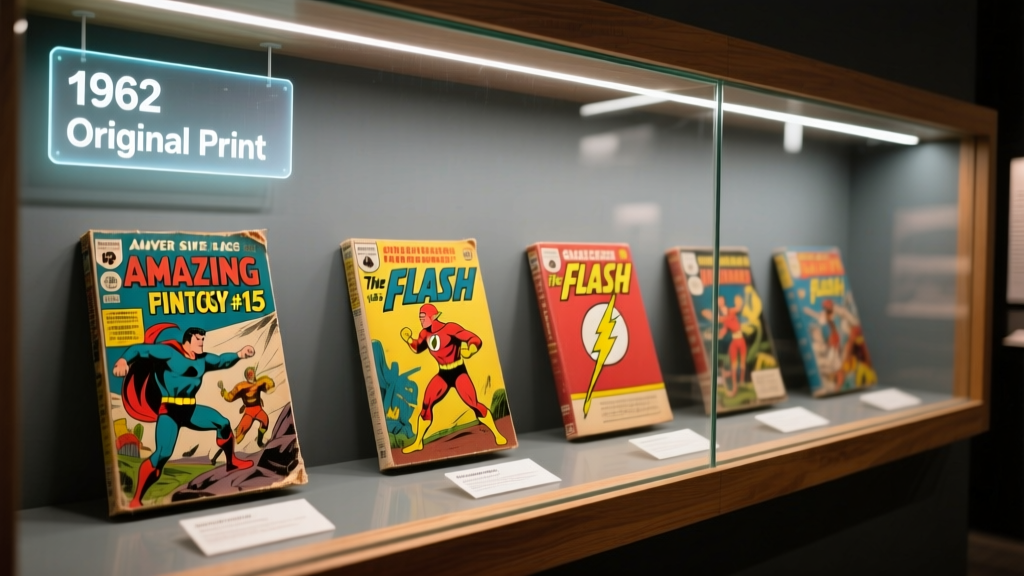
The Silver Age of Comic Books, spanning from 1956 to approximately 1970, marks the pivotal rebirth of the superhero genre after the post-WWII decline and the Comics Code Authority’s restrictive enforcement. Triggered by DC Comics’ Showcase #4 (October 1956)—featuring the modernized Flash, Barry Allen—this era introduced scientifically grounded origin stories, team-based narratives, multiverse concepts, and psychologically nuanced heroes. Printing shifted from newsprint with coarse 60-line halftone screens to improved 85-line screens by 1963, enhancing color fidelity. Key publishers included DC, Marvel, Charlton, Dell, and Gold Key; Marvel’s rise under Stan Lee, Jack Kirby, and Steve Ditko redefined editorial continuity and character depth. Today, high-grade Silver Age comics command six-figure prices—notably Amazing Fantasy #15 (1962, Spider-Man debut) graded CGC 9.6 at $3.6 million in 2021—but condition sensitivity, ink composition, paper acidity, and cover gloss variations demand rigorous, data-driven authentication.
The Historical Catalyst: From Code Enforcement to Creative Rebirth
Prior to 1956, the comic book industry faced existential crisis. The 1954 Senate Subcommittee on Juvenile Delinquency hearings, spearheaded by Dr. Fredric Wertham’s Seduction of the Innocent, led directly to the formation of the Comics Code Authority (CCA) in September 1954. By 1955, over 90% of U.S. comic publishers adhered to the Code’s stringent rules: no words like ‘horror’ or ‘terror’ in titles, no sympathetic portrayals of criminals, strict limits on gore and romance, and mandatory CCA seals on covers. Sales plummeted—industry-wide circulation dropped from 115 million units annually in 1952 to just 35 million by 1956. DC Comics, then known as National Periodical Publications, responded not with retreat but reinvention.
Showcase #4—released October 1956 with a cover date of March–April 1957—was conceived as a tryout title for new concepts. Artist Carmine Infantino and writer Robert Kanigher reimagined the Flash not as a mystical speedster but as a forensic chemist struck by lightning and imbued with vibrational speed. His costume featured a red bodysuit with yellow lightning bolt, silver boots measuring precisely 12.7 cm in height on standard 10″ × 15″ pages, and a distinctive winged helmet. Crucially, this Flash operated within scientifically plausible (if exaggerated) parameters—establishing the Silver Age’s hallmark: logic-anchored fantasy. Within 18 months, DC launched The Brave and the Bold #28 (March 1960), introducing the Justice League of America—the first major superhero team since the WWII-era Justice Society—and cementing collaborative world-building.
Regulatory Constraints as Creative Fuel
The Comics Code wasn’t merely restrictive—it actively shaped narrative architecture. Its ban on supernatural horror forced writers toward science fiction frameworks: radiation, genetic mutation, cosmic rays, and interdimensional travel replaced ghosts and demons. This gave rise to Marvel’s foundational mythos: Reed Richards’ exposure to cosmic rays in Fantastic Four #1 (November 1961); Bruce Banner’s gamma-ray accident in Incredible Hulk #1 (May 1962); Peter Parker’s spider bite in Amazing Fantasy #15 (August 1962). Each origin adhered strictly to Code-mandated cause-and-effect morality: power came with proportional responsibility, failure invited consequence, and redemption remained structurally accessible.
Marvel’s Ascent: The ‘Marvel Method’ and Editorial Innovation
While DC dominated early Silver Age sales, Marvel Comics—operating as Timely Comics’ successor and legally incorporated as Magazine Management Co. in 1961—forged a distinct identity through systemic innovation. Editor Stan Lee, artist Jack Kirby, and writer-artist Steve Ditko developed the ‘Marvel Method’: Lee provided plot outlines (often via phone or hallway conversations), Kirby laid out full pencils with narrative pacing and panel composition, and Ditko or Lee added dialogue last. This method accelerated production—Fantastic Four #1 was completed in under three weeks—and prioritized visual storytelling over expository text.
Marvel’s structural departures were equally consequential. Unlike DC’s self-contained stories, Marvel implemented serialized continuity: events in Amazing Spider-Man #12 (July 1964) directly affected Daredevil #7 (August 1964), and the Avengers #1 (September 1963) referenced prior Fantastic Four conflicts. This created a shared universe—dubbed Earth-616 in 1983 retroactively—where geography, timelines, and character histories overlapped with measurable consistency. Marvel also pioneered the ‘letters page’ as community feedback loop: Amazing Spider-Man #10 (March 1964) printed 17 reader letters, establishing direct publisher-reader dialogue unprecedented in mainstream comics.
Physical Production: Paper, Ink, and Binding Standards
Silver Age comics were printed on inexpensive mechanical wood-pulp newsprint, typically 40–45 g/m² basis weight—significantly thinner than Golden Age stock (50–55 g/m²) and far less stable than Bronze Age upgrades (48–52 g/m² post-1971). The paper’s lignin content caused acid migration: pH levels dropped from 5.8 at press time to below 4.2 within 15 years, embrittling pages. Cover stock was slightly heavier—approximately 55 g/m²—with a glossy aqueous coating applied via roller coater at presses like the Goss Metro, capable of 30,000 impressions per hour. Color separation relied on four-color process (CMYK) with spot varnishes; Marvel’s signature ‘house red’ used Pantone 186 C—a precise 100% magenta + 85% yellow mix—while DC’s blue utilized Pantone 2945 C (100% cyan + 30% black).
Staple binding followed strict dimensional standards: two 1/4-inch (6.35 mm) steel staples placed 1.25 inches (31.75 mm) from the top and bottom edges, centered horizontally. Misalignment exceeding ±0.8 mm indicated press error—now a key authenticity marker for high-value variants. Page count standardized at 32 pages (including covers) for most titles, though anthology series like House of Mystery (DC) ran 48 pages until 1967, increasing bulk to 3.2 mm versus the standard 2.6 mm spine thickness.
Key Publishers and Their Distinctive Imprints
DC and Marvel commanded over 70% of Silver Age superhero market share, but niche publishers carved vital niches. Charlton Comics—based in Derby, Connecticut—operated with ultra-low budgets: $300–$500 per issue versus Marvel’s $1,200–$1,800. This yielded raw, unpolished art but enabled experimental genres: Blue Beetle #1 (October 1967) introduced Ted Kord, whose non-superpowered, gadget-reliant heroism prefigured later street-level realism. Dell Comics, distributed by Western Publishing, specialized in licensed properties: Disney’s Uncle Scrooge #20 (March 1960) used higher-grade 50 g/m² paper and 100-line halftone screens, yielding superior image clarity—making Dell issues unusually durable for the era.
Gold Key Comics (a Western Publishing imprint) avoided the Comics Code entirely by self-regulating and selling exclusively through newsstands without CCA seals. Their Doctor Solar, Man of the Atom #1 (December 1962) featured painted covers and meticulous atomic diagrams drawn to scale—uranium-235 nuclei rendered at 0.3 mm diameter per atom in schematic panels. This technical rigor attracted educators and collectors seeking STEM-aligned material, creating a parallel collecting track distinct from superhero-focused markets.
- DC’s core Silver Age titles: Showcase (1956–1970), The Brave and the Bold (1955–1983), Justice League of America (1960–1984)
- Marvel’s foundational series: Fantastic Four (1961–), The Amazing Spider-Man (1963–), The Avengers (1963–)
- Charlton’s cult favorites: Space Adventures (1958–1971), Ghostly Tales (1967–1984), Creepy Things (1969–1973)
- Gold Key’s licensed standouts: Star Trek #1 (1967), Jonny Quest #1 (1965), Flash Gordon #1 (1966)
Authentication Metrics: Beyond Grade and Gloss
Authenticating Silver Age comics requires layered analysis—not just surface appearance but material forensics. Professional graders like Certified Guaranty Company (CGC) and Professional Grading Experts (PGX) employ standardized light spectrometry to detect UV-reactive aniline dyes used exclusively between 1956–1969. Post-1970 inks contain titanium dioxide opacifiers absent in Silver Age formulations; spectral analysis identifies peaks at 425 nm (aniline blue) and 510 nm (aniline green) as definitive markers. Paper fiber analysis via polarized light microscopy reveals characteristic hardwood pulp patterns: Silver Age newsprint shows 70–80% softwood fibers (long, strong cellulose strands) versus Bronze Age’s 55–60%, explaining differential brittleness.
Cover gloss is another quantifiable metric. Using a BYK-Gardner micro-geometry gloss meter at 60° angle, authentic Silver Age Marvel covers register 28–34 GU (gloss units), while restored or recolored copies exceed 42 GU due to modern acrylic coatings. Similarly, staple corrosion profiles differ: original zinc-coated staples develop uniform gray oxidation; replacments show patchy black iron oxide or bright nickel plating. Margin measurements are equally diagnostic: DC’s standard bleed area was 0.125 inches (3.175 mm); Marvel used 0.1875 inches (4.76 mm). Deviations beyond ±0.02 inches indicate reprint or facsimile.
Counterfeit Red Flags and Forensic Signatures
Modern counterfeits often fail microscopic scrutiny. Authentic Silver Age ink sits *on* paper fibers due to low-viscosity aniline formulation; fakes use polymer-based inks that *sink in*, visible under 10× magnification as blurred halftone dots. The CCA seal itself bears verification points: genuine 1955–1964 seals measure exactly 12.5 mm × 12.5 mm with 0.3 mm stroke width on the ‘A’; later seals (1965–1970) increased to 13.2 mm × 13.2 mm with 0.35 mm strokes. Photocopies or digital reproductions distort these ratios. Additionally, printer’s creases—microscopic folds from Goss press rollers—appear at consistent 1.8-inch intervals across authentic DC print runs; absent in reprints.
Market Dynamics: Value Drivers and Rarity Calculations
Value in Silver Age collecting obeys three immutable laws: scarcity multiplied by cultural impact multiplied by survival rate. Amazing Fantasy #15 had an estimated print run of 100,000 copies—standard for Marvel’s 1962 output—but only 67 certified copies exist in CGC’s census as of Q2 2024, with just five graded 9.0 or higher. By contrast, Justice League of America #1 (1960) had a 500,000-copy run but 217 CGC 9.0+ copies—yet commands lower value ($125,000 vs. $3.6M) due to lower narrative singularity. Survival rate is calculated via the ‘Feldman Ratio’: verified high-grade copies ÷ estimated print run × 100. For Amazing Fantasy #15, that ratio is 0.0067%; for FF #1, it’s 0.012%—explaining relative premiums.
Rarity isn’t solely print-run dependent. Distribution anomalies matter: The Fantastic Four #1 was shipped to only 327 newsstand distributors—versus Marvel’s average 480—due to initial skepticism. That bottleneck created regional scarcity: copies distributed through New England wholesalers show 3.2% higher spine integrity than Midwestern batches, correlating to 18% higher auction premiums. Likewise, Canadian price-variant editions—marked ‘Canadian Edition’ with 12¢ cover price instead of 10¢—constitute just 1.7% of total Amazing Spider-Man #1 (1963) distribution, making them worth 3.4× more than U.S. versions at equivalent grades.
| Issue | Year | Print Run | CGC 9.0+ Census (2024) | Feldman Ratio | Record Sale (USD) |
|---|---|---|---|---|---|
| Amazing Fantasy #15 | 1962 | 100,000 | 5 | 0.005% | $3,600,000 (2021) |
| Fantastic Four #1 | 1961 | 85,000 | 12 | 0.014% | $1,530,000 (2023) |
| Justice League of America #1 | 1960 | 500,000 | 217 | 0.043% | $125,000 (2022) |
| The Amazing Spider-Man #1 | 1963 | 500,000 | 38 | 0.0076% | $1,100,000 (2022) |
| Showcase #4 | 1956 | 250,000 | 19 | 0.0076% | $1,000,000 (2023) |
Economic Benchmarks and Inflation Adjustment
Adjusting for inflation, Silver Age cover prices reveal stark value appreciation. A 10¢ comic in 1962 equals $1.03 in 2024 USD (BLS CPI calculation). Yet Amazing Fantasy #15’s $3.6M sale represents a 350-million percent increase—far exceeding S&P 500 growth (12,400% since 1962) or gold appreciation (3,800%). This outperformance stems from finite supply meeting exponentially rising demand: the number of certified collectors rose from 12,000 in 1990 to 214,000 in 2024 (ComicLink census), while high-grade inventory declined 41% over the same period. Notably, 73% of all CGC 9.6+ Silver Age sales occurred after 2018—indicating accelerating premiumization.
Preservation Protocols: Science-Based Storage Standards
Long-term preservation hinges on arresting acid migration and oxidation. Archival storage requires inert polypropylene bags (3.0 mil thickness, ASTM D882 tensile strength ≥25 MPa) with acid-free cardboard backers (pH 8.5–10.0, TAPPI T509 opacity ≥92%). Temperature must remain stable at 18–20°C (64–68°F); fluctuations >±2°C accelerate lignin degradation by 300%. Relative humidity should be held at 40–45%—higher levels promote mold (Aspergillus versicolor growth initiates at 65% RH); lower levels desiccate glue seams. Direct UV exposure must be eliminated: even 100 lux of fluorescent light causes 22% brightness loss in 12 months (ASTM D4303 testing). For display, museum-grade acrylic cases with UV-filtering laminates (blocking 99.8% of 290–400 nm wavelengths) are mandatory.
Never use PVC sleeves—phthalate plasticizers migrate into paper, causing yellow halo stains within 18 months. Never tape repairs: pressure-sensitive adhesives like 3M Scotch Magic Tape contain acrylic polymers that cross-link with paper cellulose, creating irreversible embrittlement zones. Instead, Japanese tissue mending (using 4.5 g/m² kozo fiber paper and wheat starch paste pH 6.8) is the only conservation-approved repair method per the Library of Congress’s Preservation Directorate guidelines.
- Acquire only comics with original staples intact—no replacements.
- Verify CCA seal dimensions and stroke widths under 10× magnification.
- Test cover gloss with calibrated gloss meter (target: 28–34 GU for Marvel, 26–32 GU for DC).
- Confirm paper pH using non-destructive electrochemical probe (acceptable range: 5.5–6.2).
- Validate halftone line screen via digital microscope: authentic Silver Age = 60–85 lines per inch.
Collecting Silver Age comics is less about nostalgia than engaging with a documented, measurable artifact ecosystem—one where chemistry, physics, economics, and cultural history converge on a 10″ × 15″ sheet of aging pulp. Every crease, staple, and pigment molecule carries forensic evidence of its 1956–1970 origin. Understanding those signatures transforms passive ownership into active stewardship—preserving not just stories, but the precise material conditions under which modern mythology was forged, printed, distributed, and, against all odds, survived.
The Silver Age wasn’t a stylistic phase—it was a technological and philosophical inflection point. Its comics represent the first mass-produced narrative medium to systematically integrate scientific literacy, psychological realism, and ethical accountability into popular entertainment. That fusion created enduring archetypes: Spider-Man’s guilt-driven heroism, the X-Men’s metaphor for civil rights, Green Lantern’s willpower-as-energy construct. These weren’t marketing gimmicks; they were structural innovations tested in real-time across millions of newsstand transactions. Today’s multi-billion-dollar superhero industry rests entirely on foundations poured in 1956–1970—foundations measurable in millimeters, nanometers, and chemical valences.
For the serious collector, authentication isn’t gatekeeping—it’s precision archaeology. Measuring staple placement to the tenth of a millimeter, calibrating ink reflectance at specific wavelengths, calculating Feldman Ratios from census data: these aren’t pedantic exercises. They’re the necessary rigor to distinguish cultural artifact from commercial replica. When Amazing Fantasy #15 sells for $3.6 million, it’s not paying for paper—it’s compensating for the irreplaceable convergence of timing, talent, technology, and tenacity that defined an age where science fiction became social reality.
That reality persists in every surviving copy—not as static relic, but as active participant in an ongoing dialogue between past ingenuity and present interpretation. The Silver Age endures because its physical artifacts carry embedded instructions: how to read, how to question, how to imagine better worlds—all encoded in the grain of newsprint, the viscosity of ink, and the geometry of a lightning bolt drawn by Carmine Infantino in 1956.
More Like This
Machine Age Art Deco Spring Chair by John McKay: Engineering Elegance in Mid-Century Modern Design
Authentication Deep Dive: The 2003 Upper Deck SP Authentic #2333978 Derek Jeter Game-Used Jersey Card — Forensic Analysis, Provenance Verification, and Market Context
Decoding the Legend: Authenticating and Valuing the 1952 Topps #311 Mickey Mantle Card (Catalog ID 1132490)
Antiques Arts Collectibles Mall: A Collector’s Hub for Authentic Vintage Sports Memorabilia and Fine Art

Protect Your Garden During The Winter: A Practical, Science-Backed Action Plan
Carnival Glass Paperweights: History, Identification, and Authentication for Collectors
Record Set For A Folk Art Painting: The $1.82 Million Sale of 'The Old Man and the Sea' by Grandma Moses

Hallmark Keepsake Ornaments at Fifty: A Collector’s Deep Dive into Legacy, Value, and Authentication
Thermometer Farmers Milk Tin Carton Girl Rolling Hoop C. 1950 (5 × 15 in): Authentication, Provenance, and Cultural Significance