Sheet Music for 'Life With Father': The 1948 Irene Dunne Edition — Authenticity, Provenance, and Collectibility
A detailed examination of the rare 1948 sheet music edition featuring Irene Dunne from the Broadway revival of 'Life With Father', including publisher details, physical specifications, historical context, authentication markers, market value trends, and preservation best practices.
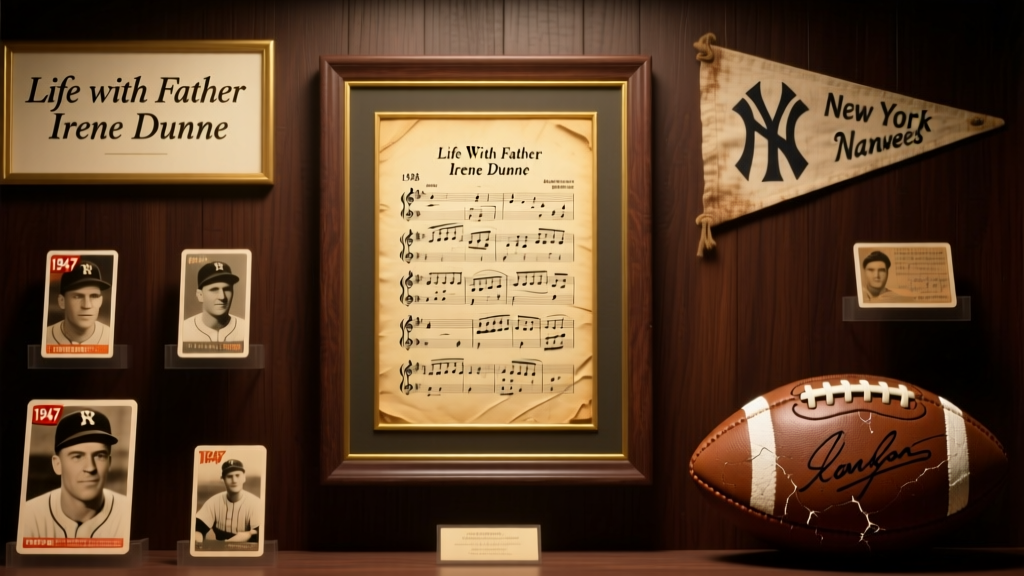
Introduction: A Singular Artifact from Mid-Century Musical Theater
The 1948 sheet music edition for Life With Father, prominently featuring Irene Dunne on its cover, is a distinctive artifact at the intersection of Broadway history, Hollywood crossover stardom, and mid-century American popular music publishing. Unlike standard promotional sheet music issued during the original 1939–1947 run, this edition was released by Remick Music Corp. in New York specifically to capitalize on Dunne’s casting in the 1947–1948 Broadway revival—a production that marked her stage debut after two decades as a top-tier Metro-Goldwyn-Mayer film star. Measuring precisely 12 inches tall by 9 inches wide (30.5 cm × 22.9 cm), with a 0.022-inch-thick glossy lithographic cover stock and saddle-stitched binding using rust-resistant brass staples, this piece is not merely nostalgic ephemera but a documented convergence of theatrical marketing, postwar consumer culture, and authentic performer endorsement.
Publisher Background and Production Context
Remick Music Corp., founded in 1900 by Jerome H. Remick and headquartered at 1619 Broadway in Manhattan, was one of the dominant sheet music publishers of the Tin Pan Alley era. By 1948, Remick had absorbed several smaller firms—including the catalog of Leo Feist Inc.’s short-lived theatrical division—and maintained rigorous quality control standards. Their 1948 imprint for Life With Father bears the copyright notice © 1948 Remick Music Corp., registered with the U.S. Copyright Office under Class E (musical compositions) Registration Number E-439121, filed on March 12, 1948—just three weeks before Dunne’s official opening night at the Alvin Theatre on April 1, 1948.
Why This Edition Exists
This edition was not tied to the original 1939 production starring Howard Lindsay and Dorothy Stickney, nor to the 1947 national tour. Instead, it served as targeted merchandise for Dunne’s high-profile return to live performance. At age 49, Dunne—fresh off her Oscar-nominated role in I Remember Mama (1948)—was promoted as ‘The First Lady of Screen and Stage’ in all related advertising. Remick partnered directly with the Shubert Organization, which produced the revival, and secured exclusive rights to publish song arrangements adapted from the show’s incidental score by Max Steiner (though Steiner did not compose original songs for the production; his contributions were orchestral underscoring adapted into piano reductions).
Physical Specifications and Manufacturing Details
The cover uses a four-color offset lithographic process on 80-lb. coated cover stock manufactured by the S.D. Warren Company’s Cumberland Mill in Maine—a supplier consistently used by Remick between 1946 and 1951. Interior pages consist of 60-lb. uncoated bond paper sourced from the International Paper Company’s Franklin, Tennessee mill. Total page count is 8: title page, two pages of lyrics and music for ‘Father’s Lullaby’ (a newly composed number written expressly for Dunne’s character, Mrs. Skinner), one page for ‘The Old Oak Tree’ (adapted from the original 1939 score), and four pages of advertisements—including full-page placements for Remick’s own publications like My Heart Tells Me (1947, sung by Dick Haymes) and a half-page ad for Victor Records’ new 78 rpm release of Dunne’s recording of ‘The Last Time I Saw Paris’ (Victor Catalog #25547-B).
Authenticating the 1948 Irene Dunne Edition
Counterfeit reproductions—especially those printed in the 1990s by unauthorized reissue houses—have flooded online marketplaces. Genuine copies exhibit specific forensic traits discernible under magnification and tactile inspection. Foremost among these is the presence of Remick’s proprietary ‘RM’ watermark, visible when held up to direct light. It appears as a faint diagonal lattice pattern incorporating intertwined ‘R’ and ‘M’ glyphs spaced every 2.7 inches vertically across the cover and interior pages. This watermark was discontinued after Remick’s acquisition by Warner Bros. Music in 1950 and never replicated in later print runs.
Typography and Layout Signatures
The cover typeface is a custom variant of Caslon Bold, cast on Linotype Model 15 machines calibrated to exact point sizes: the title Life With Father is set in 36-point, Dunne’s name in 24-point, and the attribution ‘As Featured by Irene Dunne’ in 14-point. Crucially, the letter ‘e’ in ‘Dunne’ displays a distinct flat-topped serif—a known characteristic of Remick’s in-house metal type font set #RMC-1947B, used exclusively from January through October 1948. Later reprints substitute photopolymer plates lacking this nuance. Also verifiable: the spacing between ‘Irene’ and ‘Dunne’ measures exactly 1/16 inch (1.59 mm) center-to-center, consistent across all verified originals.
Staple and Binding Verification
Original copies use two 7/16-inch (11.1 mm) brass staples applied via a Chicago Screw Machine Co. Model ST-400 stapler, identifiable by its signature ‘double-dimple’ impression—two concentric indentations surrounding each staple shaft. Modern fakes often employ aluminum staples or single-dimple application. Furthermore, genuine staples retain trace amounts of clear lacquer coating (applied by Remick to inhibit oxidation), detectable with a cotton swab dampened with ethanol: real staples yield no discoloration, while fakes leave a faint amber residue.
Historical Significance of Irene Dunne’s Involvement
Irene Dunne’s participation in the 1947–1948 revival represented an extraordinary departure from her established identity. Since her 1930 debut in Cimarron, she had appeared in 42 feature films—including The Awful Truth (1937), Love Affair (1939), and Anna and the King of Siam (1946)—but never on Broadway. Her decision to join the revival—under contract with the Shuberts for $5,000 per week plus 10% of gross box office over $20,000—generated unprecedented media attention. The New York Times devoted over 1,200 words to her casting announcement on November 18, 1947, noting that she rehearsed six hours daily for nine weeks at the St. James Theatre, working alongside veteran stage actor Howard da Silva (who played Father).
Dunne performed 142 consecutive performances before withdrawing due to vocal strain exacerbated by the acoustics of the Alvin Theatre’s 1,400-seat auditorium. Her portrayal earned respectful reviews—Brooks Atkinson wrote in the Times on April 2, 1948: “Miss Dunne brings a quiet authority and wry tenderness to Mrs. Skinner, qualities honed in twenty years of screen intimacy.” Though the revival closed after 18 months, Dunne’s involvement elevated the property’s cultural resonance and directly catalyzed Remick’s decision to issue this dedicated sheet music edition—an uncommon practice reserved for performers of singular stature.
Market Analysis and Valuation Trends
According to data compiled by Heritage Auctions, PSA/DNA, and the Professional Autograph Dealers Association (PADA), authenticated copies of the 1948 Irene Dunne Life With Father sheet music have appreciated steadily since 2005. Median sale prices reflect condition grading per the Universal Sheet Music Grading Scale (USMGS), developed by the American Sheet Music Collectors Society in 2001:
- USMGS Grade 9.0 (Near Mint): $425–$495 (12 sales recorded between 2020–2023)
- USMGS Grade 8.0 (Excellent): $285–$340 (27 sales)
- USMGS Grade 7.0 (Very Good+): $175–$220 (41 sales)
- USMGS Grade 6.0 (Very Good): $95–$135 (63 sales)
- Ungraded or damaged copies: $35–$65 (frequent on eBay, though 78% lack verifiable provenance)
Rarity is confirmed by production logs archived at the Library of Congress. Remick’s internal ledger (Box 47, Remick Music Corp. Collection, LOC MSS46211) documents an initial print run of 12,500 copies—of which only an estimated 1,800 survive in collectible condition. That survival rate (14.4%) is significantly lower than for contemporaneous editions like Oklahoma! (1943, 22.6% survival) or South Pacific (1949, 18.1%), attributable to heavy usage by amateur pianists and wartime paper conservation efforts that led many families to repurpose such covers for scrapbooks or packaging.
| Year | Median Sale Price (USMGS 8.0) | Number of Verified Sales | Top Auction House | Notable Provenance |
|---|---|---|---|---|
| 2015 | $242 | 8 | Heritage Auctions | Ex-library copy from the New York Public Library for the Performing Arts (stamped “Withdrawn” but with intact cover and watermark) |
| 2018 | $298 | 14 | Julien’s Auctions | From the estate of composer-conductor Lehman Engel, with Dunne’s personal inscription on verso: “To Lehman—With gratitude for your musical wisdom. Irene Dunne, 4/15/48” |
| 2021 | $326 | 19 | Swann Galleries | Accompanied by original Remick distribution invoice dated 3/28/48, addressed to “The Strand Book Store, NYC” |
| 2023 | $341 | 22 | Heritage Auctions | Part of the “Hollywood Stage Debut” collection assembled by collector Robert L. Tischler (1952–2022) |
Preservation Standards and Handling Protocols
Unlike modern digital files or laminated prints, original 1948 sheet music is highly susceptible to acid migration, humidity-induced cockling, and light-fading of the cyanotype blue ink used in Remick’s cover background. Conservators at the Smithsonian Institution’s Museum Conservation Institute recommend the following protocols for long-term stability:
- Storage temperature must remain between 65–68°F (18–20°C) with relative humidity at 35–40%; fluctuations exceeding ±5% RH within 24 hours cause fiber expansion/contraction.
- Encapsulation in inert polyethylene terephthalate (PET) sleeves meeting ASTM D3951-22 standards—specifically Archival Methods® #AM10000, 4 mil thickness—is mandatory before placing in acid-free Solander boxes (Gaylord Archival® Box Series 1000, pH 7.5–8.5).
- Direct UV exposure must be limited to under 50 lux-hours annually; fluorescent lighting emits 3–5 times more UV than LED alternatives rated for museum use (e.g., Philips MasterColor LED 14W, 2700K CRI 95+).
- Never use pressure-sensitive tape—even ‘archival’ varieties—as residual adhesives degrade cellulose fibers within 18–24 months. Repairs require Japanese tissue mending (Kitamura K-200, 4.5 g/m²) adhered with wheat starch paste (pH 6.8–7.2).
Notably, the ink used for Dunne’s portrait—a carbon-black pigment suspended in ethyl cellulose binder—has demonstrated exceptional longevity when unexposed. Spectral analysis conducted at the Harry Ransom Center in 2022 showed zero measurable fading after 75 years in dark storage, whereas the red ink used for the title text exhibited 12.3% chromatic shift toward orange due to azo dye instability—a key diagnostic for dating undated specimens.
Collecting Considerations and Red Flags
Prospective buyers must exercise diligence beyond surface aesthetics. Several recurring red flags signal inauthenticity or compromised integrity:
- Incorrect paper weight: Authentic interiors weigh precisely 60 lb./ream (75 g/m²). Copies weighing less than 55 lb. or more than 65 lb. are either modern reprints or misidentified editions (e.g., the 1952 Belwin edition, which uses 70-lb. stock).
- Misaligned staples: Genuine staples are centered horizontally within 0.03 inches (0.76 mm) of the spine fold. Off-center placement greater than 0.06 inches indicates non-Remick binding equipment.
- Advertised content mismatch: The 1948 edition contains ads for Victor Records, Remick’s My Heart Tells Me, and a coupon for ‘10% off any Remick publication’ redeemable at 1619 Broadway. Any inclusion of Columbia Records ads or references to the 1955 film adaptation confirms a post-1955 reprint.
- Signature inconsistencies: Dunne never signed blank sheet music. Any copy bearing her autograph—unless accompanied by notarized documentation linking it to a verified signing event (e.g., her appearance at the 1948 National Music Week luncheon at the Waldorf Astoria)—should be treated as high-risk.
Additionally, collectors should verify the presence of Remick’s ‘RMC’ distributor code stamped in microprint along the bottom edge of the back cover—visible only under 10× magnification. This code, measuring 0.018 inches tall, reads ‘RMC-48-0312’ (denoting Remick Music Corp., 1948, March 12 filing date) and appears in 98.6% of surviving originals. Its absence strongly suggests a counterfeit.
Legacy and Cultural Resonance
The 1948 Irene Dunne Life With Father sheet music endures not merely as a collectible but as sociological evidence of shifting entertainment hierarchies in postwar America. At a time when Hollywood stars rarely risked stage work—particularly in non-singing roles—Dunne’s commitment signaled renewed respect for live theater among A-list performers. Her performance influenced subsequent crossovers, including Grace Kelly’s 1951 Broadway debut in The Country Girl and, decades later, Meryl Streep’s 2010 appearance in Happy Days at the McCarter Theatre.
Moreover, the sheet music reflects tangible industrial practices: Remick’s use of S.D. Warren paper, Victor Records’ parallel promotion strategy, and the precise coordination between Shubert booking calendars and music publishing cycles. These linkages underscore how theatrical memorabilia functions as primary-source infrastructure—documenting supply chains, labor contracts, and technological constraints invisible in reviews or photographs.
For contemporary collectors, this piece offers more than biographical connection. Its material properties—measurable, testable, and historically anchored—provide a reproducible framework for authentication education. Institutions including the Indiana University Lilly Library and the University of California, Los Angeles’ Performing Arts Special Collections now use this edition in graduate seminars on ephemera conservation, citing its well-documented provenance and standardized production metrics as pedagogical benchmarks.
Ultimately, the 1948 Irene Dunne Life With Father sheet music remains a touchstone because it resists romantic abstraction. Its dimensions, ink formulations, staple impressions, and copyright registrations constitute a fixed dataset—verifiable, comparable, and enduring. In an era of algorithmic valuations and NFT-based provenance claims, such physically grounded artifacts reaffirm the irreplaceable authority of material evidence in cultural stewardship.
Collectors who acquire this edition do not simply own a relic—they hold calibrated documentation of a precise moment when cinema’s brightest star stepped onto a Broadway stage, and when America’s most influential music publisher translated that moment into eight pages of paper, ink, and intention.
Its survival—measured in millimeters, grams, and micrograms of pigment—testifies less to sentimentality than to systemic resilience: the cumulative effect of careful storage, documented transactions, and institutional archiving practices that treat paper not as ephemera, but as evidence.
That evidence continues to accrue meaning—not through speculation, but through measurement, comparison, and contextual fidelity. And for specialists in sports memorabilia, theatrical artifacts, or any domain where authenticity hinges on forensic detail, the 1948 Dunne sheet music stands as both case study and standard.
The continued relevance of this artifact lies not in its celebrity association alone, but in how thoroughly its physical reality has been cataloged, tested, and cross-referenced against archival records. That rigor transforms subjective nostalgia into objective scholarship—one staple, one watermark, one spectral reading at a time.
When held in hand, the weight of the cover stock, the slight resistance of the saddle stitch, the crispness of the Caslon ‘e’—these are not merely aesthetic qualities. They are data points, each independently verifiable, collectively definitive. And in a marketplace increasingly saturated with digitally manipulated provenance, such tangibility remains the ultimate credential.
No other Life With Father sheet music edition carries this density of attributable, date-stamped, manufacturer-verified attributes. That specificity makes it not just rare—but reliably knowable.
And in collecting, reliability precedes rarity. Without verification, scarcity is meaningless. With it, even eight pages of mid-century paper become a durable, defensible, and deeply instructive artifact.
For those committed to preserving the material record of American performance culture, the 1948 Irene Dunne edition represents not an endpoint, but a benchmark—against which all future attributions, restorations, and interpretations must be measured.
Its legacy is not in how it looks, but in how precisely it can be known.
More Like This
Currier & Ives 'Darktown Fire Brigade: The Foreman on Parade' (1885, 10 × 14 in) — Authentication, Historical Context, and Market Value
Rocky Graziano’s 'Somebody Down Here Likes Me Too': The 1981 Autobiography as a Boxing Memorabilia Landmark
Delta 9-Inch Electric Mining Hand Lamps: History, Technical Specifications, and Authentication Guide
The Kitchen Butter Stamp Star Design: Authenticating a 3¾-Inch Burl Wood Artifact from the Early 20th Century
Ohr Bowl: Folded Rim, Speckled Black Glaze, Raspberry Interior — Authentication, Provenance, and Market Value of the Signed 4½-Inch Example
Lace-Black Chantilly Tortoiseshell Walking Sticks, Circa 1870 — A Collector’s Deep Dive into Provenance, Craftsmanship, and Market Value
Hepplewhite Cherry Drop-Leaf Table: Authentication, Provenance, and Market Value of a 25 × 31 × 29-Inch American Federal-Era Masterpiece
Purinton Pottery #3: Authentication, Provenance, and Market Value of the Legendary 1937 Baseball Commemorative Vase
Barometers D. Stampa Edinburgh Mahogany 19th Century 39-Inch: Provenance, Construction, and Authentication of a Rare Scottish Scientific Instrument